


Talking about Polygon — the “Internet” of Ethereum-compatible chains
Polygon Chain was originally a one-tier network launched under the name Matic. At launch, Matic intended to be an “Internet of Blockchains (Internet of Blockchains)” that would allow developers to build products with cross-chain compatibility and interoperability. However, as Ethereum became the dominant smart contract chain, Polygon gradually faded out of people's eyes, but with the development of the entire network and the saturation of Ethereum, the market slowly began to understand the importance of cross-chain. In response, the Polygon team turned to a framework for building and connecting Ethereum-compatible blockchains to help Ethereum scale, and their goal changed from an “internet of blockchains” to an “internet of Ethereum-compatible chains.”
Polygon has always focused on the experience of its users and developers. Since reinventing the brand, developers have begun to pour into Polygon, and the slogan “made for developers” seems to have become a reality. Polygon has made great strides in 2021 due to Polygon's dual aura of optimizing the developer experience and mitigating Ethereum's scaling issues.
Over the past six months, the number of contracts deployed on Polygon has completely surpassed Ethereum.

Since May 2021, the number of daily active addresses began to rise sharply.

To continue growing, Polygon must simultaneously attract new developers and retain them. To allow developers (and end users) to participate in the construction of its ecosystem, the Polygon team has been focusing on building a light-deployment development environment for blockchain networks, while also focusing on improving its module security (“security as a service”).
Ethereum's shortcomings; Polygon's breaking point
As Ethereum becomes the dominant blockchain, while enjoying an increasingly prosperous ecosystem, gas fees have also become an indelible pain for countless users. Polygon's strategic decision to focus on the Ethereum ecosystem is prescient from now on. In the first half of 2021, gas fees continued to exceed 100 gwei, and during the peak period to over 350 gwei.
Due to Ethereum's price fluctuations and the complexity of interaction with the network, a transaction may cost users tens or hundreds of dollars, and transaction processing time will also increase dramatically. These problems are all forcing users and developers to seek suitable alternatives.

Polygon aims to solve the dual problems of transaction costs and time costs by providing various scaling solutions while retaining users for Ethereum. Polygon is highly consistent with Ethereum in terms of goals and philosophy. Through EVM compatibility and most importantly, Polygon still maintains the security of Ethereum behind it.
Polygon Framework: Overview

Independent chain and safety chain
Two types of blockchains can be deployed on Polygon: standalone chains and secure chains.
A “standalone” chain does not rely on Ethereum's consensus to guarantee a secure blockchain. This solution is for projects that already have their own validation nodes or are looking to implement another scalability solution. These unique chains are usually used by enterprise networks or mature chains looking to integrate with the Polygon-Ethereum ecosystem.
A “secure” chain is one that doesn't have its own verification network, but instead relies on Polygon's security layer. Polygon has an extremely high level of security while allowing developers to choose from a variety of security solutions, the most popular of which is the Polygon PoS (Proof-of-Stake) chain. These safety chains are designed to help startups and projects that require reliable security systems.
Whether it's an independent chain or a secure chain, it's relatively easy for developers to deploy. This ease of deployment gives developers more options to meet the needs of their users, and this flexibility comes from Polygon's infrastructure.
architectures
Whether it's a standalone chain or a secure chain, the blockchains deployed on Polygon operate within the same architectural framework. Polygon's architecture has four components: the Ethereum layer, the security layer, the Polygon network layer, and the execution layer.

Ethereum layer
Polygon uses Ethereum as its base layer. This layer consists of a set of smart contracts on Ethereum that perform settlements by verifying nodes, staking nodes, and passing information between Polygon and the Ethereum ecosystem. This layer is responsible for solving the final processing process on Ethereum. While this layer is optional, this component of the architecture is Polygon's strength. By using Ethereum as an endpoint, Polygon can make good use of Ethereum's security as the ultimate shield and benefit from it.
security layer
The second layer of architecture is an optional layer of security. This layer is known as “Verification as a Service” because it allows developers to utilize several security solutions to verify transactions. Users can use proof of fraud or PoS sidechains (as well as other solutions) to ensure security.
By far the most popular security solution is the PoS sidechain. The PoS sidechain uses a set of about 100 verification nodes to ensure the security of the blockchain project (a certain verification fee will be charged), and verification node management is carried out. Also, this layer can use Ethereum's miners (final verification nodes) to reach consensus.
Again, this layer is optional. Generally speaking, structural layers away from layer 1 are often lacking in security, but they can improve transaction throughput and user experience. Not all chains require Polygon's security layer. Some projects, such as chain games, may even want to reduce security in exchange for faster settlement, so that players can have a good user experience.
Polygon network layer
The Polygon network layer is a network of independent blockchains that determines transactions, produces blocks, and determines the consensus of each chain. These chains can be standalone chains or safety chains. The block producers of these chains group their individual transactions, and according to the security solution, the network layer will publish a Merkle root as the first layer's checkpoint.
Execution layer
Finally, there's the execution layer. The execution layer interprets and executes transactions determined by the Polygon network layer. This layer has two components.
Execution environment - implemented by a virtual machine. Similar to EVM, it can track the state of the blockchain.
Execution logic - Implement state transitions for specific Polygon blockchains. This logic is used to define the transition to the next blockchain state, and Ethereum can be thought of as an “infinite state machine.” (In contrast to finite-state machine (English: finite-state machine, abbreviation: FSM), a finite state machine, usually abbreviated as a state machine, is a mathematical calculation model representing a finite number of states and behavior such as transitions and actions between these states.)
Among all of these layers, however, the key value-added point for developers is the security layer, as it allows the flexibility of the Polygon framework to really unleash. Developers can choose the right security solution for their project, and exchange solutions if they choose to change direction. Its purpose is to provide developers with a set of tools to achieve the role of customized blockchain projects.
Security layer: a deep dive
While low transaction costs and high processing efficiency are the main drivers of Polygon's rapid growth, none of these increases would have been possible without Polygon's modular security solutions. These “security-as-a-service” solutions include Polygon's PoS sidechains and fraud proof mechanisms, while new solutions like generic data availability layers Avail and Hermez zk-Rollups are still being developed. Some of these solutions can be mixed, but they all rely on the Polygon SDK.
Polygon SDK
The Polygon SDK (Software Development Kit) is a framework for projects to launch their own EVM compatible chains. This SDK implements “security as a service” and allows developers to choose the ideal scaling solution for their projects.
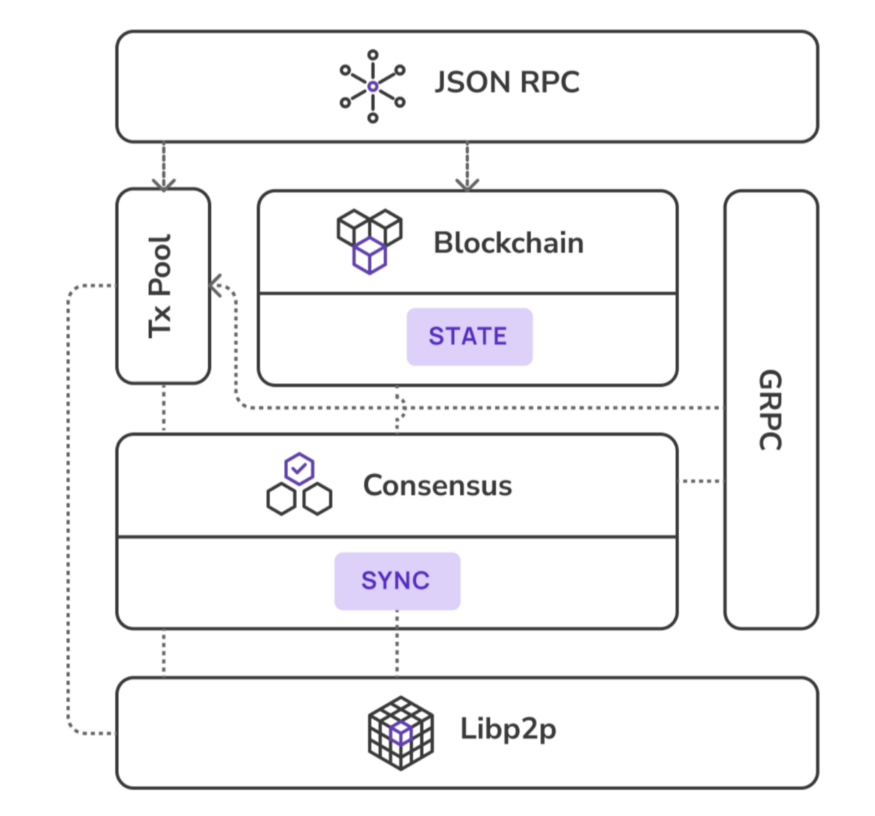
As shown above, the Polygon framework separates functionality, allowing developers to choose their own consensus mechanisms or develop their own consensus mechanisms while maintaining interoperability with other chains within the Polygon ecosystem.
This interoperability enables Polygon chains with different scaling solutions to communicate with each other, allowing developers to choose customized security solutions. Polygon also plans to add more out-of-the-box consensus mechanisms, database implementations, and other ancillary services.
Polygon Hermez (zk-rollup) Security
Polygon recently acquired Hermez, a zk-rollup solution. Hermez is developing a ZK-Rollup equivalent to EVM, a very promising two-tier solution designed to make asset transfers more secure and less costly. zk-rollup compresses batches of transactions into a small amount of data in the form of proof of validity (or zk-SNARK). This data is then posted to the chain to verify the correctness of the proof. Compared to Ethereum, Hermez has 133 times the throughput and is only one-tenth the transaction cost.
This solution doesn't have the downside of Plasma, which is the seven-day withdrawal wait time, since there's no need to challenge the data with fraudulent proofs, as SNARK proofs are computationally easy to verify. However, the structure of proof of effectiveness is still computationally intensive. The real solutions currently expected by users will have to wait a while, and like Avail, the future of zk-Rollup looks like an easy one.
Polygon Miden
Polygon also recently announced a new ZK project called Miden, a STARK-based EVM-compatible rollup. The project is led by Bobbin Threadbare, the core developer of the other ZK technologies Distaff VM (a STARK-based virtual machine) and Winterfell (a high-performance STARK validator).
This solution will be based solely on STARK, support any transaction and automatically generate proof of execution. Miden will compile the Solidity code into Miden Assembly, and Miden VM will use it to execute transactions and generate zero-knowledge proofs.
Hermez's goal is to be fully compatible with EMV (at the code level), and Miden will start by compiling with Solidity and then move to other languages.
conclusions
Polygon's decision to focus on providing scaling solutions for Ethereum proved successful as the Polygon network experienced explosive growth throughout 2021. To continue this growth, Polygon is working to build out-of-the-box scaling and security solutions that enable developers to take advantage of Polygon's reduced transaction costs and inclusion times. With over $1 billion in funding for the ZK-Rollup solution alone, Polygon has sufficient resources to further expand its suite of solutions to help Ethereum scale to meet anticipated future network loads.
Source: Bankless DAO
Compiled by: Comparing Exclusive Chen Zou
This article is from Bitpush.News. The source must be indicated for reprinting
