


Du Yu: Understanding the current market from the perspective of WEB3.0

On August 10, 2022, the “Metaverse Innovation: Prosperity and Future - Metaverse Industry Development Summit 2022 and “Global Digital Collections Research Report (2022)”, co-hosted by the Zhongguancun Blockchain Industry Alliance, 01 Think Tank, and ForeChain, were held grandly. The conference invited more than 10 academics and industry experts from universities, representative companies, investment institutions and law firms to discuss in depth global trends in the metaverse and digital collections and innovation in China. At the conference, the Zhongguancun Blockchain Industry Alliance, ForeChain, and 01 Blockchain jointly released the “Global Digital Collections Research Report (2022)”.
A round-table forum on the theme “Compliance and Prospects for Digital Collections Under the Metaverse Outbreak” was held during the summit. The round table was presided over by Bai Liang, founder of the 01 Think Tank. Zhou Wenjiang, Deputy Secretary General of the Zhongguancun Blockchain Industry Alliance; Xiao Sa, senior partner of Beijing Dacheng Law Firm; Wang Fenghe, senior partner of Beijing Yingke Law Firm; and Wang Yueming, an expert from the Digital Economy Working Committee of the China Productivity Promotion Center Association.Du Yu, former venture capitalist at Sequoia China and author of “WEB3.0: Empowering a New Era of Digital Economy”They participated in the round-table discussions together.
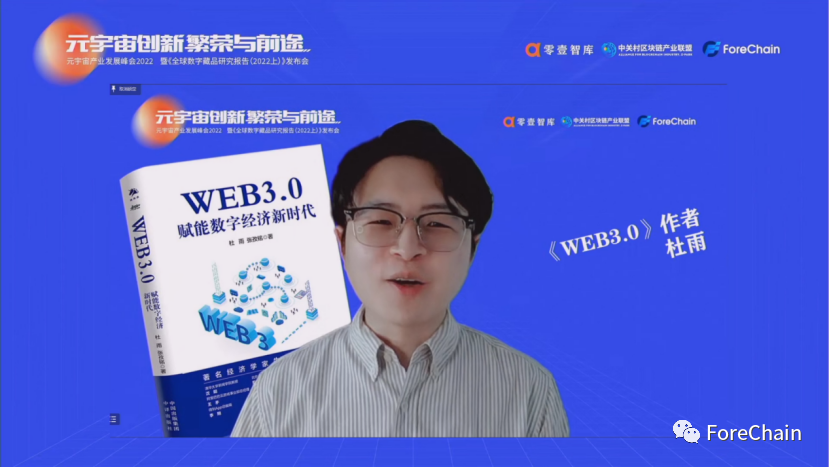
The picture shows Mr. Du Yu attending the 2022 Metaverse Industry Development Summit Roundtable Forum - Compliance and Prospects for Digital Collections Under the Metaverse Outbreak
On the topic “Understanding the Current Market Situation from the Perspective of WEB3.0,” Du Yu shared from two perspectives. One is to observe from the perspective of research as an author, and the other is to observe the project as an investor.
First, from a research perspective, Du Yu defined the differences between the two concepts of digital collections and NFTs from his own perspective. Du Yu believes that digital collectibles and NFTs are not a concept. Digital collections are more of a domestic term, and an NFT is an overseas statement. The differences between the two can be viewed in detail in three dimensions.
First, most domestic digital collections are based on domestic affiliate chains. Overseas mainstream NFTs are distributed on public chains, especially Ethereum and Polygon. That's its first big difference.
Second, when purchasing on the only digital collection platform such as Art and Magic Core, domestic users use RMB to buy. However, overseas NFTs are not purchased with fiat currency; they are purchased with digital currency. First, you need to have a digital wallet, such as the cryptocurrency ETH.
Third, current domestic digital collections do not support secondary transactions, but overseas NFTs support secondary market transactions.
If you make a distinction from the above three dimensions, you'll find that these two are not the same thing, so it's easy for us to get lost if we mix them up many times.
Next, from an investor's perspective, Du Yu analyzes why the public recently felt that the digital collection market is beginning to move from hot to cold. Du Yu shared his observations from three different perspectives.
The first is from a macro and regulatory perspective.
Recently, we have discovered that the government has been promoting the digital economy. There is no doubt about this general direction. In particular, in May, the Central Office and the State Office issued “Opinions on Promoting the Implementation of the National Cultural Digitalization Strategy”, and digital collections are only one application scenario in the field of cultural digitization. According to Du Yu, the first stage card point facing the entire “digitization of culture” is actually digitization, not digital assets. Du Yu believes that before talking about digital collections, more infrastructure companies should use their technical value to help complete the digitization process of China's cultural treasures. It is only after this “digitization” process that it evolves to the stage of “digital collectivization”. However, the first step of “digitalization” is currently insufficient. Du Yu discovered that the current proportion of “code farmers” in the domestic cultural industry is relatively low, which also shows that the degree of digitalization of the cultural industry is still low. If the first step isn't completed well, the collection that can be distributed and disseminated later is limited. Therefore, Du Yu believes that now we still need to vigorously develop the first step of “digitalization.”
Currently, there are also people who have proposed the NFR concept, because the concept of an NFT or token is very close to finance, and it is easy to touch the red line, but Rights is the value that blockchain technology itself brings to the industry in terms of affirming rights. This is definitely a positive aspect.
Second, from an enterprise perspective.
Recently, Dachang is also gradually shrinking the digital collectibles business segment. From an industrial perspective, Du Yu believes that if we use digital collectibles as a SKU, the unit price is lower and the audience is narrower. This kind of business is not currently a sizable direction for Internet giants, so I don't think there is any need to overinterpret Dachang's backward actions on this matter. Du Yu believes this is a normal business decision that is in line with business logic. If there is no huge return after trying an industry for a period of time, then from an investment perspective and management perspective, it is unlikely that there will be a large investment, let alone a direction where it is easy to touch the red line of regulation.
The third is from the user's point of view.
Currently, the most active topics under WEB3.0 are the post-95 and post-00s, and young people's preferences are changing rapidly. Recently, more and more people are embracing the DAO concept, and everyone's attention to WEB3.0 has gradually begun to explore DAO organizations, starting with digital collections.
In the roundtable discussion session, the question “How to find a direction when compliance is not particularly clear and how to move towards compliance” was discussed. Du Yu shared the following views:
Currently, entrepreneurs and practitioners who are embracing WEB3.0 are quite young. Not only are people less aware of blockchain and WEB3.0 laws, but due to lack of experience and social experience, there is still a gap in their perception of the legality and compliance aspects of company operations and business development compared to veterans of entrepreneurship.
The first point is to raise the legal awareness of practitioners; otherwise, it is easy for some cases to occur.
Once there is more negative news about a new industry, all parties will wear tinted glasses to view the industry, which is not conducive to the long-term development of the industry, so practitioners need to raise their legal awareness. At the same time, we also hope that the relevant supervisory authorities and associations will issue some relatively clear guidelines as soon as possible, so that the enthusiasm of young people will not be thrown cold water, and that they will also receive positive guidance and encouragement from the supervisory authorities.
The second point is to hope that large Internet companies and technology companies can make more use of their advantages and play a certain leading role.
Large mature internet companies have experienced legal compliance teams. They have a deeper understanding of the market and are more suitable for exploring the development of the industry from a compliance perspective. From the perspective of the innovation dimension of fintech as a whole, through the P2P era and the 1.0 and 2.0 era of blockchain, major Internet companies and regulators have experienced a lot. Du Yu believes that big manufacturers should actively embrace innovation. In existing businesses, innovation that really brings real value is something to be encouraged. For example, in the consumer sector, tea from Mengniu, Jiang Xiaobai, and Nai Xue are all distributing digital collections. Under the current legal compliance situation, they promote business innovation and development, help to rejuvenate the brand, and help build awareness among young consumers.
Du Yu believes that in exploring how new technology can truly create commercial value, it is possible to further explore the future.
