


Vitalik reveals Bitcoin's future blueprint

Vitalik recently published a new blog post about the different types of layer 2 solutions (L2s) on Ethereum, presenting the three main types of layer 2 solutions: Rollups, Validiums, and Disconnected Systems. They differ in the trade-offs between security, scalability, and decentralization. Additionally, Vitalik showed usBitcoinThe future roadmap includes a variety of layer 2 solutions, which support different application scenarios through different trade-offs, and jointly promote the decentralization of the Bitcoin layer 2 ecosystem.
Written by Bob Bodily, PhD
Source of original text:Twitter @BobBodily
Compiled by MK
Vitalik just showed us a blueprint for Bitcoin's future development
Vitalik recently published a new blog post about different types of layer 2 solutions (L2s) on Ethereum, which I think are inextricably linked to Bitcoin.
Please allow me to elaborate.
Heterogeneity of two-tier solutions (differentiation of L2s)
Vitalik believes that we are gradually seeing L2S on Ethereum become more diverse, which means there is no single type of L2, but rather a broad L2S spectrum, each with different trade-offs.
The trade-off here is best explained by the blockchain triple dilemma (proposed by Vitalik himself), which points to a trade-off between three key aspects of blockchain technology: security, scalability, and decentralization.
Some of the characteristics of L2s are:
Slower, more expensive, but safer.
Faster, cheaper, but with more trust assumptions.
It's in the middle when it comes to speed, cost, and security.
example
In some cases, these are L1s that have decided to become L2S (such as Polygon's gradual transition to Polygon 2.0's ETH L2 rollup as an ETH sidechain).
In other cases, they are fully centralized systems that want to decentralize their technology stack.
In other cases, these are games or social media platforms that want to be decentralized but don't necessarily require high security.
In each case, you'll want to make different trade-offs on the blockchain triple dilemma, meaning you want different solutions (or L2s) to complete different tasks.
Three types of L2s (actually more like a gradient)
Vitalik talks about the three main types of two-tier solutions in his article:
Rollups
Validiums
Disconnected systems
Rollups
Rollups are zero-knowledge proof Rollups we know and love because you can always bring assets back to L1 without trust.
The calculation is verified by proof of fraud or proof of validity, and all data is stored on L1. We don't yet have zk rollups like this on Bitcoin because Bitcoin can't verify proof of validity. But there are plenty of projects working to achieve this on ETH.
Generally, these will be expensive due to full data availability on L1 and the need to generate lots of expensive proofs.
Validiums
Validiums is a downgraded version of Rollups. In Validium, you store data elsewhere down the chain and only store proof on L1. This means that Validiums are much cheaper than Rollups, but they add an additional trust assumption for off-chain data storage.
In the case of Validiums, if off-chain data is lost, your assets may also be lost (*not stolen).
In this model, the main costs are proof costs. You transferred the cost of storing the data, but kept the cost of generating proof.
disconnected
A Disconnected L2 is essentially a sidechain. You have a completely independent blockchain or server, and you trust certain multiple signatures or groups of people to protect your assets, then you get all the benefits of sidechains (such as faster transactions, lower costs, etc.).

The two-tier solution is a spectrum
Importantly, Vitalik notes that this is agradients, not a discrete category. This means an L2 is probably right between Validiums and Rollups, or between Disconnected L2 and Validium.
Another important aspect of L2s is their “connectivity” with L1. Vitalik divides it into two areas:
The security of withdrawing money to Ethereum
Read the security of Ethereum
These properties are also presented as a continuous spectrum.

Ultimately, he explored the security spectrum, extending from security requirements on the left to scale requirements on the right.
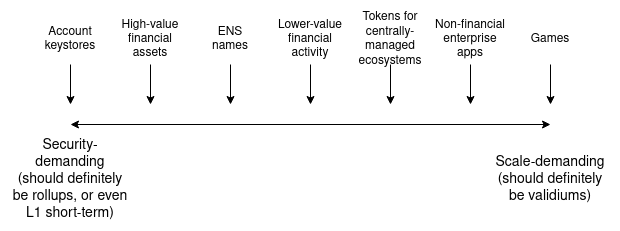
So what does this have to do with Bitcoin?
This is closely related to Bitcoin.
On Bitcoin we have: Ordinals, BRC-20, Counterparty, Stamps, SRC-20, Colored coins, ARC-20, Atomicals, TAP, PIPE, BRC-100, BRC-69, BRC-21, ORC-20, ORC-CASH, Runes, Runestone,, Lightning Network BRC-721 , Taproot Assets, RGB, Omni, MVC, Libre, Chia, Babylon, Interlay, Liquid, Stacks, ICP, RSK, ETH, BitVM, Bitcoin Script, TapScript, DLCs, Drivechains, Sidechains, Spacechains, SpiderChains, Statechains, Softchains, Ark, Optimistic Rollups (similar), Sovereign Rollups (in development), ZK-Rollups (someday), and many others.
Bitcoin has a diverse hierarchy, all of which can be categorized through Vitalik's simple L2 framework, from Rollup L2 to Validium L2 to the spectrum of Disconnected L2, how can you safely withdraw from L1 and how to read safely from L1, and whether you're more focused on security or scale.
All of these Bitcoin layers have trade-offs (explained in detail by the blockchain triple dilemma), and explain why we might see multiple layers built on Bitcoin over time.
conclusions
Vitalik just showed us Bitcoin's future roadmap. The future roadmap is a wonderful world full of various second-tier solutions. They support different application scenarios through different trade-offs, and together promote the decentralization of the Bitcoin second-tier ecosystem.
