


Big and American Act, Trillion-Dollar Monetary Expansion: The “American Moment” for Crypto Assets
Source: SevenUp DAO
Original link: https://mp.weixin.qq.com/s/Qxlvwe_m6k2jfwaKvHiOdA
By Luke, MarsBit
Source | MarsBit
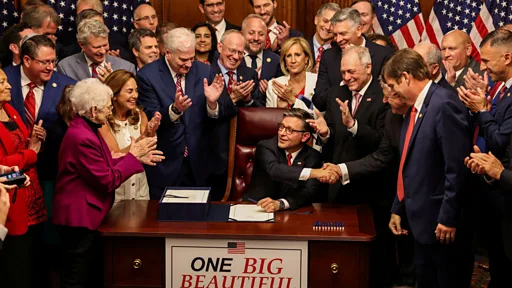
In Washington, seemingly unrelated events are often intertwined at a deep level, outlining a grand strategic picture. At the beginning of July, when public attention was focused on the US House of Representatives for President Trump's “Independence Day Gift Package” — a massive fiscal bill dubbed the “One Big Beautiful Bill (OBBB)” (One Big Beautiful Bill (OBBB)), another quieter but equally profound revolution was quietly brewing on Capitol Hill — a series of legislative proposals targeting digital assets were being put on the agenda at an unprecedented rate.
These two seemingly parallel trajectories — one is aggressive fiscal expansion and the other is sophisticated regulatory reshaping — are no accident. Together, they form a carefully designed “Washington Conspiracy”: by creating a huge macroeconomic wave while building a regulatory moat tailored for the US, it has established its unshakable hegemony in the global digital asset race. It's not just about tax cuts or regulation; it's a gamble about future dominance of the financial system.
I. The economic engine and debt black hole of the “Big and Beautiful Act”
Structurally, the OBBB Act is a carefully designed duet. On the one hand, it introduced tax breaks on an unprecedented scale. The bill has been described by critics as the ultimate “robbery of the poor and the rich”: it permanently locks the corporate tax rate at 21% and brings about $6,000 in annual tax savings to high-income people. On the other hand, what paid for all of this was a cruel cut in social welfare programs. Food stamps for about 600,000 households will be reduced by $100 a month, and Medicaid (Medicaid) will be directly cut by $1.2 trillion over the next ten years.
At the heart of the game's controversy is its true financial cost. The White House Council of Economic Advisers (CEA) uses a “dynamic scoring” model, insisting that tax cuts will stimulate economic growth and generate enough tax to cover costs. However, this optimistic forecast is far from the conclusion of almost all non-partisan analysts.
The non-partisan Congressional Budget Office (CBO) predicts that the bill will net the federal debt by $3.3 trillion over the next ten years. Think tanks such as the center-left Brookings Institution (Brookings Institution) and the liberal-leaning Cato Institute (Cato Institute) have come to similar conclusions, arguing that their boosting effect on GDP is minimal and cannot offset its huge debt costs at all. Goldman Sachs economists are even more outspoken, believing that any weak growth impetus brought about by the bill will completely offset the economic drag caused by the tariff policy implemented by the government during the same period.
The academic debate about scoring models actually conceals a more fundamental truth that cannot be ignored: no matter how calculated, the US has clearly chosen a path of stimulating the economy through large-scale, unfunded fiscal expansion. This is not an ordinary policy adjustment; it is a paradigm shift in fiscal posture. The real economic reality behind this is that a debt-driven super-stimulus cycle has begun.
II. The inevitable rise
Fiscal expansion of this scale is bound to have repercussions in the monetary sector. A trillion-dollar hole in additional treasury bonds means that monetary expansion of the same scale is needed to finance it. This will inevitably cause fiat currencies to depreciate, creating a strong and structural long-term benefit for scarce, non-sovereign hard assets like Bitcoin.
This logical chain was explained to the fullest by two thought leaders in the crypto world — Michael Saylor and Arthur Hayes. Michael Saylor, founder of MicroStrategy, likened currency depreciation to a “leak of economic energy.” In his view, Bitcoin is an engineering solution to this problem, and is “the first time in human history that you can tie economic energy closely to an individual... without having to live in fear.” Meanwhile, BitMEX co-founder Arthur Hayes believes that government spending and fiat currency creation are the most fundamental fuel for the crypto bull market. “Printing money was their only answer,” Hayes asserted, and predicted that the massive stimulus from the Trump administration would be the catalyst to push Bitcoin to hit millions of dollars.
These views are supported by macroeconomic data. There is a significant positive correlation between the global broad money supply (M2) and the price of Bitcoin. Historical data shows that when global M2 rises, excess capital will pour into “risky assets” such as cryptocurrencies. The passage of the OBBB Act essentially announced the advent of an era of “fiscal dominance” (fiscal dominance). The Federal Reserve's monetary policy will have to serve the government's fiscal needs and finance it by buying newly issued bonds — this is essentially debt monetization, and what Hayes describes as “stealth quantitative easing” (Stealth QE).

So the OBBB Act is more than just a tax bill; it is a clear sign that the US has chosen to manage its heavy debt burden by devaluing its currency. This changed the logic of investing in Bitcoin from cyclical speculation to a long-term, structural, inevitable choice.
3. Rules of the Game: A New Regulatory Framework
If the huge macroeconomic wave was the first step in a “conspiracy,” then the regulatory blitz that followed was the second step. Washington is simultaneously advancing a carefully designed regulatory combo. The purpose is not to stifle, but rather to build a strong “regulatory moat” for the US digital asset ecosystem to attract capital and talent on a global scale and shape the industry pattern according to America's wishes and advantages.
The first pillar of this regulatory reshaping is the GENIUS Act, which aims to tailor the legal framework for stablecoins. The bill establishes a comprehensive federal regulatory framework for “payment stablecoins,” strictly limits the scope of issuers, and requires that reserves must be supported by high-quality liquid assets such as cash or short-term US Treasury bonds in a 1:1 ratio. This not only provides an advantage for traditional banks to dominate the racetrack, but as Arthur Hayes pointed out, it cleverly channeled trillions of private savings into the US Treasury bond market, creating a huge buyer base for the new bonds created by the OBBB Act.
The second pillar is the Digital Asset Market Clarity Act (CLARITY Act), which aims to resolve the vagueness of regulatory responsibilities between the SEC and CFTC. The bill is regulated by the CFTC by creating a clear path for digital assets to be classified as “digital goods” once their networks are sufficiently decentralized. This paved the way for compliance with mainstream crypto assets such as Ethereum, and greatly reduced the legal risk of institutions entering the market.
The final pillar of the regulatory framework is the Anti-CBDC Surveillance National Act. The bill clearly prohibits the issuance of retail central bank digital currency (CBDC) through legislation, announcing to the world that the US will commit to a private, permissionless financial future rather than a “Chinese-style surveillance tool.” This strategic choice competes with China's digital yuan by supporting an ecosystem led by the private sector and built on the principles of openness and freedom, thus ensuring that the US dollar continues to dominate the world with its new form of digital agency.
IV. Market Judgment: Capital Flows and Future Trajectories
As Washington's macroeconomic and regulatory blueprint slowly unfolded, the market was already voting with real money. But as many investors are worried, all recent policy benefits seem to have been realized. After the short-term boosting effect of the OBBB Act on US stocks, the market may usher in a period of fluctuation and adjustment caused by huge deficit pressure.
5. Analysis of on-chain data and market sentiment
Currently, the market is digesting a series of mixed signals. While superficial indicators of market sentiment showed greed (the Panic and Greed Index rose to 73), in-depth on-chain data revealed a more mature and stable picture. According to Glassnode's analysis, despite the sharp fluctuations in the market, its bullish structure remained stable, forming solid structural support between $93,000 and $100,000.

Although the price increase brought about a profit settlement, the data shows that selling pressure is weakening, and the behavior pattern of long-term holders (LTH) is shifting back to “HODL” (long-term holding). More notably, the supply of Bitcoin held by long-term holders reached a record high, which was extremely unusual in the late stages of the bull market, showing that they have strong faith in the future. This divergence between superficial sentiment (greed) and underlying data (calm) is a sign of a mature, institutionally-driven market. The market is building a strong foundation of support, patiently absorbing selling pressure, and waiting for the full implementation of macroeconomic and regulatory policies.
6. Enterprise Balance Sheet 2.0
The “corporate playbook,” pioneered by MicroStrategy, which uses listed companies as a tool to gain exposure to crypto assets, is entering version 2.0. Under the dual trend of macroeconomics and regulation, businesses are beginning to expand their gaze beyond Bitcoin to other strategically valuable digital goods, particularly Ethereum.
Crypto mining company Bitmine Immersion (BMNR)'s stock price soared more than 130% in a day, and the catalyst was the company's announcement of a $250 million private placement with a clear purpose — to buy Ethereum as a backup asset for its core library. Tom Lee, a well-known crypto bully and founder of Fundstrat, became the new chairman of the company, injecting huge market credibility into this strategy. Coincidentally, Canadian fintech company Mogo Inc. (MOGO) also announced a $50 million Bitcoin treasury reserve license and used Bitcoin as the “corporate threshold rate of return” for all capital allocation decisions.
It's a perfect positive feedback loop. The CLARITY Act de-risks Ethereum, which makes BMNR's ETH treasury reserve strategy possible. The BMNR's actions, in turn, were a huge proof of concept, proving the importance of the CLARITY Act. We're seeing the birth of a new corporate balance sheet asset class. The market is beginning to differentiate between “Bitcoin as a store of value” and “Ethereum as a decentralized computing platform/settlement layer.” Washington's regulatory machinations provide a framework for the two to co-exist and thrive in the portfolio of compliant entities.
7. Conclusion: Navigating the New Paradigm of US Cryptography
In summary, the inflationary fiscal blitz, a set of regulatory frameworks aimed at legalizing and guiding the industry, and a strategic veto of the country's control of the currency are no coincidence. It's a well-thought-out “Washington plot” to solidify America's leadership in the next generation of financial and technological revolutions.
The US is choosing to manage its debt through inflation, which creates permanent structural demand for hard assets. At the same time, it is building a regulatory moat to bring digital assets into its dominant trajectory. It provides a clear path to legalization for the broader Web3 ecosystem, ensuring that the next generation of the internet is built in the US. More importantly, while doing all of this, it clearly chose the path of economic freedom and personal privacy rather than national surveillance, which gave it a strong advantage over authoritarian opponents in the global ideological competition.
The market has picked up on this signal and responded with mature consolidation and strategic corporate adoption that surpassed Bitcoin. For investors, developers, and builders around the world, Washington's message couldn't be more clear: the game has begun, and the US is determined to win. The world's most attractive macro and regulatory environment, tailored for digital assets, is taking shape in the US. This gamble is risky, but its goal is clear — to attract global capital, nurture local innovation, and ensure that the US dollar continues to thrive in the 21st century as an undisputed global reserve currency through its new, private, decentralized digital agency.
