


IOSG Ventures: Is Hyperliquid disruptive infrastructure or an overvalued bubble?

Source: IOSG
Author | Joey @IOSG
Hyperliquid has received a lot of attention over the past few months. The purpose of this article is to keep everyone up to date with the latest developments and expectations for the future. It's both a guide to getting started with Hyperliquid and some of my nuanced insights into the ecosystem as a whole.
TL; DR
For those readers who just want to know the main points of this article and its key takeaways:
Hyperliquid quietly accounts for 13.6% of Binance's monthly perpetual contract trading volume, generating $116 million in monthly revenue — but most analyses overlooked the subtle risk/reward dynamics, which would determine whether it would become a breakthrough infrastructure project in the cryptocurrency sector or another DeFi victim.
Market position
It accounts for 70% of the total trading volume of decentralized perpetual contracts, and accounts for 9.9% of Binance's daily trading volume
665,000 traders generate $300,000 per person per month (the transaction intensity is 65 times that of Binance retail users)
The $4.4 billion USDC on the platform accounts for 71% of Arbitrum's USDC holdings across the network
fundamentals
Monthly revenue of $116 million, of which 97% is returned to ecosystem participants
38% of the total token supply (388 million HYPE) is still reserved for future growth incentives
24 verification nodes maintain network security vs Ethereum's 1,000,000+ (trade-off between centralization and performance)
The competitive landscape
Expect 15-25% of volume transactions (better than industry standards, but still something to watch out for)
Binance perpetual futures market share increased from 2.2% to 13.6% in 12 months
The Jupiter platform is $32 billion in 60 days. Perpetual contract trading volume shows increased on-chain competition
While most people are concerned about the token price appreciation, I analyze its underlying commercial sustainability through multiple market cycles, including bear market stress tests and competitive pressure
The unlocking of 238 million tokens starting at the end of the year will generate an average daily selling pressure of $17 million — equivalent to 8 times the current repurchase capacity. Most bulls are ignoring this structural resistance
The $600 million NASDAQ listed treasury bond allocation and VanEck endorsement indicate that non-retail demand may absorb unlocking pressure, but the institutional adoption schedule is still uncertain
Zero gas fee transaction + 0.2 second delay + built-in order book formation conversion costs, but technical debt and consensus mechanism restrictions may erode the advantage
Hyperliquid may face loss of users due to token depreciation and revenue compression, but the 97% fee rebate model and ability to generate sustainable revenue make it a promising multi-cycle infrastructure project.
Unlike traditional DeFi protocols that rely on token emissions or subsidized earnings, Hyperliquid generates revenue from real economic activity and almost fully returns it — showing resilience when unsustainable revenue models collapse
A 60-80% decline is expected during the 2025-2027 unlocking period, but business intelligence and infrastructure advantages make it expected to rise strongly in industry consolidation
This article goes straight to the keys that really determine Hyperliquid's long-term success: a sustainable business model, competitive positioning, and the ability to survive multiple cycles in an industry-wide crisis.

What Happened?
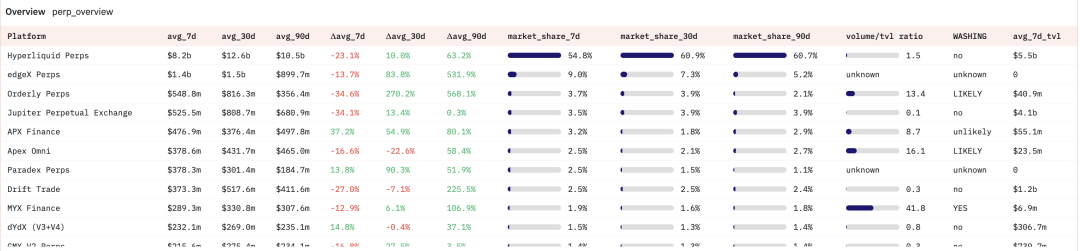
The well-known part — Hyperliquid is a leading decentralized perpetual contract exchange (Perpetual DEX) and is seeking vertical expansion. It accounts for 60% of the trading volume of the decentralized perpetual contract market, and its main drivers include regulatory arbitrage opportunities, airdrop activities, excellent user interface/experience (UI/UX), deep liquidity, and strong community consensus.
Initial growth
Users can use a perpetual contract exchange with seamless UI/UX without KYC (but still subject to regulations in different regions). This is due to:
#零 Gas fees and low transaction costs
The unique order cancellation and post-only priority mechanism is superior to other order types (such as immediate or cancelled IOC), which significantly reduces the harmful effects of high frequency trading (HFT) order rush (10x more). For more technical details on how to do this, read the instructions on precompiling (precompiles):
xhome/emaverick90/status/1919727174426284488
#直观的界面
One-click DeFi operations
#极速交易体验
0.2 second block generation time, achieving 20,000 TPS on the chain through a unique consensus model
#优秀的做市商和流动性提供
The initial launch was led by the Hyperliquid core team
In a cryptocurrency world where everyone is desperately seeking convenient leverage channels (such as meme coins, prediction markets, derivatives, altcoin betas, etc.) in the midst of a bull market, perpetual contracts have found a foothold with the easiest leverage access method, achieving product market fit (PMF).
airdrop
Subsequently, their airdrop began to be distributed — this time the airdrop covered nearly 94,000 wallets, and each participant received an average of $45,000 to $50,000 worth of HYPE tokens:
No selling pressure from insiders
Broad user holdings promote loyalty and alignment of interests
Notably, the Hypios community also provided extremely lucrative airdrops to its holders, and even meme coins on Hyperliquid (such as $BUDDY and $PURR) maintained low selling pressure and firm holders.
As traders/DeFi deep participants received the tokens, many chose to stake (to reduce transaction fees) and deposit them into the HLP vault (https://hyperliquid.gitbook.io/hyperliquid-docs/hypercore/vaults/protocol-vaults),从而提升了交易体验,启动了一个强劲的飞轮效应).
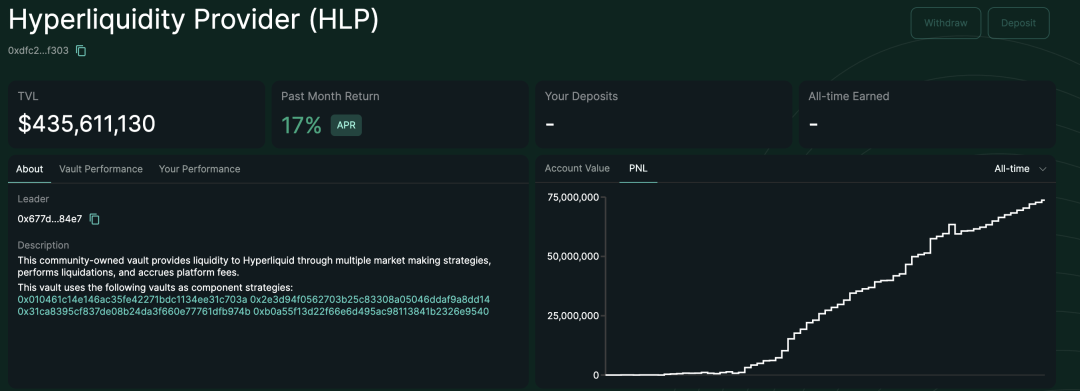
Heavy users continue to actively use their newly acquired wealth — fee revenue is used to buy back tokens — strengthening product and market influence — Hyperliquid has attracted more users and trading volume.
As a result, this mass distribution enabled HYPE to avoid a common price drop after an airdrop. In fact, over the next few months, HYPE's price soared 1,179% — from $3.90 when it launched in November 2024 to $47 in August 2025.
The HyperEVM
On February 18th, HyperEVM was officially unveiled.

▲ Source: ASXN
It's not a standalone chain, but is secured by the same HyperBFT consensus mechanism as HyperCore. The two share state and essentially use a hardforked version of Cancun without blobs.
Developers can now access mature, liquid, and high-performance on-chain order books. For example, a project can deploy an ERC20 contract on HyperEVM using standard EVM development tools and deploy corresponding spot assets in HyperCore spot auctions without a license. Once linked, users can either use the token in HyperEVM's apps or trade on the same order book.
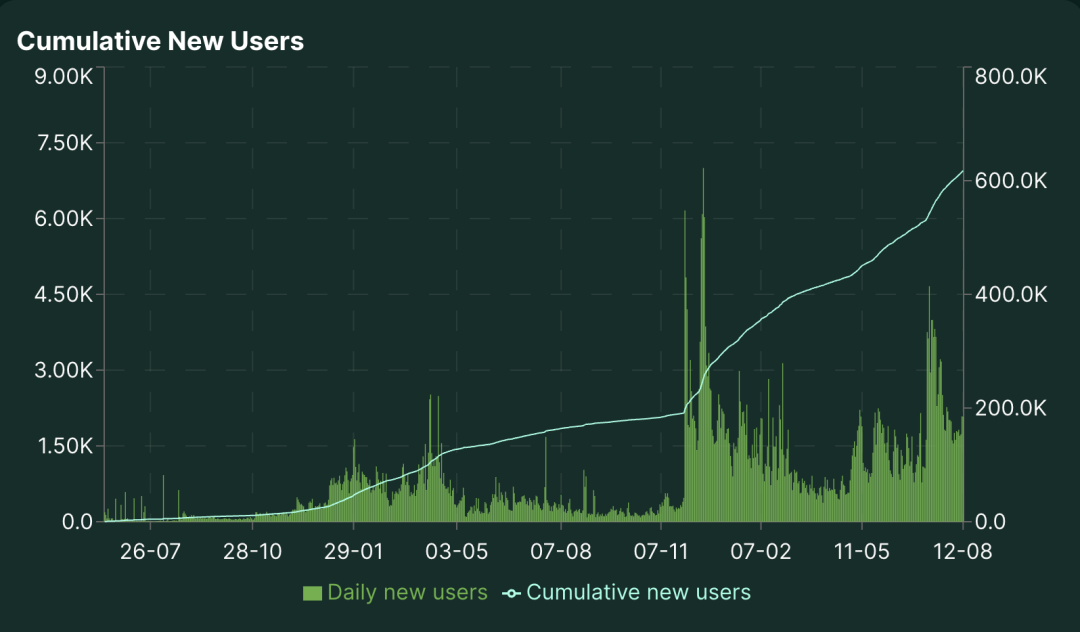
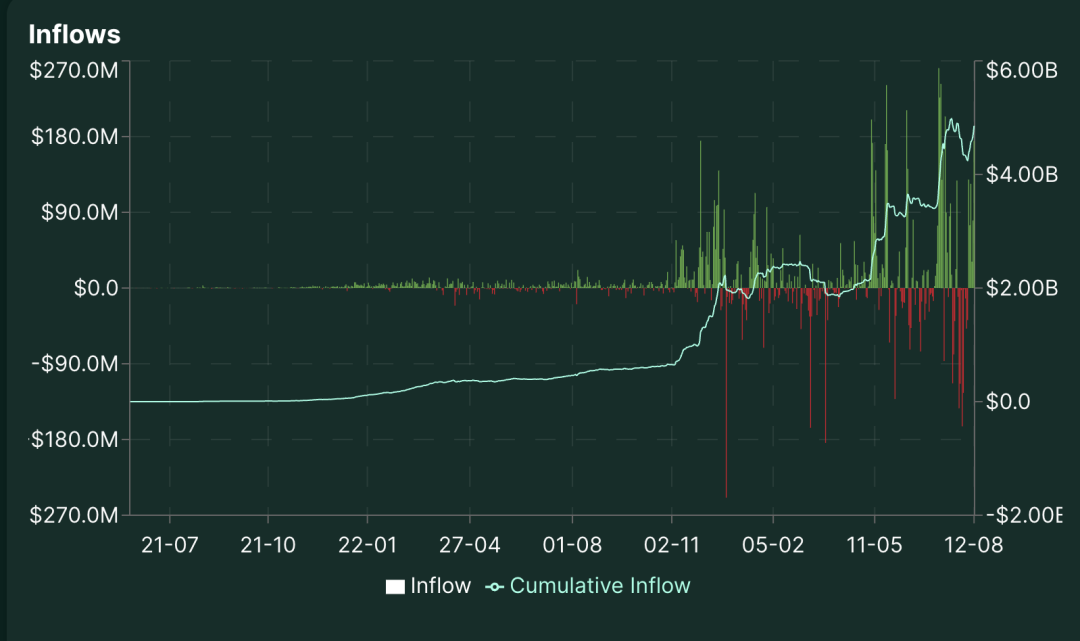
This empowers developers and communities by supporting a wider range of use cases. It allows a broad range of users and liquidity consistent with Hyperliquid to further leave its mark on the ecosystem. It also opens up another path for Hyperliquid usage to flow back into the hands of participants by providing a composable, programmable layer to improve fluidity.
Notably, this also provides a way for projects outside of the Hyperliquid ecosystem to join. For example, Pendle is now integrated with HyperBeat and Kinetiq's LST and LoopedHype's WHLP & LHYPE (https://x.com/looping_col/status/1955645499970560311). EtherFi and Hyperbeat are rolling out PreHype (https://thedefiant.io/news/defi/etherfi-expands-to-hyperliquid-ecosystem-through-collaboration-with-hyperbeat). Morpho provides a treasury on HyperBeat, and top curators include MEV Capital, Gauntlet, Re7 labs, and many others.
HyperEVM's network effect isn't about cloning or EVM compatibility; its core is creating a programmable financial operating system where code, liquidity, and incentives are natively aligned and instantly accessible. Liquidity will not be fragmented; on the contrary, it will grow exponentially as more use cases, revenue streams, and protocols are integrated. As the entire technology stack becomes rich, users and developers can benefit, making the Hyperliquid ecosystem the “center of gravity” of DeFi in the future.

What Now?
In an ecosystem full of financialized individuals — whether farmers, quantitative traders, developers, or traders — Hyperliquid already has all the liquidity and infrastructure needed. So how do you build on that and expand outward?
Builder Codes
Hyperliquid has launched developer code (Learn more: https://hyperliquid.gitbook.io/hyperliquid-docs/trading/builder-codes),允许将平台接入任何分销渠道,并让接入方获得部分费用分成. For the Phantom wallet, which has 17 million users, this is an excellent opportunity to both expand the wallet's use cases and increase revenue.
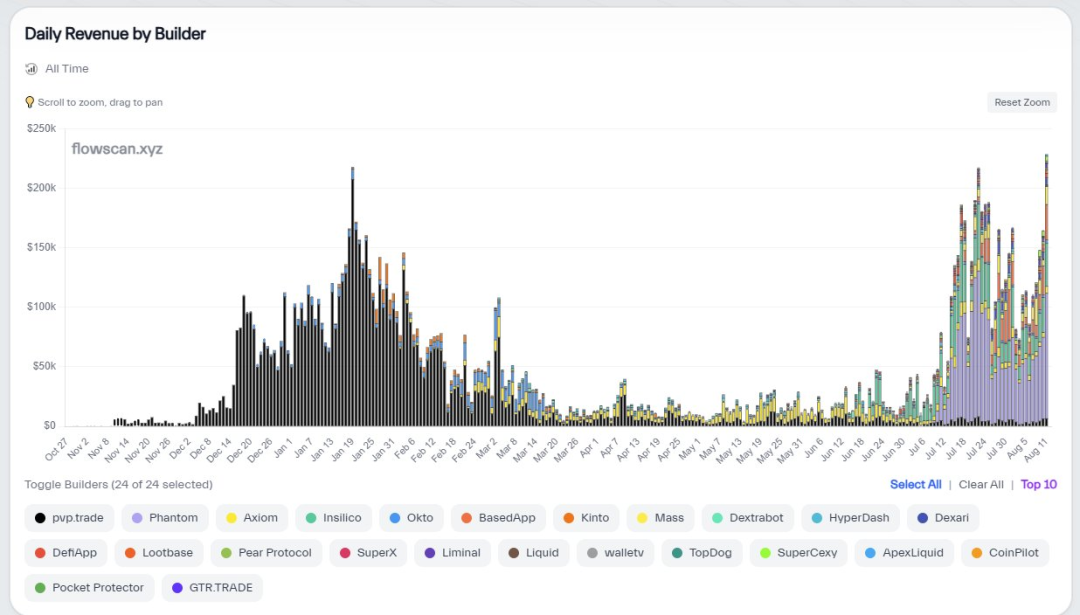
HIP Proposal Overview
Furthermore, the Hyperliquid improvement proposal (HIP1, 2, 3) has further promoted the vertical deepening of the technology stack.
HIP-1 is a standard for deploying native tokens and on-chain spot order books.
Learn more: https://hyperliquid.gitbook.io/hyperliquid-docs/hyperliquid-improvement-proposals-hips/hip-1-native-token-standard
HIP-2 is committed to permanently injecting liquidity into the HIP-1 token's spot order book.
Learn more: https://hyperliquid.gitbook.io/hyperliquid-docs/hyperliquid-improvement-proposals-hips/hip-2-hyperliquidity
The Unit project has strongly promoted the adoption of HIP-2 by providing a more native spot trading experience. Essentially, Unit is a multi-signature wallet that allows traders to index the native chain and make permissionless transactions on Hyperliquid. (Learn more: https://docs.hyperunit.xyz/)
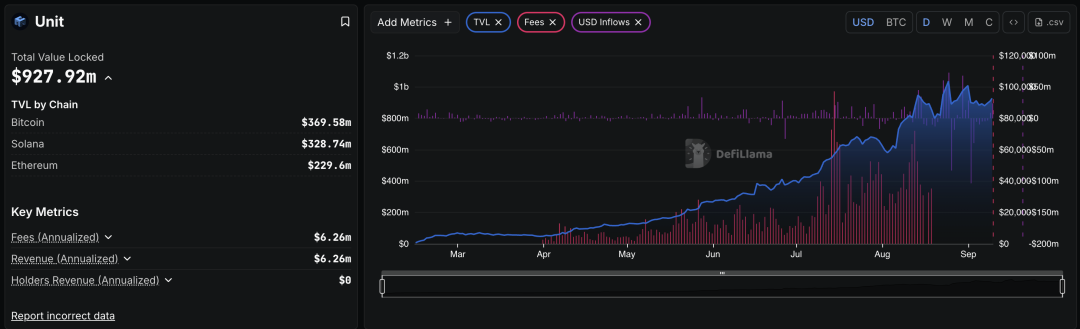
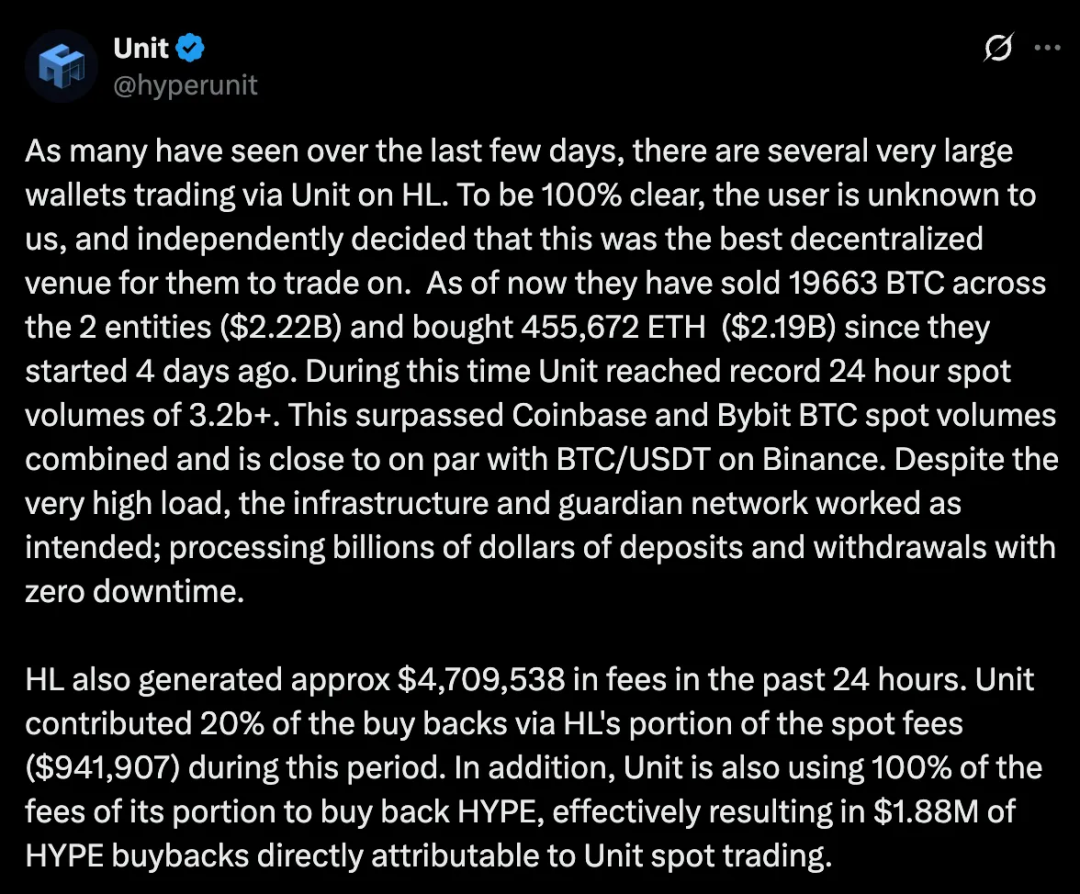
But arguably the most popular update was HIP-3: https://hyperliquid.gitbook.io/hyperliquid-docs/hyperliquid-improvement-proposals-hips/hip-3-builder-deployed-perpetuals
HIP-3 introduces a perpetual contract market that requires no license and is deployed by developers on the core infrastructure. Before HIP-3, only the core team could launch a perpetual contract market, but now anyone who staked 1 million HYPE could deploy their own marketplace directly on the chain.
The process is as follows:
Pledge 1 million HYPE
Define market details: market name and code (still need to be purchased at auction, similar to spot), selection of collateral types, source and backup logic of the oracle, leverage and margin parameters, contract specifications, and funding mechanisms.
Set up a fee structure (set basic transaction fees and any additional custom fees) and determine the market deployer's fee share ratio (up to 50%).
Similar to the revenue sharing relationship between Binance and Circle.
Deploy the marketplace
Market operators are required to direct the liquidity themselves, and Hyperliquid receives an additional 50% of the fee (this portion of the fee will be refunded to HYPE tokens). Note that these marketplaces won't appear directly on Hyperliquid's main interface, but anyone can choose which markets to connect to. This makes Hyperliquid's role not just a launch platform, but more like an asset provider.
So far, Hyperliquid has successfully conquered the following core areas:
High-performance trading engine: Provides a trading experience that effectively mimics the performance of centralized exchanges for spot and perpetual contracts.
This includes leveraged trading and spot transfer features.
Consumer-grade user experience combined with distribution channels.
EVM as a programmable execution layer: A programmable layer (HyperEVM) closely linked to the user experience and mobility center is built on top of it.
Stablecoin infrastructure: successfully attracted $5.6 billion worth of USDH into its ecosystem.
For Hyperliquid itself or for other projects in its ecosystem (based on HyperEVM), there are still vast opportunities to explore:
Native fiat currency deposit and withdrawal channels: Build a more convenient and low-cost fiat to cryptocurrency conversion bridge.
Payment Solution: Develop new payment applications using its high-speed, low-cost network.
Web2-level consumer apps: Develop complex decentralized products with an experience similar to traditional Web2 apps to attract a wider user base.
Risk Management Engine: Create better risk management and hedging tools for institutions and advanced traders.
Current status of tokens/liquidity
According to the repurchase program led by the Assistance Fund, 28 million HYPE units have now been repurchased, with funding from 54% of total revenue (46% of perpetual contract fees are distributed to HLP depositors, which means 92-97% of total revenue is returned to users), with an average daily repurchase amount of $2.15 million.
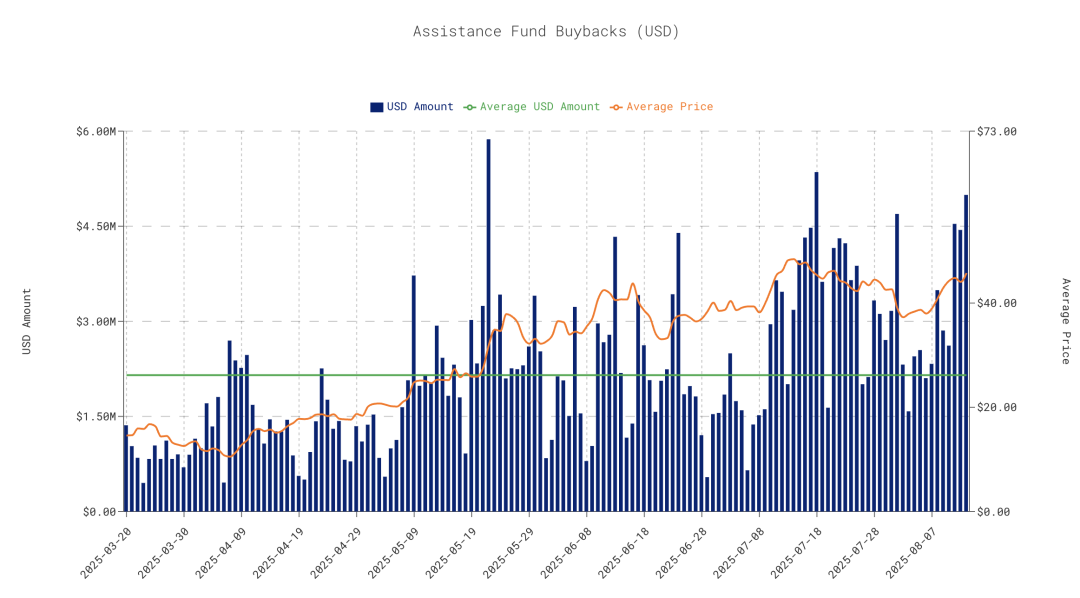
Currently, 38% of HYPE's total supply of 1 billion copies is still dedicated to airdrops and incentives, which has the potential to further drive ecosystem use. However, this is a double-edged sword, as such a drastic increase in circulation supply may generate huge selling pressure that far exceeds current repurchase capacity.
In terms of USDC inflows, Hyperliquid continues to grow and currently has a stock of around $4.4 billion. Surprisingly, this accounts for 71.11% of Arbitrum's USDC holdings across the network, and these funds are being used in the Hyperliquid ecosystem.
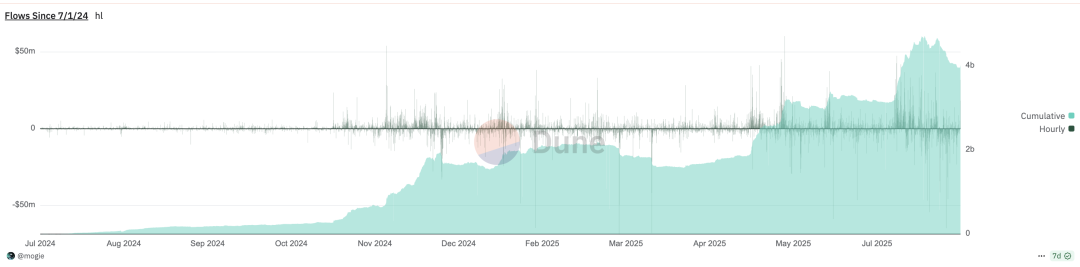
Non-HLP trading volume metrics (cumulative total of $4.3 trillion) were used for analysis. Since HLP is a passive liquidity provider/platform pool responsible for internal ordering and hedging risk, non-HLP transaction volume represents the user-to-user (peer-to-peer) transaction flow. Note that this portion of the user-to-user transaction flow still includes:
market maker
Regular trading mining accounts accounting for about 20% and vaults using a systematic strategy (see appendix)
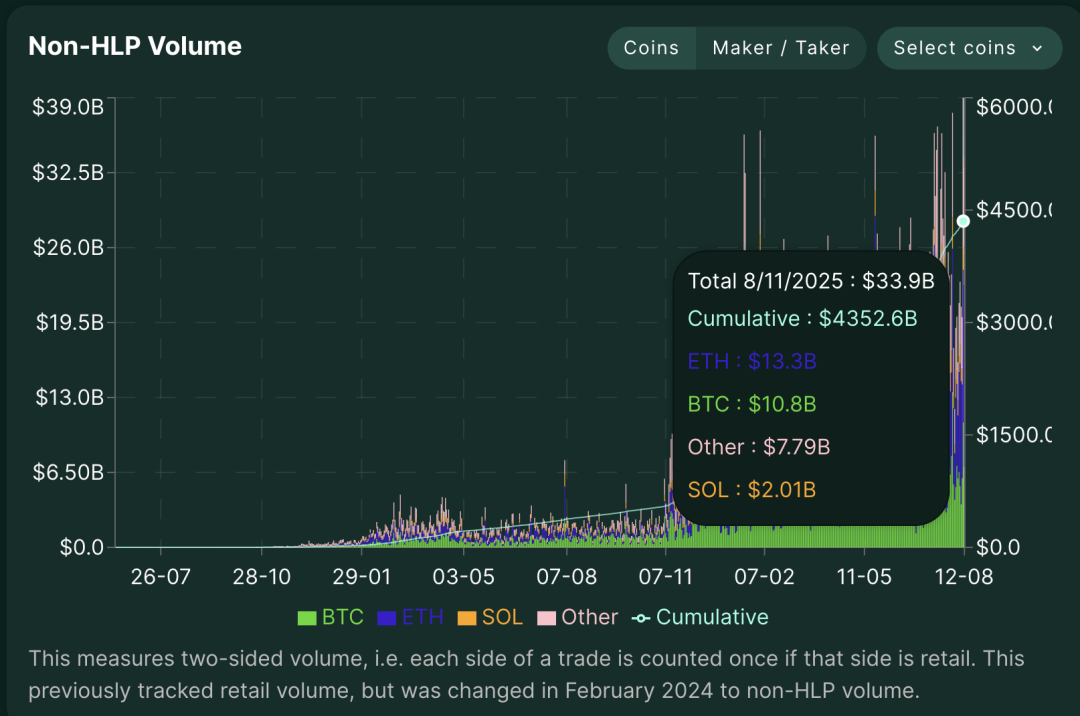
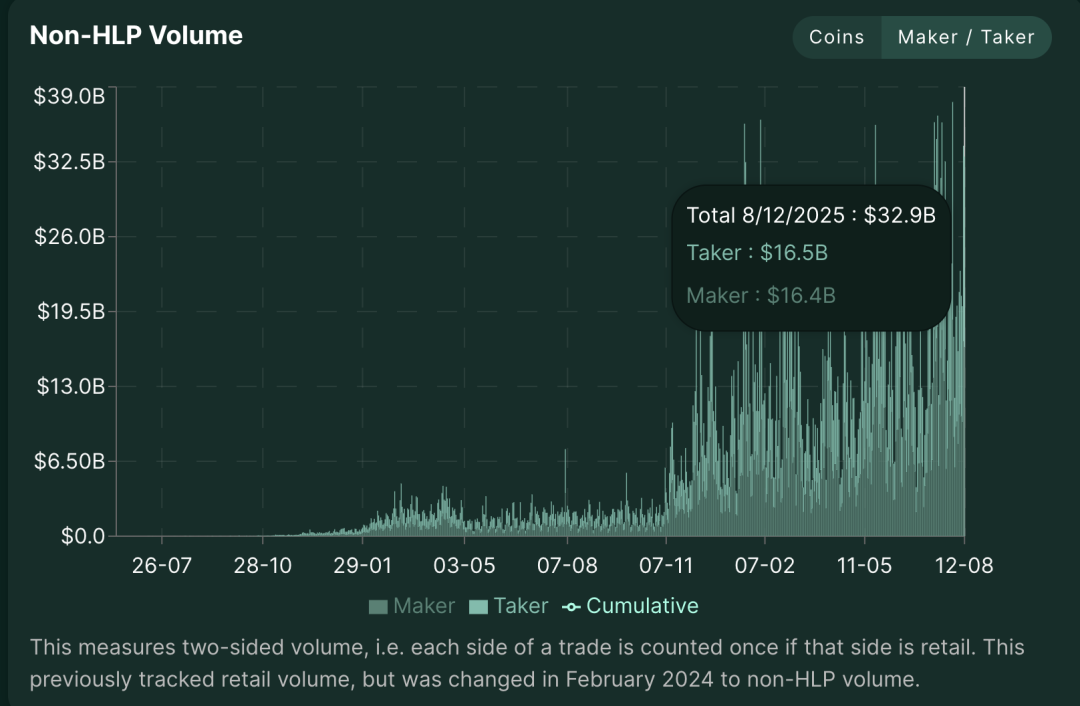
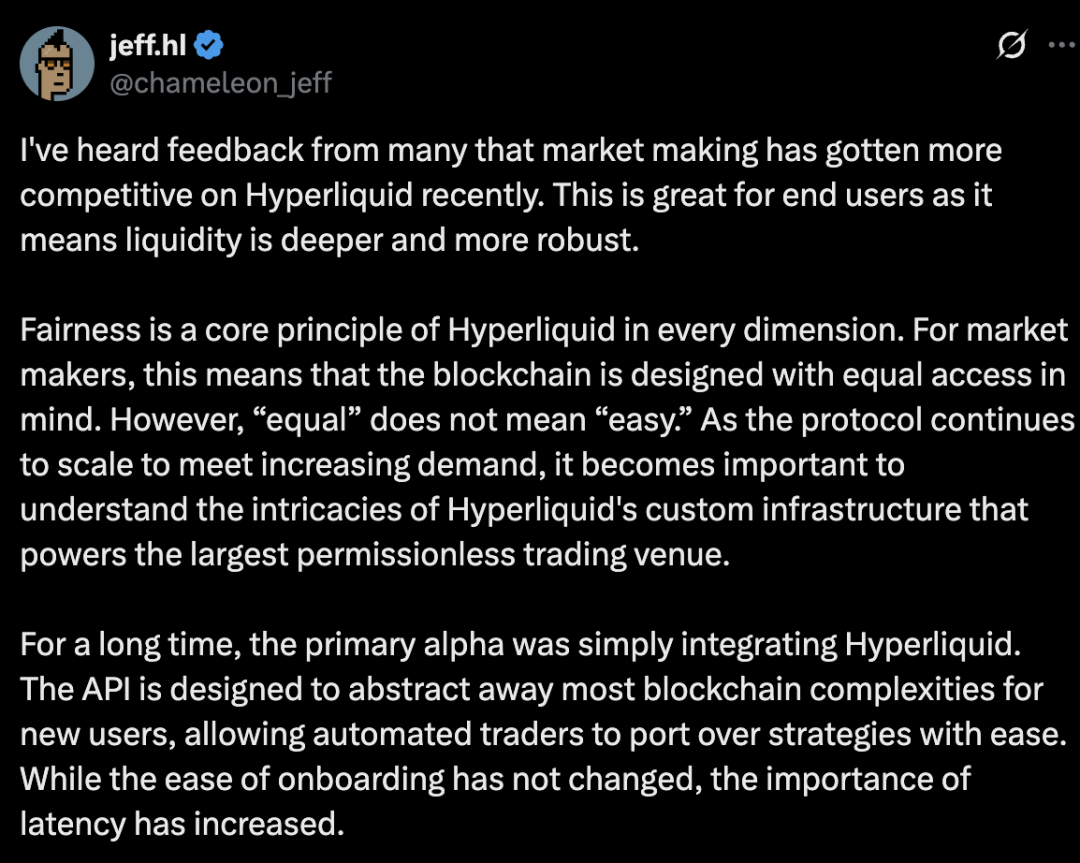
For an exchange, the increase in market makers is a “sweet annoyance.” In fact, Jeff mentioned that there are already “too many” market makers.
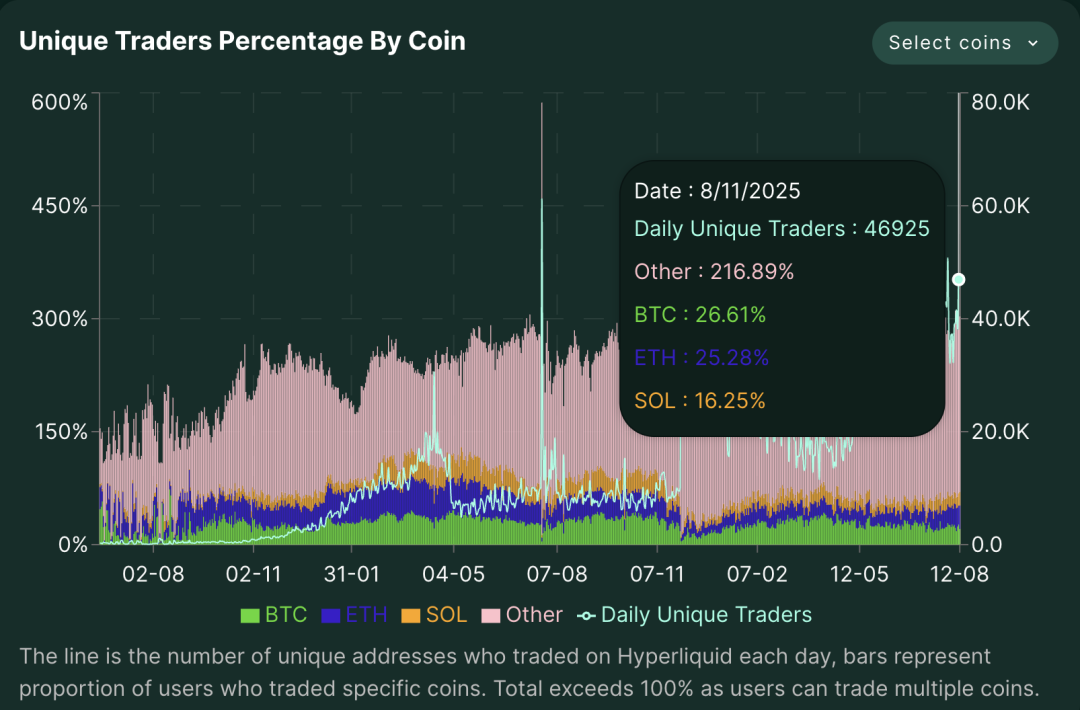
As of the analysis date, the number of daily independent traders was 46,925. Statistics show that the sum of currency percentages traded by users exceeds 100% because one address trades multiple assets. This multi-currency overlapping transaction means that Hyperliquid is more than just a single asset trading place — traders are exposed to multiple assets per session, which indicates extremely high platform stickiness and cross-currency speculation. Meanwhile, the number of traders on Hyperliquid is growing quite steadily.
So what does that mean?
As it stands, everything seems to rely heavily on bringing users into the HyperCore infrastructure and then returning value back to the ecosystem in some way:
HyperEVM will bring more trading volume to Hyperliquid + a stable financialization layer.
Builder Codes help expand Hyperliquid's distribution channels, bringing fees back to HYPE tokens.
HIP-3 will enable permissionless marketplace creation and share fees with HYPE tokens.
HYPE token inflation will benefit stakers and generally bring higher returns to HyperEVM.
With HYPE tokens, the perfect marketing tool and the best way to coordinate community growth, Hyperliquid has formed its own close-knit community of believers. At the end of the day, if leveraged trading is a valuable experience for consumers, then Hyperliquid's flywheel effect will continue to work.

What next?
Bearish Case
#监管收紧的可能性
Perpetual contracts provide end users with access to the leveraged market. In the absence of adequate KYC/anti-money laundering measures, there will be a risk of money laundering. Platforms may be forced to implement more stringent compliance systems and report on high-value transactions. Like Polymarket, US users may eventually need to go through KYC to use the platform.
#代币解锁
If not handled properly, the locked airdrop supply could trigger significant selling pressure.
The 238 million core contributor tokens (23.8% of the total supply) will begin linear unlocking on November 29, 2025.
At current prices, the equivalent selling pressure of approximately $17.3 million is expected to be generated every day between 2027-2028.
The insider holding ratio will surge from the current 15.9% to 45.8% after full dilution.
Why it matters:
Currently, the aid fund's repurchase capacity is only about $2 million per day
Generates a selling pressure 8.6 times greater than the buyback capacity
The point in time overlaps with the 2027-2028 downward cycle after Bitcoin's halving
Maintaining price equilibrium alone requires 6-7 times increase in expenses and revenue
#流动性分流风险
With the advent of many new forms of distribution for Hyperliquid L1 (such as the marketplace created by Builder Codes and HIP-3), there is a risk that trading volume will flow to other markets. Although fees will eventually flow back to HYPE tokens (although the share ratio may be discounted), and Hyperliquid controls the core market and distribution channels, this risk still exists.
#回购效应的边际递减与飞轮断裂风险
The effect of buybacks on price increases has a marginal diminishing effect. If Hyperliquid's adoption rate and revenue generated by the product don't match the market's demand for growth or the opportunity cost of holding other tokens, it could break the flywheel effect of growth (macro trends may also weigh down prices; see April 2025 example). The mitigating factor is economic game theory: if prices fall back to a sufficiently low market value, repurchases will consolidate and drive prices back up. But the core risk is how many users are actively using the platform because of HYPE tokens.
#安全性与信任对比
Although retail users love Hyperliquid's user experience, they still prefer Ethereum as an asset storage location — because of its stronger validator set (800,000 vs. 16 HL), longer security records, and harsher punishment mechanisms (HL's consensus design is secure, but it is more centralized and the risk of punishment is more concentrated). Incidents such as $JELLYJELLY have also raised questions about safety and governance in the community.
#发展资金匮乏
97% of fees are spent on repurchases, meaning zero budget for growth, marketing, or security incentives. Any misappropriation of funds to fund development through governance proposals would be doubly bad for token holders. Competitors actively fund ecological development, while Hyperliquid has left itself in a “hungry” state.
Bullish Case
#增长动力
Attracting significant capital inflows through EVM integration and better interoperability
HIP3 markets bring traditional financial inflows from institutions and retail
The number of mainsite perpetual contract markets continues to increase
38.8% token reserve provides growth ammunition for airdrops
#USDH Earnings Potential
The USD deposit on the platform is about $5 billion. After the introduction of USDH, based on current US bond interest rates, it can generate annual revenue of US$1.5-2 billion. If this revenue originally retained by Circle can be redirected to HYPE to be repurchased, it would be extremely beneficial to the ecosystem.
#跨链扩张
One-click recharge from any LayerZero chain through LayerZero. Initial assets include USDT0, USDE, PLUME, COOK. Break the single-chain ceiling and preempt L2 order flow capture.
#费用优势
The current charge rate is about 2.8 basis points, and the competitor is about 1 basis point
Zero gas orders+on-chain matching provide a sustainable profit model
Stay profitable even if expenses are cut in half
#CEX Trust crisis opportunity
Accidents on centralized exchanges (such as FTX) damage their image. As a semi-trusted neutral infrastructure, Hyperliquid promotes blockchain concepts with a CEX-like experience to close gaps in hosting decentralization, operating costs, and regulatory arbitrage.
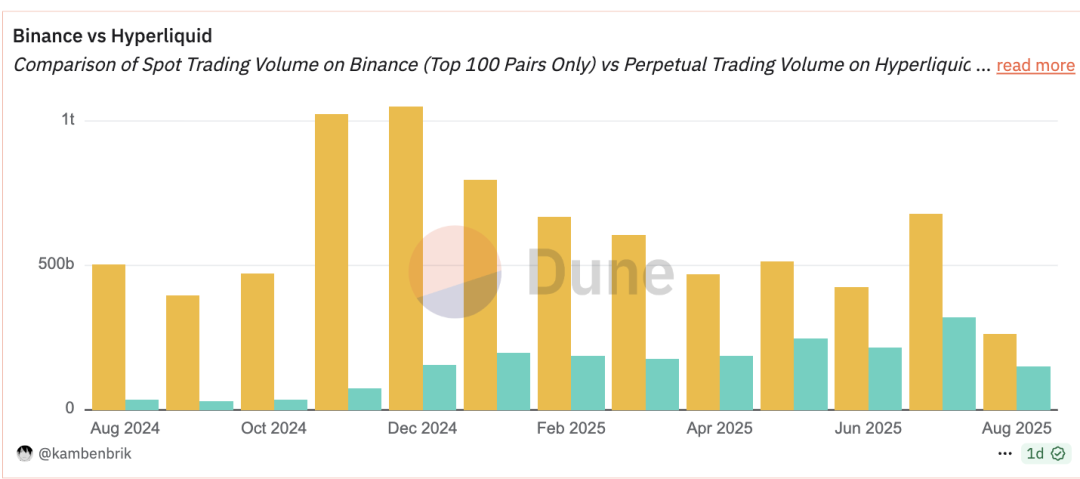
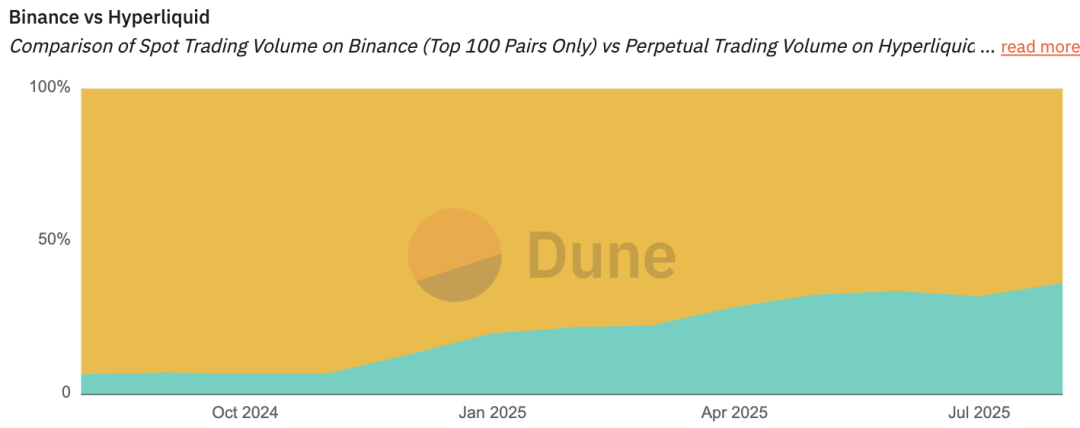
However, directly comparing spot trading volume to perpetual contract trading volume is like comparing apples and oranges. If we want to clearly differentiate the actual shares of Binance (Binance) and Hyperliquid (HL) in the spot and perpetual contract markets, we can see the following:
#Daily trading volume (September 9, 2025))
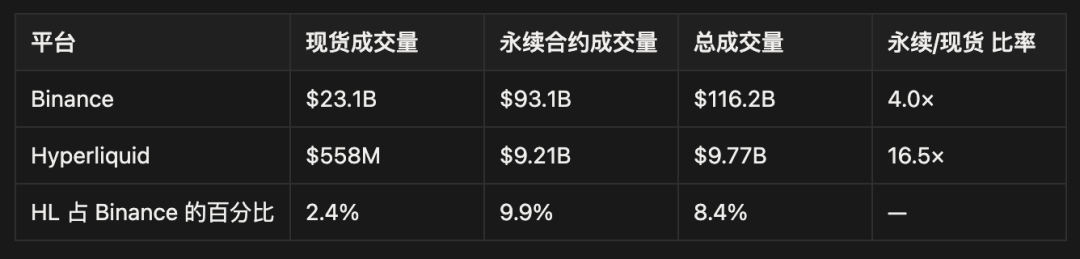
#30 day trading volume
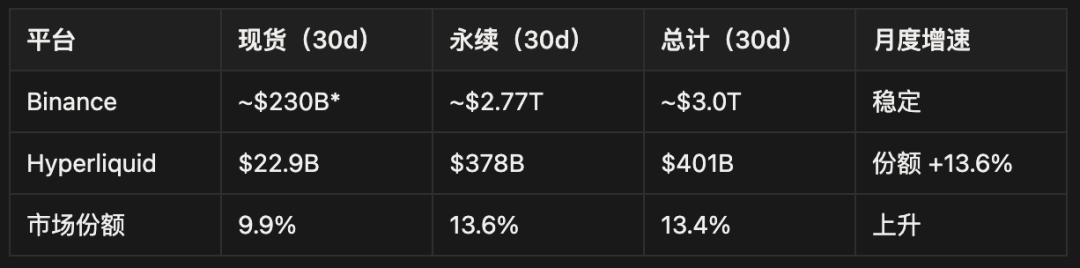
Based on the $730 billion monthly total transaction volume and daily ratio estimates provided by Messari
The two have completely different market positions. One mainly serves off-chain (off-chain) users, while the other targets on-chain (On-chain) users. The chart below shows how dominant the two are in their respective fields.
#用户基数分析(User Base Analysis)

#交易强度(Trading Intensity)
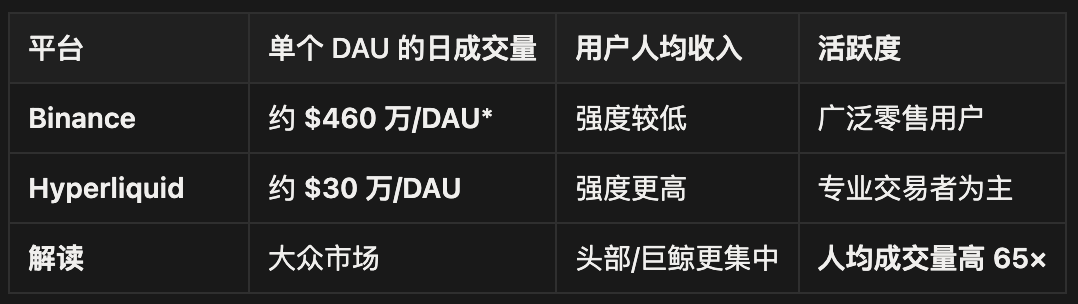
Based on rough estimates of 25 million active users
#市场份额(Market Share)
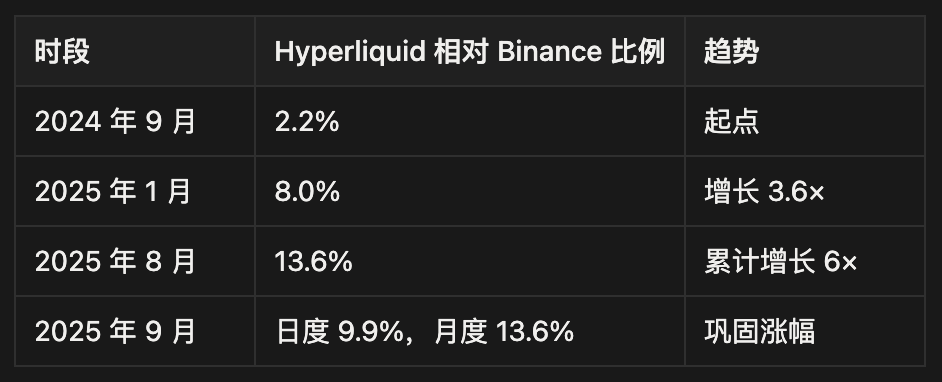
The many builders I've talked to in the Hyperliquid ecosystem so far are all teams that work hard, create value, and are community-driven. The formation of this atmosphere is largely due to the way the ecosystem guides everything from products to airdrops.
To bring cryptocurrencies to the masses, this field needs to create new value and a better experience for potential new retail users. Fundamentally, I believe Hyperliquid can provide a large number of such products.
For example:
Excellent trading interface (on-chain version of Robinhood): can access on-chain liquidity while providing a seamless financial experience. If the crypto market wants to create a better financial structure, we also need a better interactive portal to abstract the confusing UI/UX.
Pre-IPO products: With $PUMP's ICO/TGE (token generation event), we've seen that pre-markets promoted on perpetual contract exchanges allow users to speculate on this, while also providing a better price discovery mechanism for underlying assets. If this were replicated on pre-IPO assets, it would be an intuitive way to provide real value arbitrage (this tweet explains it very well: https://x.com/j0hnwang/status/1947330391590752532).
Dealing with fragmentation: As many new markets (HIP3, other CLOBs, etc.) emerge, we see that liquidity and user experience may gradually become fragmented. And projects like https://superstack.xyz provide a great solution, just like 1inch did for DEX, Jumper did for bridging bridges, and Beefy did for yield farming.
Real world assets (RWA): HIP3 provides a way for off-chain assets like SPX to be recorded on-chain. Other forms of RWA will provide more sustainable, revenue-supported benefits and financial activities that will help drive the ecosystem's growth.
All in all, Hyperliquid takes a user-centric approach. From the core team's product decisions to the thousands of builders who align with the vision, the entire ecosystem is designed so that the ultimate winners will be those who create value rather than extract it. Newcomers now have equal opportunities to prove their insight without being bothered by bad actors, and have access to a rich and mature ecosystem. Whether any product can survive a bear cycle is a mystery to anyone, but personally, I'm very hopeful about their ability to rebound and continue to attract more builders.
This isn't a bet on HYPE rising prices or keeping earnings high — it's a bet that building a real business with real users and real revenue will eventually win, even if the path includes significant volatility and loss of users.
The market is likely to give you multiple opportunities to accumulate assets for this theme at distressed prices (undervalued prices). The question is, do you believe that in the long-term evolution of cryptocurrencies, business intelligence and a sustainable revenue model are ultimately more important than short-term token games.
There's plenty of room for growth, but like any venture capital, I believe it's in the right hands.
Twitter:https://twitter.com/BitpushNewsCN
Compare the TG exchange group:https://t.me/BitPushCommunity
Compare TG subscriptions:https://t.me/bitpush
