


New game for US stocks: 100 billion AI turntable, who will be the final taker?
Written by 51st
original title|US stocks are playing a new type of AI turntable game
Recently, a story has been circulating in the US stock market:
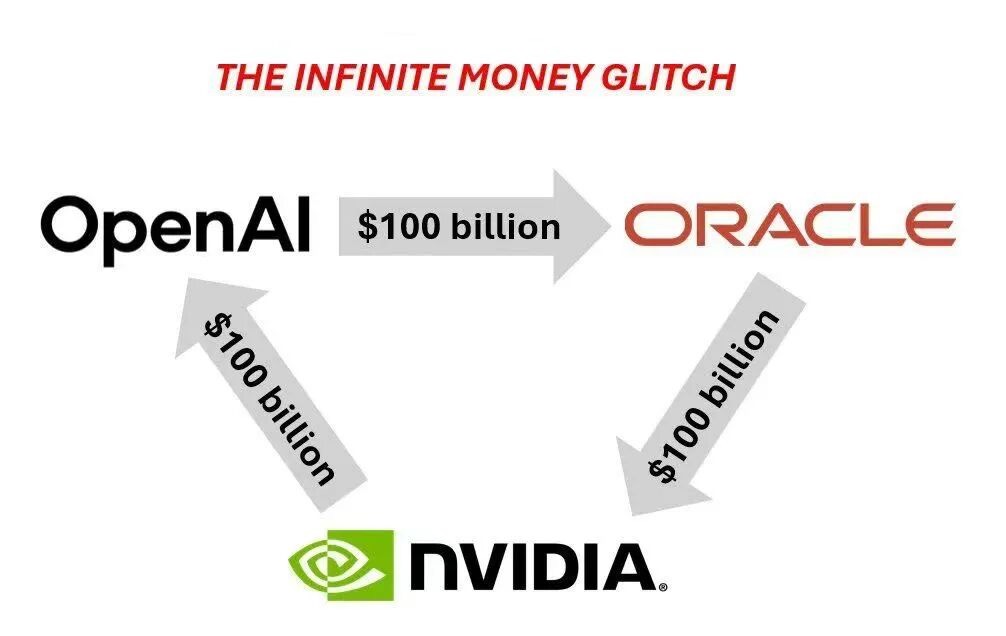
“OpenAI invests 100 billion US dollars in cloud computing services; Oracle invests 100 billion US dollars in Nvidia to buy video cards; Nvidia invests another 100 billion US dollars in OpenAI's AI system. The question is, who actually paid for this 100 billion dollars?”
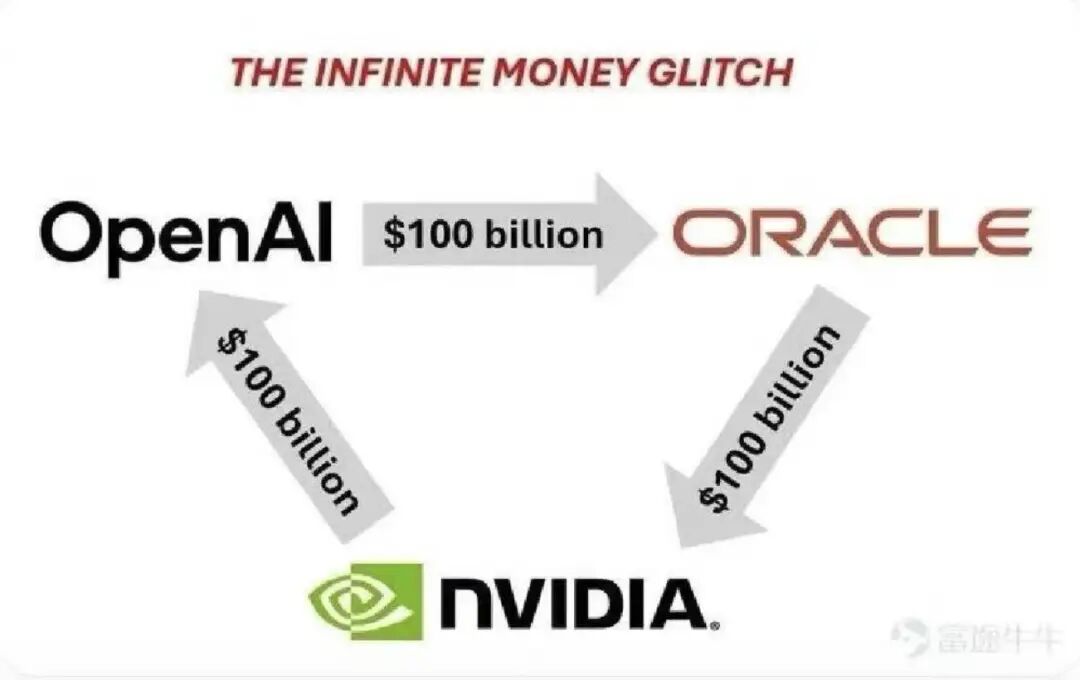
Of course, the above is just a joke. There is a big discrepancy between the amount and the facts, and it's not that the three companies are putting the same amount of money around, but this does reflect a closed loop in a new type of capital narrative.
In this closed loop, every step is a real contract or investment, and every action will be amplified by the capital market, which in turn will increase the market value by trillions of dollars.
On September 11, Oracle shares surged 36%, the biggest one-day increase since 1992. Overnight, the company's market capitalization soared to $933 billion, and founder Larry Ellison even briefly surpassed Musk to become the richest man in the world.
On September 22, Nvidia and OpenAI announced that they have reached a strategic cooperation. Nvidia plans to invest up to 100 billion US dollars in OpenAI. Nvidia closed up nearly 4%, the market capitalization exceeded 4.46 trillion US dollars, and set off the overall technology stock market. The three major US stock indexes all reached new highs.
$100 billion may seem like a lot, but overnight it drove US stocks up trillions of dollars, and properly spend a small amount of money to do big things.
US stocks are playing a new kind of AI turntable game.
Triangular cycle: How does money turn around?
In the real-life version of the investment maze, three names form a perfect closed loop of capital: OpenAI, Oracle, and Nvidia.
Part 1: OpenAI is hungry for computing power
The central protagonist of the story is OpenAI. As the creator of ChatGPT, OpenAI processes requests from 700 million users every day. AI computation on this scale requires massive computational power.
This year, OpenAI and Oracle signed the largest technology contract in history, a 5-year $300 billion cloud computing agreement. Under this contract, OpenAI will pay Oracle approximately $60 billion a year, equivalent to six times the company's current annual revenue.
What did this money buy? 4.5 gigawatts of data center capacity, equivalent to the electricity consumption of 4 million American households. Oracle wants to build data center campuses spread across five states, including Wyoming, Pennsylvania, and Texas for OpenAI.
For OpenAI, this guarantees a model with location and computing power; for Oracle, this is revenue certainty for the next five years.
Part 2: Oracle requires a chip
After receiving a huge order from OpenAI, Oracle faced a question: how to build these data centers?
The answer is chips, lots of chips. Oracle plans to spend tens of billions of dollars on the Stargate project to buy Nvidia GPUs. According to industry estimates, 4.5 gigawatts of computing power would require more than 2 million high-end GPUs.
Oracle CEO Safra Katz put it bluntly: “The vast majority of our capital expenditure investments are used to buy revenue-generating equipment that will go into data centers.”
These “revenue-generating devices” are mainly Nvidia's H100, H200, and the latest Blackwell chips.
Oracle became one of Nvidia's biggest customers.
Part 3: Nvidia Backfeeding
At the same time as Oracle is frantically purchasing chips, Nvidia announced an amazing decision: invest $100 billion to support OpenAI's construction of a 10-gigawatt AI data center.
The investment will be phased in, and every time OpenAI deploys 1 gigawatt of computing power, Nvidia will invest the corresponding amount of money. The first phase is scheduled to launch in the second half of 2026, using Nvidia's Vera Rubin platform.
Nvidia CEO Hwang In-hoon said in an interview, “10 gigawatts of data center capacity is equivalent to 4 million to 5 million GPUs, which is approximately our total shipment volume this year.”
At this point, a perfect capital cycle has been formed:
OpenAI pays Oracle to buy computing power, Oracle takes money to buy chips from Nvidia, and Nvidia invests the money it earns in OpenAI.
An amplifier of wealth between fiction and reality
The $300 billion long-term contract raised Oracle's market capitalization by more than $250 billion in a single day, and the $100 billion investment brought Nvidia an increase of $170 billion in a single day.
The three companies stood on each other's platforms and endorsed each other, creating a stock price resonance.
Behind the rise in stock prices, there is rationality.
What is scarce for capital markets is certainty about the future.
The contract between Oracle and OpenAI means that part of its cloud revenue will be locked in for the next five years, and investors will naturally give a higher valuation.
Also, Nvidia is using “GW (gigawatt)” as the unit of measurement this time. 1 GW is roughly the size of a super data center. 10GW means Nvidia and OpenAI are building a next-generation AI factory. This new narrative language is more imaginative than “how many GPUs did you buy”, and the market was easily driven by it.
Nvidia's investment in OpenAI is tantamount to saying “I agree that it is a future supercustomer”; OpenAI signed a contract with Oracle, which means “Oracle has the ability to support my future cloud computing power needs,” and OpenAI can obtain more financing; Oracle's purchase of Nvidia GPUs is tantamount to “Nvidia's chip supply is in short supply.”
This is a stable and prosperous industrial chain.
The cycle looks perfect, but if you take a closer look, you'll discover its mysteries.
OpenAI currently has annual revenue of around $10 billion, but is committed to paying Oracle $60 billion a year. Where can this huge gap be filled?
The answer lies in round after round of financing. In April, OpenAI closed $40 billion in financing and is expected to continue.
In fact, OpenAI uses investors' money to pay Oracle, Oracle uses this money to buy Nvidia chips, and Nvidia returns part of the revenue to OpenAI. It is a circular system driven by external capital.
Furthermore, most of these astronomical contracts, which are based on “promises” rather than immediate delivery, can be delayed, renegotiated, or even cancelled under certain conditions. The market sees promised numbers rather than actual cash flowing.
This is the magic of modern financial markets: expectations and promises can create multi-fold wealth effects.
Who will pay for it?
Back to the original question in the paragraph: “Who actually paid for this 100 billion?”
The answer is, investors and debt markets.
Investment institutions such as SoftBank, Microsoft, and Thrive Capital are direct buyers of this game. They invested tens of billions of dollars in OpenAI to support the entire capital cycle. In addition, banks and bond investors have also provided financial support for Oracle's expansion, and ordinary people who hold related stocks and ETFs are “silent buyers” at the end of the chain.
This AI capital rotation game is essentially a kind of financial engineering in the AI era. It leverages the market's optimistic expectations for the future of AI to build a self-reinforcing investment cycle.
In this cycle, each side was a winner: OpenAI got computing power, Oracle got orders, and Nvidia got sales and investment opportunities. Shareholders are happy to watch their book wealth grow.
But this joy is based on the premise that the future commercialization of AI can support these astronomical investments. Once this premise falters, the beautiful cycle can turn into a dangerous spiral.
Ultimately, the buyer of this game is every investor who believes in the future of AI, using today's money to bet on tomorrow's AI era.
Let's hope the music doesn't stop.
Interest: The author holds shares related to Nvidia and AMD.
Twitter:https://twitter.com/BitpushNewsCN
Compare the TG exchange group:https://t.me/BitPushCommunity
Compare TG subscriptions:https://t.me/bitpush
