


IOSG Ventures: In-depth analysis of the stablecoin crypto payment circuit prospects

Author | Frank @IOSG
Core ideas TL; DR
Stablecoins are crypto's killer apps: It's not an NFT, and it's not a meme coin. They are already the “everyday currency” of the global South. The market's focus is not on creating new currencies, but on how to truly integrate existing stablecoins into everyday payment scenarios. Consumer value is driven by B2B: P2P remittance between individuals and cryptographic cards are certainly important, but the author believes that the largest TAM will take place in the field of cross-border payments between companies. Cryptographic orchestration layers and PSPs that abstract stablecoins and directly embed them into the transfer systems of large companies can capture the additional benefits brought about by huge capital flows and capital accumulation. License + Corridor = Moat: Just as infrastructure shifts from technology competition to distribution, the real barriers to B2B payments are regulatory licenses (MSB/EMI/SVF, etc.), banking cooperation, and the first-mover advantage of cross-border corridors. (Example: Bridge has the US MSB/MTL, and RD Tech has the Hong Kong SVF license). Orchestration > Aggregation: Aggregators are only market-matching platforms, and profit margins are very thin; orchestrators control compliance and settlement rights. Real defense comes from directly holding a license and being able to transfer funds on your own. Competition is intensifying: From emphasizing “underlying technology” to competing for “actual use”: Similar to consumer apps, the market rewards actual adoption and user size. The rise in TRON fees has verified the strong demand for stablecoin transactions, and the next stage will be stablecoin native chains (stablecoin issuers with distribution and distribution channels, such as Plasma, Arc, etc.), which will actively guide users to directly use their own stablecoin blockchain for transactions and settlements like Hyperliquid, thus preventing most transaction fees from being taken away from the general public chain. At the same time, users can also directly use the transferred stablecoins to pay processing fees to unify payment media and network incentives.
introduction

Stablecoins and blockchains built around stablecoins are the focus of the industry and headlines almost every day. Plasma and Stable launched by Tether.io, Circle's Arc, Stripe's Tempo, Codex PBC, 1Money, the next-generation L1 blockchain being developed by Google, and projects that will appear one after another continue to accelerate this trend. At the same time, as one of the most widely used self-hosted wallets in the world, Metamask also officially announced that it will launch its native stablecoin, marking the further expansion of wallet products to payment and value carrying functions. Meanwhile, personal cross-border remittance giant Remitly announced the launch of Remitly Wallet, a multi-currency fiat and stablecoin wallet. It is currently in the testing phase and plans to launch it officially in September in partnership with Circle.
Together, these actions show that more and more large payment companies and Web2 and Web3 tech giants are speeding up “vertical integration” and directly entering the stablecoin and blockchain payment circuit. Instead of just relying on infrastructure provided by a third party, they chose to issue their own stablecoins, build their own wallet products, and even launch an exclusive payment blockchain. Stablecoins are rapidly expanding from cryptographic native scenarios to a wider range of payment, remittance and financial services, and have become one of the most effective application directions of blockchain. Current stablecoin payment technology stack A racetrack with PMF Propose an investment framework for each payment circuit
Therefore, this post provides us with a great opportunity to discuss:
Stablecoin payment infrastructure

Although there are various definitions on the market, the author believes that the stablecoin payment technology stack can be broken down from the following perspectives:
* The mapping used in this article was compiled by the author in July. For the latest market map, please refer to the ASXN board (https://stablecoins.asxn.xyz/payments-market-map).
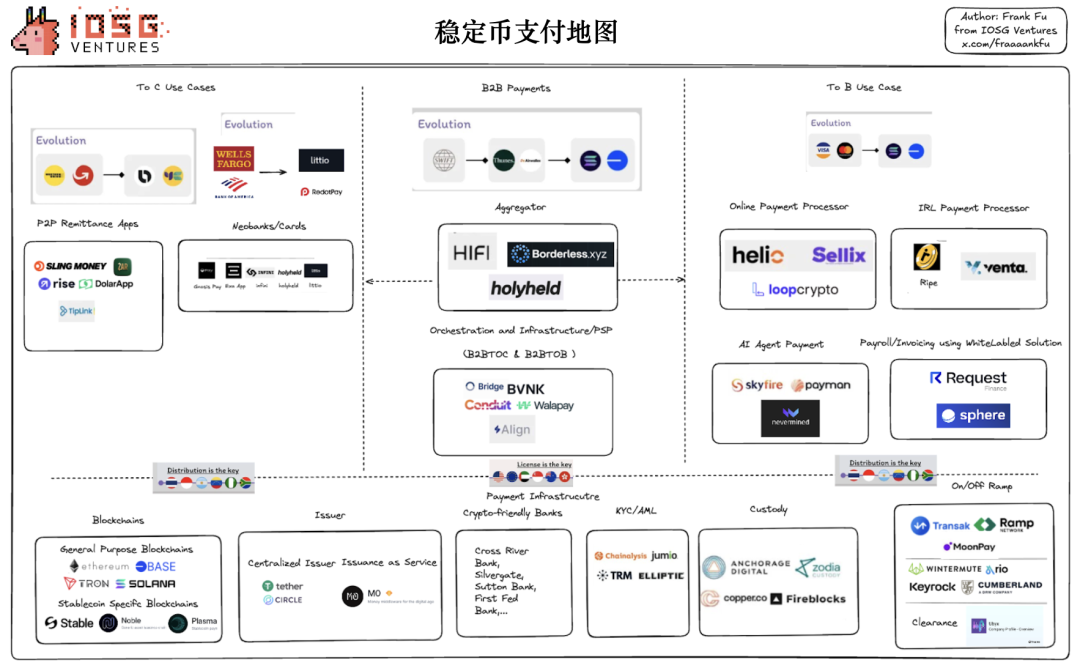
At the bottom of the entire payment map is blockchain itself, which is both the infrastructure and the foundation.
Recently, when Paradigm's Matt Huang explained why Stripe chose to build a new L1 Tempo over Ethereum L2, he gave a long list of reasons. Although many of these reasons have been criticized by the Ethereum community and various VC investors. But one of them, about Fast Finality (fast final confirmation), clearly reveals the real problems facing Ethereum today.
▲ Source: Matt Huang from Paradigm
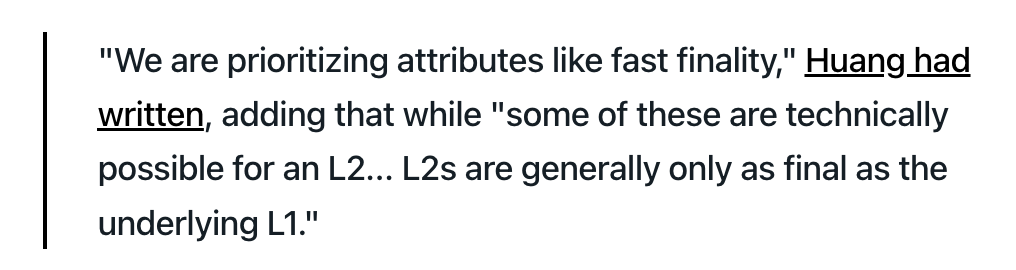
“Finality” in blockchain means that once a transaction is confirmed, it cannot be reversed or changed, and it cannot be undone due to network fluctuations or on-chain restructuring. The so-called “fast finality” means that this guarantee can be provided at the level of a few seconds or even sub-seconds, rather than making the user wait ten minutes. Also, since the final confirmation of L2 depends on L1, no matter how fast and powerful the processing speed of L2 is, its security and final confirmation speed must still be based on L1. Ethereum's current mechanism is solid, but appears to be a bit slow. Blocks are generated every 12 seconds. The transaction will soon be included, but the final confirmation of the economic aspect will take about 12-15 minutes, or two PoS epochs (epochs). During this period, verifiers will continue to vote and seal the results. Although sufficient so far, the market is increasingly demanding that the final confirmation time be reduced to less than 2 seconds to meet the needs of commercial payments and institutional-level high-frequency settlement. If the underlying chain is slow, it cannot support high-speed payments; if network transfer costs are high, the promise of “low rates” cannot be fulfilled; even the best user experience will be dragged down by poor infrastructure.
▲ Source: OKX Gas Tracker (July 23, 2025), block time & finality time: Token Terminal
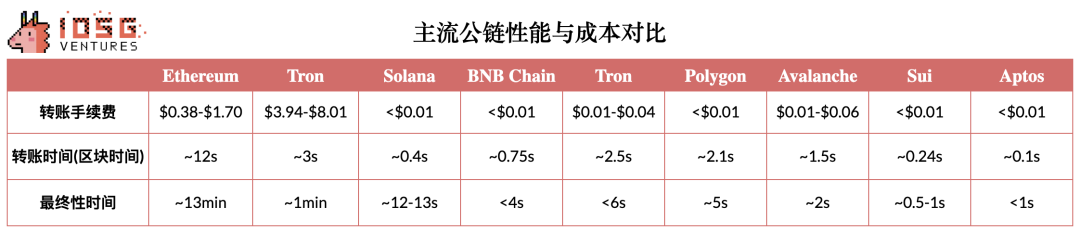
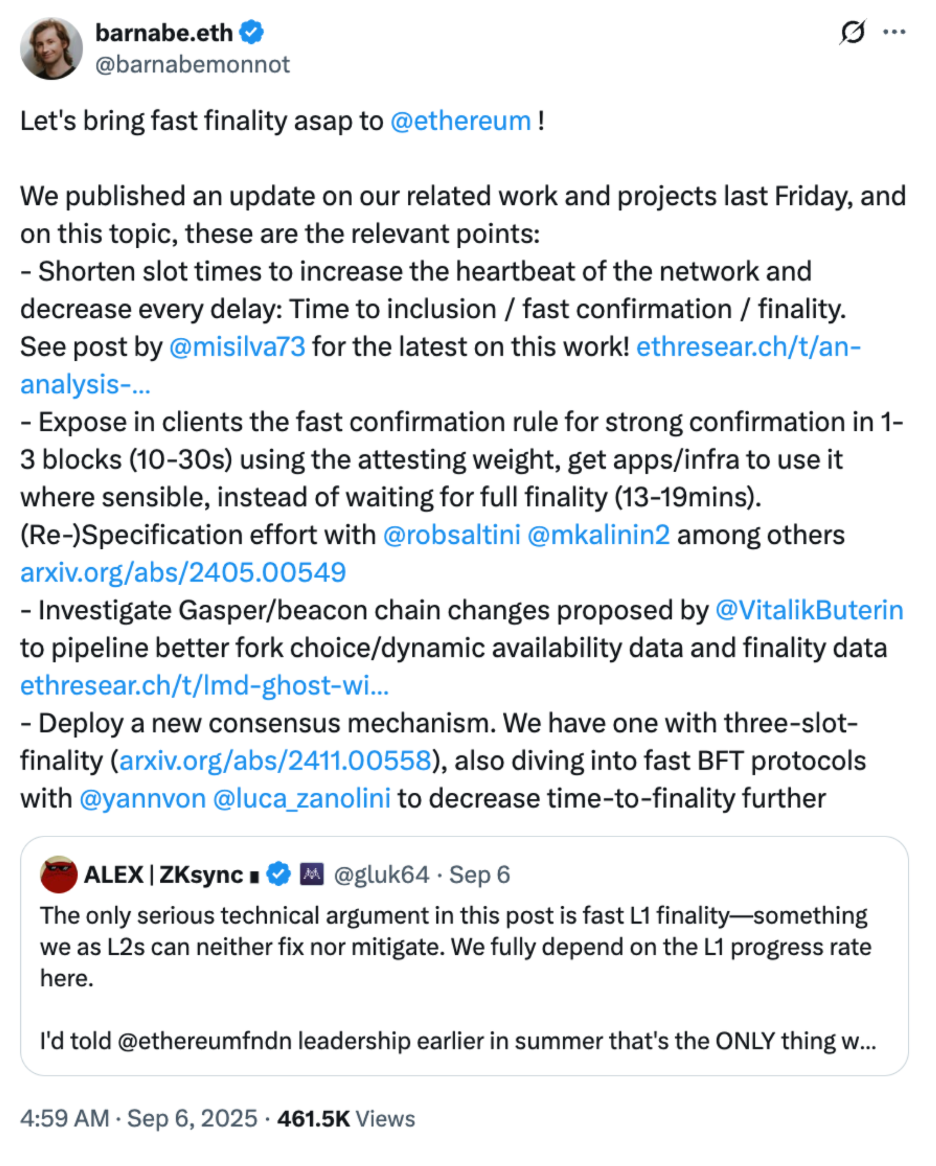
Leaving aside the vertical integration perspective, this is why we are seeing more and more stablecoin issuers and traditional payment giants start building their own blockchains. In addition to commercial profit sharing considerations, the core reason is that all upper tier applications and user experiences ultimately depend on the underlying infrastructure. Only by achieving processing fees as low as a fraction, near-instant finality, and a token design that allows users to not worry about gas can we truly bring about a smooth and seamless user experience. Common core foundational characteristics include: Stable and low processing fees, and payments can be made directly with stablecoins Licensed validator node set High Throughput (TPS) Compatibility with other blockchains and payment systems Optional privacy features What really determines success or failure is often outside of technology, including: A clear market entry (GTM) strategy Effective business development execution A sound partner ecosystem Efficient introduction and support of developers Marketing and external communication The specific comparison between different blockchains will be explained in more detail in another subsequent article, so I won't go into detail in this article. Of course, Ethereum has long been aware of the importance of Fast Finality without affecting decentralization. Community members are pushing the Ethereum Foundation (EF) to speed up this process, and EF's Barnabé Monnot shared plans in progress: The block generation time will be shortened from 12 seconds to 6 seconds, and the relevant tests have already passed. After the new “quick confirmation rule” is launched, transactions only need to wait 1 to 3 blocks (about 10-30 seconds) to be forcefully confirmed, so there is no need to wait silly for complete final confirmation. They are also experimenting with core protocol optimization based on Vitalik's proposed solutions, and exploring next-generation consensus mechanisms, such as “three-slot final confirmation.”
▲ Source: Barnabé Monnot from EF
In addition to the rapid development of the stablecoin network, the issuance scale of stablecoins themselves is also experiencing blowout growth. Stablecoin issuance platform M0 recently completed a $40 million Series B round led by Polychain Capital, Ribbit Capital, and Endeavor Catalyst Fund. M0's StableCoin-as-a-Service platform enables institutions and developers to issue highly customized stablecoins and have full control over the brand, functionality, and revenue. All stablecoins built on M0 are inherently interoperable and share uniform liquidity. With an open multi-issuer framework and fully transparent on-chain architecture, M0 is breaking the boundaries of traditional stablecoin issuance.
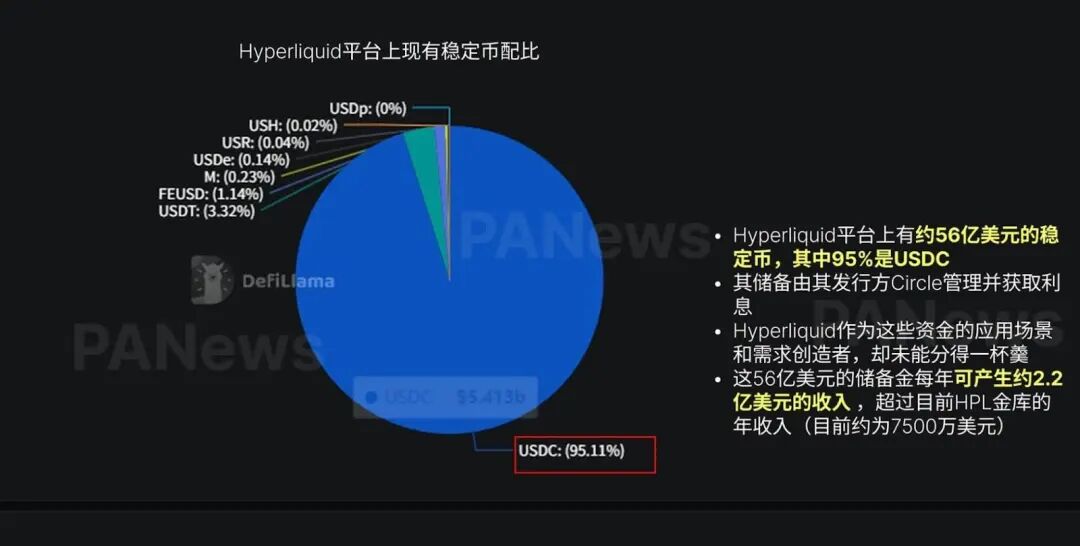
Since its inception, M0 has been selected by MetaMask, Noble, KAST, PLAYTRON, Accumulation, USD.AI, USDHL and other projects to issue stablecoins for various purposes. Recently, the total circulation of M0-based stablecoins surpassed $300 million, an increase of 215% since the beginning of 2025. Similar to the trend of stablecoin issuers integrating vertically into the underlying blockchain infrastructure, application chains that now require creative scenarios are also beginning vertical integration at the stablecoin issuance level, with a view to establishing deeper bonds at the ecological level. On Friday, Hyperliquid posted big news on Discord: it plans to launch the native stablecoin USDH in its HyperEVM ecosystem and select the issuer through on-chain voting and public tenders. In the week that followed, different stablecoin issuers submitted tenders one after another, and the final winning bidder will be decided by a majority vote of $HYPE stakers. To highlight the nature of decentralized governance, although Hyperliquid Foundation holds a large amount of $HYPE stakes, it chose to abstain and leave decision-making power entirely to the community. Hyperliquid's motivation for launching USDH is straightforward: the platform is now settledApproximately $5.6 billion in stablecoin assets, of which95% to USDC. The reserves of this portion of the capital are managed by the issuer Circle and interest is earned, yet Hyperliquid, the creator of application scenarios and requirements, is unable to share the revenue. If this $5.6 billion of stock capital can be replaced by USDH, it is expected to generate interest income of more than $220 million per year based on treasury bond interest rates, far exceeding the platform's current HLP annual revenue (about $75 million). This additional revenue will be used to repurchase and distribute $HYPE to feed back the ecosystem.
▲ Source: PA News
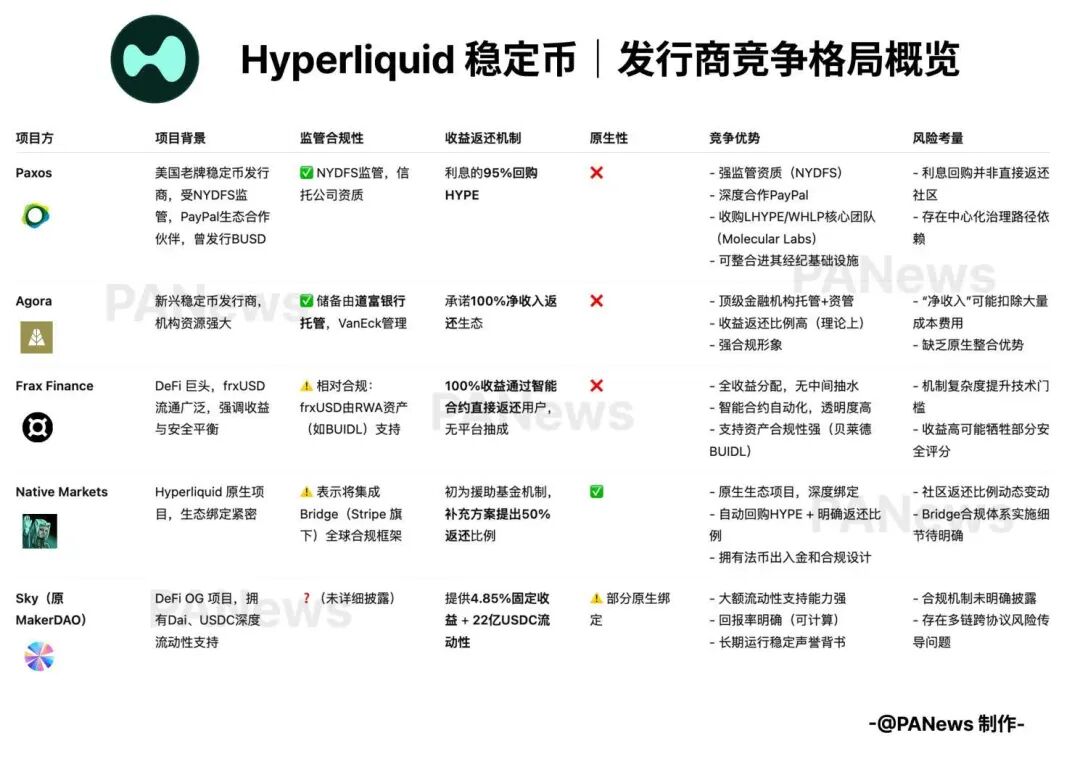
Among the many bid proposals, the Hyperliquid native project Native Markets proposal won. The relevant details can be found here: https://www.theblock.co/post/370570/native-markets-team-wins-hyperliquid-usdh-stablecoin-bid-eyes-test-phase-within-days
▲ Source: PA News
In addition to the importance of blockchain and stablecoins, we can also clearly see the key role of on/off ramps (deposit and withdrawal channels between fiat and crypto assets) on the user experience. Whether users can smoothly and inexpensively exchange fiat for stablecoins or other cryptographic assets often directly determines whether the entire application can achieve real large-scale adoption.
IOSG proactively invested in Transak five years ago, the world's leading on/off ramp service provider. Transak is committed to providing seamless fiat currency entry and exit channels for wallets, exchanges, and payment applications, supporting users in more than 150 countries and regions. Recently, in the latest round of funding, Transak received $16 million in funding led by Tether (USDT parent company) and IDG. In addition to Transak, IOSG has also invested in a Latin American fiat and cryptocurrency deposit and withdrawal project, Kravata, to provide B2B APIs to enterprise customers and B2B2 APIs that can be integrated into third-party applications. As of Q2 2025, there are over 90 customers worldwide, operating in three countries. This move not only proves the market's long-term optimism about on/off ramp tracks, but also once again confirms IOSG's accurate judgment on the value of industry infrastructure in the early investment stage. Predictably, as stablecoins and blockchain payments gradually move into the mainstream, on/off ramp infrastructure like Transak will become a key hub for users to enter the crypto world and a bridge for stablecoins to integrate into the global payment system.
A racetrack with PMF

Once the payment infrastructure is improved, cross-border payments will become the most direct and obvious breakthrough. The scale of global cross-border capital flows is as high as 150 trillion US dollars every year, and the current system is oftenIt takes 3 days, and the payment is about 3%The cost is, and it has gone through multiple layers of intermediaries. If you switch to a stablecoin based on an efficient “track,” the whole process only takes 3 seconds, the fee is as low as 0.01%, and direct peer-to-peer settlement is possible. With the efficiency gap so wide, frustration is almost an inevitable trend.
B2B corporate cross-border payments are currently a perfect product market fit (PMF) in the cryptocurrency sector. Today, 40% of blockchain fees come from transferring USDT, and hundreds of millions of emerging market users use it every day to combat depreciation and inflation in their own currencies. Aside from infrastructure and speculative consumption cycles, payments (especially B2B cross-border payments) are the most likely areas in the crypto reality to complement SWIFT. The real winners will probably not be new chains or general-purpose stablecoin issuers,Instead, orchestrators (Orchestrators) that are licensed and have distribution capabilities in key cross-border corridors。
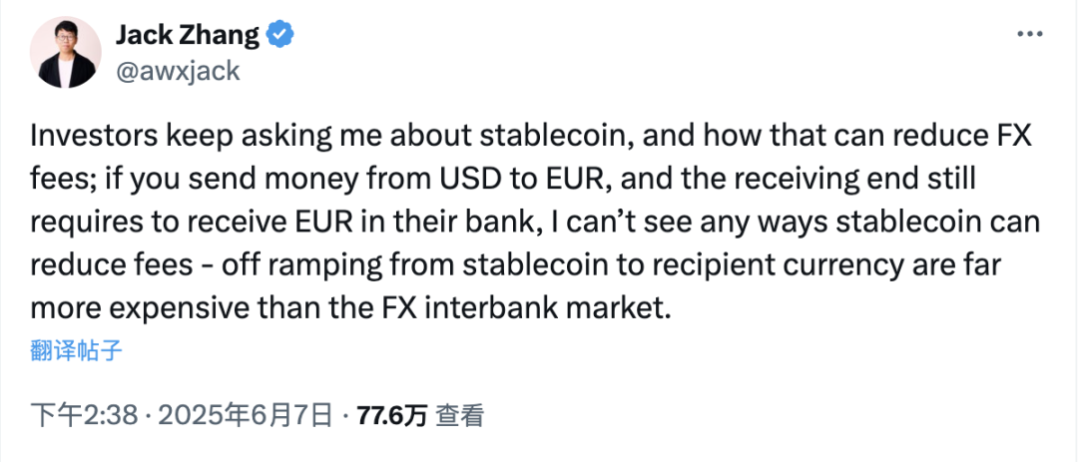
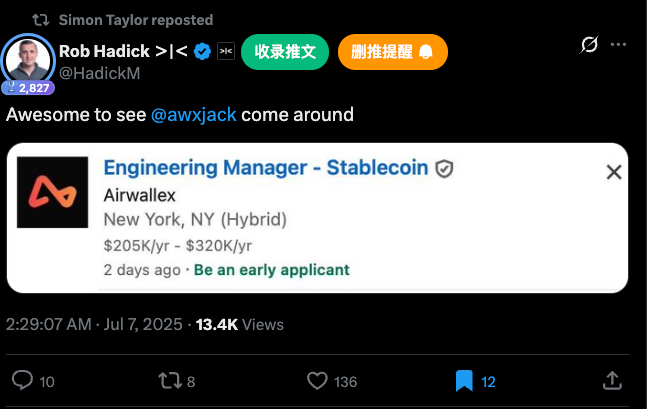
This is why we saw earlier that Airwallex, a Web2 enterprise cross-border transfer giant, actually felt the threat of a stablecoin cross-border payment company and made defensive remarks on Twitter, but it did publicly recruit stablecoin developers on its recruitment website. The “Payment Orchestration Layer” (Payment Orchestration Layer) means integrating fiat and stablecoins, various payment methods, channels, and processing services to provide an end-to-end payment/settlement solution. Highlight the ability to be “stablecoin compatible”: it not only supports fiat currency receiving/payment, but also supports stablecoin receiving/cross-border transfers/stablecoin exchange back to fiat currency, etc. Cross-border payments often form a “fiat → stablecoin → fiat” path, that is, local fiat currency is exchanged for stablecoins → international transfer/settlement using stablecoins → the receiving end is then exchanged for local fiat. The role of the payment orchestration layer is to optimize this path, reduce friction, save time and cost, and improve efficiency. Although traditional large companies such as Airwallex and Stripe are also actively deploying stablecoin payments, in comparison, startups tend to have an advantage in terms of speed of innovation and execution. For example, Align focuses on the cross-border remittance needs of large multinational companies, and ArrivalX focuses on overseas payment scenarios for Chinese merchants. The author believes that what is more likely to be formed in the future isThe region-centered solution is not a single global unified model, similar to the competitive pattern on the on/off ramp side. Because every region is greatly affected by local regulations, laws, and banking/financial infrastructure. In the context of the rapid development of stablecoin payments,If small and medium-sized startups can achieve the “local + regional + orchestration layer” position, there is still plenty of room in specific payment corridors.In addition to the core advantagesIn addition to the license, it also provides payment/settlement services with stable coin-fiat two-way circulation and strong compatibilityIt's a key point of differentiation,Compliance and risk controlIt will be the key to determining long-term success.
▲ Source: ASXN https://stablecoins.asxn.xyz/payments-market-map
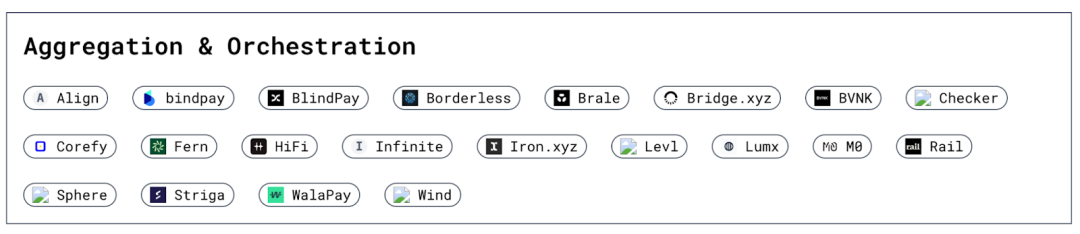
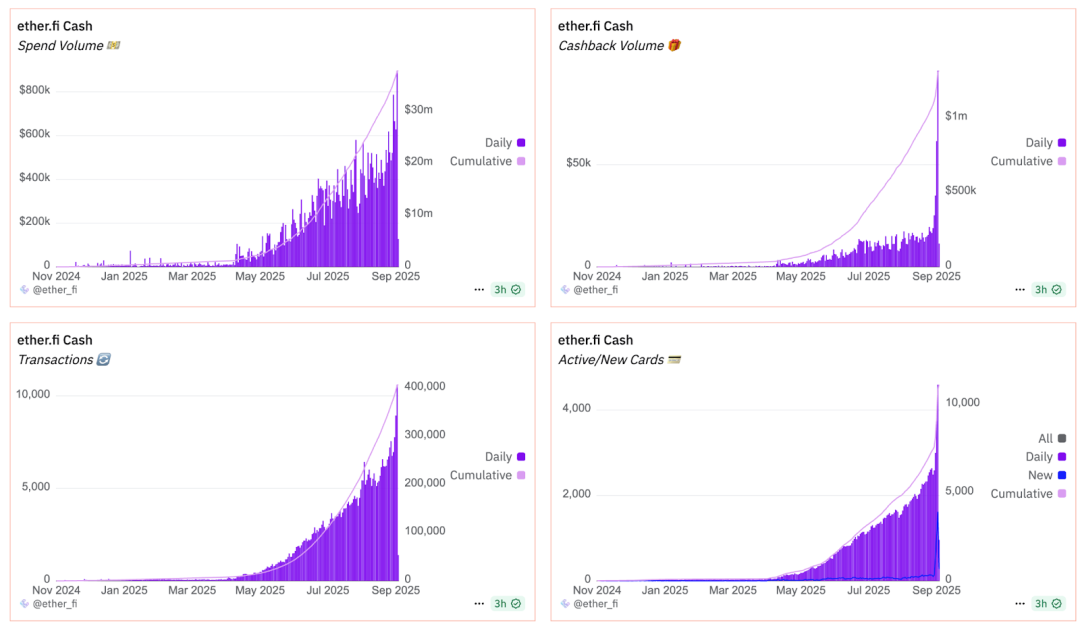
Additionally, in many articles on the market about payments, we can see that Aggregation and Orchestration are included in the same quadrant, but we think there is a difference between the aggregation layer and the orchestration layer in terms of capturing the value of B2B transactions. The aggregation layer, since it has no license, can be understood as a wrapper (packaging layer) of the Orchestration layer. Although it can be connected to more regional platforms, it is limited by its profit sharing side in terms of price negotiation. This can be seen as a business model similar to Circle — the larger the scale, the harder it is to achieve high profits. In addition to being the underlying services of the B2B aggregation layer, these orchestrators also further support the application side of the entire payment network, which can be broken down into To-C applications and To-B applications. Currently, To-C applications mainly focus on P2P payment applications, such as Sling, and neobanks that provide consumers with more stablecoin interest-bearing scenarios, such as Infini and Yuzu.Money, and stablecoin cards for stablecoin consumers to solve their problems in using them in the real world. IOSG actually had a presence on the To C app for a long time and invested in Ether.fi. An income-generating payment superapp. Its card transaction volume, cashback volume, transaction number, and card issuance volume all reached their highest values in September.
▲ Source: Ether.fi Dune Dashboard
On-chain capital is clearly profit-seeking: about 45% of DeFi's TVL (about $56 billion) is chasing revenue, mainly distributed in protocols such as Aave, Morpho, and Spark. The market capitalization of yield-based stablecoins is growing rapidly, soaring from $1.5 billion to $11 billion, accounting for 4-4.5% of the entire stablecoin market ($255 billion). Projects surrounding DeFi earnings continue to receive attention, including Ethena, Pendle, Aave, Spark, Syrup, etc.
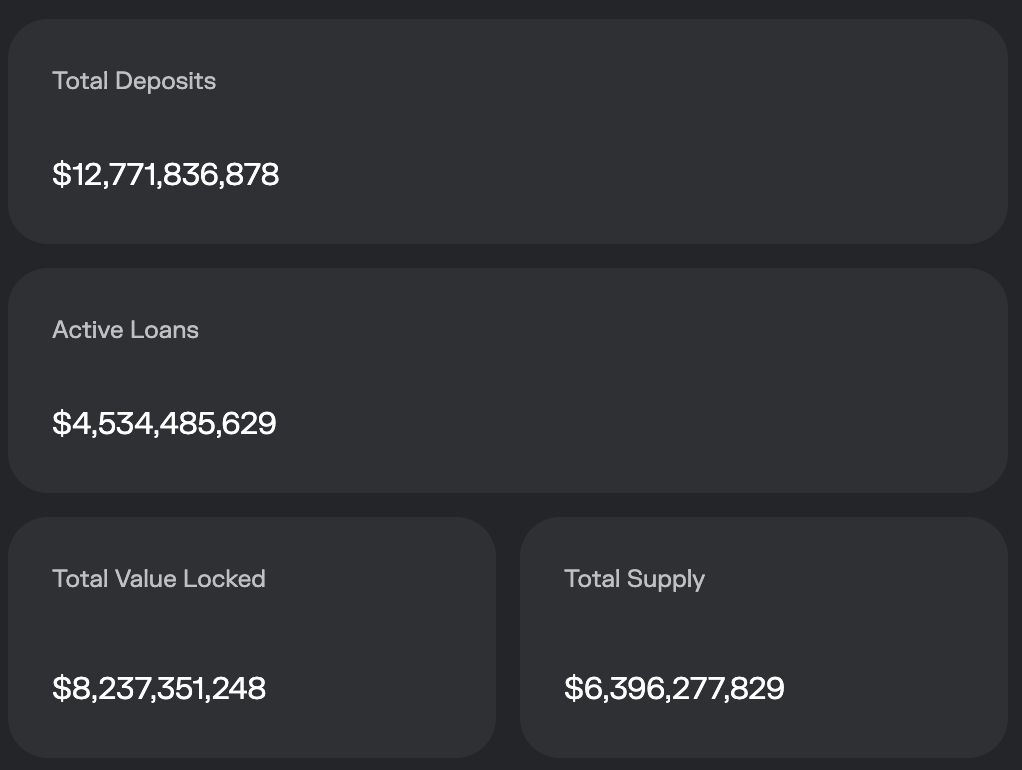
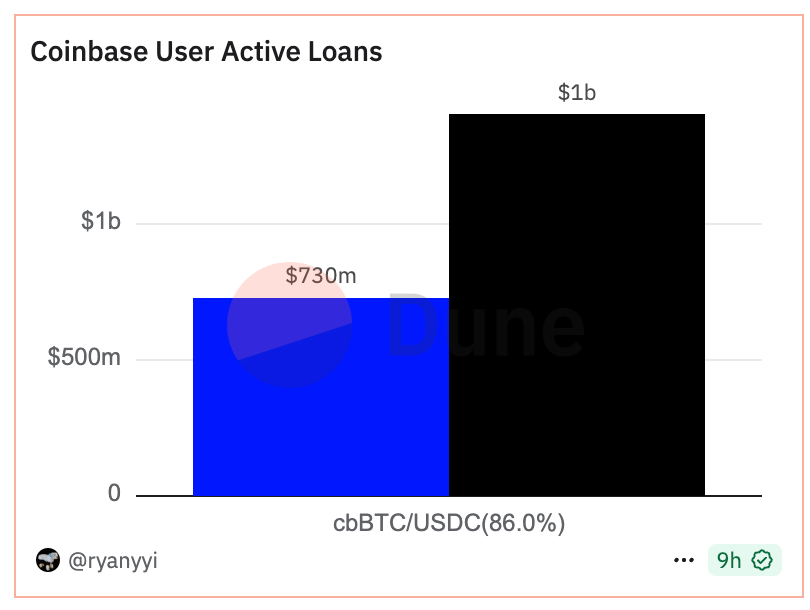
As the number of DeFi protocols continued to increase, so did the complexity of operations, and the user experience became less friendly. To ease this pain point, Coinbase officially integrated Morpho into its exchange and launched Coinbase Onchain Borrow, a lending product that combines CeFi and DeFi. Users only need to complete collateral and borrow with one click on the front end, and the bottom layer is supported by Coinbase Smart Wallet. The entire process completely abstracts the user's wallet creation and interaction with Morpho, greatly simplifying the user experience. Coinbase Onchain Borrow provided Morpho with $1.4 billion in deposits and $73 billion in active loans, accounting for 11% and 16% of Morpho, respectively. This has also helped Morpho's total deposits reach $12.7 billion, and active loans have now reached $4.5 billion.
▲ Source: https://app.morpho.org/ethereum/explore https://dune.com/ryanyyi/coinbase-onchain-loans
Investment logic based on the same simplified user experience on the chain, we chose to invest in Ether.fi early on. It initially focused on ETH staking earnings and gradually expanded to more complex third-party Vault strategies, drastically lowering the threshold for stablecoin users in DeFi operations, making it easy for users to obtain profits, and even launched DeFi credit cards, which allow users to use future interest to repay credit card loans and achieve “Buy Now, Pay Never” in the true sense of the word. The reason why stablecoin digital banks and stablecoin credit cards have great potential is that they move credit creation (credit creation) directly onto the chain, fundamentally weakening or even replacing the intermediary position of traditional banks to some extent. Under the traditional model, a bank's core income comes from the spread between deposits and loans, which is the foundation of the entire system. But this model also gives banks excessive “screening power”: on the one hand, they will rule out a large number of inaccessible placesDeposit systemUnbanked people (unbanked accounts); on the other hand, they will also reject those who don't meetBorrowing standardsbusinesses and individuals (those who can't pay for loans or credit cards). By contrast, the stablecoin system completely reshaped this logic. Relying on the programmability, atomic settlement, and immutability of blockchain, lenders and borrowers can connect directly on the chain and are no longer subject to traditional banks' entry standards, thus rewriting how payments and credit participate. Based on this, the new stablecoin digital bank has built an almost risk-free lending product based on a loan pool through further encapsulation of stablecoins, cryptocurrencies, and DeFi lending agreements, combined with the trustless model of excessive collateral. This model can be expressed not only by Coinbase Onchain Borrow, a new bank that provides loans, but also as a stablecoin credit card similar to Ether.fi. In terms of commercializing To-B, we have also observed some new opportunities. For example, it helps online and offline merchants directly connect to stablecoin payments, thereby avoiding interchange fees from receiving banking institutions. At the same time, more convenient invoicing (Invoicing) and global payout (Global Payout) platforms for corporate customers also have broad potential for development. However, in particular, this kind of emphasisEnterprise-side user experience products may face some competition in the future in the process of gradual vertical integration of payment orchestration layers.
A new paradigm of AI-driven on-chain payments

In the future, in TOB applications, another very interesting potential area is AI Agents as payment application customers. Currently, with the advent of automated AI Agent trading and yield farming applications, such as Theoriq, Giza, and Almanak, we can see the emergence of more fully automated AI Agents in the future, and they will be searching for new yields 24/7. At the same time, these automated AI agents need a wallet to buy the data, computing power, and even human services they need.
The development of AI Agent requires new on-chain infrastructure, which could also be a potential investment opportunity.The traditional payment system is slow in settlement, has a high chargeback rate, and often relies on labor. Obviously, it is not suitable for autonomous agents. To this end, Google launched the AP2 protocol and released A2A x402 with Coinbase. If MCP is the “tentacle” and A2A is the “language,” then AP2 and x402 are the “last mile” for AI to fully automate — autonomous payments and value exchange. AP2's mission is to make AI trustworthy, controllable, and traceable in financial transactions. It doesn't replace Visa or Mastercard, but rather builds a generic layer of trust on top of it. Through an authorization mechanism based on verifiable credentials (Verifiable Credentials), AI can hold cryptographically signed digital authorizations to ensure that transactions are secure and auditable. Its Authorization (Power of Attorney) mechanism has two modes: Real-time authorization: After the AI finds the product, the user needs to confirm it on the spot. Delegated authorization: Users can set complex conditions in advance (such as “hotels within $200”), and AI will only automatically execute when the conditions are triggered. All transactions form an immutable chain of evidence and are secured and auditable by verifiable credentials (Verifiable Credentials) to avoid “black box” payments. Google's strategy is clear: Unite financial and crypto giants, not directly issue or clear coins, but define “trust” rules. The most notable of these is A2A x402, which is an extension component created by Google specifically for crypto payments. It collaborates deeply with Coinbase and the Ethereum Foundation to enable AI to seamlessly handle on-chain assets such as stablecoins and ETH to support native Web3 payments. In a sense, Google's AP2 wants to introduce AI into the existing financial system, while Coinbase and the Ethereum Foundation's A2A x402 extension wants to create a new crypto-native economic environment for AI. Google's A2A standard allows AI agents for different projects to communicate with each other, but only in a “environment of mutual trust.” To this end, ERC-8004 launched by the Ethereum Foundation adds a layer of trust, similar to a digital passport system, which allows agents to securely discover, verify, and interact with unknown counterparties on Ethereum or other L2. The name x402 derives from the HTTP status code “402 Payment Required”. Its idea is to integrate payments into internet communication: when the AI calls the API, the server returns a “402 bill”, and the AI can use stablecoins on the chain to complete payments and obtain services instantly. This not only enables automated, high-frequency transactions between machines, but also enables AI services to be billed in detail according to request, length of time, or computing power, which is difficult to achieve with traditional payments.
▲ Source: Google
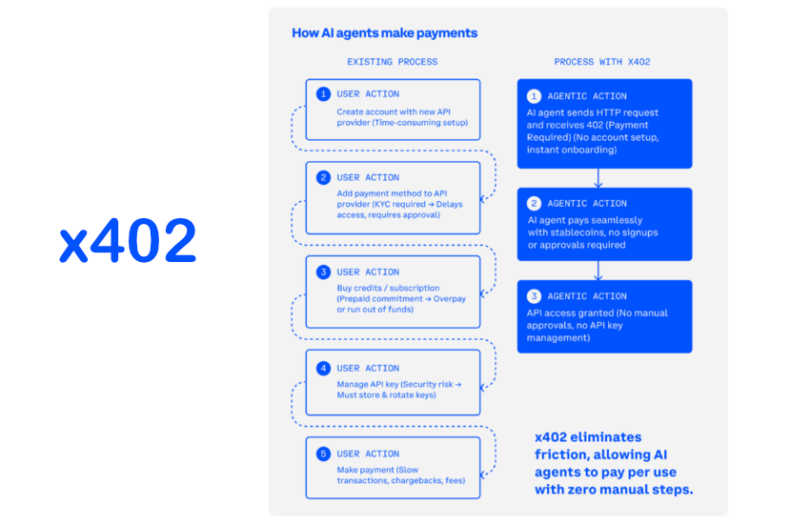
Onchain Agentic Commerce (Onchain Agentic Commerce) is taking shape at an accelerated pace, driven by the dual innovation of stablecoin payments and AI agents. Currently, emerging companies such as Skyfire and Crossmint have also begun to abstract AP2 and x402 standards into SDKs and APIs that are easy for developers to call. The ChaosChain team has taken the lead in completing a prototype, combining AP2 with Ethereum's latest ERC-8004 “untrusted agent” standard, and this is just the beginning. The Ethereum DaI team, built and led by Davide Crapis, is furthering this process. As the underlying layer for future AI agent collaboration, Ethereum is expected to help us move from the current highly centralized AI system to a censorship-resistant and truly decentralized future. At that time, from payment chains and stablecoin settlement to AI-driven value innovation, this link will give birth to the emergence of more interesting superapps, SuperApps. References: Combining the Ultimate Stablecoin Credit Card - Doğan Alpaslan, Cyber Fund (https://cyber.fund/content/stablecoincreditcard) Stablecoin On-Chain Payments, Clearing Web2 Thinking - Grandpa Zoe (https://x.com/zuoyeweb3/status/1969367029011644804) The Final Battle for AI Payments: Google, Coinbase, and Stripe - Luke, Marsbit (https://news.marsbit.co/20250919092805091063.html?utm_source=substack&utm_medium=email)
Twitter:https://twitter.com/BitpushNewsCN
Compare the TG exchange group:https://t.me/BitPushCommunity
Compare TG subscriptions:https://t.me/bitpush
