


From explosion to concern: Interpreting Hyperliquid's successes and challenges
Author | Juyo-kun
Original title: Opinion: Talk about Hyperliquid's path to success and future concerns
The author's personal opinion does not represent what Wu said. The content of this article does not constitute any investment and financial advice. Readers are requested to strictly abide by local laws and regulations.
I. Research Background
Recently, the author has basically studied all the Perps (perpetual trading platforms) on the market. The 5-fold growth of the Hype market once again proved that when I first studied it last year, my judgment still ignored its core values.
Also, recently Aster, Antex, dYDxV4, and even Grandpa Sun left the field, and SunPerps, which shook the track, have all gradually ushered in an explosive period on the Perps track.
In addition, various mainstream exchanges are scrambling to launch Hype and the above sustainable trading capabilities. Yesterday, it was once again reported that Metamask has become another large-scale wallet platform after Phantom. It plans to connect to Hyper's sustainability, and circle will also become its validator, breaking down its core decentralization concerns. Hyperliquid itself is also struggling to continuously improve its openness, especially the gradual introduction of HyperEVM and Hip2/3/4.
1. 3 elements of the new track
At this point, Perps can basically be described as having all 3 key elements of the new track.
In fact, if we look back at any huge circuit wave in history, we can see that it is often a new leading platform, a new wealth opportunity, and a new narrative background. Trend aggregation brings peaks, while subsequent platforms' airdrop strategies and gradually developing platform complexity reduce the level of freshness perceived by users, and eventually gradually bring about valleys.
This process has actually gone through many waves. Typical scenarios are as follows:
2. Explaining the key steps in Hyperliquid's development
2.1 Development Status
Objectively speaking, until now, the system is still in a relatively centralized state. Theoretically, it has the ability to unplug the network cable and change the state. Furthermore, hacker funds are also on top. This is a big sticking point for many exchanges in terms of compliance and popularity access. However, his data is just too contradictory.
Hyperliquid currently has around 10,000 to 20,000 daily active users, and the total number of users is around 600,000. Of these, 20,000 to 30,000 core users contributed nearly $1 billion in revenue, a significant portion of which came from the US.
Over $3 trillion has been accumulated in trading volume, and the average daily trading volume is already close to $7 billion.
Currently, Perps trading is supported for over 100 assets.
Looking at his data this way, I can only say that it's really good, and they don't seem to have a large number of users, but they are all the people who can generate the most money.
2.2 Major updates and interpretations
The specific timeline is as follows:
How do you understand this series of updates?
First, compared to last year, Hyperliquid has now opened up core order processing capabilities.
HyperEVM
In particular, the dual-chain architecture based on EVM has outrageous logic. Under the premise that HyperCore is not open (not deployable), a large number of pre-compiled contracts are added to HyperCore through HyperEVM. Theoretically, it has access foundations such as wallets (phantom, metamask) and exchanges. Theoretically, it can implement EVM transaction operations and the ability to execute Core's order asset trading capabilities.
There is an official picture showing HyperEVM's position in the system.
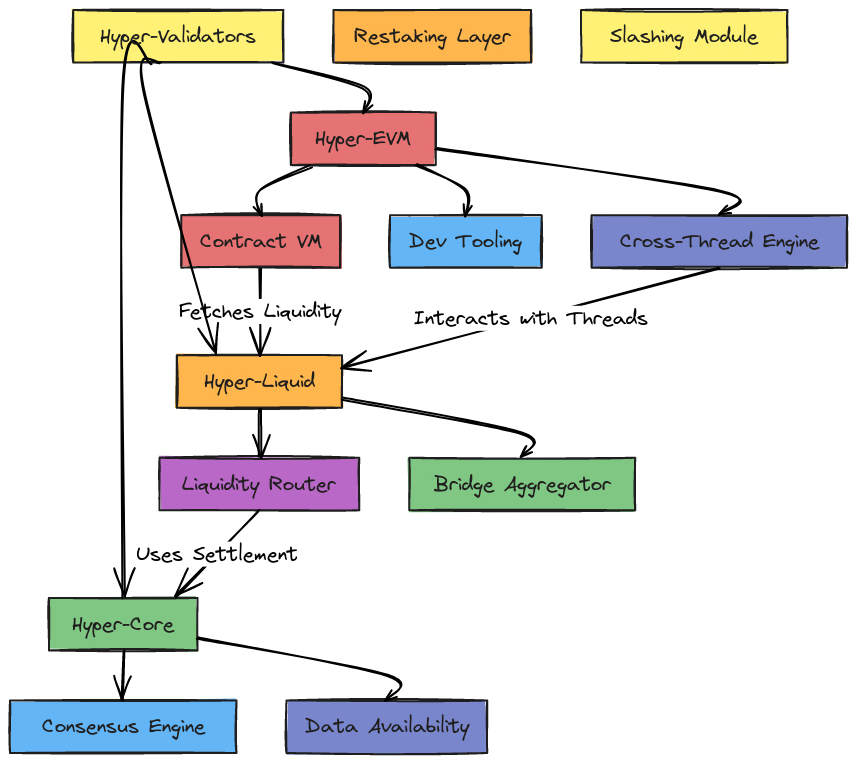
As can be seen, HyperCore and HyperEVM writes and reads are uniformly confirmed by HyperBFT. The specific mechanism of the verifier's confirmation information mechanism has not been disclosed, and there is no cross-chain bridge or time-delay synchronization.
The dynamic that can be seen through on-chain transactions is that HyperEVM can affect HyperCore, execute writes through system contracts (0x333... 3333, coreWriter.sendAction (...)), and can perform order placement, settlement, and loan operations. The state (of the previous block) reported by HyperCore can be read by HyperEVM's smart contract.
The essence of the information is received by EVM's system contract to generate corresponding receipts or events, and records. Also, in EVM, you can call perp positions or oracle price (oraclePx) for pre-compiled contracts (0x000... 0800).
Second, the launch of Hip2 and Hip3 is changing Hyperliquid's platform positioning.
hyperliquidity
It's an on-chain liquidity mechanism built into Hypercore.
It automatically places buy and sell orders based on the token's current price, and can maintain a tight spread of around 0.3% without human intervention.
This mechanism, without an AMM or a third-party robot, is built into block logic to achieve native-level fluidity insertion operations.
For example, when the PURR/USDC spot market was launched, Hyperliquidity immediately issued initial deep seed transactions, so real transactions can be carried out before normal user liquidity arrives.
Builder core
This is a very future-valuable mechanism that allows Defi builders (developers, quantification teams, aggregators) to charge additional processing fees as service revenue when placing orders on behalf of users. The application scenario of this set is very clear. It is an act to liberalize profits and welcome ecological co-construction.
· Quantitative strategy hosting. The quantification team helps users place perp position orders and collect management fees through builder fees to form a “revenue share+builder fee” compound profit model.
The initial launch has already brought dividend revenue of more than 10 million US dollars to some projects. It can be seen that Hyper's capital has been deeply settled to the platform level.
In fact, opening up depth is not only about Hyper. From the previous Uniswapv4, they actually wanted to do it through hooks, but v4 hasn't improved much, and most users are still used to it in v2 and v3.
This is probably due to the low historical burden and the strong influence of centralized decision-making.
III. Summary review
1. pros
Hyperliquid's primary advantage is that his early products were actually very strong, because he focused on 2 user pain points:
Second is the team background itself. His biggest advantage here is that there are few people, and communication gaps, wear, and efficiency are very high. Under the overall specifications of about a dozen people, eliminating 3-4 product operation BDs and deducting the front and back ends is equivalent to only 3-4 people being able to complete a 20 Wtps high performance chain.
Compared to how many blockchain teams from big traditional manufacturers, they can put together a bunch of palace fighting dramas, I don't know how many.
In the background, his own market maker foundation, which began in 2020, actually brought great initial depth. In many details, he can also feel that his matching logic and other order book systems do not simply settle gradually over time and by amount. However, the data is insufficient, so I'll add it later when doing multiple Perps comparative analysis.
Then there's the trend. A typical project has to adapt to the market, but when the popularity of a platform reaches its peak, the market can adapt to it. Now Hyperliquid is that kind of treatment.
On the one hand, it stems from the openness in the update above. First, there is room for all kinds of ecosystems to enter. Compared to many other platforms in the past, I often think that doing the full part of the work, taking the full dividends, and criticizing Opensea by name can also toss out a set of mandatory royalties, so that the market can only follow the lead. Each time it has a fixed high cost, interferes with the flow of products, affects the actual pricing in the market, and eventually becomes an heirloom.
And in Hype, he opened EVM and all kinds of dex peps APIs, so I soon saw a bunch of derivatives on the market.
Hyperliquid's generosity was also evident in the airdrop; he was unable to follow the compliance route from the beginning.
Therefore, he won't try to embrace so-called listing expectations; that will naturally liberalize earnings. Hype is then staked back through the HLP mechanism to make profits again, decentralize the official tokens, and reap the rare decentralized evaluation and word of mouth in the market.
His openness has led to market crowding. Phantom first accesses his perps ability from the perspective of a decentralized wallet. This is actually not very difficult; it is mainly a large amount of adaptation and development costs. Recently, it was rumored that Metamask is also being added.
From this, we can also see that those decentralized wallets that haven't been updated for more than half a year now know how to capture the story of the year after missing the inscription.
Finally, he also promoted the introduction of giants such as Circle as validators to bring decentralized security and fill the decentralized gap. Such a highly compliant CEX platform also has an opportunity to access it.
2. shortcomings
After the most difficult phase of momentum has passed, that is the compliance issue. Even pure DEXs such as Uniswap are embracing compliance, not to mention that users are also starting businesses with Hyperliquid in Europe and the US? Once characterized as non-compliant or otherwise serious, all existing CEX/wallet partnerships will be cut off, and former allies will also part ways.
Furthermore, the subsequent development of this system will also face the problem of development complexity. Most projects are more complicated as they are written, making it difficult to cut out the complicated and keep it simple, returning to the first principle, and finally leaving Xiaobai users without understanding and losing fresh blood.
Finally, there is a single point of risk. Once accessed by multiple globalized platforms, the 20 Wtps, which is now known, will extend a large amount of inconsistent information in the middle, and will also bring tremendous pressure to the core HyperCore module. This high-performance construction will not happen overnight. The official background of more market makers may not be able to handle traffic, if there are multiple liquidation issues due to downtime (similar to the previous shortfall incident in March).
The word-of-mouth that has been so painstakingly built up is inherently very weak.
Twitter:https://twitter.com/BitpushNewsCN
Compare the TG exchange group:https://t.me/BitPushCommunity
Compare TG subscriptions:https://t.me/bitpush
