


New Digital Asset Bureau: CeDeFi x RWA, full analysis of 2026 market making strategies

In the 2025-2026 global financial landscape, the digital asset market has evolved from an early retail-driven speculative field to a highly specialized, institutionalized, and technology-intensive complex ecosystem. Market Makers (Market Makers), as core participants in this ecosystem, not only perform the basic functions of providing liquidity, narrowing spreads, and maintaining price stability, but also play a decisive role in promoting technological integration and institutional innovation between centralized exchanges (CEX) and decentralized exchanges (DEX). The current market making environment is at a critical turning point. The extreme optimization of high-frequency trading (HFT) technology, the widespread adoption of programmable liquidity protocols, and the formal implementation of regulatory frameworks such as the European Union's Crypto Asset Market Regulation (MiCA) and the US GENIUS Act have jointly created an operating environment with extremely high compliance requirements.
Chapter I: The underlying technical architecture and performance benchmarks of centralized exchange (CEX) trading
With its high-performance matching engine, microsecond matchmaking delays, and mature fiat deposit and withdrawal channels, centralized exchanges are still the preferred trading venue for institutional investors and high-frequency traders. In the competitive landscape of 2025, the success or failure of CEX market makers will largely depend on their ability to optimize physical infrastructure and system cores to the extreme.
Match engine dynamics with ultra-low latency infrastructure
The matching engine is the core of CEX's technology, and it processes massive order flows according to the principles of price and time priority (Price-Time Priority). In order to gain an edge in competition, market makers must use various means to minimize the “quote to transaction” delay. Physical distance played a decisive role in this process. Professional market makers usually use co-location (co-location) services to place the trading server in the same computer room as the exchange matching engine to eliminate physical delays caused by long-distance optical fiber.
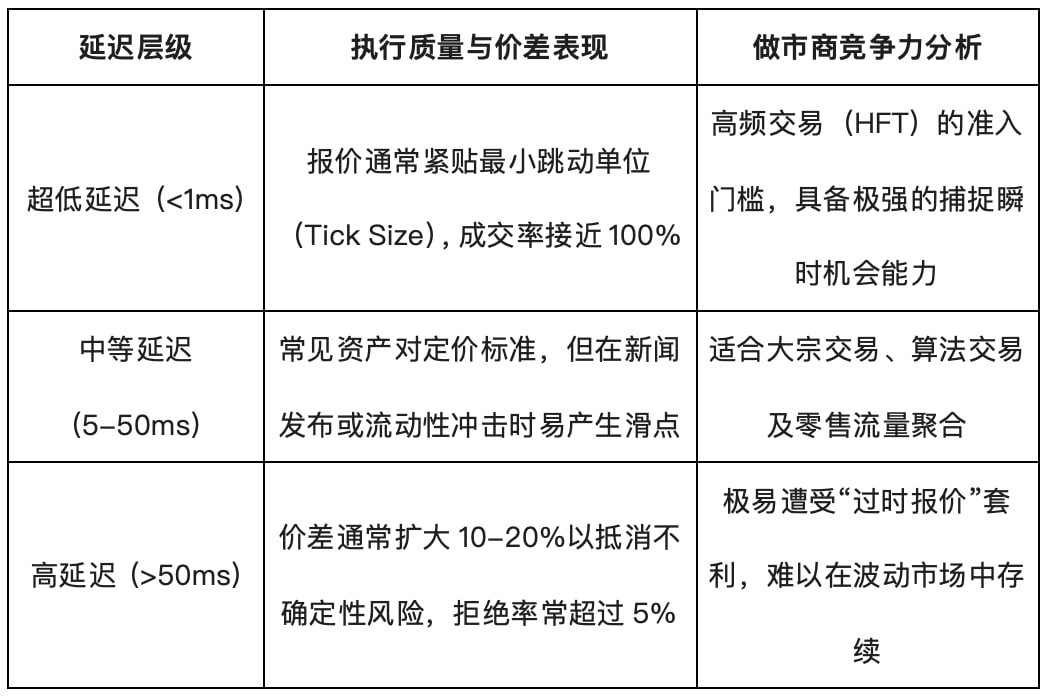
At the software level, market makers widely use Kernel Bypass (Kernel Bypass) technology, which enables market data to be transmitted directly from the network card to the transaction logic layer, skipping the standard protocol stack processing of the operating system, thereby reducing the delay and jitter caused by context switching. At the same time, the design of high-performance matching engines generally follows the “single-writer principle” (single-writer principle), that is, a single thread has order book status, and auxiliary threads such as risk control and market data distribution read data through unlocked ring buffers (Ring Buffers). This architecture ensures that the system remains extremely low in jitter and extremely predictable while processing millions of transactions per second.
Performance Optimization of Cloud Native Marketplace: Taking AWS as an Example
As cloud infrastructure matures, some market makers have begun to build their trading systems in cloud environments such as AWS, which requires a deep understanding of cloud network topology. Benchmark data for 2025 shows that top market makers' “tick-to-trade” (tick-to-trade) delays in the cloud have been optimized to double digits of microseconds.
To achieve this goal, market makers use Cluster Placement Groups (Cluster Placement Groups) to place instances on the same network backbone in the same availability zone, which can reduce P50 latency by approximately 37%. Furthermore, the introduction of hardware packet timestamping (Hardware Packet Timestamping) technology enables market makers to identify blocking points in the network stack, kernel, or application layer with nanosecond accuracy. In terms of protocol selection, financial information exchange (FIX) protocols have completely replaced traditional REST or WebSocket APIs among institutional market makers due to their lower binary processing overhead.
Order book depth and liquidity mirroring strategy
The core goal of CEX marketing is to provide sufficient depth at each price level of the order book to minimize the slippage of large orders. Professional market makers are usually designated as “designated market makers” (DMM) by exchanges and are subject to service level agreements (SLAs), which require maintaining a certain price retention rate and maximum spread bandwidth during periods of fluctuation.
A common strategy is “cross-exchange liquidity mirroring” (Liquidity Mirroring), which provides quotes on a “Maker Exchange” (Maker Exchange) with low liquidity while hedging on a highly liquid “Taker Exchange” (Taker Exchange, such as Binance). This approach ensures that spreads are synchronized across platforms and prevents extreme price fluctuations due to insufficient depth in a single market. Additionally, market makers must monitor Order Book Imbalances (OBI) signals in real time to identify real trading intentions by filtering high-frequency “Flickering Quotes” (Flickering Quotes), so as to narrow down offers without creating excessive inventory risks.
Chapter II: Evolution and Programmability of Decentralized Exchange (DEX) Market-Making Mechanisms
DEX market making has evolved from an early simple automated market maker (AMM) to a highly complex smart contract-based liquidity engine. The successive launches of Uniswap V3 and V4 have completely changed the way capital operates on the chain, enabling market makers to accurately allocate liquidity with extreme efficiency.
The mathematical logic of concentrated liquidity (Concentrated Liquidity)
The centralized liquidity mechanism introduced by Uniswap V3 is a milestone in DEX market-making history. The traditional xy=k model distributes liquidity across the entire price range, causing the vast majority of capital to be idle in trading pairs with minimal price fluctuations, such as stablecoins. Centralized liquidity allows liquidity providers (LPs) to allocate funds within specific price ranges (ticks), thereby simulating a deep distribution similar to a centralized order book.
Mathematically, this mechanism can be viewed as a segmented function where the pool's liquidity k jumps as the current price p crosses a pre-set price point:
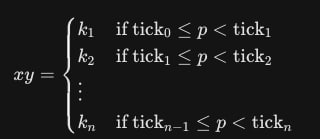
This structure allows LPs to concentrate capital near the middle price where transactions are most likely to occur. For example, in the DAI/USDC pool, LP can concentrate all funds between 0.99 and 1.01, thereby obtaining extremely high commission income with a very small capital occupation. However, this also means that once the price moves out of this range, all LP positions will be converted into a single asset, and no fees will be earned, which requires market makers to have a highly dynamic ability to balance positions.
Uniswap V4: A revolution in Hooks (Hooks) and Singleton (Singleton) architectures
Uniswap V4, which was officially launched in January 2025, brought DEX market-making into the “infinitely programmable” era. V4 abandons the model of deploying separate contracts for each transaction pair and instead uses the Singleton Architecture (Singleton Architecture) to manage all pools in a single contract. This change significantly reduces gas costs for cross-pool transactions through “flash accounting” (Flash Accounting), making multi-step conversion path choices more flexible.
The core innovation of V4 is the “Hooks” system (Hooks). Market makers can now customize trading logic for specific liquidity pools to achieve complex market making goals by inserting custom code at various stages before and after swap (swap).
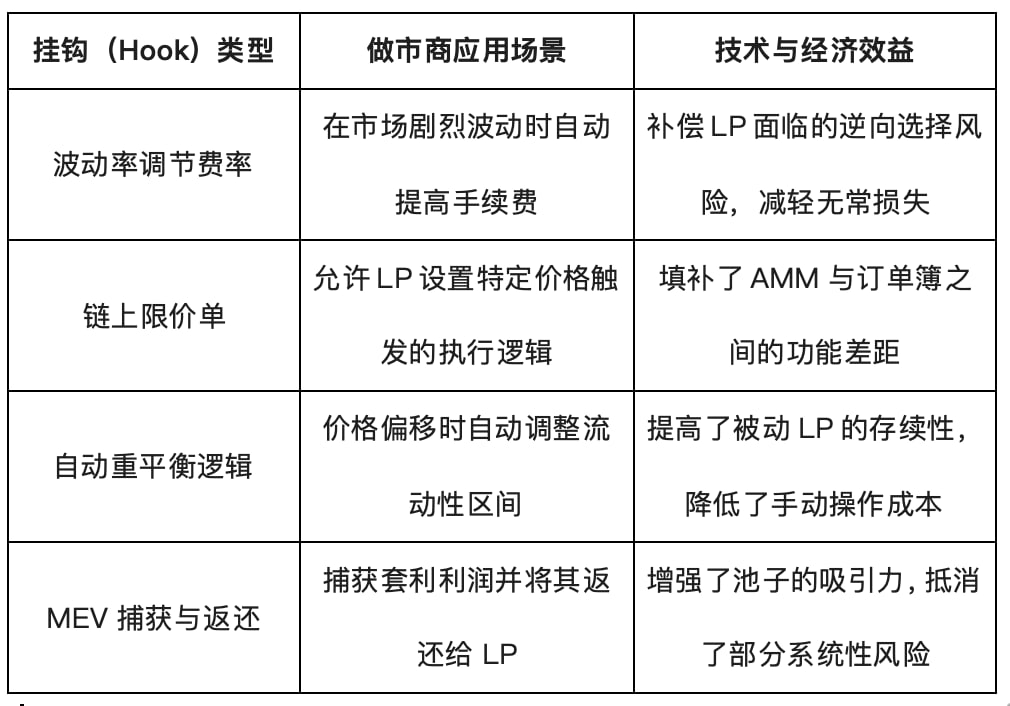
This modular design allows Uniswap to evolve from a simple trading agreement to a developer platform where market makers can design differentiated liquidity strategies based on different asset attributes (such as stablecoins, long-tail assets, or real-world asset RWA).
Intent-based (intent-based) and solver (solver) architectures
In 2025, the on-chain transaction structure underwent a fundamental shift, and the traditional model of direct interaction with AMM is gradually being replaced by an intent-oriented architecture. In intent mode, users no longer specify a specific execution path, but instead post an “intention” describing the ultimate goal (e.g. selling 1 ETH at a price of at least 3000 USDC).
Professional market makers compete as solvers (Solvers) to fill these intentions by finding optimal solutions through private liquidity, CEX inventory, or complex on-chain paths. CoW Protocol and UniswapX are leaders in this field. CoW Protocol uses Fair Combinatorial Batch Auctions (Fair Combinatorial Batch Auctions) to match complementary transaction requirements within a single block, thereby eliminating slippage and providing native MEV protection. This architecture changes the role of a market maker from a simple liquidity provider to an efficient executor of pricing logic.
Chapter III: Quantifying Market Making Strategies: Risk Hedging and Sources of Excess Profit
In a volatile digital asset market, market makers must use highly complex quantitative strategies to hedge against directional risks and capture subtle market inefficiencies.
Delta-Neutral (Delta-Neutral) and Funding Rate Arbitrage
Delta neutrality is the core method for institutional market makers to manage the risk of price fluctuations. The basic principle is to establish a portfolio with zero total exposure, so that the rise or fall in asset prices has little effect on the total value of the portfolio. In the digital asset sector, this usually manifests as a “spot-perpetual contract” hedging strategy.
Market makers buy assets in the spot market and open an equal amount of short positions in the perpetual contract market. Since perpetual contracts have a Funding Rate (Funding Rate) mechanism (designed to anchor the contract price to the spot price), when the market is bullish and perpetual contracts have a premium, long holders are required to pay fees to short holders. In this way, market makers obtain stable cash flow returns while maintaining asset position neutrality.
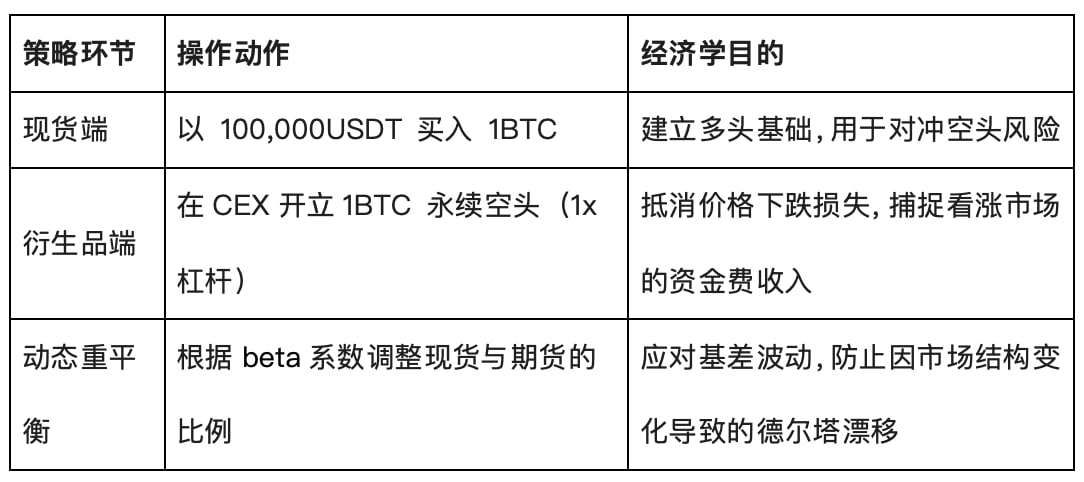
Professional funds such as Liquibit will monitor more than 160 tokens in 2025 and carry out cross-platform arbitrage between up to 10 exchanges, taking advantage of funding rate gaps between exchanges due to differences in cross-margining algorithms.
Cross-chain arbitrage and yield capture
With the explosion of the multi-chain ecosystem, cross-chain arbitrage has become an important source of profit for market makers. Since liquidity is fragmented between different chains (such as Ethereum, Solana, BNB Chain, Avalanche), there is often a brief divergence in the price of the same asset on different chains. Market makers use automated solvers (Solvers) to detect these premiums in millisecond time and execute cross-chain intent transactions to lock in profits. In addition, market makers will also invest idle inventory assets into liquid staking (liquid staking) or restaking (restaking) agreements as a supplement to market-making profits, but this requires an extremely high ability to screen the risk of underlying smart contracts.
Statistical filtering and order book imbalance (OBI) signals
High-frequency market makers use complex statistical models to identify short-term directional pressure in order books. Order book imbalance (OBI) is a key indicator that measures the ratio of pending orders at the Best Bid (Best Bid) and Best Ask (Best Ask). Research shows that significant shifts in OBI usually indicate impending fine-tuning of prices. However, the modern market is full of “strategically cancelled” false orders aimed at misleading the pricing logic of other market makers.
To improve signal quality, market makers use three real-time filtering schemes: based on order lifetime (Order Lifetime), Update Count (Update Count), and Inter-update Delay (Inter-update Delay). By eliminating temporary orders that last less than a few milliseconds, market makers can more accurately capture actual trading pressure, thereby adjusting quotes at optimal prices and reducing losses due to reverse selection (adverse selection).
Chapter 4: The Risk Landscape: Inventory Risk, Adverse Selection, and MEV Challenges
While providing liquidity, market makers are also exposed to multiple dimensions of risk. These risks have very different characteristics in centralized and decentralized environments.
Inverse Selection and Impermanent Loss (Impermanent Loss)
In a DEX environment, the core risk faced by LPs is impermanent loss (IL). When the price of the tokens in the pool deviates from the entry price, arbitrators will extract higher value assets from the pool and inject lower value assets until the pool price is consistent with the fair market price. This phenomenon is essentially a form of reverse selection: LPs are always forced to counteract more informed traders at the wrong time.
According to empirical research in 2025, the profitability of LPs is highly dependent on the volatile nature of assets. Stablecoin trading pairs have minimal IL and steady returns; while highly volatile asset pairs that lack stablecoins anchor often cause LPs to eventually record negative returns due to huge IL.
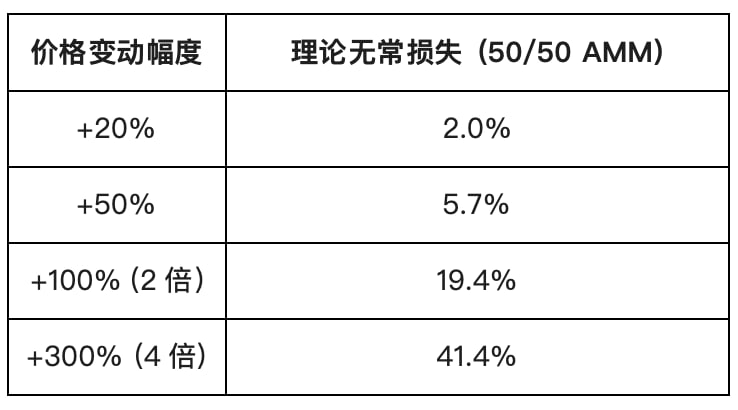
To meet this challenge, new AMM models such as BMM (Better Market Maker) use an algorithm based on the power law invariant function (x^n*y=K, n=4), which aims to preserve 3.98 times more liquidity than traditional constant product models during high fluctuations and reduce IL by about 36%.
Systemic threats to maximum extractable value (MEV)
MEV has become an economic variable that cannot be ignored in the blockchain architecture, and it has had a profound impact on the profit structure of market makers. In 2025, although MEV revenue on the Ethereum mainnet stabilized, extraction methods became more specialized and industrialized.
Sandwich Attacks (Sandwich Attacks) are the main antagonist of market makers. By placing orders before and after the victim's pending transaction, the attackers profit from the price shock generated by the transaction. Statistics show that sandwich attacks account for more than 38% of total MEV transactions, with annualized withdrawals close to $300 million. Furthermore, the JIT Liquidity (JIT Liquidity) strategy also poses a threat to long-term LPs: JIT robots instantly inject massive amounts of liquidity before execution of large transactions to “snipe” fees and withdraw immediately after the transaction is completed, which greatly reduces the profit margin of ordinary market makers.
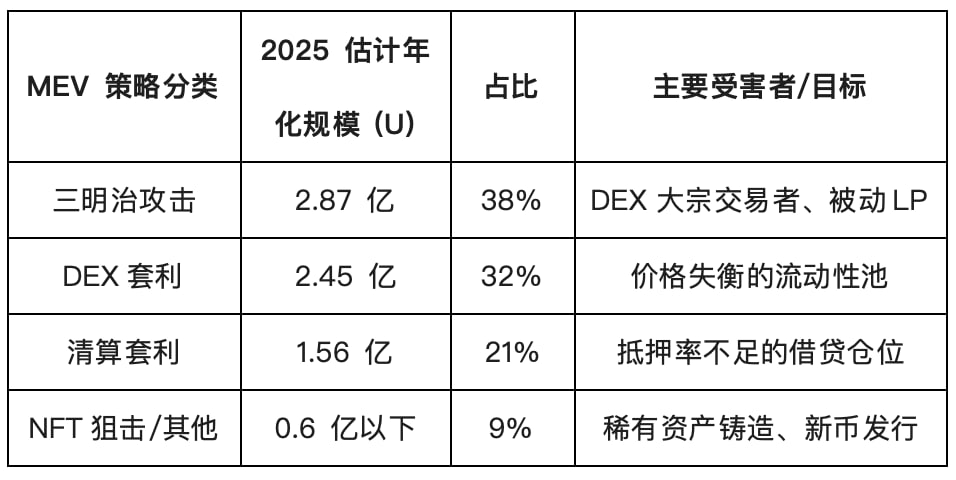
To combat MEV, market makers are increasingly turning to private transaction channels (such as Flashbots Protect), which ensure that transactions are submitted directly to block builders without entering public memory pools. According to the 2025 performance benchmark, Flashbots Protect has a success rate of 98.5% and a response time of only 245 ms, making it one of the most effective MEV protection methods at present.
Chapter V: The Regulatory Landscape: MiCA, GENIUS Act, and the Future of Compliant Market Making
2025 marks a new era of full regulation for the digital asset industry. Regulators' work has moved from a simple “ban” to establishing a clear path to compliance to support innovation and protect investors.
Full implementation of the EU MiCA framework
The European Union's Crypto Asset Market Regulation (MiCA) came into full force in early 2025, establishing a uniform rulebook for all 27 member states. For market makers, MiCA imposes stringent compliance requirements, including standardized format requirements for order book records, strict monitoring of market manipulation, and custodial quarantine regulations for customer assets.
MiCA's strict classification and reserve requirements for stablecoins (aRts and EMTs) have led to a significant “rotation towards compliant tokens” in the European market. Exchanges and service providers are generally prohibited from offering non-compliant stablecoins, which forces market makers to adjust their collateral structures to meet regulatory requirements for liquidity and security.
US GENIUS Act and institutional transformation
In the US, the GENIUS Act passed in July 2025 marked the end of the legislative impasse. The Act created the first federal-level stablecoin regulatory framework, clarifying reserve requirements, auditing standards, and financial integrity guidelines. At the same time, the SEC and CFTC showed a more pro-business attitude, shifting from “regulation through enforcement” to “guidance through rule-making.”
This transformation has opened the door for traditional finance (TradFi) to enter the digital asset market on a large scale. Banking regulators revoked previous policies that restricted banks from providing crypto services and issued detailed guidance on escrow and asset custody. In 2025, major banks will not only begin offering crypto asset transactions, but will also begin issuing their own tokenized deposits and compliant stablecoins.
Global Compliance Trends: Anti-Money Laundering (AML) and Transparency Standards
Globally, implementation of the FATF “Travel Rules” (Travel Rules) has entered the deep-water zone. Most jurisdictions now require crypto exchanges and service providers to share sender and receiver information when making transfers, making digital asset transactions at the same level of transparency as traditional bank transfers. Market makers must now embed compliance checks into every large-scale transaction and be regularly audited for intellectual property blocking, information barriers (information barriers), and internal controls.
Chapter 6: Industry Outlook: Market Evolution and Macro Impacts in 2026
Looking ahead to 2026, the digital asset market will show more obvious “industrialization” and “top-level” characteristics.
CeDeFi: The Ultimate Fusion of Centralization and Decentralization
A major trend in the future is the deep integration of centralized efficiency and decentralized security (CEDeFi). Market makers will continue to use CEX's high-performance execution layer for quick matchmaking, but the settlement layer will use blockchain-based non-custodial models or regulated asset-isolated trust structures (such as Copper's ClearLoop). This hybrid model not only preserves millisecond response times, but also minimizes counterparty credit risk at the exchange level.
Real world assets (RWA) and the tokenization wave
Market-making activities in 2026 will no longer be limited to native digital currencies. With the explosion of RWA (Real-World Assets), tokenized US Treasury bonds, private credit, and commodities such as gold have become the core collateral infrastructure. By the end of 2025, the asset management scale of tokenized treasury bonds had exceeded 8 billion US dollars, and tokenized gold had exceeded 3.5 billion US dollars. The role of market makers in these fields will be more similar to traditional fixed income market makers, responsible for providing term arbitrage, spread arbitrage, and liquidity support across asset classes.
Reduced infrastructure costs and application layer prosperity
As the underlying blockchain scaling scheme (Layer 2, Layer 3) matures and data availability (DA) costs continue to decline, the operating costs of market makers are expected to be further reduced. This will allow liquidity to more effectively penetrate into long-tail assets and emerging application-specific chains (AppChains). Market makers will not only be market participants, but also key infrastructure providers for decentralized financial services. By providing stable quotes and accurate pricing signals, market makers will support a fairer, more transparent, and efficient global digital finance network.
Twitter:https://twitter.com/BitpushNewsCN
Compare the TG exchange group:https://t.me/BitPushCommunity
Compare TG subscriptions:https://t.me/bitpush
