


Agent Economic Platform: A Panoramic Teardown of the Web 4.0 Infrastructure Circuit
summary
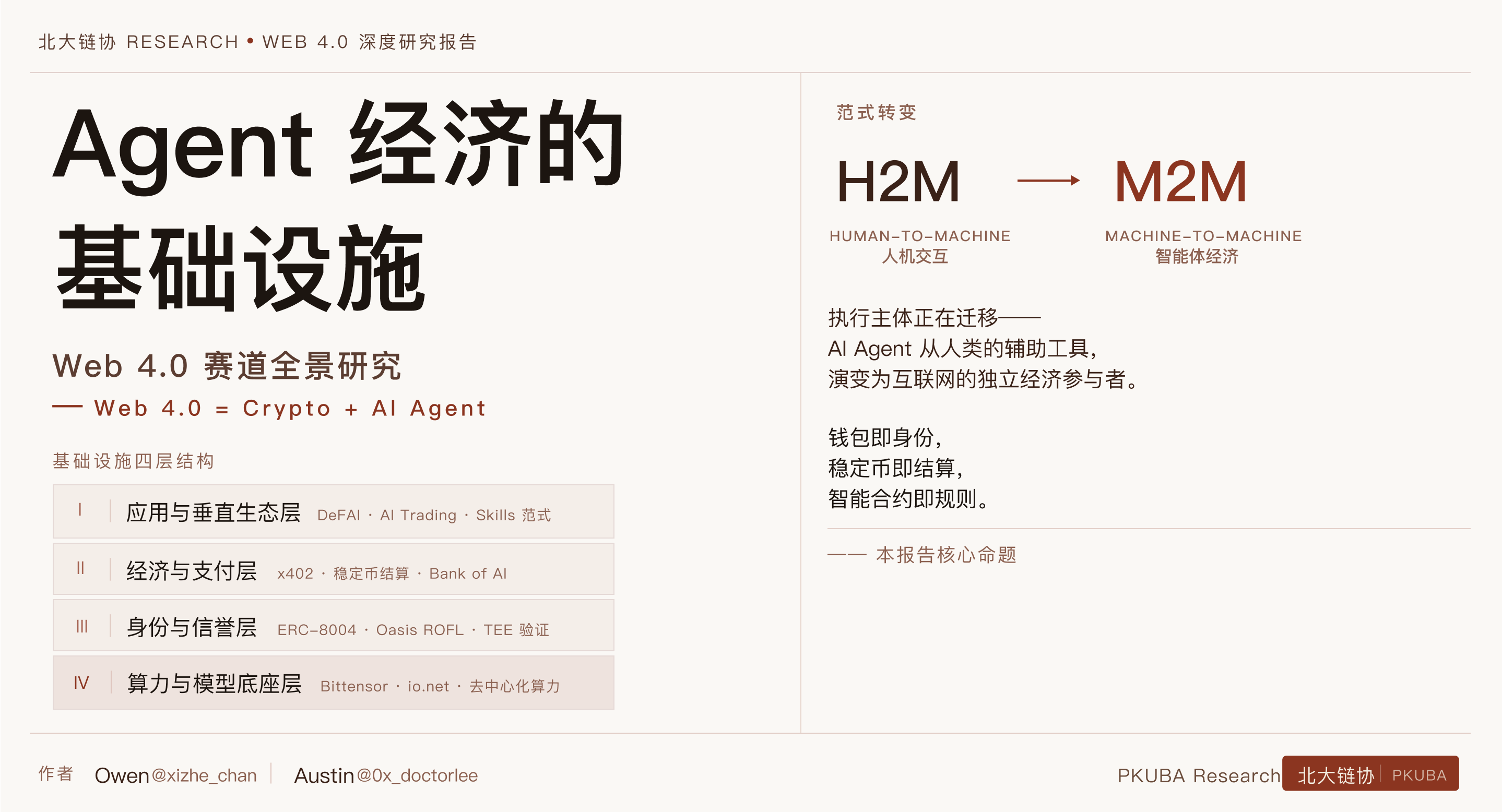
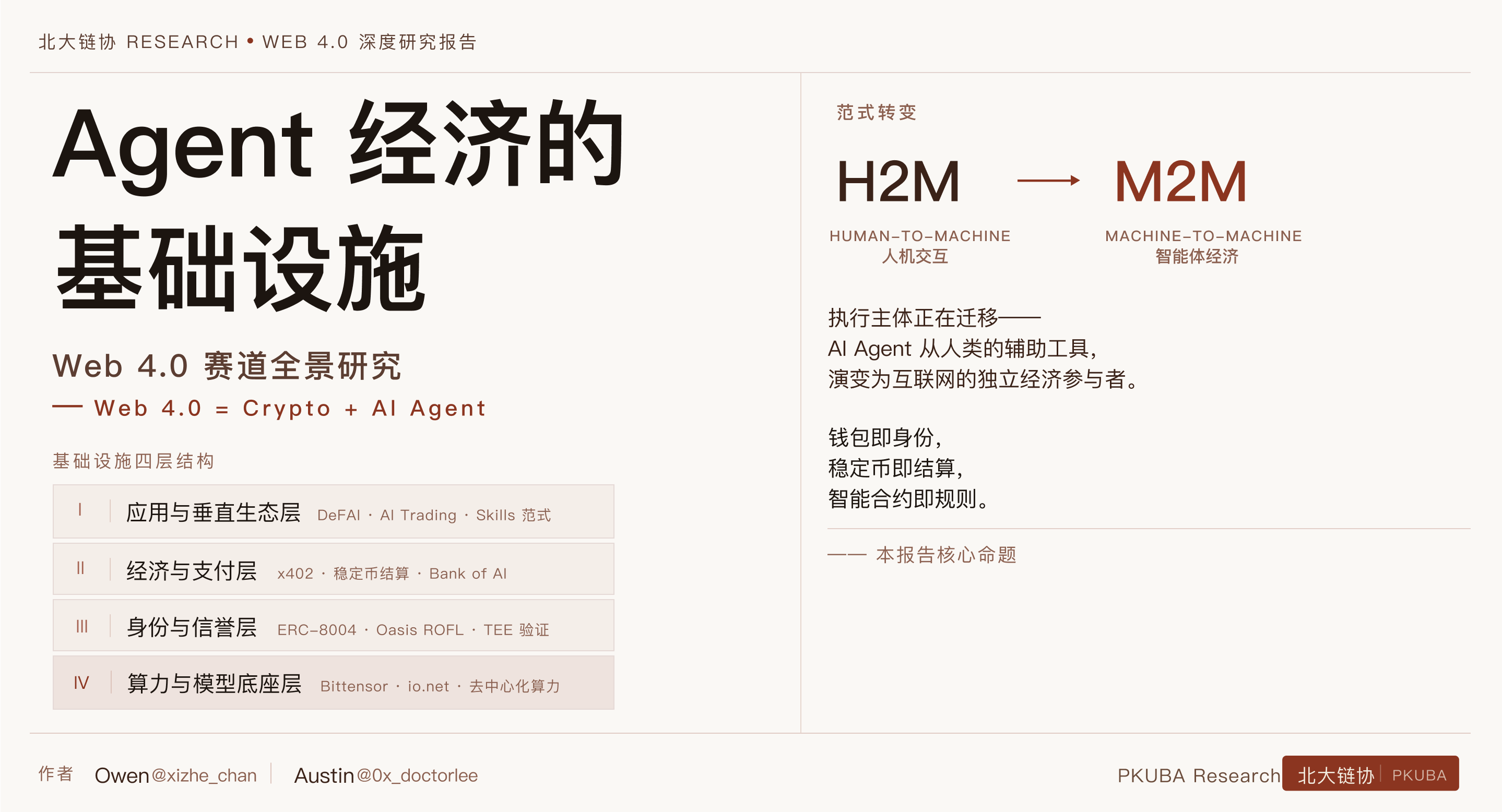
The core proposition of Web 4.0 is the migration of execution agents — AI agents are gradually evolving from human aids to independent economic players on the Internet. The underlying driving force behind this transformation is that the existing financial system is structurally excluded from AI agents. Whether it is account opening, contract signing, or micropayment settlement, traditional financial infrastructure is not compatible with machine-native behavioral logic. The permissionless blockchain network just provides agents with an alternative path to circumvent these restrictions — wallets are identities, stablecoins are settlements, and smart contracts are rules.
This report systematically sorts out the context of the evolution of Web 4.0 from narrative to infrastructure. At the protocol layer, gaps in the three layers of the x402 payment standard, ERC-8004 identity standard, and MCP tool calling protocol are being filled centrally to form the minimum operational protocol stack required for an Agent as an independent economic entity. At the track level, the report scanned representative projects at four levels from the bottom up:
●Bittensor andio.netProviding decentralized computing power supply
●Oasis ROFL pioneered the TEE integrated card slot in the ERC-8004 verification layer
●Bank of AI (based on TRON ecosystem) packages x402, 8004 protocols, MCP, Skills, and OpenClaw extensions into a one-stop agent financial operating system for developers
●Midaz demonstrated the “Built for Agents, Visualized for Humans” Skills product form at the application level
From an investment perspective, the Web4.0 circuit is currently in a window of centralized infrastructure construction: the dispute over standards has yet to be settled, actual commercial traffic on the chain is still in the early stages of verification, and the overall narrative is ahead of implementation. The first-mover card window for the underlying infrastructure is narrowing, and being able to transform protocol capabilities into a closed commercial vertical application layer will be the most noteworthy opportunity in the next phase.
Keywords: Web4.0, AI Agent, Smart Economy, Decentralized Infrastructure
I. Introduction: Why is Web4.0 suddenly everywhere
The past year has seen a sharp rise in the frequency of the Web4.0 concept in crypto research reports and AI industry gatherings. Along with the “lobster fever” triggered by OpenClaw, the wave of AI agents has taken the world by storm, and more and more people are beginning to realize that the underlying logic of this wave of technology is very different from previous AI crazes.
There is currently no strict definition of Web 4.0, but the core proposition has gradually become clear - Web 4.0 = Web 3.0 + Agent, that is, combining blockchain infrastructure with AI agents to gradually become new active actors on the Internet, fundamentally changing the network's participant structure.
The capital side's response to this judgment has arrived. Dragonfly completed a $650 million new fund raising in February 2026, and partner Haseeb publicly stated: “Crypto was not designed for humans, but for AI agents.” At the same time, the key puzzle of the infrastructure layer was also in place during the same period: in May 2025, Coinbase launched the x402 payment protocol, which first provided a standardized channel for machine-native settlement between agents; in August 2025, the Ethereum Foundation and others took the lead in proposing the ERC-8004 identity standard, which provided a verifiable foundation of trust for cross-organizational agent collaboration.
Narrative, capital, and infrastructure, the three forces resonate within the same time window — this is a sign that Web 4.0 is moving from concept to racetrack.
This report will systematically sort out the core logic, infrastructure gaps and racetrack pattern of Web 4.0, focus on analyzing representative projects at the four levels of computing power, identity, payment, and application, and use Bank of AI as an implementation case to discuss the complete closed-loop path of the Agent economy from agreement to product, and provide a reference framework for investigating investment opportunities on this racetrack.
II. What is Web 4.0: the core is the smart economy
2.1 From Web1.0 to Web3.0: Executors are always humans
Looking back at the three stages of development of the Internet, each transition is expanding the depth of human interaction with the Internet. The Web 1.0 era enabled one-way reading (Read) of information, and users browsed static pages through portals; the Web 2.0 era established bidirectional interaction and content production (Read/Write), and mobile internet and cloud computing spawned social media and platform economies; the Web 3.0 era introduced ownership confirmation (Read/Write/Own) of digital assets, and blockchain technology enabled users to have independent control over on-chain assets for the first time. Although the underlying technology continues to change, these three stages share a basic premise: humans are always the core subjects of online interaction. Whether browsing the web, posting content, or signing on-chain transactions, the final decision makers and executors are natural people, which is a typical human-computer interaction model (H2M).
2.2 Definition of Web4.0: Executor migration to AI Agent
“Web 4.0” is the next stage in the evolution of the Internet. Currently, there are still various definition paths in academia and industry.
●The European Commission released the “Web 4.0 and Virtual World Strategy” in July 2023, defining it as a form of integration of AI, semantic networks and immersive technology;
● In the context of cryptographic native research, this concept was first systematically proposed in 2026 by former OpenAI researcher Sigil Wen and Conway Research, which founded it, and regards the combination of AI agents and decentralized cryptographic infrastructure as the core characteristics of Web4, which can be succinctly expressed as: Web 4.0 = Cryptographic Infrastructure (Crypto) + Intelligent Executor (AI Agent))
Figure 1: Comments made by Sigil Wen on the Web 4.0 website
Source: Web4.ai
Under this framework, active entities of the network will migrate from large-scale humans to AI agents that operate independently. Humans will mainly assume the role of intended publishers, and specific execution tasks such as information retrieval, service procurement, cross-chain interaction, and value settlement will all be carried out independently by agents. This new type of economy, with machines as the main economic players, is known by the industry as the agentic economy (agentic economy), and its interaction mode is also shifting from H2M (human-computer interaction) to M2M (machine-to-machine) automated commerce.
Table 1: Evolution of implementing entities and infrastructure at various stages of the Internet
staging | Core logic | Allocation of value | Core Executing Entities | Underlying infrastructure |
Web 1.0 | Information Acquisition (Read) | Platform monopoly | Human (one-way viewer) | Portal/PC |
Web 2.0 | Content production (Read/Write) | The platform takes the lead | Human (creator) | Mobile Internet/Cloud Computing |
Web 3.0 | Value ownership (Read/Write/Own) | Agreements and community co-building | Human (coin holder) | Blockchain/Smart Contract |
Web 4.0 | Agentic economy | Automated settlement between machines | AI Agent (Autonomous Agent) | Crypto + big language model |
Source: Edited by PKUBA Research
2.3 The three core elements of the Agent economy
An AI Agent that can truly participate in the economic cycle must simultaneously possess three core competencies: perception, decision making, and action. Perception and decision-making ability have been initially solved with the rapid development of large-scale model technology in the past two years, but the ability to act is currently the biggest infrastructure gap — the existing financial system is strictly based on natural or legal personality, and AI agents cannot open accounts or legally apply for credit cards at commercial banks, which directly causes AI to only operate at the information layer.
Table 2: Comparison of the three factors and maturity of the Agent economy
Core competencies | Function description | Technical support | Current maturity |
Perception ability | Understand natural language and read real-time data | LLM + API/Oracles | Basically solved (GPT-4O/Claude, etc.) |
Decision-making ability | Formulate optimal execution strategies | Reinforcement Learning/zKML Verification | Preliminary solution (reasoning ability continues to improve) |
Ability to act | Mobilize funds, sign agreements, execute on-chain | Wallet/smart contract/MCP | The biggest gap (lack of native infrastructure) |
Source: Edited by PKUBA Research
This reality directly leads to the core proposition of Web 4.0: How to build an underlying protocol for agents that bypass traditional financial restrictions? The answer points to existing Crypto infrastructure, as only permissionless blockchain networks can provide AI agents with verifiable digital identities and native automated settlement channels. ——And this is the fundamental reason why Web4.0 must rely on Crypto infrastructure.
3. Why does Web 4.0 require Crypto
3.1 The traditional financial system's structural exclusion of AI agents
The core obstacle to AI Agent's commercial implementation is not the lack of model ability, but rather the fact that the Agent's “right to act” in the real business system is limited. Specifically, traditional financial systems are based on real-name authentication of natural persons or legal entities: opening an account requires an ID or business license, and payment gateways require binding to a mobile phone number and multiple authentication. An AI program running in the cloud has neither legal status nor can it independently sign a legally binding contract. Without legal fund scheduling rights and independent financial status, agents can only assist humans by acting as “information processing tools” and cannot actually assume the main actors of economic activity.
A deeper mismatch lies in the granularity of payments. The pricing logic of traditional card organizations (in the case of Stripe, standard rate 2.9% + $0.30/transaction) is designed for human consumption scenarios — assuming a single transaction is large enough and the frequency is low enough. However, the Agent's typical behavior is the opposite: high frequency, micro, per-call billing. A $0.001 API call can't even cover fixed processing fees under the credit card system.
Table 3: Comparison of payment characteristics between human users and AI agents
Comparative dimensions | Human users (H2M mode) | AI Agent (M2M mode) |
Trading frequency | Low frequency (several to dozens per day) | High frequency (multiple to 100 calls per second during peak task periods) |
Single amount | typically > $1 | Extremely small ($0.001 - $0.1/pen) |
Settlement method | Subscription payment (monthly credit card payment/precharge) | On-demand real-time billing (pay-per-call) |
Status requirements | KYC real-name authentication | Public-private key pair (no natural person identity required) |
runtime | Subject to business hours and time zone restrictions | 7x24 hours uninterrupted |
Trust building | Government License/Third Party Credit Rating | On-chain history/Verifiable reputation record |
Source: Edited by PKUBA Research
3.2 The three-tier infrastructure that Crypto complements for Agents
Crypto complements the Agent economy with a bottom-up economic behavior stack — from identity, to payments, to financial services.
The first layer: the identity layer - the wallet is the identity. In a permissionless blockchain network, generating a digital identity does not require approval from any centralized authority; only local code is required to generate a pair of public and private keys within milliseconds. AI agents can create independent wallet addresses for themselves or their derived subtasks at any time as an objective identity and asset carrier for the on-chain world. This layer completely removes the premise that “financial accounts must be tied to a natural person.”
Second layer: Payment layer — programmable pay-per-call settlement. Smart contracts and stablecoins allow the flow of funds to be compressed into code logic. Take the x402 protocol released by Coinbase in May 2025 and now co-promoted by Cloudflare, Google, Visa, AWS, Stripe, etc.: it reuses the “402 Payment Required” status code that has been idle for a long time in the HTTP protocol, so that the server directly returns a payment request in an HTTP request, and the client (person or agent) can obtain resources by completing an on-chain signature with USDC or other stablecoins. The single fee is as low as zero cents, and there are no subscriptions, API keys, or pre-charges. This made the micropayment business model, which can never be carried by traditional payment channels, established economically for the first time.
Third layer: Financial layer - DeFi network with 7×24 hour programmable access. DeFi is a global protocol network with a standardized interface. Modules such as DEX, lending, and revenue aggregation can be directly called through code. Agents can independently complete operations such as asset exchange, collateral, and hedging, using “financial capacity” as a tool without relying on manual approval or business hours.
Together, these three layers make up the infrastructure necessary for an Agent as an independent economic entity: identity allows it to exist, payment allows it to act, and DeFi allows it to accumulate and schedule resources.
3.3 Adaptation gaps in the existing Web3.0 ecosystem
However, the fit between Crypto and Agent is currently more limited to the underlying protocol layer — ledgers, stablecoins, and smart contracts themselves are agent-friendly; however, the application layer is still designed for human users. Mainstream dApps and wallets rely on graphical interfaces, requiring users to read pop-ups through browser plug-ins and click the mouse to confirm signatures; however, AI models excel at system-level APIs and structured data interaction, and are not naturally capable of visual operation.
This “protocol layer fit, interaction layer misalignment” gap is the direction that a number of new infrastructure projects are currently trying to bridge — machine-native payment agreements represented by x402, AP2 (Agent Payments Protocol) launched by Google and connected to x402, and MCP (Model Context Protocol) support for paid resources led by Anthropic are all restructuring Web 3.0 from “human-facing” to “simultaneous machine-oriented” . The actual implementation of Web 4.0 depends on the degree of completion of this adaptation upgrade.
IV. The three-tier infrastructure gap of Web 4.0
Agents are automatically upgraded to independent economic entities that can independently mobilize funds and sign agreements. A new protocol stack based on M2M business logic must be built between the underlying blockchain and the upper AI model. Currently, this protocol stack is under centralized construction, and its core gaps can be divided into three levels: payment layer, identity and reputation layer, and interaction and tool call layer.
Table 4: Comparison between the gaps and evolution of the three-tier infrastructure of Web 4.0
tier | Core demands | Existing Web3.0 model (for humans) | Evolution direction of Web 4.0 (for agents) | Representative agreement |
Payment layer | Machine-to-machine fund settlement | Manual signature one by one, low frequency, large amount | Automatic machine authorization, high-frequency micro-payment | x402 (Coinbase/Cloudflare) |
Identity and reputation layers | Collaborative trust across organizations | ENS domain name, human KYC | Verifiable on-chain records and cross-chain reputation | ERC-8004 (Ethereum standard) |
Interaction and tool call layer | Agent → external system | Browser front-end + wallet manual confirmation | Standardized model - real-time communication of tools | MCP (launched by Anthropic, donated to Linux Foundation in 2025) |
Source: Edited by PKUBA Research
4.1 Payment layer gap: x402 protocol
The business pain point solved by x402 is that traditional payments cannot support Agent's microcommerce. In the Agent economy, the most typical transaction scenario is an API call between machines, and a single settlement amount may only be $0.001 to $0.01. The following table shows the processing rate of traditional payments and the x402 processing fee rate. It can be clearly seen from this: since traditional payment networks have fixed processing fees, it is basically impossible to provide profitable commercial services in the micropayment side scenario.
Table 5: Cost comparison of different payment methods in the micropayment scenario
Single transaction amount | Stripe fees | Stripe fee rates | x402 (base L2) gas cost | x402 fee rate |
$0.01 | $0.30 + 2.9% ⇔ $0.3003 | Approximately 3,000% | ~$0.0001 | Approximately 1% |
$0.10 | ~$0.303 | About 303% | ~$0.0001 | About 0.1% |
$1.00 | ~$0.329 | Approximately 32.9% | ~$0.0001 | About 0.01% |
$10.00 | ~$0.59 | About 5.9% | ~$0.0001 | About 0.001% |
Source: Standard rate on Stripe's official website; refer to publicly available data from on-chain browsers for gas fees on the Base L2 chain.
Note: The x402 protocol layer itself has zero processing fees. The fees in the table are only the underlying network gas fees. The official Coinbase facilitator offers 1,000 free monthly billing credits over $0.001/transaction.
Based on this, x402 uses the 402 status code in the HTTP protocol: “402 Payment Required”. This protocol code derives from the low-level coding rules of HTTP in the 90s. At the time, a status code beginning with 4xx meant an error was returned, while 402 meant that an error was returned because the payment was not completed (Payment Required) was returned.
However, when the financial infrastructure of digital currency became popular, on-chain payments provided a new way to use the HTTP402 code. In May 2025, Coinbase officially launched the x402 protocol based on this, turning it into a set of operational open payment standards.
Figure 2: Schematic diagram of x402 core work steps
Source: Pharos Research
In terms of ecology and adoption, as of early 2026, the x402 protocol has been deployed on many mainstream networks such as Base, Solana, Polygon (PoS), BNB Chain, and Avalanche.
●Among them, Base's single chain has accumulated about 119 million transactions and a cumulative turnover of about 35 million US dollars, which is one of the main execution environments;
●Solana has surpassed Base several times in a single day since the end of 2025. According to Solana Foundation's official disclosure, Solana contributed about 65% of x402 trading volume since 2026.
However, actual adoption declined significantly in early 2026: According to Artemis on-chain data, the x402 daily transaction volume declined rapidly after reaching a phased high of about 3.8 million transactions and a single day turnover of about 2 million dollars in February 2026. The average daily turnover in March 2026 was only about $2.8 million, an average of about 0.20 dollars per transaction, and the analysis estimates that about half were self-financing or test transactions rather than actual commercial practices, indicating that real demand is still in the early stages of verification.
At the governance level, Coinbase and Cloudflare announced the joint launch of the x402 Foundation on September 23, 2025. By April 2, 2026, the x402 agreement was officially merged into the Linux Foundation, with Coinbase, Cloudflare, and Stripe forming the initial governance entities. The first batch of publicly supported institutions totaled 22, including AWS and American Express, Base, Circle, Google, KakaoPay, Mastercard, Microsoft, Polygon Labs, Shopify, Solana Foundation, Visa, etc. Meanwhile, Google and Coinbase jointly launched AP2 (Agent Payments Protocol) in September 2025, integrating x402 as one of its on-chain settlement channels.
4.2 Identity and Reputation Layer Gaps: ERC-8004 Standards
After giving agents the ability to pay independently, trust issues ensued. In the absence of an objective reputation evaluation system, malicious developers can create fake agents in batches to defraud funds or falsify service records through false accounts (that is, witch attacks). Trust mechanisms in traditional commerce that rely on business licenses and third party credit ratings don't work in a code-only world.
To address this trust gap, the Ethereum ecosystem introduced the ERC-8004 standard in August 2025, which was jointly drafted by representatives of MetaMask, the Ethereum Foundation, Google, and Coinbase. On January 29, 2026, the ERC-8004 reference registry contract was deployed to the Ethereum mainnet (the standard itself is still draft), and the contract has been audited by Cyfrin, Nethermind, and the Ethereum Foundation security team.
ERC-8004 is not an AI model, but an on-chain trust layer designed specifically for Agents to collaborate across organizations. It extends the trust mechanism on top of Google's A2A protocol. The core architecture includes three lightweight on-chain registries. The specific protocol structure is shown in the figure below.
ERC-8004 and x402 complement each other in design - ERC-8004 solves who this agent is and whether it is trustworthy, and x402 solves how the agent is paid. The x402 protocol works seamlessly with ERC-8004. The former handles payment mechanisms, while the latter manages identity and trust verification; completed x402 transaction hashes can be directly written into the reputation registry as positive feedback, forming a closed loop of “real money flow → real reputation”, significantly increasing the economic cost of witch attacks.
4.3 Interaction and Tool Call Layer Gaps: MCP Protocol
The Big Language Model is essentially a text prediction engine running in a closed environment. Although models can understand users' natural language instructions and output policy text, they themselves are not capable of directly manipulating external systems. In the Web 3.0 scenario, even if an agent decides to buy some kind of token on a decentralized exchange, it cannot directly interact with a smart contract. A standardized, secure and controllable communication interface is required between the model and the blockchain.
In this context, MCP (Model Context Protocol) was released as an open source by Anthropic in November 2024 to standardize how AI models access external tools and data sources. The MCP uses a client-server architecture to enable bidirectional communication between AI applications and external capabilities through the JSON-RPC 2.0 protocol. In Web4 application scenarios, blockchain nodes, oracles, and DeFi protocols can all be encapsulated as MCP servers. Agents act as clients to securely obtain on-chain status, read contract codes, and convert strategies into blockchain transaction instructions for signature broadcasts.
Table 6: Key Milestones in the Development of the MCP Protocol
time | occurrences |
2024 November | Anthropic open-source releases MCP v1, provides Python and TypeScript SDKs, and integrates the first batch of early adopters such as Block, Apollo, Zed, and Reply |
March 2025 | OpenAI CEO Sam Altman announced full support for MCP, integration into Agents SDK, Responses API, and ChatGPT desktop; on the same day, MCP released the second version of the specification, introducing Streamable HTTP transmission |
April 2025 | Google DeepMind confirms support for MCP in Gemini model; security researchers release MCP security issue analysis report in the same month |
May 2025 | Microsoft announces full MCP integration with Copilot Studio, Foundry, and Azure at Build |
November 2025 | Major updates to MCP specifications: asynchronous operation, stateless mode, server authentication; official community-driven MCP Registry launched |
December 2025 | Anthropic donates MCP to Agentic AI Foundation (AAIF) under the Linux Foundation, co-founders are Anthropic, Block, and OpenAI; Platinum members include AWS, Google, Microsoft, Cloudflare, and Bloomberg |
As of December 2025 | The SDK has been downloaded more than 97 million times per month, there are more than 10,000 active MCP servers worldwide, and mainstream AI products such as ChatGPT/Cursor/Gemini/Copilot/VS Code have all been integrated |
Data source: Anthropic official blog and AAIF announcement (December 2025); Wikipedia MCP entry (2026).
In terms of security, MCP ensures that AI models can only access clearly authorized on-chain tools through a strict permission declaration mechanism, preventing the model from losing assets due to illusions or malicious reminder injections to a certain extent. However, it should be noted that MCP's security model is still being iterated — in April 2025, security researchers published an analysis report on issues such as prompt injection, data breaches caused by tool permission combinations, and tool phishing.
4.4 The synergy of the three-tier gap
The three characteristics of Web 3.0, which have long been advocated without permission, verifiability, and immutability, are more reflected in the pursuit of technical ideas in the era of human users. However, when the execution entity of the Internet switches to AI agents, these characteristics become the basic requirements for the bottom line of the business:
●Without a permission-free account system, AI cannot break through traditional financial identity restrictions to open x402 payment channels;
● Without an immutable distributed ledger, the historical reputation that Agent has accumulated through ERC-8004 has no credibility;
● Without a verifiable cryptographic execution environment, cross-chain instructions issued by MCP cannot be confirmed in a zero trust environment.
The gradual improvement of these three infrastructure layers indicates that the protocol layer is completing a systematic adaptation from serving humans to serving machines. An Agent economic network supported by decentralized protocols has initially taken shape, and project competition and ecological construction around this three-tier infrastructure will be the most interesting investment theme on the Web 4.0 circuit in the next one to two years.
However, it's worth pointing out that x402 isn't the only solution in the Agent payment field. OpenAI collaborated with Stripe to launch ACP (Agentic Commerce Protocol), and Google led the development of AP2 (Agent Payments Protocol). Compared to the x402 ecosystem protocol, it represents a very different technology path and business philosophy.
Table 7: Comparison of the three major agent payment agreements
dimensions | x402 Ecosystem (Coinbase+Cloudflare) | ACP (OpenAI+stripe) | AP2 (Google) |
Payment medium | Stablecoins (USDC, etc.) | Traditional credit cards | Traditional card network + on-chain optional |
Settlement layer | blockchain | Traditional payment gateway (Stripe) | Traditional methods such as the Visa network + on-chain settlement |
Micropayment capabilities | Native support ($0.001 level) | Subject to card network guarantee fees | Partial support |
Entry threshold | No license required | Stripe merchant account required | Cooperative access such as Visa and Mastercard is required |
Open source situation | Fully open source (Apache 2.0 license) | Completely open source | The specification is open and open source |
Core Positioning | Internet native payment standards | Agentization of existing e-commerce payments | Regulated agent commerce |
Data source: Payram.com, November 2025; official documents of each agreement
Through the comparison table above, it can be clearly seen that:
●The core advantage of the x402 ecosystem is that it was created for machines: no merchant account or KYC is required, and any server can receive payments with a few lines of code; based on stablecoin settlement, the single cost is as low as Asian American rating, and is natively adapted to Agent's high-frequency and small-amount call billing model.
●ACP and AP2 essentially connect AI to existing card organizations and merchant systems: the service is “AI helps people buy things”, while the x402 service is “direct transactions between machines”, which is a lower level of infrastructure for the agent economy to operate autonomously.
Therefore, several payment systems are not completely competitive; on the contrary, there is room for complementarity and common development in the AI economy era.
5. Track pattern scanning: who is building the Web4.0 era
Based on the aforementioned analysis of the three-tier infrastructure gap for Web4.0, this emerging circuit can be further divided into four levels from the bottom up according to the stack logic:
● The lowest computing power and model base layer provides resource support for the Agent's inference operation;
● The identity and trust layer addresses the foundation of trust issues in cross-organizational collaboration;
●The economic and payment layer enables agents to have real settlement and fund scheduling capabilities;
● The application and vertical ecosystem layers carry the implementation of the Agent's value in specific business scenarios.
The four layers are superimposed to form a complete agent economic operating environment. The following will separately select the most representative project cases at each level to show the current implementation progress and ecological pattern of the Web4.0 circuit.
5.1 Computing Power and Model Foundation Layer: Decentralized AI Computing Power Network
The large-scale operation of the Agent economy depends on an abundant and sustainable supply of computing power. In the traditional cloud computing market, centralized supercomputing platforms such as AWS and GCP have long dominated, but their pricing structure and access threshold are not friendly to the cryptography-native agent economy. Decentralized computing power networks provide an alternative path for agents to bypass traditional cloud vendors by aggregating idle global GPU resources and using token economy to incentivize computing power suppliers, and are therefore regarded as the most basic layer in the Web 4.0 stack.
Bittensor is currently one of the largest projects in the decentralized AI computing power circuit. It is Layer 1 built on the Substrate framework (same origin as Polkadot), and has its own consensus mechanism, validator node network, and native token TAO. Bittensor uses the blockchain incentive mechanism for AI model production itself — miners compete on the chain to contribute valuable AI inference and model training, and TAO distributes rewards according to the quality of contributions, thus forming a permissionless decentralized AI model market. Agents can use various AI capabilities from it without relying on centralized service providers such as OpenAI or Anthropic.
According to CoinGecko and CoinMarketCap data, as of mid-April 2026, the price of TAO tokens is in the range of $240 to $250, and the market value in circulation is about $2.4 to 2.7 billion. At the network level, Bittensor currently runs 128 active subnets, covering various AI task segments such as language model training, decentralized inference, and network security. In the first quarter of 2026, the subnets generated a cumulative revenue of about 43 million US dollars, and about 70% of the TAO in circulation is pledged. The first halving was completed on December 14, 2025, reducing daily emissions from 7200 TAO to 3,600 TAO. Additionally, Grayscale increased the TAO allocation ratio in its AI fund from 31% to 43%, and submitted an S-1 application to the SEC for the conversion of Bittensor Trust to a spot ETP (to be listed on NYSE Arca under the code GTAO) on December 30, 2025, and submitted a revised version in April 2026. The institutionalization channel is gradually being established.
io.netIt is a protocol based on Solana's deployment, which focuses on aggregation and scheduling of decentralized GPU clusters. It solves the problem of accessing physical computing power at a lower level — it aggregates the world's idle GPUs into a distributed computing power pool that can be scheduled as needed, and through the MCP protocol, AI agents can directly purchase and release GPU resources without human intervention, KYC, or enterprise accounts, completely circumventing traditional cloud computing's mandatory dependency on natural person identity.
pursuantio.netOfficially disclosed and disclosed data. The network covers more than 130 countries and regions around the world, providing on-demand computing services for AI training, inference and rendering scenarios. The market value of IO tokens in circulation as of April 2026 is about $30 to 36 million, and there has been a sharp correction of more than 98% from the 2024 all-time high (about $6.43), reflecting the pace of token unlocking and the valuation pressure of the overall DePin sector.io.netIt surpassed $20 million in annualized on-chain revenue in October 2025.io.netThe IO Intelligence product line further encapsulates basic computing power as an inference platform and agent development environment, and has reached computing power supply cooperation with many AI Agent projects such as Gaia and ChainGPT, gradually forming a complete closed loop from computing power supply to higher-level applications.
Data source: io.net official website
Table 8: Decentralized Computing Power Layer Representative Project Comparison
projects | Underlying network | Size of core assets | Token market capitalization | Ecological progress |
Bittensor | Own L1 (Substrate) | 128 active subnets, Q1 2026 subnet revenue is approximately $43 million | Approximately US$24-2.7 billion | Grayscale AI Fund allocates 43%; first halving completed |
io.net | Solana | Covering more than 130 countries, the annualized on-chain revenue exceeds 20 million US dollars | Approximately $3,000-36 million | Annualized on-chain revenue exceeded 20 million US dollars; partners such as Gaia and ChainGPT |
Source: CoinGecko, CoinMarketCap, Nansen Research, io.net official website data as of April 2026.
5.2 Identity and Reputation Layers: ERC-8004 and Oasis ROFL
As mentioned before, ERC-8004 addresses the problem of “how to trust each other” between agents. However, the standard itself is deliberately neutral about verification methods — it doesn't care about how trust is established; it only provides an interface to record results. This means that whoever can be the first to equip it with a fully usable authentication mechanism will get stuck at the key entrance to the identity layer.
Currently, the most advanced project integrating in this direction is Oasis Protocol's ROFL (Runtime Offchain Logic). Oasis Protocol is a Layer 1 that focuses on privacy protection, and ROFL is a computational framework developed by Oasis itself. The full name is Runtime Offchain Logic, which literally translates as “off-chain operation logic” - the problem it solves is very specific: how to make the computations that occur off-chain be trusted on-chain. After the ROFL module is launched, it is positioned as “Trustless AWS” for AI applications: developers can run agent code in an off-chain trusted execution environment (TEE), and the calculation results are cryptographically proven and then written back to the chain. The whole process does not rely on any centralized operator's creditworthiness endorsement.
When the ERC-8004 draft was released a month later, Oasis followed suit and open-sourced a dedicated ROFL-8004 container image — developers only needed to add a few lines of code to the configuration file, and the ROFL Agent could automatically register as ERC-8004 compliant when first started and submit a TEE execution certificate to the verification registry.
It is worth explaining that in the three-tier architecture of ERC-8004, the identity layer and reputation layer have been followed up and integrated by multiple teams, and the verification layer — that is, the part that targets high-risk scenarios such as fund escrow and contract execution and requires cryptographic proof rather than social consensus — is the real technical barrier. Oasis ROFL is currently one of the first TEE solutions to provide an official integrated tool chain at this level, which is also its core card logic.
Early projects already running on ROFL include the privacy AI companion platform Zeph, and the autonomous trading agent WT3, which is supported by the Oasis Foundation's $100,000 seed funding. However, there are still a few layers of uncertainty about how far this path can go that are worth paying attention to:
● First, ERC-8004 itself is still a draft and has not yet been finalized, and there is a risk that Oasis's integrated tools will need to be restructured as versions are iterated;
●Second, ROFL is essentially a general TEE calculation framework. ERC-8004 integration is a product of later strategic follow-up. It is not deeply bound from the beginning; the depth of collaboration between the two parties remains to be seen;
●Third, real production-level agents have not yet appeared on a large scale, and commercial verification of the entire racetrack is still in the early stages.
Taken together, the technical direction of Oasis ROFL has been established. “TEE execution + on-chain identity” is a reasonable and verifiable path, and the timing of the card slot is early enough. But the story was founded on the premise that ERC-8004 will eventually move from a draft to an industry standard—until then, it was more like an early card holder worth keeping track of than an already running infrastructure.
5.3 Economy and Payment Layer: x402 Protocol and Bank of AI Implementation Case
The payment layer is a key part of Agent's transition from an information processing tool to a true economic agent. The previous article has explained the technical principles and governance structure of the x402 protocol. This section focuses on its typical implementation case in the TRON ecosystem - Bank of AI (https://bankofai.io/), it is the basic financial facility of the AI Agent era BAI (https://b.ai/) An important component module of the product. The reason why this case is representative is that it is not limited to abstract discussions at the protocol level, but rather packages the five core components of x402, ERC-8004, MCP Server, Skills, and OpenClaw into a complete Agent financial operating system for the first time, so that the Agent has end-to-end business execution capabilities in a real chain environment.
Bank of AI was officially released on February 16, 2026, and the first batch supports TRON and BNB Chain. According to public data from TRON DAO, as of April 2026, the TRON network has exceeded 22 billion US dollars in daily transactions, about 86 billion US dollars in circulation of USDT on the chain, the cumulative number of transactions is about 13 billion, the total number of user accounts is about 375 million, and the annual stablecoin transfer scale is about 7.9 trillion US dollars. This amount of stablecoin clearing capacity and carrying capacity for high-frequency small transactions provides a large-scale underlying foundation for machine-native settlement between agents.
In terms of product architecture, Bank of AI deconstructs the core competencies required for Agent's economic operation into five composable modules. The x402 payment protocol is responsible for processing high-frequency micro-on-chain settlements. Developers only need one line of code to integrate automated payment functions for AI agents, and TRON officially provides gas fee subsidies; the 8004 protocol issues verifiable on-chain identities for each agent to solve trust issues in A2A interactions through decentralized registration, full-life cycle behavior records, and multi-dimensional reputation systems; MCP Server acts as a standardized interface between AI models and blockchain services to seal complex on-chain interactions Installed as a set of usable tools; the Skills module further packages the MCP interface into a reusable workflow template, enabling the Agent to deeply integrate mainstream TRON DeFi protocols such as SunSwap and JustLend DAO to cover complete financial scenarios such as token exchange, lending, and yield strategies; the OpenClaw Extension injects all of these capabilities into existing agents with one click to achieve zero transformation and seconds-level deployment .
Table 9: Bank of AI's five core component function matrices
component name | Belongs to the tier | Core features | Corresponding business capabilities |
x402 | Payment layer | An automated on-chain settlement protocol based on HTTP 402 | High-frequency micropayments between machines, billing per call |
8004 agreement | Identity and reputation layers | Verifiable on-chain identity and reputation registry | A2A collaborative trust, anti-witch attacks |
MCP server | Tool call layer | Standardized interface between AI big models and on-chain services | Call smart contracts and read on-chain status |
Skills | Application abstraction layer | A library of modular DeFi workflow templates | Implement exchange, borrowing, and revenue strategies with agreements such as SunSwap and JustLend |
OpenClaw Extension | Deploy an adaptation layer | One-click integration plug-in for the OpenClaw framework | Zero transformation of existing agents to become Web3 economic agents |
Source: AINFT official announcement, TRON DAO press release, RootData, ChainCatcher public data compilation, as of April 2026.
Bank of AI's strategic significance is that it has completed a closed-loop transition from agreement to product. For developers, before, it was necessary for an Agent to have complete capabilities for on-chain payments, authentication, and DeFi operations, which required connecting multiple independent agreements and bearing heavy engineering costs; Bank of AI reduced this process into a plug-and-play toolbox, significantly lowering the implementation threshold for the Agent economy.
Starting from the perspective of the TRON ecosystem, Bank of AI has the potential to become the early core settlement layer of the Agent economy, based on its huge stablecoin settlement scale and low transaction costs. TRON DAO has officially joined the Agentic AI Foundation (under the Linux Foundation) and has a seat on its governance committee, which also indicates that this implementation plan has been incorporated into the mainstream governance framework of the global Agent infrastructure.
5.4 Applications and Vertical Ecosystems: Commercial Applications for Agents
The gradual maturity of the three-tier infrastructure of underlying computing power, identity trust, and payment and settlement has created conditions for the implementation of a vertical application ecosystem. In the current emerging direction of Web 4.0 applications, DeFai — that is, the combination of DeFi and AI — is one of the most popular racing tracks in the market. Its core logic is to use AI Agents to track the DeFi market in real time and complete cross-protocol arbitrage and ancillary transactions. Expanding the horizons further into the stock, options, and prediction markets corresponds to the recent emergence of a large number of AI trading tools.
This circuit naturally has the soil to integrate with the Agent economy: the financial market itself is a machine-readable environment that operates 7 x 24 hours. The data is highly structured, the decision cycle is short, and the results are quantifiable. In theory, it is very suitable for AI agents to participate as autonomous execution agents.
However, sorting through the AI trading products currently on the market reveals a common structural problem: these tools are highly consistent in terms of product form and design logic — to help humans complete transactions. AI plays a role in data processing and signal generation, and humans are still responsible for the final judgment and execution. This means that they are essentially still Web2 tools designed for human users, only plugged into the big model on the front end.
This is the core proposition that AI trading aims to break through under the Web 4.0 framework. A notable feature of the Web 4.0 commercial layer is that the core object of the service must be switched from a person to an agent — instead of using AI to assist people in transactions, agents become independent market participants, receive structured market intelligence, independently form judgments, and complete execution through on-chain agreements. To achieve this, the key is not the model's ability itself, but a shift in design philosophy: can complex signals from the financial market be compressed into structured outputs that the Agent can directly call, and embed the Agent's decision-making framework in the form of a Skill.
Midaz (midaz.xyz) is currently the most representative practice in this direction. The core idea can be summed up in one sentence: Built for Agents, Visualized for Humans. As the winning team of the 2025 Binance Hackathon, Midaz's core team members came from top Wall Street quantitative funds such as Millennium and Citadel, and restructured market information into three structured levels: the Assets layer corresponds to specific transaction targets, the Topics layer aggregates events and signals surrounding assets into market themes with directional judgments, and the Drivers layer further abstracts the causal forces driving the evolution of these themes — such as US inflation and the broken consumer credit cycle, AI infrastructure expansion, and Use of custom chips, etc.
Midaz's core value is that it proposes a Skills product form for agents, which has directional significance for the evolution of the Web 4.0 application layer. The key features of this form are that it can be assembled, supports partial invocation, natively targets agents, and is compatible with direct use by human users. Unlike the traditional front-end paradigm with GUI as the core, Skills essentially decompose product capabilities into functional units that can be programmatically called - Agents don't need to “look at the interface” and only need to call the required modules as needed to complete tasks. It can be expected that this design logic will gradually replace the traditional front-end paradigm centered on visual interaction and become the mainstream product form in the Web4 era.
As the x402 payment layer and 8004 identity layer matured further, AI Trading was only the first mature scenario for the verticalization of the Web4 application layer. Similar structured skills supply logic will rapidly spread to more fields such as insurance actuarial, supply chain fulfillment, and content copyright settlement, and push the agent economy from single-point testing to networked collaboration.
Taken together, the above four levels of projects form the core framework of the current Web 4.0 circuit: Bittensor andio.netProviding computing power fuel, ERC-8004 and Oasis ROFL build a foundation of trust, the x402 agreement opens up economic blood with Bank of AI, and vertical projects such as Midaz demonstrate product forms for native agent applications. From an investment perspective, infrastructure projects closer to the bottom usually have more obvious network effects and valuation flexibility, while projects closer to the application layer are more dependent on the commercialization pace of specific scenarios. For a comprehensive infrastructure such as Bank of AI that spans payment, identity, and application adaptation layers, the real value anchor is whether it can usher in a window period for a large-scale explosion of the Agent economy, so it has strong beta and market potential.
6. Summary and trend analysis
The essence of Web 4.0 is a migration of execution agents — from humans operating the Internet to AI agents participating autonomously in the economy. This is not a gradual product iteration, but a systematic reorganization of the underlying logic: when the core participants in the network change from natural people to machines, the entire protocol stack needs to be re-adapted.
Currently, this restructuring is in the window period of centralized infrastructure construction. A three-tier agreement for computing power, identity, and payment has been initially formed, and the vertical application ecosystem is being followed up. However, what needs to be clearly understood is that most projects are still in the prototype verification stage, actual commercial traffic on the chain has not yet reached scale, and the narrative ahead of landing is the reality of the entire racetrack.
Based on the above analysis, the following trends are worth focusing on:
First, the standard dispute will enter a decisive phase in 2026. Whether ERC-8004 can move from a draft to a formal standard, and whether x402 can surpass test traffic to form a real commercial settlement will directly determine the explosive pace of the upper application ecosystem. Once the standard is established, early card holders building a tool chain around it will have a significant first-mover advantage.
Second, Skills will become one of the mainstream product forms in the Web 4.0 application layer. There is a fundamental mismatch between the traditional front-end paradigm with the GUI as the core and the agent's calling logic. The Skills architecture, which can be assembled and programmatically invoked, will gradually become a standard product unit for agent design, and the implementation of projects such as Midaz has directional significance.
Third, TRON's stablecoin infrastructure makes it a strong competitor in the Agent settlement layer. The average daily trading volume of TRON's chain is $23+ billion, and the USDT stock on the chain is $80+ billion, providing a ready-made liquidity base for high-frequency micro-amount machine-native settlement. The implementation of Bank of AI is the first complete example of this logic moving from theory to practice.
Fourth, the investment window for underlying infrastructure is narrowing, and application-layer opportunities will emerge in the next phase. The pattern of the computing power layer (Bittensor/io.net) and protocol layer (x402/ERC-8004) is initially clear, and vertical applications that can actually transform infrastructure capabilities into closed loop business will be the most interesting investment direction in the second half of Web 4.0 — especially those projects that are the first to replicate the Skills model in traditional industries such as insurance, supply chain, and copyright outside of AI Trading.
The infrastructure for Web 4.0 is going from zero to one. Standards have yet to be determined, commercial traffic is still being verified in the early stages, and there is still a long way to go before actual large-scale implementation. However, the key parts of the protocol layer are already in place, and the direction of migration of the implementing entities is clear. The next year or two will be a critical transition period for this transformation from technically viable to commercially usable. This is both a risk and an opportunity.
Twitter:https://twitter.com/BitpushNewsCN
Compare the TG exchange group:https://t.me/BitPushCommunity
Compare TG subscriptions:https://t.me/bitpush
