


Wall Street eyes HYPE ETF, the era of on-chain exchanges is approaching

Author: Winnie, CryptoPulse
Original title: Behind the explosion of HYPE ETFs: Wall Street begins to bet on the era of on-chain exchanges
There has been a strange phenomenon in the crypto market for the past few years. The daily trading volume of the market is hundreds of billions of dollars, but the one that really makes the most money is often not the public chain, but the exchange.
Whether it's a bull market or a bear market, platforms such as Binance, OKX, and Bybit can continue to charge fees, eat liquidity, and earn trading volume as long as the market remains volatile. So to some extent, the real most stable business model in the crypto industry has never been about issuing coins, but rather as a trading market.
Today, Hyperliquid is actually bringing this model to the chain for the first time. More importantly, Wall Street seems to have begun to realize this.
1. Crypto's Really Most Profitable Business - User Trading
On May 27, Kairos Research data showed that in just 10 trading days after the HYPE spot ETF was launched, the amount of capital absorbed reached 1.04% of HYPE's total market value.
This data directly broke the initial launch record for crypto spot ETFs. Even when compared to mainstream assets such as BTC, ETH, and SOL, HYPE's efficiency in attracting money is still far ahead.
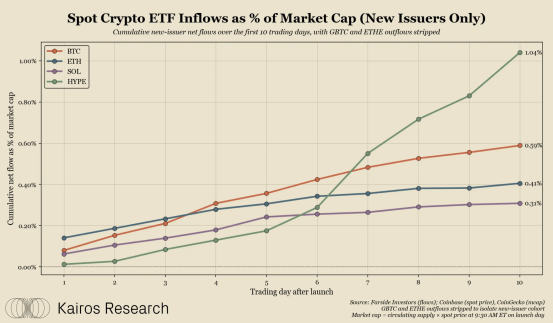
If stock products converted from trusts such as Grayscale GBTC and ETHE are excluded, HYPE can be said to be currently the strongest newly issued crypto ETF.
Behind this, it may mean an even bigger change, and that is that the capital market is repricing crypto exchanges.
Many people used to understand the crypto industry and always liked to focus on hot tracks such as public chains, AI, memes, and RWA. But if you look back at the past ten years, you'll find that the vast majority of racetracks have strong cyclicality.
The hot spots are intense, but the tide is also falling fast. Tradable markets are not the same. Regardless of whether the market rises or falls, as long as someone trades, the exchange can continue to make money.
This was the 2021 bull market, the 2022 crash was like this, and the 2024 ETF bull market is still the case. This is why Binance has been able to maintain the strongest profitability in the entire industry for a long time.
Because transactions are essentially the most stable source of cash flow in the crypto world. What's special about Hyperliquid is that for the first time, it actually gave an on-chain exchange an experience close to a centralized platform.
The biggest problem with many on-chain derivatives platforms in the past was not that they had a bad concept, but that they couldn't take on real big money at all. The liquidity is insufficient, the delay is too high, and the depth is too poor, and professional traders simply cannot use it for a long time.
But Hyperliquid chose a different path. Instead of following the traditional AMM model, it uses order book matching, self-built Layer 1, and public chain-level performance optimization.
The end result is that it's becoming more and more like a “Binance on a chain.” This is why over the past six months, more and more high-frequency traders and quantitative teams have begun to migrate.
Because for professional traders, what really matters is never whether to decentralize or not. Instead, the depth is insufficient, delays are low or not, processing fees are high or not, and whether it is possible to make stable money.
Hyperliquid actually met those conditions for the first time. This is also an important reason why it is beginning to be re-examined by institutional funding.
2. The HYPE ETF explosion is essentially betting on “on-chain Wall Street”
Many people still understand HYPE ETFs as ordinary crypto ETFs. But in reality, it's very different from BTC ETFs and ETH ETFs.
BTC ETFs are more like digital gold, and ETH ETFs are more biased towards blockchain infrastructure. However, HYPE ETFs are essentially betting on the ability of the entire on-chain financial market to trade.

In other words, what the institution is really interested in is probably not the HYPE token itself. It's the trading ecosystem behind Hyperliquid. This can already be clearly seen from the on-chain data.
Data from May 27 showed that the net inflow of Hyperliquid ETF reached US$20.4 million in a single day. Among them, BHYP had a net inflow of $19 million and THYP had a net inflow of $1.4 million.
More importantly, this type of ETF has achieved net inflows for 15 consecutive days, and the cumulative capital volume has exceeded US$101 million. This means that institutional funding is not a short-term hype, but a continuous allocation.
At the same time, Hyperliquid's on-chain fundamentals have also begun to strengthen at the same time. The platform's TVL has now reached $5.529 billion.
This is a new high since the “10.11 crash.” The volume of open positions also rose to US$9.647 billion, the highest level since February this year.
The volume of transactions in the last 24 hours reached $7 billion. Among them, the most noteworthy point is that approximately 28.1% of the trading volume has already come from traditional markets in the HIP-3 ecosystem.
That means Hyperliquid isn't just crypto users playing anymore. It is beginning to absorb traditional financial market traffic.
To some extent, Hyperliquid is more like doing one thing: moving NASDAQ, the foreign exchange market, and traditional derivatives trading to the chain little by little.
And this is probably where capital is really excited.
3. HYPE ETF is forming a new capital flywheel
Many people are still discussing Hyperliquid on the DeFi circuit. But in reality, it is probably not GMX or dYdX that it is challenging at all, but Binance.
Because over the past few years, centralized exchanges have always firmly grasped the core power of the industry. Liquidity, user assets, contract transactions, and market pricing power are almost all concentrated in the hands of leading platforms.

However, the on-chain world can only handle long-tail demand most of the time. However, the advent of Hyperliquid has allowed the market to see another possibility for the first time: the chain can also carry mainstream trading markets.
This is actually very dangerous. Because once the on-chain trading experience is infinitely close to a centralized platform, market makers, quantitative funds, and high-frequency trading institutions are likely to gradually migrate in the future.
And the migration of transactions will eventually lead to a shift in liquidity. After the migration of liquidity, pricing rights will also begin to migrate.
This is why more and more people are beginning to see Hyperliquid as a combination of an on-chain version of CME and Binance. It's no longer just a DeFi project, but more like a growing on-chain financial infrastructure.
More importantly, the advent of ETFs will further reinforce this trend. ETFs bring institutional capital to HYPE, and institutional funds drive increased market attention.
More users and traders entered Hyperliquid, the platform's trading volume and TVL continued to grow, and eventually on-chain cash flow strengthened HYPE's valuation logic. This would form a very typical financialized flywheel.
Historically, the real big cycle of the crypto market often comes from this kind of resonance of capital plus fundamentals. This was the case with BTC ETFs, stablecoins, and RWA. Today's on-chain perpetual contract market may also be entering this stage.
Of course, there are still risks. Regulation, security, extreme market liquidity pressure, and competition with giants like Binance will all be issues Hyperliquid must face in the future.
epilogue
Especially after experiencing the “10.11 crash,” the market remains wary of the high leverage system on the chain. But it is undeniable that the HYPE ETF explosion has sent a very clear signal. Perhaps Wall Street's real interest is not just holding crypto assets, but starting to directly participate in the crypto world's trading market itself.
And this may also mean that the next biggest war in the crypto industry will no longer just be a public chain dispute. Instead, on-chain exchanges are beginning to challenge traditional centralized trading empires.
Twitter:https://twitter.com/BitpushNewsCN
Compare the TG exchange group:https://t.me/BitPushCommunity
Compare TG subscriptions:https://t.me/bitpush
