


From Liberty Banks to Stablecoins: Money's Reputation Dilemma
Source: Token Dispatch
Author: Thejaswini M A
Compiled by Block Unicorn
Original title: The quality of the currency depends on the issuer's credit
In 1840, a shopkeeper placed a book of accounts under the counter. When you pay with banknotes, he takes out his books and checks how much your money was worth for the day.
Ten dollar notes issued by the Bank of Cincinnati are not worth ten dollars everywhere. Maybe it's only worth nine dollars. Its value can vary widely. If the bank goes out of business and the news hasn't reached his county, it might even be worth nothing. The most famous book of this type comes from Philadelphia and is called “Bicknell Counterfeit Money Detector”. It's actually a currency price list, printed in order, because the value of one dollar changes according to the name printed on the banknote.
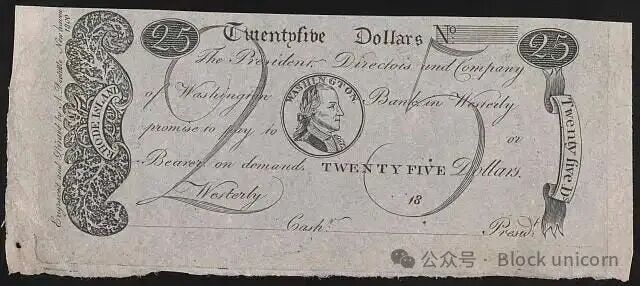
Source: Library of Congress; printed $25 note with a bust of George Washington on the note.
This is America between 1837 and 1863. Any bank with a state government license can print its own banknotes, and obtaining a license is also very easy. Michigan pioneered this in 1837, making it possible to open a bank with almost no conditions or approval from the legislature. Thousands of different banknotes circulate all over the country at the same time. Roughly one-third of the banknotes in circulation are completely counterfeit.
Each note represents a gamble against the issuing bank. This system collapsed during the Civil War, when the government printed a unified dollar, partly to raise money for the war, but more importantly, trusting that 8,000 private banknotes had exhausted the country's funds.
On June 22, the Senate passed the 21st Century Housing Pathways Act by an overwhelming majority (85 votes in favor and 5 against), and the House of Representatives passed the bill the next day. Hidden in this housing bill is a provision prohibiting the Federal Reserve from issuing a central bank digital currency (CBDC) until 2030.
That's why we want to look back and unravel the specter of the Liberty Banking era.
The dollar balance in your Venmo account is promised to you by the bank, and if the bank goes out of business, your money is at risk of being beyond the coverage of the Federal Deposit Insurance Corporation (FDIC). Central bank digital currencies (CBDCs), on the other hand, bypass banks and allow holders to directly hold national currencies in digital form.
The Senate rejected this proposal for two reasons.
The digital dollar issued by the government can track every penny you spend, and can freeze your wallet at any time, just like the Chinese digital yuan.
Second, banks are strongly opposed because funds directly held at the Federal Reserve will never go to their deposit accounts. They will lose the floating capital they need to survive.
Now, even the people who wrote and signed seem unsure about what they want to sign. On June 24, just one hour before the signing ceremony began, Trump called off the ceremony and asked to pass a voter identification bill that had already been vetoed by the Senate. But it is likely that this ban will eventually become law.
Well, the government won't issue digital dollars. At the same time, however, it handed over the work to a private company. This meant that the old ways of 1840 were back.
Even after the GENIUS Act was signed in July 2025, the current regulatory focus is still mainly on the quality of reserves rather than strict entry thresholds. More than a dozen companies are lining up to apply for concessions in order to issue their own dollars. Every fintech company wants to have its own branded currency.
The current market size is approximately $312 billion. Tether's USDT and Circle's USDC account for about 80% of them. There are also PayPal's PYUSD, Ripple's RLUSD, and Paxos's white-label tokens for anyone in need. They all repeat what the Bank of Cincinnati said: Trust us, they're guaranteed.
It's not 1840, and Kim Carey is still trying to prove she's not a clone of herself. We don't believe everything, do we? This is both a good thing and a bad thing. It is this distrust that motivates issuers to come up with evidence to prove their reliability, and at the same time make them expect the market to remain shallow, because a group of people who doubt everything but never verify any facts are the easiest group for you to hand over money to.
An illegal bank claims that its notes are backed by silver in its treasury. However, so-called vaults are often just a bucket of nails, hidden deep in the woods and cannot be touched by any inspector. Stablecoins use US Treasury bonds as collateral and publish relevant receipts every month. In terms of collateral, there are significant differences between the two, and stablecoins are superior in this regard.
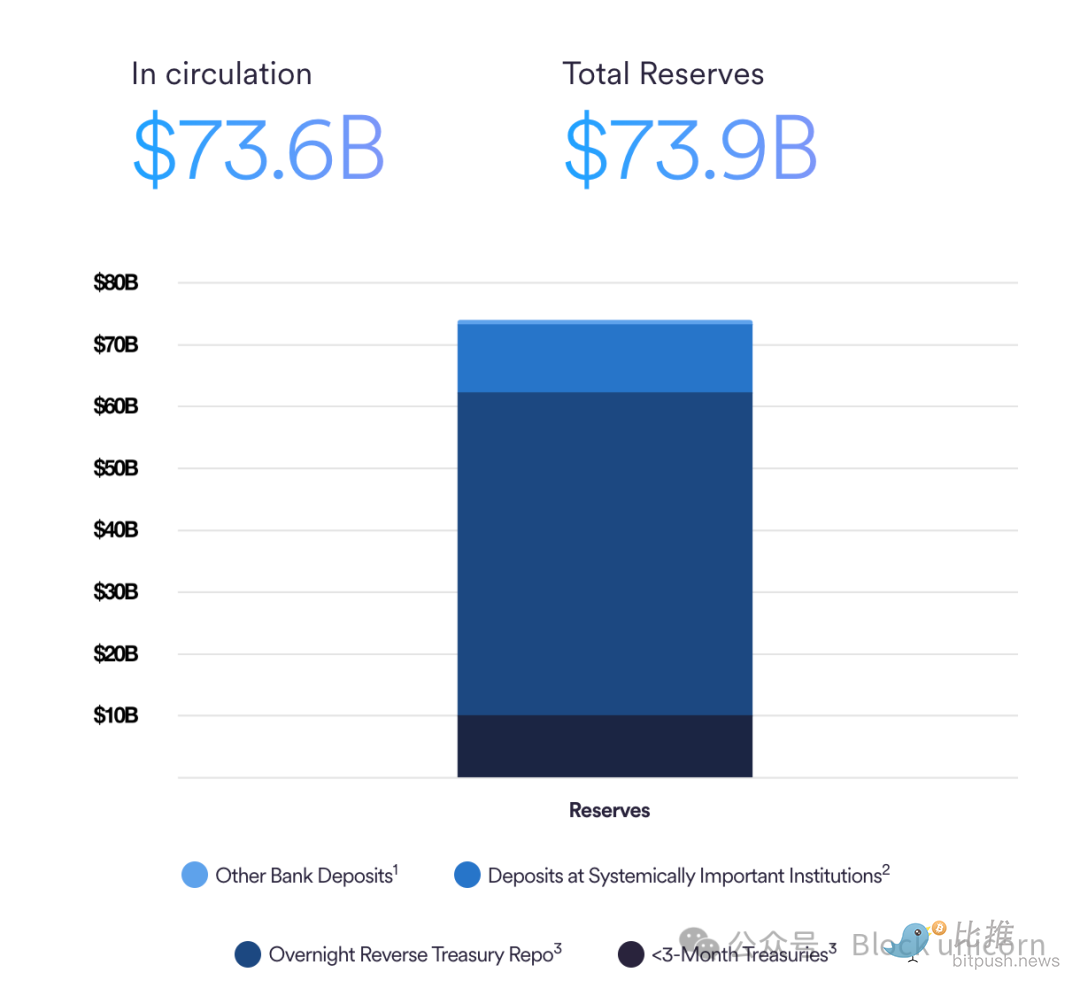
Without talking about the collateral issue, a problem came up next. The reason why one dollar is equal to one dollar is because everyone agrees on three things at the same time: the issuer has confidence in this money; reserves actually exist and can be used; and if the situation starts to get out of control, some people will intervene. Taking all three things into account, a dollar is a dollar, so you don't need to think about it anymore.
When one side fluctuates, the currency is priced individually by the issuer, just like in 1840. This is how money works.
Even checking accounts work the same way. The government guarantees all three at the same time, so you can't see it. Stablecoins, on the other hand, are different; you can clearly see how this machine works.
Tether is the world's largest USDC issuer and the least transparent. Its reserve report has been questioned for many years. In 2021, Tether reached a settlement with the New York Attorney General, admitting that its reserves were not always as sufficient as claimed. It has lent billions of dollars of reserves to affiliated companies. Circle, on the other hand, is regarded as a “good guy” and is favored by regulators. It is audited monthly and has been on the market since 2025. However, what happened in March 2023? Circle held $3.3 billion in USDC reserves at SVB when the Bank of Silicon Valley (SVB) went bankrupt. USDC fell to 87 cents over the weekend before the government backed SVB deposits. There are plenty of reserves, yet a dollar is only worth 87 cents in just 60 hours. Because people no longer believe USDC can be cashed out.
Today, every company in the payments sector wants to own its own dollar. PayPal has PYUSD, Ripple has RLUSD, USDG, which is run by the alliance, and a range of bank tokens launched by companies such as J.P. Morgan Chase and Western Union. In December 2025, the US Office of Monetary Affairs (OCC) issued trust banking licenses to Circle, Paxos, and three other cryptocurrency companies, and others followed suit. Due to being shut out, Tether issued an independent US token called USAT in order to return to the market.
Be sure to read the terms carefully, though. These are “trust bank” licenses, not insurance banking licenses. The Federal Reserve provided them with very limited account features, no overdraft limits, and no access to an emergency loan window — and the emergency loan window was the key to actually saving banks when the crowding started.
And the people you pay for tickets are their record companies.
Paxos, which issues PYUSD and six other branded tokens, was ordered by New York regulators to stop issuing Binance's stablecoins as early as 2023. Some newer tokens don't even have cash support. Ethena's USdE relies on derivatives trading strategies to maintain its fixed exchange rate.
The Act prohibits these issuers from paying you interest, so they seek ways to avoid it. Coinbase will pay “rewards” for USDC. PayPal, on the other hand, provided PYUSD with a 3.7% return. These attractive yields attract your money. Unlike regular bank accounts that are covered by the Federal Deposit Insurance Corporation (FDIC), these funds don't have any security guarantees.
Since stablecoin tokens are backed by US Treasury bonds, the money supply is still determined by Washington. Interest on these treasury bonds will eventually go to the issuer. With around 100 employees, Tether expects profits to reach around $10 billion in 2025, and holds even more US Treasury bonds than Germany.
But if all else fails, the losses will be entirely your responsibility. Crowding is like everyone is simultaneously flocking to a door that would only allow a trickle through. Stablecoins have a very narrow redemption channel. Most people can't redeem with Tether at all. They can only sell Tether to a few arbitrators, and Tether only has an average of about six arbitrators per month, and the minimum amount to be redeemed from source is $100,000.
If Tether crashes tomorrow, the price of 100 billion tokens will drop to 0. Tether holds so much treasury debt that it shakes up the treasury bond market itself when it is in a panic sell-off.
Washington stepped in because another option was a coordinated credit and liquidity freeze.
Moreover, governments don't even need a global economic collapse to do this. In 1971, in a vote to break the deadlock, the government saved Lockheed with a $250 million loan guarantee, saving 60,000 jobs and the Pentagon's largest supplier. An admiral who witnessed the incident called it “a new concept, that is, privatize profits and socialize losses.”
When America's largest railroad company, the Pennsylvania Central Railroad, went out of business in 1970, the government allowed the company to go bankrupt, then spent public funds to build the Conrell Railroad to take over its tracks because trains had to keep running.
A dollar token used by 250 million people easily met this requirement. For a long time, the government refused to guarantee private risk until private risk threatened the stability of public infrastructure.
There are many ways to solve this problem. What if instead of banks that might go out of business like Silicon Valley Bank (SVB), the issuer's reserves were stored directly in the Federal Reserve? The risk of crowding out would be greatly reduced, because the Federal Reserve is not as prone to bankruptcy as regional banks. Alternatively, you can let the issuer buy real deposit insurance, so you can pay this fee before the crisis hits.
The government could try taxing treasury bond gains and returning the proceeds to the risk-taking public.
But we definitely don't like these, right? The Federal Reserve's reserves mean that the Federal Reserve is now the last line of defense. Insurance means that a government agency guarantees it, just like the Federal Deposit Insurance Corporation (FDIC) puts pressure on the Treasury when things get really bad. Taxing earnings means treating these companies as public utilities. We don't want the government to get back involved in the monetary sector. This is the reason central bank digital currency (CBDC) was banned in the first place.
Let's go back to human history again. In about 375 BC, at an Athenian bazaar, the city hired a slave to sit at the banker's table to verify the authenticity of silverware. He would cut the gold-plated counterfeit currency in half and return the real money to the customer. As long as the silverware was pure silver, he would even let go of foreign silver coins imitating the Athenian owl pattern. There was also a law at the time that required all merchants to accept silverware certified by him.
2,400 years have passed, have we really reached our destination? The good news is that major changes are always accompanied by loopholes, which are gradually filled over time. Perhaps in ten years, reserves will be more adequate, and the rules will be more effective.
But what you need to focus on is the trade-off.
Think about what you would give up. Now, your dollars are covered by the Federal Deposit Insurance Corporation (FDIC), and the Federal Reserve can respond to fears by printing money. It's slow, but it's one of the most reliable assets you can hold. The bank loaned the dollar on the day it was issued. The Federal Reserve reduced the reserve ratio to zero in 2020, so by law, your bank doesn't have to hold a penny of your deposit. What really supports you is FDIC insurance, which holds approximately $154 billion in funds to protect the nation's savings. Simply put, for every $1 of the guarantee amount, there are about 1.5 cents in reserve. Even so, it still can't handle the systemic panic of syncing. If the fund is exhausted, the FDIC must immediately activate its backup line of credit with the US Treasury or coordinate with the Federal Reserve to print money to release emergency liquidity.
Within a month of 2023, three major bank failures in US history followed one after another: Silicon Valley Bank, Signature Bank, and First Republic Bank. To stop the rush, regulators broke the $250,000 deposit insurance cap and fully reimbursed all uninvested depositors for losses, similar to the emergency measures they later took for stablecoins. The move cost the fund around $20 billion.
Stablecoins are inexpensive and fast to trade. They are open around the clock, reserves are stored in vaults that can be viewed on-chain, and the best issuers publish receipts every month, which is far more information than banks disclose about the whereabouts of deposits.
I wouldn't hesitate to do this. Maybe you would too. You've read this article, you're already in it. You know what anchoring is, and you know where to start to anchor. But the real test lies with ordinary people. The reason this person uses USDC to receive payments is because it is the easiest dollar they can hold. And the reason this store accepts PYUSD is because the processing fee is lower. Most people never understand the risks behind such a simple system.
After all, convenience spreads much faster than understanding.
The value of your money depends on the issuer's credit, which in turn depends on the credibility of the country that guarantees it.
Twitter:https://twitter.com/BitpushNewsCN
Compare the TG exchange group:https://t.me/BitPushCommunity
Compare TG subscriptions:https://t.me/bitpush
