主网上线 · 1210

Arthur Hayes clarifies Flop Labs hasn't issued any tokens

BitMEX co-founder Arthur Hayes wrote an article clarifying that Flop Labs has not issued any tokens, no pre-sales, and no memecoins. There are currently no $FLOP tokens. Hayes said he will personally announce the airdrop in a few months when it starts, and will separately notify relevant developments when the main network goes live next year.

12h ago

HertzFlow's $4.44 million USD1Genesis Vault has been filled, and the mainnet will open for trading on August 24

In comparison, HertzFlow announced that its $4.44 million USD1 Genesis Reserve Vault has been fully booked. HertzFlow officially stated that this is an important milestone before the launch of the main network of the project, and final preparations are currently being made for the official opening of the main network for trading on August 24. According to reports, HertzFlow aims to create a leveraged trading market with assets supported by oracles without permission, further activate BNB Chain's on-chain liquidity through composable DeFi strategies, and transform more on-chain capital into liquid assets that generate sustainable returns.

1d ago

Ripple lays out the RLUSD lending ecosystem to support institutional credit funds to provide loans to fintech companies

In comparison, Ripple is supporting a new institutional credit fund that will partner with lending platform Clearpool and credit management agency Cicada Partners to provide working capital loans to fintech and payment companies using RLUSD, a stablecoin issued by Ripple on XRP Ledger. According to the disclosure, the fund will issue loans in RLUSD. Cicada Partners will be responsible for finding borrowers, formulating loan terms, and managing credit risk; Clearpool will be responsible for building the infrastructure to create and manage loan pools; and Ripple will provide financial support as one of the investors, but the exact size of the investment has not been disclosed. Currently, this product is not available on the XRP Ledger mainnet. Ripple will participate as a limited partner, enjoy the same terms as other investors, and will not be liable for loan losses. Borrowers will receive RLUSD and use RLUSD to repay loans, which will drive demand for this stablecoin while introducing borrowing activity to XRP Ledger.

1d ago
Will compliant ICOs be revived? New SEC regulations open up a financing channel for the cryptocurrency industry

Will compliant ICOs be revived? New SEC regulations open up a financing channel for the cryptocurrency industry

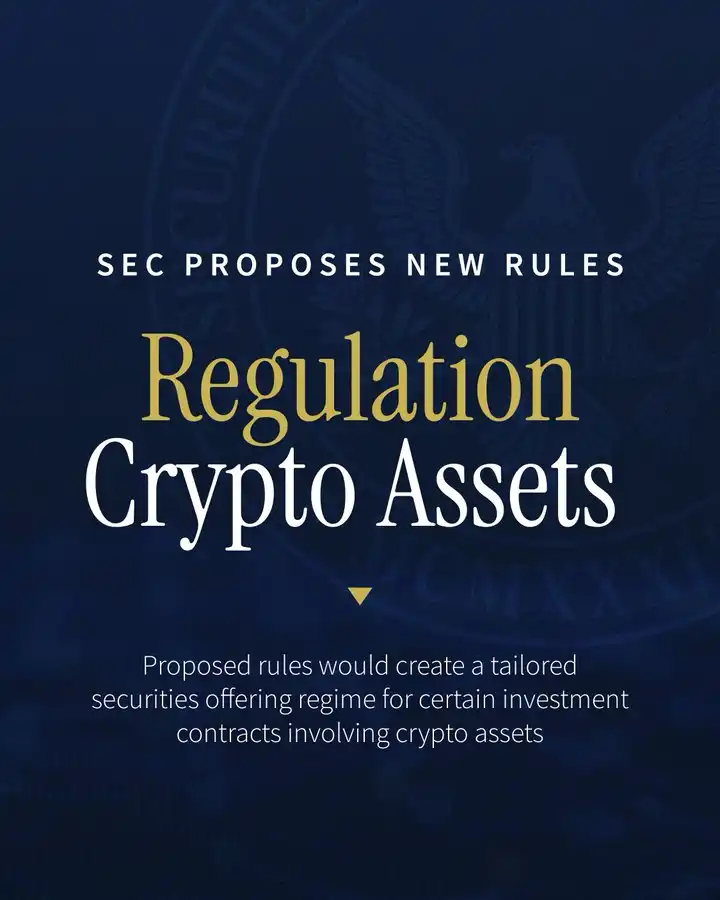
Source: ChainCatcher Author: 0xFACAI Original title: The biggest benefit for the coin industry, is compliant token financing coming back? Public coin sales and financing have once again gained a legal path in the US. On August 18, the US Securities and Exchange Commission released a draft “Regulation Crypto Assets”. According to this draft, startups can raise $5 million in up to four years, and larger projects can raise $20 million or $75 million in 12 months. Without completing a complete set of securities registration, the project can also sell tokens to investors to raise money for network development. The biggest benefit for the coin industry, is compliant token financing coming back? Sounds like ICOs are back. But the SEC gave far more than three funding lines. It wants to establish a set of rules for tokens from birth to “graduation”: projects can be sold to finance first, but it is necessary to clearly explain what to do with this money; if the key work promised by the team is not completed, the token continues to carry the regulatory responsibility for investment terms; only after fulfilling the promise, the token has a chance to exit this level of relationship. “Promises” are the core of the entire draft, and devs must “work” until the token “graduates” before they can “sell”. The draft rules gave the project parties two options. The first type is suitable for startup teams. Assuming a project required $3 million to develop, common choices in the past were to seek venture capital, limit buyers and issue coins outside of the US, or incur the high cost of registering securities. The new draft allows it to use the “startup exemption,” raise no more than $5 million over a maximum period of four years, and file with the SEC when the funding starts and ends. The second type is suitable for projects with greater funding requirements. The first tier raised up to $20 million every 12 months, and the second tier raised up to $75 million. Compared to the $5 million startup exemption, this path can be used over and over again, but the rules are more stringent. Projects can't just hand in a white paper and start selling coins. Both exemptions require the team to disclose how the network is being managed, how the product is being prepared and developed, what security risks the code has, what the company's financial situation is, and who is managing the project. The two larger funding levels also require financial statements to be provided and continuously updated, and the $75 million tranche requires an audit. The SEC didn't remove the original fence either. Issuers and insiders with a record of serious violations cannot use these exemptions, and anti-fraud and anti-manipulation responsibilities remain in effect. If the project uses other securities exemptions at the same time, it must also comply with existing consolidated financial calculation rules. The most important aspect of how to define “graduation” in the entire draft is to treat tokens separately from the investment relationships formed around tokens. A project sells coins to raise money to build a network. Buyers often buy more than just a digital asset that can already be used. They are also expecting the team to create products, attract users, increase token demand, and profit from these efforts. This relationship, which depends on the team's future work, is what the SEC calls an “investment clause.” The token itself can be just a digital asset, but how the project sells it and what it promises to the buyer makes it covered by a layer of investment terms. What the SEC really regulates is this level of relationship between issuers and buyers. The draft designs an exit path for the token. The token can only enter a “safe harbor” after the issuer has completed or permanently ceased all key management tasks of its promises, no new related commitments, and then submitted public certification and analytical instructions to the SEC. As a result, tokens have the concept of “graduation.” When the project is sold and financed, construction is promised to the market. After the project is completed and key tasks are completed, the buyer can no longer rely on the team to fulfill the old promises before the token can “graduate” and the project party can withdraw. The new regulations don't focus on whether tokens are considered securities. In the past, the market judged when a token was no longer subject to securities laws, and often questioned whether the network was “decentralized enough.” As long as the foundation, development company, or founding team continues to work, many people will understand this as the token still relies on a central entity. The SEC draft changed the question: what promises did the project rely on to sell the tokens, and are those promises fulfilled now? Take an example. When Project A sells coins, it tells investors that the team will develop the main network, launch transfer and pledge functions, and then leave the network to a decentralized validator to operate. The main network was later launched, and the features were also available, but the validators were still controlled by the team. Since “decentralizing the network” was also a promise at the time of financing, the token is still unable to “graduate” at this point. When Project B sells coins, it only promises to create a network that can function properly, without “the team must disappear” or “the network...

2d ago22#ICO #SEC
“Graduation rules” under SEC's new rules: token financing is legal, but too many promises make it impossible to get away

“Graduation rules” under SEC's new rules: token financing is legal, but too many promises make it impossible to get away

Author: 0xFACAI Original title: The SEC threw a bombshell, is the spring of compliant token financing finally here? Public coin sales and financing have once again gained a legal path in the US. On August 18, the US Securities and Exchange Commission released a draft “Regulation Crypto Assets”. According to this draft, startups can raise $5 million in up to four years, and larger projects can raise $20 million or $75 million in 12 months. Without completing a complete set of securities registration, the project can also sell tokens to investors to raise money for network development. Sounds like IC0 is back. But the SEC gave far more than three funding lines. It wants to establish a set of rules for tokens from birth to “graduation”: projects can be sold to finance first, but it is necessary to clearly explain what to do with this money; if the key work promised by the team is not completed, the token continues to carry the regulatory responsibility for investment terms; only after fulfilling the promise, the token has a chance to exit this level of relationship. “Promises” are the core of the entire draft, and devs must “work” until the token “graduates” before they can “sell”. The draft rules gave the project parties two options. The first type is suitable for startup teams. Assuming a project required $3 million to develop, common choices in the past were to seek venture capital, limit buyers and issue coins outside of the US, or incur the high cost of registering securities. The new draft allows it to use the “startup exemption,” raise no more than $5 million over a maximum period of four years, and file with the SEC when the funding starts and ends. The second type is suitable for projects with greater funding requirements. The first tier raised up to $20 million every 12 months, and the second tier raised up to $75 million. Compared to the $5 million startup exemption, this path can be used over and over again, but the rules are more stringent. Projects can't just hand in a white paper and start selling coins. Both exemptions require the team to disclose how the network is being managed, how the product is being prepared and developed, what security risks the code has, what the company's financial situation is, and who is managing the project. The two larger funding levels also require financial statements to be provided and continuously updated, and the $75 million tranche requires an audit. The SEC didn't remove the original fence either. Issuers and insiders with a record of serious violations cannot use these exemptions, and anti-fraud and anti-manipulation responsibilities remain in effect. If the project uses other securities exemptions at the same time, it must also comply with existing consolidated financial calculation rules. The most important aspect of how to define “graduation” in the entire draft is to treat tokens separately from the investment relationships formed around tokens. A project sells coins to raise money to build a network. Buyers often buy more than just a digital asset that can already be used. They are also expecting the team to create products, attract users, increase token demand, and profit from these efforts. This relationship, which depends on the team's future work, is what the SEC calls an “investment clause.” The token itself can be just a digital asset, but how the project sells it and what it promises to the buyer makes it covered by a layer of investment terms. What the SEC really regulates is this level of relationship between issuers and buyers. The draft designs an exit path for the token. The token can only enter a “safe harbor” after the issuer has completed or permanently ceased all key management tasks of its promises, no new related commitments, and then submitted public certification and analytical instructions to the SEC. As a result, tokens have the concept of “graduation.” When the project is sold and financed, construction is promised to the market. After the project is completed and key tasks are completed, the buyer can no longer rely on the team to fulfill the old promises before the token can “graduate” and the project party can withdraw. The new regulations don't focus on whether tokens are considered securities. In the past, the market judged when a token was no longer subject to securities laws, and often questioned whether the network was “decentralized enough.” As long as the foundation, development company, or founding team continues to work, many people will understand this as the token still relies on a central entity. The SEC draft changed the question: what promises did the project rely on to sell the tokens, and are those promises fulfilled now? Take an example. When Project A sells coins, it tells investors that the team will develop the main network, launch transfer and pledge functions, and then leave the network to a decentralized validator to operate. The main network was later launched, and the features were also available, but the validators were still controlled by the team. Since “decentralizing the network” was also a promise at the time of financing, the token is still unable to “graduate” at this point. When Project B sells coins, it only promises to make a network that works properly; it does not include “the team must disappear” or “the network must reach a certain degree of decentralization” in the financing promise. Wait until the Internet is online and produced...

3d ago律动BlockBeats#SEC #financing

Curve H1 progress: Llamalend V2 launched, FastBridge shortens cross-chain time, plans to increase protocol rates

According to Curve.Finance Governance, Swiss Stake AG submitted an H1 2026 progress report, Llamalend V2 has been audited by ChainSecurity and launched on the Optimism and Ethereum mainnet, supports LP Token and PT collateral, and introduces a new admin revenue fee for Curve DAO. FXSwap has entered the production optimization phase to conduct research on liquidity concentration, price_scale, and dynamic rates. FastBridge has launched Arbitrum, Optimism, and Fraxtal, shortening the withdrawal time of crvUSD from Tier 2 to Ethereum from about 7 days to about 15 minutes. The team has received the second phase of 8.725 million CRV and additional CRV and crvUSD funding to support operations until the end of 2026, and plans to submit a proposal to raise the DAO agreement fee share from 10% to 30%.

3d ago

Uniswap will be deployed synchronously when the Arc mainnet goes live in September

Comparatively, Uniswap announced that it will complete deployment when the Arc mainnet is officially launched in September to provide developers with deep on-chain liquidity infrastructure and support the construction of DeFi applications such as lending, structured products, LP strategies, and token issuance. Arc is a public chain owned by Circle. It uses USDC as the gas token and has sub-second deterministic finality.

4d ago#On-chain dynamics

BNB Chain will launch Pasteur hard fork on August 25th

According to news, BNB Smart Chain (BSC) announced that the Pasteur hard fork will be officially launched on the main network at 10:30 Beijing time on August 25 (02:30 on August 25 UTC), and node operators will need to upgrade to the client version v1.7.7 in advance. The upgrade includes three improvements: BEP-682, BEP-695, and BEP-675, which focus on improving cross-chain security, validator governance mechanisms, and network throughput capabilities. Among them, BEP-682 will strengthen the BNB Chain cross-chain bridge verification mechanism, prevent the risk of permission bypass caused by repeated calculation of verifiers' signatures, and improve the security of cross-chain asset transfers. BEP-695 optimizes the validator key rotation mechanism to ensure that old keys no longer retain administrative rights after exit, while fixing potential vulnerabilities related to penalties and governance voting. In terms of performance, BEP-675 reduces the time consumption caused by validators repeatedly executing transactions by optimizing the block construction process. In the BNB Chain internal QAnet test environment, the solution increased throughput from 1237 TPS to 2324 TPS, and the average block gas usage increased from 46.35 million to 84.15 million while keeping the 450 ms block generation time and 100 million gas block limit unchanged. BNB Chain said the upgrade is mainly aimed at validators and block builders to provide greater capacity during peak network periods and drive the throughput expansion goals in BNB Chain's roadmap for the second half of 2026.

8d ago#On-chain dynamics

Enterprise blockchain infrastructure Aventus launches Aventus Cloud node sale

On August 12, Aventus, an enterprise blockchain infrastructure provider, announced the official launch of Aventus Cloud node sales. The program aims to expand participation in Aventus network infrastructure by enabling individuals and institutions to run nodes with available computing resources. Established in 2017, Aventus has provided blockchain infrastructure for enterprise applications in the aviation, energy, telecommunications and other industries, and has become a Polkadot parachain. Aventus Cloud went live on the mainnet in April 2026. Nodes can handle verification network activities, and eligible operators can receive network rewards. Currently, Genesis Tranche node licenses cost $1,755, and the network is ultimately planned to have up to 40,000 nodes, and over 2,500 nodes are already active.

10d ago
Some people use it, have brands, and don't issue coins. Why has POAP reached the end?

Some people use it, have brands, and don't issue coins. Why has POAP reached the end?

Author: imToken Original title: When POAP also comes to an end: When the “wave of bankruptcies” in the crypto industry hits, how can ordinary users cope with themselves? Recently, the crypto industry seems to have entered an intensive farewell period. From BitMEX, which has been in operation for 11 years, to Satori Finance, which has received investment from top institutions such as Polychain and Coinbase Venture, one familiar name after another has ceased operations and officially reached the end, covering various directions such as trading platforms, DeFi, wallets, NFTs, and infrastructure. Among them, POAP's departure was unquestionably particularly impressive. If you've gone through the previous crypto cycle, especially if you've participated in Devcon, ETHDenver, Hackathon, DAO community events, or various online and offline meetups, many people can probably pull out a few POAPs from their wallets. It may be from a conference, an online sharing, or just a community event where you can't remember the details. Most of these POAPs aren't worth much, but because of this, they're probably closer to the original meaning of “collecting” than many NFTs that used to be expensive. It is for this reason that POAP's farewell is particularly representative. It didn't suddenly go back to zero due to hacker attacks, and didn't even issue a native token that needed to continuously maintain price expectations. It just had real users, clear scenarios, and a high enough brand awareness, but in the end, it still hasn't found a business model that can support the company for a long time. This is exactly what is changing in the crypto industry today. In the past, we were more accustomed to discussing how a project was born; next, we may need to get used to discussing how a project dies. And this isn't necessarily a bad thing. However, as regular users, we need to know how to avoid being affected by the aftershocks of a bear market. 1. A new form of “shutdown wave” swept through the Web3 encryption industry. In the last round of expansion, it is actually not difficult for a project to prove that it was “founded.” The completion of financing, the launch of the main network, the issuance/airdrop, and a round of liquidity incentives are enough to attract the first batch of users. TVL, number of addresses, and transaction volume can quickly grow. Even over a long period of time, whether a project actually has revenue is not the most urgent issue. However, when the cycle is reversed, and token prices and liquidity cannot continue to perform financing functions, this model will reveal one of the easiest questions, which is, if no new money comes in, can this project support itself? This round of projects came to an end in 2026, and this is where the real focus is also on. Because many of those that have disappeared are not air projects that had no products at the beginning, but projects that have already been funded, launched, have real users, and even run well technically. For example, on July 23, BitMEX announced that it would officially shut down the trading platform on September 23, 2026. This trading platform, founded in 2014, was once one of the most representative companies in the entire crypto derivatives market. Perpetual contracts, 100x leverage, and a complete set of trading products that were later widely used by the entire industry are closely related to the early development of BitMEX. It even specifically emphasized in its official shutdown announcement that “in more than 11 years of operation, BitMEX has never lost user funds due to hacking,” but this has not made it an infrastructure that can run permanently. A similar story happened on the DeFi and infrastructure circuit. As a Bitcoin L2 project that has been under construction for nearly four years, Botanix has maintained 100% normal operation and zero security incidents since its launch. It has processed about 25 million transactions, 200,000 wallet addresses, and tens of millions of dollars of assets have entered the network, and is connected to infrastructure and DeFi products such as Chainlink and Morpho. Looking only at traditional Crypto KPIs, it's hard to even call it a “no-go” project — the chain has been created, the products can be used, the users have come, and the money has come in. But in the end, Botanix decided to shut down the network, and the review showed that the actual transaction demand was insufficient to generate sufficient fee revenue and could not cover the infrastructure costs required for the long-term operation of an independent network. At the end of the day, Crypto used to be too used to measure an ecosystem with TVL, number of addresses, and number of transactions, but it rarely asked that last question:...

12d agoburnking