代币化美股 · 52

Dinari and Circle launch tokenized US stock platform, plan to add S&P 500 constituent stocks to the chain

According to the news, Dinari, a California-based tokenized securities company, announced a partnership with stablecoin issuer Circle to provide blockchain-based tokenized stock trading services to US investors, and plans to introduce the entire S&P 500 index constituent stock to the chain. Dinari said that its platform represents underlying stocks through DShares, and each token corresponds to real securities managed by a regulated authority. Investors can use USDC to trade stocks through self-hosted wallets, and supports functions such as instant settlement and cross-platform asset transfers. The model aims to connect the approximately $300 billion stablecoin market with the US stock market of more than $60 trillion. Currently, the Dinari platform has been launched in 85 jurisdictions, supporting more than 6000 tokenized assets. This article is sponsored by GENG, Build Your Fortune on GENG (https://geng.one)

18d agoburnking

Bitget released rToken institutional cross-asset management guidelines, and unified accounts support over 370 types of collateral assets

Comparatively, Bitget published rToken's institutional cross-asset capital management guide, detailing how market makers, hedge funds, quantitative trading companies, primary brokers and asset management companies can use their cross-asset unified accounts (UTA) to improve capital efficiency between cryptocurrencies and tokenized US stocks. The guide focuses on portfolio construction and financing strategies, covering core transaction scenarios such as cross-asset collateral, dividend arbitrage, and borrowing structures that balance capital efficiency and risk isolation, providing a practical framework for institutions to optimize multi-asset allocation. Currently, Bitget's Cross-Asset Unified Account (UTA) supports over 370 collaterable assets, including 105 tokenized US stocks. Eligible crypto assets and tokenized stocks can enter the same margin system, share collateral and offset margin requirements, and help institutions reduce idle funds scattered in exchange and brokerage accounts. Bitget CEO Gracy Chen said that institutions do not lack access to the stock market; the real challenge is how to move capital efficiently between different markets. As tokenized assets gradually enter institutional portfolios, managing crypto assets and tokenized stocks under a unified framework will provide more possibilities for risk management and asset allocation.

24d ago
A new face on the DTCC list: How can Ondo eat 70% of tokenized US stocks?

A new face on the DTCC list: How can Ondo eat 70% of tokenized US stocks?

Author: Curry, Shenchao TechFlow Original title: On-chain US stocks became the main line of the version. ONDO rose 30% in three weeks. What kind of catalyst is capital hyping up? When the market is bad, seeing who is still rising may be a sign of investigating which projects will still work. Bitcoin has been grinding at $63,000 for almost a month, and most of the altcoins are lying on the floor and no one is watching. The crypto market was basically in the same state in the first half of this year. After memes subsided, money and attention were finding their next destination. The meme on Robinhood is part of it, but currently there is also a trend of falling back; RWA is another high-confidence battleground. For example, the ONDO token was still at $0.31 at the beginning of July, but now it's around 0.40, and has risen nearly 30% in three weeks. This could of course be a bookmaker's pick or market value management. But what's even more interesting is that ONDO's rise occurred in a larger context. On Hyperliquid, the trading volume of tokenized stocks and commodities reached $25.1 billion in the third week of July. According to Startup Fortune, it surpassed the trading volume of crypto assets on the platform for the first time. Trade [XYZ] has launched SpaceX and the latest Changxin Storage on-chain contract, and tokenized stocks already account for 23 of Hyperliquid's top 30 assets. Binance also followed suit, taking 56% of RWA perpetual contracts in the CEX market. Even the SEC is discussing opening an “innovation exemption” for tokenized stock trading. In other words, trading US stocks on a chain is clearly the main line of this version of encryption. Ondo, on the other hand, happens to be the most action-intensive one on the main line recently. Of the US stock contracts on Hyperliquid, most of them are Ondo's shipments, ONDO, which rose 30% in this round. If you only see “another RWA concept coin rising,” you will lose money. Ondo's position on this table is different from Hyperliquid and Binance. Hyperliquid and Binance are stealing trading volume. Trade [XYZ] achieved 79% of the RWA Perpetual Circuit's open positions, and Binance's cumulative RWA perpetual transaction volume in the first quarter was $450 billion. To use an inappropriate analogy, they opened a restaurant, and Ondo was for food. Most of the underlying assets of the tokenized stock contracts listed on trade [XYZ] come from Ondo Global Markets. According to aInvest, Hyperliquid's on-chain tokenized shares accessed through Felix Protocol in May of this year are also tokens issued by Ondo. According to RWA.xyz data, Ondo Global Markets has a share of over 70% on the tokenized stock issuer side, a TVL of over $5 billion, and a cumulative trading volume of over $18 billion. There are more than 260 tokenized US stocks and ETFs on the platform, spread on Ethereum, Solana, and BNB Chain, distributed through channels such as Binance, Bitget, MetaMask, and Blockchain.com. When the DTCC news came out on July 15, ONDO rose 18% on the same day. For an old token, the market reacted so violently. This is the reason. DTCC is the settlement and clearing center for US stock trading, and almost all US stock transactions eventually have to go through it. On-chain US stock certificates issued by Ondo through DTCC tokenization services, and BlackRock and J.P. Morgan, Goldman Sachs, and Nasdaq appeared on the same list of participants. This is not a “partnership announcement” level message; this is a distribution channel level message. When Ondo went from being a supplier to starting its own store, and Perps data analysis accounted for 70% of the upstream share, Ondo began to eat downstream. Ondo Perps, which went live on July 7, is equivalent to Ondo opening its own trading platform. US stocks, ETFs, and commodities perpetual contracts with up to 20x leverage. This platform...

25d agoburnking#MEME #RWA #token #Bitcoin #US stocks
The head of Robinhood Crypto personally stated: Meme+ tokenizing US stocks is a “barbell” customer acquisition strategy, and all business lines have already achieved hundreds of millions of dollars in revenue

The head of Robinhood Crypto personally stated: Meme+ tokenizing US stocks is a “barbell” customer acquisition strategy, and all business lines have already achieved hundreds of millions of dollars in revenue

Original title: Johann Kerbrat: Inside Robin Hood's Crypto Strategy (Full Coverage) Original Article Source: TheRollup Compilation: Shenchao TechFlow Interest Statement Johann Kerbrat is a Robinhood executive responsible for the entire crypto business product line (including Robinhood Chain, tokenized stocks, pledge services, and perpetual contracts), Its compensation and equity incentives are directly tied to $HOOD's share price. All discussions on the Robinhood Chain in this issue relate to the business it is directly responsible for. The title uses an “insider's perspective” rather than an “analysis” to reflect this interest. Abstract Three weeks after the main network of Robinhood Chain was launched, the weekly DEX volume exceeded $3 billion, the number of transactions exceeded 105 million, and the TVL exceeded 300 million dollars. Johann Kerbrat explained the chain's strategic logic in detail for the first time in a podcast: why the “barbell” layout (meme tokens + real-world assets in parallel) was chosen, why the Arbitrum technology stack was used instead of self-built L1, and how to gradually move Robinhood's 27 million deposit account onto the chain. He made it clear that the competition is focused on “expanding the cake” rather than grabbing shares with Base, and revealed that tokenized stocks have covered 120+ countries and 90+ targets, and will expand to international stocks and private equity markets in the future. Key quote “Our philosophy is to make the chain permissionless and open to everything. Whether it's a meme or an RWA, there are many products that people can't resist. We are deeply integrating with the chain.” “Robinhood has 27 million deposit accounts. For these users, DeFi is still too complicated and requires too much technical knowledge. We're thinking about how to bring in a good DeFi product while making it easy to use and use without creating a wallet or managing private keys.” “I think competition is ultimately beneficial to the customer. We cut fees by a large margin when the crypto exchange went live. It's still too early on the chain, and it's too early to discuss market share.” “We've only been online for three weeks. If you're thinking about bringing tens of millions of users to the chain, bringing more utility, and bringing something that people actually use (not just a moment of fluctuation), then you're thinking about a long-term revenue stream.” “We don't want to see all of Robinhood's trading activity going to the chain next year. That was a bit of a dream. But if you can find things you can't do with traditional methods, such as international stocks and 24/7 trading, chains can be the solution.” 1. Data for three weeks of launch: The $3 billion weekly trading volume is only the starting point. After the launch of the Robinhood Chain mainline, the weekly DEX volume reached $3 billion, more than 50 million transactions, more than 1 million addresses, and a TVL of over $300 million. Kerbrat's response was straightforward: this data has already been surpassed. He said that the number of transactions that morning had already surpassed 105 million. He described the state of the team as “very excited”. The core idea is that this figure reflects the intensity of market demand for products on the chain. He specifically emphasized that the ecosystem was ready to accept developers from the beginning, rather than build it first and then wait for others to come. This is different from many paths where L2 goes live and then slowly drains. 2. “Barbell” Strategy: Why do memes and RWA go hand in hand The host mentioned an interesting phenomenon: Robinhood CEO Vlad Tenev described the on-chain ecosystem as a “barbell” structure on social media. One end is a meme token, and the other end is a real world asset (RWA), and said “you have two wolves in your heart.” Kerbrat explained the internal thinking. From day one, the chain was set to be permissionless (permissionless) and open to all types of apps. Meme tokens bring in market makers and DeFi users, while RWA serves users around the world who are unable to easily buy US stocks and ETFs. There is no contradiction between the two; rather, they each attract different groups. He also mentioned several integrated products that have already been launched: Robinhood Earn (receiving stablecoin earnings through on-chain agreements within the main app) and tokenized stocks (through Robinhood W...

26d agoWendy#Johann Kerbrat #MEME #Robinhood #Tokenized US stocks

a16z: The tokenized stock market is expanding at an accelerated pace, and the share of AI and chips has risen to 15.5%

According to Twitter, a16z crypto posted an article stating that as of the end of June, the total market value of tokenized stocks reached about 1.7 billion US dollars, an increase of more than 5 times over US$329 million a year ago, and has become one of the fastest growing tokenized asset classes. More than half of the current market capitalization comes from assets that were not on the chain a year ago, indicating that growth was mainly driven by new issuances, not just by rising prices of underlying stocks. The market structure has also changed markedly. The share of crypto-related products in market capitalization fell to 21% from 79% a year ago; the share of other categories made up of hundreds of small targets rose to 35%. The share of large technology stocks rose from 0.6% to 10.6%, and the share of ETFs and index products increased from 4.5% to 17.3%. AI and chip tokenized stocks grew the fastest, and their share of market capitalization rose to 15.5% from 0.3% in June 2025. On-chain activity increased at the same time. Monthly tokenized stock transfers reached $9.22 billion in June, an increase of more than 170 times over $53 million in the same period last year. Related transactions include on-chain transactions, inter-wallet transfers, and depositing collateral into DeFi protocols. Institutional infrastructure is being implemented at an accelerated pace. DTCC has completed the first batch of tokenized US bonds and stock production environment transactions on Canton Network; Robinhood has launched its own chain; the NYSE parent company has formed a joint venture with OKX to provide tokenized NYSE shares after approval; and Coinbase and Binance have also launched or plan to launch tokenized US stock services for non-US users.

31d ago
Social experiments failed, competition approached, and Base completely switched to the financial circuit

Social experiments failed, competition approached, and Base completely switched to the financial circuit

Author: Gu Yu, ChainCatcher Original title: Base founder Jesse rarely publicly admits strategic mistakes. On July 15, Jesse Pollak, founder of Base, published a long article announcing that he would return the leadership of the Base App to Coinbase, while devoting all his energy to the Base blockchain itself, with the goal of making Base a “global financial blockchain.” Jesse will continue to lead the Base Chain, but will no longer be responsible for the Base App; the Base App will be taken over by Jordan Fish, known as Cobie in the crypto community. The most notable adjustment was not Jesse's departure from the Base App, but rather his rare admission of Base's strategic misdecisions in the social direction of the past two years. In the past, Base tried to establish itself as a consumer-grade entrance into the crypto world. From Farcaster to Zora, from creator coins to miniapps, to Base App, Base hopes to use “on-chain social + creator economy” to bring more regular users to the chain. But now, Pollak personally admits: Base bet on the right builder and misplaced the social network. This statement can almost be viewed as a phased judgment in the Base social experiment. On-chain social networking has not become the center of the next round of adoption; what really comes out is predicting markets, perpetual contracts, stablecoins, and tokenized assets. It's not that users don't want to go online; they don't want to go online for the sake of social networking itself. They are more willing to go on the chain for transactions, payments, earnings, and speculation. 1. What did Jesse say? In the long post, Jesse reviewed in detail the reflections and adjustments of the past six months. “The first quarter of 2026 was a big punch,” he confessed. Over the past two years, Base has made a two-track bet: one is believing that builders will unlock the next wave of cryptographic adoption; the other is believing that adoption will be driven by “new on-chain native social experiences” (creators, content, messages). The result: “Our bet on builders was right, but our bet on social was clearly wrong.” Builder is indeed driving a wave of adoption — predicting markets, perpetual contracts, and stablecoins as the strongest growth engines — but social networking isn't at the center. Instead, “the entire social side marketplace we've been trying to build — Farcaster, Zora, miniapps, and yes, creator tokens — has completely crashed.” He said bluntly: “I was wrong. Whether the timing is wrong... or completely wrong, only time will tell, but in any case, I'm sure it was wrong.” Collateral damage is quite serious: Base lags behind in key areas — perpetual contracts (although Avantis, etc.) and the prediction market (although Limitless, etc.) all lag behind mature competitors; there is also plenty of room for improvement in enterprise-level tokenization and payment unlocking. People lost confidence, and CT reminded him of his mistakes every week. Jesse said that this year was a practice of “eating shit.” But the lesson he learned was: when things feel the worst, the best thing to do is to bow down and build. He has refocused his attention from the app to the chain, started writing code again, introduced features such as Azul, Beryl, B20, privacy, ledger, etc., and re-examined the hypothesis: Does crypto need social networking to grow? Does Base need an app? Can Base be bigger than Coinbase? The conclusion turned clear: “Better money is enough — we're seeing this in real time through stablecoins, forecasting, perpetuity, tokenization... I'm now focusing on getting one billion people on the chain by making global finance actually work.” The three main pillars of 2026 are: winning transactions (all assets, including tokenized stocks, memes, app coins, etc.), payments (global stablecoins, effective for individuals and businesses), and proxies (AI agents accelerate everything, because encryption is the native currency of computers, AI will create trillions of new economic participants). He has returned the Base App to Coinbase, led by Cobie, and allowed it to expand beyond the Base ecosystem (something he “wouldn't like” as the leader of Base). He stressed that builders are still the cornerstone, and Base will continue to support them through Base Layer, Batches, Ecosystem Fund, etc. 2. Why is Base's social dream shattered...

37d agoburnking#AI
CEX buying US stocks? You probably just bought a “digital IOU”

CEX buying US stocks? You probably just bought a “digital IOU”

Source: IOSG Ventures Authors: Ethan, Xinyang, IOSG Original title: Did you buy US stocks at CEX: Dismantling the 94% liquidation monopoly and evaporation of equity under the five-tier pipeline In 2026, CEX intensively launched US stock trading products, creating a prosperous narrative of “using USDT to seamlessly trade NVIDIA” at the front end of the industry. However, if you break away from its silky trading interface and examine the legal relationships and liquidation process behind it, you'll find that this is not a simple “RWA asset revolution,” but rather a complex game of interests involving spot pricing, equity ownership, and the underlying escrow monopoly. The three paths of US stocks are divided in terms of capital flows, asset forms, and the most fundamental legal relationships. Currently, CEX US stock trading products on the market are not in the same category. In the dark part of the highly homogenized front-end transaction interface, they are divided into three completely different evolutionary paths based on differences in underlying assets and legal relationships: the coexistence of these three models is not an overnight product design result, but a product of continuous compromise and iteration in the on-chain ecosystem over the past few years between liquidity efficiency and traditional compliance and settlement friction. The early exploration of offshore tokenization (Tokenized) and the beginning of the limited liquidity circuit stemmed from early on-chain tokenized securities (xStocks) experiments in 2021-2024, represented by Backed Finance (xStocks) and Ondo Finance. The core of the business at this stage is to establish a special purpose company (SPV) in an offshore jurisdiction to map and mint corresponding token certificates (such as AAPLx) on the chain by fully collateralizing real shares off-chain. This type of asset has the native characteristics of cryptographic assets. It can refer to Web3 wallets and circulate on the chain without permission, completing the paradigm of assets going from 0 to 1 on the chain. However, while traditional financial native clearing giants have yet to substantially enter the crypto ecosystem, this model shows serious supply-side scarcity and scale limitations. Due to a lack of underlying liquidity support from mainstream centralized exchanges (CEXs), these tokenized assets can only circulate in a few decentralized protocols or second-tier platforms, causing the total asset management scale (TVL) of the entire circuit to remain low for a long time. As of August 2025, the total asset management scale (TVL) of the entire network chain was less than 100m. This characteristic of “asset mapping and no transaction friction efficiency” made early tokenized US stocks inevitably reduced to low liquidity deposits on the chain and failed to actually reach mainstream retail traders. Synthetic perpetual contracts: pure price derivatives game In order to make up for the shortcomings of lack of liquidity in spot tokenization, US stock/ETF perpetual contracts quickly became the main players in the market. In September 2025, Bitget pioneered the launch of US stock perpetual futures and quickly expanded the number to more than 40, with a cumulative trading volume of over $15 billion. But what really set off the racetrack was HIP-3 (unlicensed perpetual contract deployment mechanism) launched by Hyperliquid on October 13, 2025, which completely activated the all-weather equity derivatives market. As of June 2026, the nominal holdings (OI) of perpetual contracts related to US stocks have exceeded US$2.25 billion. Among them, Hyperliquid dominates with HIP-3, and its permanent holdings in the Nasdaq-100 (XYZ100) and S&P 500 indices have exceeded US$310 million and US$340 million, respectively. Binance also strongly followed suit in early 2026, gaining more than 56% of the CEX market share in the RWA sustainability sector. In particular, pre-IPO derivatives such as SpaceX (SPCX) can peak at several billion dollars in a single day. Furthermore, the cumulative trading volume of Korean stock perpetual futures (Samsung, SK Hynix, Hyundai), which was launched by Binance in early June 2026, was about US$470 million in the first week, of which SK Hynix contributed more than 90%, and the daily trading volume often exceeded 100 million US dollars, showing that retail leveraged traders are keenly interested in global hot targets such as AI semiconductors. This reflects one of the major advantages of crypto perpetual contract platforms: the ability to quickly integrate traditional brokers...

43d ago章鱼烧#Tokenized US stocks #Traditional brokerage #Compliance supervision
US stocks on the Robinhood chain haven't come out of the ring yet; a “banknote cat” first became popular

US stocks on the Robinhood chain haven't come out of the ring yet; a “banknote cat” first became popular

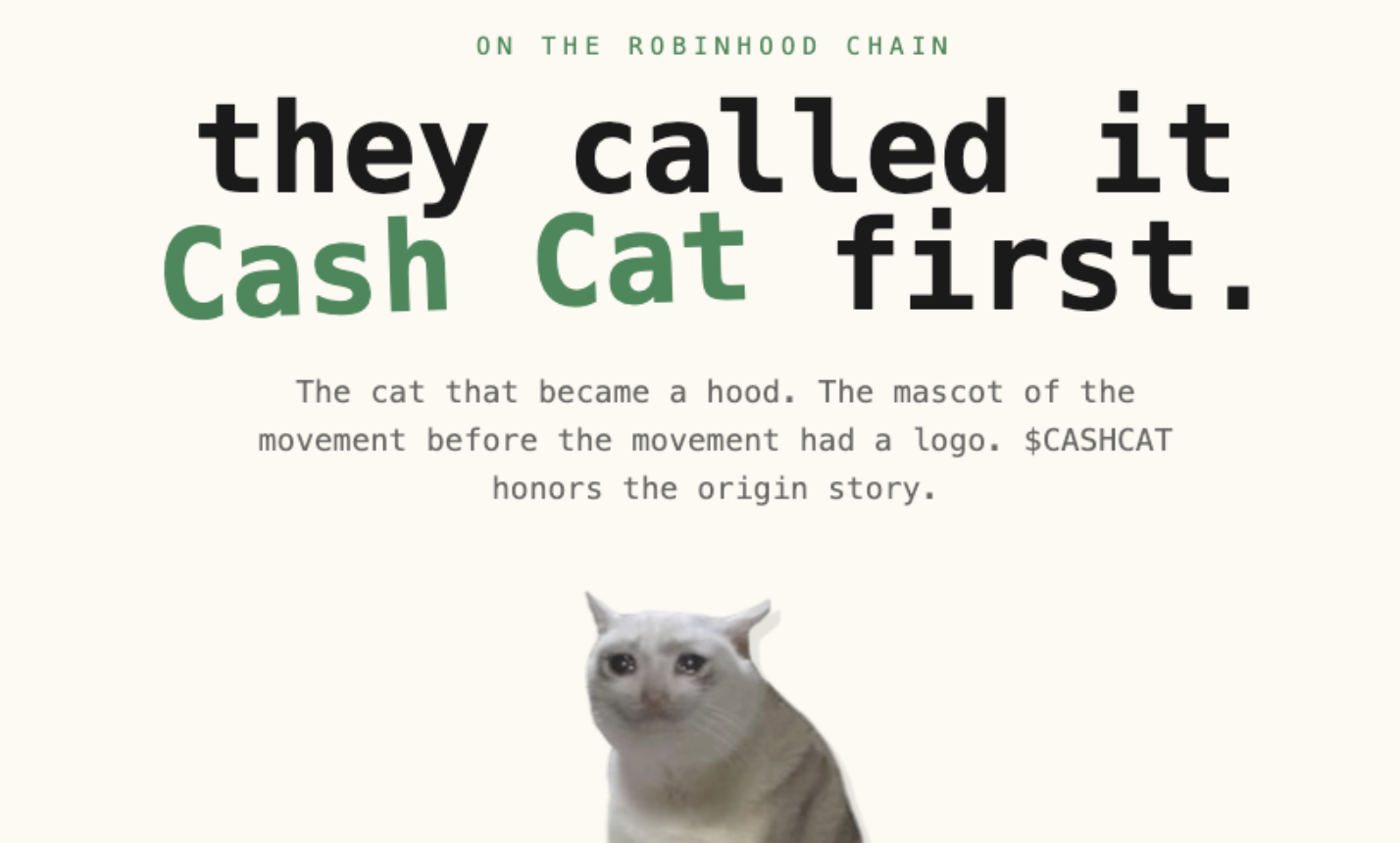
Author: Claude, TechFlow Original title: Robinhood Chain's first hit was Meme Cat: Retail investors unearthed CashCat's “former name,” and the CEO ended up playing tricks. One week after the Robinhood Chain mainnet went live, the officially promoted US stock token hasn't come out of the market. A Meme cat called CASHCAT first became popular. At one point, the 24-hour increase was over 1700%, and the market capitalization surpassed 120M. The whole story is just one sentence. Robinhood's job name when it was founded was CashCat. CEO Tenev himself talked about this history, and he was still tweeting and playing on the day of the boom. Meanwhile, copycat accounts and shouting accounts impersonating “barking kittens” have been set up simultaneously. To attract traffic and retail attention, you also need to rely on memes. Robinhood spent a year paving the way for his blockchain and telling the core story of tokenizing US stocks. However, the first real asset on the chain was a cartoon cat holding a banknote. According to GMGN monitoring, on July 8, the market value of CASHCAT, the meme token on the Robinhood Chain topped $120 million, an increase of more than 1,700% in 24 hours. Over the next few hours, the readings given by various data platforms continued to rise. According to CoinGecko data, CASHCAT mainly traded Uniswap V3 on Robinhood Chain, and the CASHCAT/WETH trading pair traded around $28 million in 24 hours. For a new chain that has only been online for a week and has only a handful of ecological applications, this cat is the current traffic itself. On the 7th day of the main network launch, the first asset that came out of the ring was Meme's background. On July 1, Robinhood officially launched the Robinhood Chain public mainnet at a press conference in London, an Ethereum Layer 2 based on Arbitrum technology, which was jointly unveiled by CEO Vlad Tenev and crypto business leader Johann Kerbrat. The official position of this chain is quite “serious”. The core product Stock Tokens tracks the price performance of more than 200 US stocks and ETFs, is open to more than 120 jurisdictions (excluding US users), and was deployed on the first day of DeFi agreements such as Uniswap and 1inch. Robinhood also promised to pay all gas fees for the first 90 days. According to the official script, the protagonists of this chain should be tokenized US stocks and RWA (real world asset chain), but the script didn't go as expected. In the first week after the launch of the main network, the most active trading pair on the chain was not any US stock token, but CASHCAT. Retail investors first set the tone for this “retail brokerage chain.” The tips for position holders are very direct. CASHCAT's current trading depth is focused on a single DEX trading pair. The new chain has poor liquidity, price readings vary greatly between platforms, and entry and exit slippage and pin risk are far higher than memes on mature chains. “Formerly known” archaeology, Tenev himself told the story of CashCat. CASHCAT was able to run, relying on a real company history. When interviewed in his early years, Tenev recalled how the company was named, “The original job name was actually CashCat, but people didn't think the name was powerful enough. When my wife introduces me to her friends, she says that they are Robin Hoods in the financial world, working for little people. That's how the name Robinhood came to be.” This oral statement was quoted in multiple company review articles after the GameStop incident, and is a well-documented “archaeological material”. This is also the biggest difference between CASHCAT and other Dogecoin stories made out of space. The structure of the token itself is extremely simple. According to the official website of the project, the total amount is 1 billion, the transaction has zero taxes and fees, and the liquidity pool tokens have all been destroyed, positioning itself as “zero utility, 100% cats.” At the same time, the official website clearly states that the project has nothing to do with Robinhood, “this is a fanfiction with a ticker” (fan fiction with a ticker). The story is true; the product is irrelevant. Readers need to separate these two things, Robinhood's history gave this cat a message...

45d agoburnking#MEME #Robinhood
Ondo, the RWA tokenization leader, will end up as a Perp DEX

Ondo, the RWA tokenization leader, will end up as a Perp DEX

By Eric, Foresight News The perpetual contract circuit is undergoing a quiet revolution. Over the past two years, Perp DEX has grown from a marginal experiment to a force to be reckoned with in the derivatives market. The total trading volume of Perp DEX reached $7.9 trillion in 2025, close to 10% of the total trading volume of centralized exchanges. In the midst of this hustle and bustle at the time, a fundamental limitation always existed: almost all platforms were trapped in the cage of cryptographic native assets. The targets of transactions were nothing more than Bitcoin, Ethereum, and a few altcoins, and the collateral was almost a single stablecoin. Meanwhile, the real-world asset (RWA) tokenization circuit is rising at an astonishing rate, from a proof of concept in 2023 to a market size of over $30 billion today. On this track, Ondo Finance has established an undisputed leading position: its tokenized stock platform Ondo Global Markets has a market share close to 70%, which is about 2.5 times that of second place. Beginning this year, precious metals, commodities, and stocks began to be included in DEX's trading list. But the direction we're used to is for Perp DEX to launch tokenized RWA assets. Things started getting interesting when the absolute leader of the RWA circuit decided to enter the Perp DEX space. The launch of Ondo Perps means that the perpetual contract circuit has finally seen a player who actually starts from traditional financial assets and deeply integrates institutional-grade asset issuance capabilities with cryptographic native trading infrastructure. This may mark a turning point in the evolution of Perp DEX from a pure cryptographic derivatives tool to a truly global asset trading infrastructure. “The opposite way” In 2021, former Goldman Sachs employees Nathan Allman and Pinku Surana founded Ondo, which was initially positioned as a DeFi structured product agreement. From the end of 2022 to the beginning of 2023, the team keenly sensed that the DeFi internal circulation model will eventually reach the ceiling, and that the bridge connecting traditional finance with the on-chain world is the next real big opportunity. So they resolutely turned to the RWA circuit, launched OUSG, a tokenized US Treasury bond fund, and then launched USDY for non-US retail investors. These two products accurately penetrated the biggest pain point of the market at the time: the huge amount of money in the crypto world urgently needed to find low-risk, high-yield on-chain footholds, and the Federal Reserve's aggressive interest rate hike cycle made US Treasury bonds the most attractive choice. Unfortunately, at the end of May, Nathan Allman, founder and CEO of Ondo and one of the main drivers of RWA's tokenization circuit, passed away unexpectedly, and long-term president Ian De Bode will take over as CEO. Ondo said Ian De Bode has been responsible for the company's strategy, products and day-to-day operations for more than two years, and his successor CEO has received full support from the management team. Ondo's execution is impressive. In March 2024, when BlackRock launched BUIDL, a tokenized money market fund, Ondo quickly transferred OUSG's main holdings to BUIDL, leveraging credit endorsements from the world's largest asset management company while maintaining its independence in distribution channels. By 2025, Ondo's TVL surpassed $2.5 billion, with the USDY single product exceeding $1 billion, making it the world's largest tokenized treasury bond product for retail investors. Meanwhile, the launch of Ondo Global Markets expanded the company's footprint from fixed income to equity assets. Launched in September 2025, the platform provides trading of more than 260 tokenized US stocks and ETFs. From Apple and Nvidia to the S&P 500 ETF, it covers popular sectors such as AI, biotech, defense, and energy. In less than eight months, the TVL broke 1 billion dollars, and the cumulative transaction volume exceeded 18 billion US dollars, which is a phenomenal growth rate in the history of any financial product. By contrast, none of the stablecoins showed such a steep adoption curve in the early stages. More importantly, Ondo isn't just a crypto project operating in a grey area. It received coverage from 30 European countries in Liechtenstein...

45d agoForesight News#DEX #Ondo #Perp DEX #RWA #tokenize

Data: Binance bStocks holdings surpass $100 million with cumulative trading volume of $458 million

Comparative news, according to Chainwire reports, within 15 days of the launch of the tokenized US stock product bStocks (1:1 anchored US stocks) by Binance on June 11, the platform's holdings have exceeded 100 million US dollars, and the cumulative trading volume has reached 458 million US dollars. According to the data, 47% of the trading volume occurred outside of the traditional US stock trading period. Emerging markets contributed 58% of the trading volume, and users mainly traded small amounts and fractional stocks. At the same time, bStocks's turnover rate is significantly higher than that of lower-tier US stocks, and positions are highly concentrated on cutting-edge technology topics (SpaceX accounts for about 53%, semiconductors about 37%).

52d ago