
稳定币支付 · 664

South Korea plans to open virtual asset accounts to about 3,500 companies, and the central bank plans to test AI proxy deposit tokens by the end of 2026

Comparing news, Factblock CEO and Korea Blockchain Week organizer Andrew Park said that the Korean crypto market is shifting from being driven by retail transactions to institutional digital finance. The focus of global financial institutions and enterprises has moved from tokens, exchanges, and prices to escrow, tokenization, stablecoins, payment and settlement infrastructure, and regulatory compliance. The Korea Financial Services Commission has proposed a framework to open corporate virtual asset accounts to approximately 3,500 listed companies and registered professional investors. The National Assembly of Korea has officially passed amendments to the Electronic Securities Act and the Capital Markets Act to incorporate tokenized real-world assets and security tokens into a unified legal framework. The Bank of Korea has completed initial testing of the Project Hangang real-world deposit token project and plans to conduct the second phase of institutional testing in late 2026. Related technical experiments have used wholesale deposit tokens to allow AI agents to execute automated conditional transactions. This article is sponsored by GENG, Build Your Fortune on GENG (https://geng.one)

10h agoburnking

The Korean stablecoin sector collectively surged, and Kakao Pay rose 10.91%

Comparatively, according to Gate data, the Korean stablecoin sector collectively surged, with Kakao Pay up 10.91% to 457,500 won; The Zone rose 10% to 2090 won; NHN KCP rose 9.76% to 148.4 million won; Hecto Financial surged 20.49% to 22.35 million won; and Danal rose 11.73% to 5190 won. Analysts believe that the market may be boosted by news that US President Trump is urging Congress to push forward the CLARITY Act. Trump emphasized during a meeting with key figures in the crypto industry at the White House that the bill will provide an institutional foundation for the US to maintain its leading position in the digital assets sector. If the US crypto regulatory framework is further clarified, it may promote the expansion of the global digital asset and stablecoin payment ecosystem, and related expectations are strengthening the payment and fintech sector in South Korea.

2d ago

Binance Blockchain Week will be held in November in Bangkok, Thailand, to focus on the integration of traditional finance and the crypto industry

In comparison, Binance announced that Binance Blockchain Week will be held from November 28 to 29 at the Queen Sirikit National Convention Center (QSNCC) in Bangkok, Thailand. This is also the return of Binance Blockchain Week to Asia after Singapore, Istanbul, Paris, and Dubai. With the theme of Evolution (EVOLVE), the event is expected to bring together thousands of developers, institutional investors, fintech leaders and policy makers to focus on industry trends such as Bitcoin institutionalization, stablecoin payments, DeFi institutionalization, RWA tokenization, tokenized stocks, cross-border payments, AI and crypto industry integration, and regulatory frameworks. Binance Co-CEO Richard Teng said that Asia will become a key market for the next stage of development and large-scale application of traditional finance and crypto industries. Co-CEO and co-founder He Yi said that the next round of large-scale adoption of crypto assets will be driven by accessibility, education, and products that can create real value, and Binance will continue to explore how to make crypto assets more accessible, more trustworthy, and integrated into everyday financial life.

3d ago

CEO Rain: Stablecoin payments have reached more than 100,000 merchants, and most of them are unaware

Comparing news, according to The Block, Farooq Malik, CEO of crypto payment company Rain, said that through cooperation with Visa and other networks, stable coin payments facilitated by Rain have reached more than 100,000 merchants, and most merchants are unaware. Currently, it takes about 3 days for transactions to be settled through the Visa network. If merchants choose to settle directly with stablecoins, they can be settled on the same day. Rain completed Series C financing of 250 million US dollars in January, with a post-investment valuation of 1.95 billion US dollars, an annualized transaction volume of over 3 billion US dollars, and cooperated with Visa and Mastercard to launch stablecoin cards and wallets. It plans to explore the use of regulated stablecoins for on-chain settlement in some business processes. This article is sponsored by GENG, Build Your Fortune on GENG (https://geng.one)

3d agoburnking

Interlace establishes Brazilian office to continue to advance Latin American market layout

Comparing news, stablecoin infrastructure platform Interlace has officially set up an office in Brazil and formed a local team to further advance the Latin American market layout. Interlace will provide enterprises with global payment and digital asset infrastructure support by connecting local financial institutions, cross-border trade platforms, digital asset ecosystems, and Web3 project parties. Additionally, Interlace recently appeared at the Rio Blockchain.rio exhibition to exchange views with Brazilian and Latin American financial, payment, and digital asset practitioners. Guilherme Santos, National Manager of Interlace Brazil, was invited to participate in the live panel to discuss topics such as digital assets, stablecoin payments, and financial infrastructure. It is reported that Interlace will attend the Crecimiento LATAM Digital Assets Conference in Argentina from August 20 to 21 and deliver a speech to share the practical experience of global card issuance projects and their Latin American market layout.

3d ago
Half a year has passed, are second-tier US crypto exchanges doing well?

Half a year has passed, are second-tier US crypto exchanges doing well?

Source: Foresight News Author: Eric Original title: Half a year has passed, how are second-tier crypto exchanges in the US doing? Halfway through 2026, the crypto market didn't experience the rebound that many were looking forward to. Bitcoin fell by more than 30% in the first half of the year. At one point, it fell below $60,000, and the industry's spot trading volume shrank by more than 20% for two consecutive quarters. The much-anticipated CLARITY Act has run aground in the Senate, and expectations of regulatory loosening have also been delayed. Coinbase portrayed this chill with a report card that lost more than $750 million in half a year. As the leading cryptocurrency exchange in the US, this is still the case, and second-tier exchanges are having an even worse time. According to recently disclosed financial reports for the second quarter, although some second-tier exchanges have achieved performance growth, their market share continues to be compressed. Gemini, who relied on blood transfusions from the founder to prolong their lives, let's talk about the worst family. Gemini's total revenue for the second quarter was $45.5 million, up 37% year over year, but exchange revenue fell 38% year over year, leaving only $12.5 million. Spot trading volume shrank 66% from $113 billion in the same period last year to $3.8 billion. Revenue growth was supported by side businesses such as credit cards, collateral, and OTC. Of these, credit card revenue was $16.2 million, up 231% year over year. Gemini had a net loss of US$107.7 million in the second quarter, with a cumulative loss of US$217 million in the first half of the year. The platform's assets fell to $8.4 billion from $182 billion a year ago. What is even more troubling is that the credit card business has taken a leap forward. The identity fraud incident discovered in the first quarter continued to ferment in the second quarter, and a transaction loss reserve of 2010 million US dollars was calculated in a single quarter. The contraction came fast and severe. On February 5, Gemini announced its withdrawal from the UK, EU, and Australian markets, which is tantamount to abandoning the overseas territory it has operated for many years. Employees were cut 40% from the high in the third quarter of 2025, leaving only 402 people at the end of the quarter, and marketing expenses were cut 45% year over year. In May, the Winklevoss brothers paid out of their own pockets to inject $100 million into the company at a price of $14 per share through their fund. The founder's premium increase sounds like a vote of confidence, but the market's signal is that the company is no longer able to finance itself externally. This life-saving money paid in bitcoins was then hit by a drop in currency prices, and an impairment was added to the book, directly dragging the adjusted EBITDA for the second quarter to negative 74 million US dollars, which is worse than the first quarter. Stock prices are the most honest voting instrument. Gemini was listed at $28 in September last year, reaching a high of $45.89 on the first day. Today, it has fallen from a high point of more than 88%, or 56% during the year. Citi cut its target price to $4 in April to maintain its sales rating. Bullish, the situation of Bullish being kidnapped by Bitcoin is a bit more complicated. In addition to the exchange, the company also has CoinDesk media, index licensing, and the Consensus Conference, and has a relatively diverse revenue structure. Bullish's second-quarter adjusted revenue was $92.6 million, up 62% year over year. Among them, subscription and service revenue hit a record of $62.7 million. Morgan Stanley and Grayscale all used the CoinDesk index to distribute products. Adjusted net profit for the second quarter was US$14.3 million, reversing losses year over year. Looking at these numbers alone, Bullish seems like the most decent one in the second tier. But the IFRS-caliber report tells a different story. The net loss for the second quarter was US$280 million, mainly due to Bitcoin held in the company's treasury, which recorded a fair value impairment of US$245 million in the second quarter alone. Digital asset sales fell 44% year over year, indicating that the institutional trading business is also shrinking. CEO Tom Farley's answer was to completely change the track. In May, Bullish announced the acquisition of securities registration and transfer agent Equiniti at the Consensus Miami conference. The transaction scale is about 4.2 billion US dollars. It is expected to be completed in early 2027. The goal is to complete the entire chain of tokenized securities from issuance and listing to trading and tracking. On August 12, the company launched its own tokenized stock exchange, which was also approved by the Gibraltar regulator. The story is a popular one, but the capital market isn't buying it right now. Bullish went public with a $37 IPO in August last year, closing at $70 on the first day...

4d agoForesight News#Exchanges

Report: Total stablecoin market capitalization fell to around $308.3 billion in July, with net outflows for three consecutive months

In comparison, CryptoRank Research released a report that the total market value of stablecoins in July was about US$308.3 billion, down about 1% from June, and has remained in the range of US$300 billion to US$320 billion for 10 consecutive months; the cumulative outflow of capital of about US$13.3 billion from May to July is the longest running round of stablecoin net outflows from 2022 to 2023. The usage of USDT and USDC is further divided. The number of USDT on-chain transactions reached a record high in July, reaching 861.4 million, an increase of 11.4% over the previous month; the number of USDC transactions fell to 656.7 million. In terms of on-chain transfer amounts, USDC leads USDT by about $3.6 trillion by $1.4 trillion, which is about 2.6 times the latter. Stablecoin payment applications continued to grow. In July, the amount of stablecoin payment card deposits surpassed $1 billion for the first time, reaching about US$1,084 billion, an increase of 15.9%; among them, USDC recharge amounts increased 46% month-on-month, which is significantly higher than 7% of USDT. Furthermore, the payments sector raised around $244 million in July, ranking second in terms of the size of funding in the crypto industry.

5d ago

RedotPay delays US IPO plans, regulatory approvals and legal issues to be resolved

Comparative news: According to Bloomberg, the stablecoin payment company RedotPay has postponed plans to go public in the US. People familiar with the matter revealed that the company previously planned to complete its IPO as soon as this year, but the current listing may be delayed until next year or even later. Before proceeding with an IPO, RedotPay is required to obtain regulatory approval from the country where it operates, and the company also faces related legal issues to be addressed.

8d ago

1kx: The crypto industry's revenue in the first half of 2026 fell 23% year on year, and countercyclical sectors such as stablecoins and RWA grew

Comparatively, crypto investment agency 1kx data shows that the total revenue of the global crypto industry fell to $47 billion in the first half of 2026, down 23% year on year, and about $14 billion less than the same period last year. The agency said that the decline in revenue is in line with the characteristics of a bear market cycle, as traditional crypto revenues such as exchanges, brokerage, wallets, staking, and mining are still highly dependent on asset prices and transaction volume. 1kx pointed out that this round of revenue decline mainly comes from two major areas: On the one hand, finance-related revenue declined markedly. Revenue from centralized exchanges (CEX), derivatives platforms, and market makers decreased by $5.2 billion year over year; on-chain DeFi revenue fell by $1.8 billion, down 32% year over year; and ETF and fund management fee revenue decreased by $1.1 billion. On the other hand, blockchain infrastructure revenue continues to weaken. Staking and mining reward revenue fell by $6.2 billion, and on-chain transaction fees and MEV revenue nearly fell short. Currently, the share of blockchain infrastructure revenue in the entire crypto industry has fallen to 25%, a record low. However, not all sectors are affected by the cycle. Low-cycle businesses such as stablecoins, real-world asset (RWA) issuance, prediction markets, and decentralized physical infrastructure (DePIN) bucked the trend by 14% in the first half of the year to reach $12 billion in revenue, accounting for 26% of the industry's total revenue. Among them: stablecoin and RWA issuer revenue increased by $700 million; stablecoin payment card and payment business increased by about $100 million; predicted a 10-fold increase in market fee revenue, an increase of about $300 million; DePin fee revenue nearly doubled; and on-chain middleware revenue increased by about 70%, mainly driven by Chainlink. 1kx said that although revenue from DeFi and financial businesses declined in absolute terms, it still occupied the largest share of the industry, rising to 64%. Consumer on-chain app revenue performance was relatively more stable, down about 20% year over year. By contrast, at the lowest point of the last crypto bear cycle (second half of 2022), the industry's revenue for half a year was around $28 billion, while the current bear market still maintained $47 billion during the same period, about a quarter of which came from emerging businesses that continued to grow during the bear market. 1kx said that its revenue statistics include other revenue such as traceable on-chain fee revenue, staking income, and off-chain revenue publicly disclosed by Coinbase or estimated on platforms such as Binance. The composition of the three types of income has remained generally stable compared to last year.

9d ago
The amount of USDT issued on the Bochang TRON chain surpassed Ethereum and then entered the world's largest USDT distribution network

The amount of USDT issued on the Bochang TRON chain surpassed Ethereum and then entered the world's largest USDT distribution network

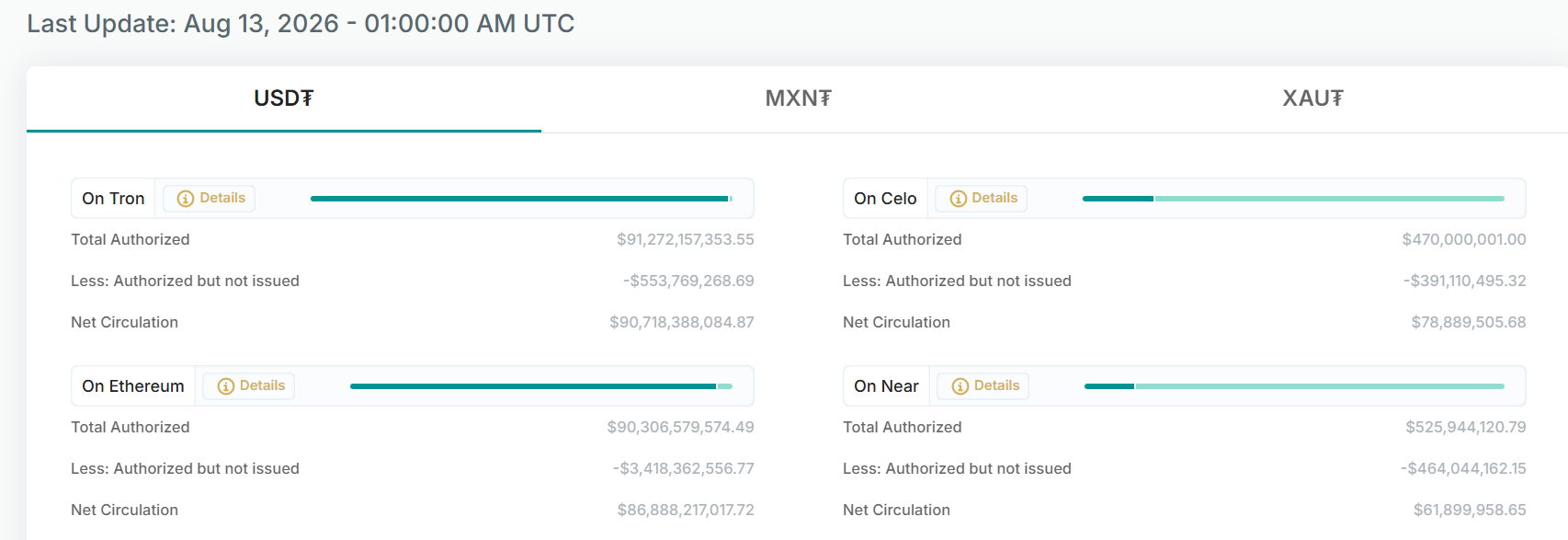
According to official Tether data, as of August 13, 2026, USDT on the Bochang TRON network chain once again increased by 1 billion US dollars, reaching 91.2 billion US dollars. The circulation volume once again surpassed the amount of USDT issued by the Ethereum network (90.3 billion US dollars), ranking first among blockchain networks. This historic milestone marks the further consolidation of Wavefield TRON's dominant position in the stablecoin field, and once again confirms the continued appeal of low-fee, high-efficiency settlement networks to global stablecoin funds. From trading assets to settlement tools, TRC20-USDT usage scenarios continue to expand the growth of USDT on the TRON chain, starting with sustainable real usage requirements. As of August 2026, the distribution volume of TRC20-USDT on the Bochang TRON network officially exceeded 91.2 billion US dollars, setting a new historical record. During the year, a total of about 10 billion copies were added, and the number of accounts held reached about 75.47 million. This size has enabled Wavefield TRON to carry half of the world's USDT issuance for a long time, accounting for about 50%. Judging from the usage structure, the actual payment attributes of Wavefield TRON are becoming more and more clear. According to CoinDesk Research data, in the first quarter of 2026, the average quarterly daily active account value of Bochang TRON rose to about 3.2 million, a new quarterly high. Meanwhile, in retail USDT transfers under $1,000, Bochang TRON's share is about 50%. It still maintains a dominant position in the $1,000 to $100,000 range, and continues to strengthen its “friendly” public chain position for retail and small to medium value settlement. This means that one of the main uses of USDT on Wave Field TRON is always the actual transfer of value between wallets. Looking at a longer period of time, the scale of on-chain transfers and settlements confirms this judgment. According to a research report released by Messari, in the first quarter of 2026, the amount of USDT transfers processed by the Bochang TRON network reached about 2.04 trillion US dollars, and the total number of transactions across the network was about 950 million. The average daily transactions rose from about 10.2 million in the previous quarter to about 10.9 million, which also set a new quarterly record; since 2026, Bochang TRON has led all public chains with annual USDT transfers of about 4.2 trillion US dollars. It depicts not a ledger within a single trading platform, but rather a scenario where multiple wallets directly transfer value on a public blockchain. Specifically, an overseas worker can send USDT to a family's wallet, and the payee can exchange it for local currency; cross-border e-commerce merchants can use USDT to settle with suppliers to reduce the impact of bank business hours and intermediary processes; freelancers can receive rewards from overseas customers and confirm on-chain payments within minutes; and digital asset service providers can transfer liquidity between exchanges, custodian wallets, and market-making accounts. The amount and purpose of the different cases are not the same, but the common requirements are fast payment, transparent fees, and 24/7 operation. Furthermore, cost stability is particularly important in a market environment where network fees fluctuate drastically. Since August 2025, Bochang TRON passed Governance Proposal No. 104 and lowered the unit price of energy by about 60%, on-chain transfer costs have been further reduced. Ecological access and secure collaboration go hand in hand. Whether the stablecoin infrastructure continues to improve and the stablecoin network can develop over the long term depends not only on circulation volume, but also on entry coverage, depth of liquidity, developer support, and risk management capabilities. Wavefield TRON is simultaneously constructing infrastructure in these directions. In terms of application entry, wallets, trading platforms, payment service providers, and DeFi protocols have extensive support for TRC20-USDT, enabling users to deposit, withdraw, transfer, exchange, and interact on the chain relatively easily. As new stablecoins such as USDD are integrated into the TRON ecosystem, stablecoin asset types have been further enriched; agreements such as JustLend DAO have extended the use of stablecoins to collateral and loan scenarios. Stablecoins are gradually shifting from a single transfer tool to the underlying asset for on-chain financial activities. In terms of user experience, mechanisms such as GasFree try to solve a common pain point: although new users hold USDT in their wallets, they may not be able to initiate transactions because there are no native tokens. By supporting stablecoins to pay associated network fees, these solutions help simplify the first-time usage process. For merchants, wallets, and payment applications, reducing the cost of user understanding bandwidth, energy, and native Gas tokens will also help stablecoin services enter a wider range of consumer scenarios. More importantly, scaling up needs to be synchronized with security governance capabilities. In September 2024, Wavefield TRON, Tether and TRM Labs joined forces...

9d agoburnking