腾讯 · 1482

Tencent's chip leader Gao Jianlin left his job and started a business to target the RISC-V high-performance AI CPU circuit

According to MaxForAI, according to MaxForAI, the core head of Tencent's chip research and development, has recently left Tencent and started a business. He plans to develop high-performance CPUs based on the RISC-V architecture around high-performance AI servers and agentic AI (intelligent AI). Gao Jianlin is regarded as one of the early core promoters of Tencent's self-developed chip system. According to data, he formed an FPGA hardware team within Tencent in 2013, began setting up AI chip research and development in 2018, established the Penglai Laboratory in 2020, and promoted Tencent's development of various AI chips and data center deployment. This startup focuses on CPUs rather than the currently competitive AI GPU market. According to the report, Gao Jianlin believes that with the rapid development of Agentic AI, the AI inference process will involve model call, tool execution, search, database interaction, and large-scale task scheduling, and the CPU will assume a more important scheduling and control role in the AI system. According to reports, Gao Jianlin was involved in RISC-V related research and development during his time at Tencent, and participated in various technical directions such as chip architecture, verification, and back-end. Its new company plans to build high-performance server CPUs based on the open instruction set RISC-V to enter the AI infrastructure market. Currently, the name of Gao Jianlin's new company, financing conditions, and specific product launch dates have not been disclosed. The market is concerned about whether it will become another emerging force in the field of AI chips in China targeting server CPUs and smart body infrastructure.

5h ago

Rumor has it that Tencent Hy4 has appeared on the Yuanbao App model list, and gray testing has started

Comparative news, according to X user MaxForAI, Tencent has begun gray testing of the new flagship model Hybrid Hy4. Some users discovered that Hy4 has already appeared in the model selection list of the Tencent Yuanbao App and is labeled as an expert model, ranking above Hy3 and DeepSeek. Official account @TencentHunyuan This model option is simultaneously visible in the relevant portal. Tencent confirmed in its Q2 earnings report last week that Hy4 with larger parameters will be launched in the near future, further improving model performance and multi-modal capabilities. Currently, Tencent has not officially released Hy4. Outsiders are unable to confirm that this is a small-scale gray test or early opening of the entrance, but judging from the progress, the model is nearing launch.

2d ago
Yao Shunyu reorganizes Tencent's multi-modal route: closer to Liang Wenfeng and away from Li Feifei

Yao Shunyu reorganizes Tencent's multi-modal route: closer to Liang Wenfeng and away from Li Feifei

Text | Miao Zheng Editor | Wang Jing Source | Letter AI Tencent's mixed element multi-modal team has undergone another personnel change. According to media reports, Lin Xudong, who was responsible for xAI's multi-modal understanding, has left xAI and joined Tencent's mixed element as the head of the multi-modal content generation algorithm. The reason this personnel news is worth paying attention to is that it takes place in the context of continuous adjustments of mixed and multi-modal teams. Over the past period of time, news of the departure of the person in charge, the transfer of researchers, and the addition of new members came out one after another within the mixed yuan. Hu Han, the former head of multimodal understanding, left his career to start a business, and Tian Yonglong and others joined Tencent. The reporting relationship between the original multi-modal team also changed with the integration of the big language model department and the multimodal model department. However, does this mean that Tencent's multi-modal team is “changing the dynasty” is currently unable to draw a direct conclusion. What can be confirmed by public information is that mixed forces have indeed experienced personnel movements and organizational restructuring. The rumor of Lin Xudong's addition is more like a new signal in this adjustment: Tencent is recombining the two routes of multimodal understanding and content generation. So the question is, what exactly did Lin Xudong come from, and what abilities can he add to Tencent? And is Tencent's multi-modal approach shifting from “generating content” to Yao Shunyu's more biased “understanding context and acting in the world”? What is Lin Xudong's origin and what can he do after joining Tencent? According to public information, Lin Xudong graduated from Tsinghua University in 2018 and then went to Columbia University to study for his doctorate. While studying at the blog, his research interests included embedded learning, video analysis, and generative models. He also participated in the Vx2Text project in collaboration with Columbia University and Facebook AI. V indicates video, x indicates unknown, can be sound, voice, or even ambient sound. 2 represents TO, and Text represents subtitles. Its logic is to first convert different modes such as video and sound into vectors similar to “language tokens”, then uniformly feed the language model for fusion, and finally generate open text by an autoregressive decoder. Transformer can only understand tokens, so AI essentially doesn't understand video and audio file formats, making it even less likely to convert them into text. For example, if a dog jumps into the water next to a swimming pool, Vx2Text's video recognizer (V) will output keywords: dog, jump, pool; sound reader (x) will output: sound of water, fluttering. Although the product function of Vx2Text is “generation,” the core difficulty of the product is “understanding.” Of course, Vx2Text doesn't simply “translate” a screen into a few sentences. Models need to recognize people, objects, movements, and events from videos, understand how these things change over time, and finally organize visual information into language. After graduating from his PhD, Lin Xudong joined DeepMind and participated in Gemini-related multi-modal pre-training and post-training work. In 2025, he also joined xAI. According to public information, it is responsible for the direction of multimodal understanding and participating in the training of multimodal content understanding and generation models. Now that he has joined Tencent Hybrid, he will be responsible for the hybrid multi-modal content generation algorithm. Lin Xudong was added not so much to improve the performance of mixed-element multi-modal generation, but rather to solve a problem that plagues all multimodals — understanding. The previous generation model was more like a picture maker. Give it a hint, and it can generate an image or a video. But as long as users make more complex requests, the model just can't keep up. For example, the characters change in the long video, the shape of the object is not consistent before and after, the camera movement does not match the spatial relationship, etc. It's not because the model doesn't generate, but because it doesn't remember and understand the world steadily. Therefore, putting Lin Xudong in the position of multi-modal content generation is probably because he “translated” multi-modality into something AI can understand. Lin Xudong's addition can only be clearly seen in a larger context. That is, now Tencent's mixed element is reorganizing its multi-modal route. In January 2025, Tencent Outstanding Scientist (Tencent Distinguished Scientist) Hu Han succeeded Liu Wei, who had previously left his job, and was fully responsible for the research and development of mixed-element multi-modal models, and also served as Tencent's mixed-element big model Tech Lead. Tencent's internal organization was adjusted in the second half of 2025. He transferred from the Multimodal Model Department to the “Frontier” Frontier Technology Research Group under the Big Language Model Department. The title was changed to Head of the Multimodal Understanding Direction, and the reporting line was also changed to report to Yao Shunyu. The actual position changed from “the head of an independent department” to a “big language model...

2d ago字母AI#AI #Li Feifei #Liang Wenfeng #Tencent

Byte Seed reorganization: pre-training, RL consolidation, separate groups of office agents

Comparative news, AI news, ByteDance Big Model Team Seed completed a new round of organizational adjustments. Seed Foundation Model established four new first-level departments to re-merge data and post-training teams previously scattered in the fields of text, code, vision, and speech. The core change is to unify pre-training data with reinforcement learning, and at the same time split post-application training into two lines of Work and Chat. Pretrain Data unifies the multi-modal data for Omni models and the data required for pre-training very large models. Horizon RL focuses on strengthening learning and improving basic model capabilities. Product Posttrain-Work is aimed at the office and B-side, and focuses on optimizing the ability to call models, operate computers, and perform long-term tasks. The original Application team changed its name to Product Posttrain-Chat and continues to be responsible for the C-side conversation model. All four departments reported to Wu Yonghui. In the past, Seed was more divided into teams based on text, code, vision, voice, etc., and each had data and post-training personnel. Now Byte wants the next generation model to go directly to Omni, so that different modes enter the same base. Seed was also previously discussing training models with more than 5 trillion parameters. The larger the model and the more modes, the easier it is for the original scattered R&D methods to cause repeated investment. Similar adjustments have also appeared on Tencent. Tencent merged the mixed big language model and multi-modal team in July, with Yao Shunyu under unified responsibility. Byte also set up a special post-work training department this time, indicating that Office Agent has become a product line optimized separately by the basic model team.

2d ago

China relaxes Nvidia H200 restrictions: Bytes and Tencent each take about 10,000

Comparing news, China has begun to ease import restrictions on the Nvidia H200. ByteDance and Tencent have each received about 10,000 H200s in recent weeks, and several other tech companies may soon be approved for similarly sized products. The US has previously approved a number of Chinese companies to buy the H200, but the deal has been stuck in Chinese approval. Now chips have finally begun to enter the mainland in batches, but they are far from being fully liberalized. Beijing currently only allows a small number of H200s to enter the mainland, hoping that companies will deploy more chips in Hong Kong and other overseas regions. Mainland procurement still requires separate approval. This not only allows leading AI companies to continue to use Nvidia to train cutting-edge models, but also leaves market space for domestic chips such as Huawei.

3d ago
Why is capital chasing AI Native and ignoring the old Internet

Why is capital chasing AI Native and ignoring the old Internet

Capital doesn't reward being old-fashioned, not because old-fashioned people are at fault. The old part is clearly priced. There is no bad information, so there is no excess profit. Global venture capital was $510 billion in the first half of 2026, surpassing $44 billion for the full year of 2025 in one and a half months. More than 70% have entered AI; OpenAI and Anthropic took 217 billion dollars, accounting for 43%. With that much money, you'd think everyone could share a little bit. The truth is that distribution is more extreme than total volume, and the first sieve doesn't screen the industry, it screens people. The category that has been screened out now has an unkind name: the internet is old. Let's just say one thing: the “old man” in this article has nothing to do with age. It refers to a set of methodologies that have been formed in the mobile internet cycle, have been tested over and over, and have brought huge returns to holders. The person holding it may be 45 years old or 32 years old. It was this methodology that was being repriced, not the year of birth. Confusing these two things is Lao Deng's most common mistake and one of the most comfortable mistakes — because if the problem is someone else's age discrimination, you don't need to change a single word. 01 What is AI Native The term has been misused. They can use ChatGPT not called AI native, nor AI in the company name, let alone in their twenties. There are three things that really separate people. First, the starting point is a model, not a requirement. The order in which Lao Deng makes a product is: look at what the user wants, write down the requirements, and find technology to implement it. The order of AI natives is reversed: first figure out what level the model is capable of today and what step it is likely to reach tomorrow, and then move from this capability boundary to the external product. The former uses the model as a tool, and the latter uses the model as the foundation. There was no difference between these two kinds of things made by humans in the first edition; by the third edition, there was a difference of one species. Article 2. The default unit of an organization is not a person. The division of labor in the Internet age is the division of one thing into ten people. AI Native's division of labor is to take ten things from one person and add a bunch of agents. The CEO of a domestic application company said that the team consists of less than ten people, but a large number of AI work at night, and the first thing employees do every morning is check the work the AI handed in the night before. Cursor's side is even more extreme. Public reports mention that the company doesn't have a product manager; engineers write their own code, talk to users themselves, and participate in recruiting people themselves. Article 3. Information is first-hand. AI Native's input sources are papers, model cards, GitHub issues, original discussions on X, and self-run evals. Lao Deng's input sources are industry summits, closed-door meetings, brokerage reports, interpretation of public accounts, and finding someone to drink coffee with. This one is the least obscure and most lethal; I'll talk about that separately later. I'm satisfied with all three. The 25-year-old is an AI native, and so is the 45-year-old. I'm not satisfied with the three rules; I'm still an old man at the age of 25. AI natives are a state, not an age group. The trouble is that tickets in this state are works, not resumes. 02 The two lists spread the results of this round on the table. These are two lists. The first one is an all-AI native company. Their valuations are not rising; they are exchanging orders of magnitude. List 1 · Upstream OpenAI raised $122 billion in a single round of financing in Q1 2026, followed by $852 billion, the largest private equity financing in history. Anthropic Q2 had a single round of $65 billion, after investing $965 billion, accounting for about half of the total global venture capital for the quarter; the revenue operating rate in May reached about $47 billion. DeepSeek raised about 70 billion yuan in its first round of financing in May 2026. In April of the same year, Liang Wenfeng raised his direct shareholding from 1% to 34%, and controlled a total of about 84.29% of the shares through related entities. The Dark Side of the Moon (Kimi) was estimated at $4.3 billion in December 2025; it went for three consecutive rounds from January to February 2026 to reach 18 billion; the D round in May was about $2 billion, breaking 20 billion dollars after the investment; the July round surpassed $3.5 billion, after investing 35 billion dollars; the pre-IPO target was 50 billion dollars. ARR broke 100 million in March, 200 million in May, and held steady at 300 million US dollars in June, with APIs accounting for more than 70%. Smart Spectrum · MiniMax successively landed in Hong Kong stocks in early 2026, with a market capitalization exceeding 100 billion yuan. It was one of the first major model companies listed in China. The second one...

3d agoWendy#AI #DeepSeek

Civil service adding AI colleagues? Tencent WorkBuddy connects to Guangdong government system

Comparing news, Tencent officially released Wanqing WorkBuddy. The first batch of provincial units, such as the Guangdong Health Insurance Administration and the SME Service Center, are already piloting dozens of government scenarios, which will be opened to the first batch of civil servants in late August. It not only checks policies and writes materials, but also works directly with the business system. For example, in the Health Insurance Administration, WorkBuddy can identify maternity allowance materials, pre-review them in batches, and write the results back to the system after manual confirmation. Additionally, it can automatically organize government knowledge bases, clean enterprise data, and support local deployment. Files and data remain in the government environment, and AI can only use the permissions originally possessed by civil servants.

4d ago
When local city investment started selling tokens, did this student agree?

When local city investment started selling tokens, did this student agree?

Author: Cookie Original title: When local CITIC began selling tokens on July 30, the Jiaxing Yangtze River Delta (Jiaxing) Token Operation Center was officially launched. The operator standing in front of the stage is Jiaxing City Investment and Development Group, an urban construction state-owned enterprise that has repaired roads, bridges, gas, and renovated the city. During the investigation, city leaders asked what everyone wanted to ask: “Why did you do CITIC?” In the past 20 years, the default division of labor in China's urbanization was: government development, urban construction and road construction, and enterprises moving up. Now, a state-owned urban construction enterprise has begun to personally sell tokens. Some people explained that on the day the city entered the market, the token profit peaked. The road builder sold the token and first clarified a concept: CITIC does not directly produce tokens, nor does it build a Wanka cluster. Ma Yinxiao, the head of the operation center, put it bluntly: “We are carriers,” which means integrating scattered computing power and models to become a “model wholesaler.” Take the Jiaxing model as an example. Its core is the “five unifications”, which unify API entry, unify token measurement, unify fee settlement, unify policy deductions, and unify security audits. Once connected, enterprises can use more than 100 mainstream models such as DeepSeek and Qwen as needed, and provide three types of services: inclusive packages, on-demand packages, and exclusive customization. The goal is to make AI capabilities “as convenient and transparent as water and electricity, and can be used as needed”. Why is local CITIC starting to sell tokens now? China's infrastructure construction over the past 30 years has a clear path: once any new type of infrastructure is recognized as a “public service” by the country, it will follow the same path. First, private capital will explore the path, then state-owned platforms will take over the operation, and eventually become municipal utilities. Water, electricity, gas, broadband, all without exception. Pathfinders are responsible for proving the existence of demand, and state-owned assets are responsible for turning it into a public good that can be used by humans, at a manageable price, and operated for a long time. Jiaxing's operation this time, from a logical point of view, is that the computing power infrastructure has reached the “state-owned assets takeover” stage of this path. Moreover, Jiaxing has a strong reputation: as a national computing power hub city, the city has gathered four 10,000 card computing power centers, Runze, Ali, China Telecom, and China Mobile, ranking first in Zhejiang in terms of computing power; on the industrial side, the city has 6,327 regulated industrial enterprises and more than 230 AI science and innovation enterprises. Road construction aggregates scattered travel needs into a toll road network, and selling tokens aggregates scattered AI requirements into a measurable computing power network. The subject is different, and the method is the same. With an increasingly crowded table, urban investors aren't the only state-owned players who want to sell tokens. In the spring of 2026, the three major operators announced their entry into the “Token Hour” almost simultaneously. China Telecom Chairman Ke Ruiwen's original phrase was “An intelligent cloud system is a word management system.” China Mobile wants to promote “Byte+Token double high-speed growth,” and Shanghai Mobile directly launched a general service of 1 yuan 400,000 tokens, which can even pay phone bills. Operators' motivation to switch to Token is simple: in 2025, China Mobile's revenue growth rate was 0.9%, China Telecom 0.07%, and China Unicom 0.68%. The growth rate of all three companies fell to less than 1%, and the traditional traffic business peaked, and new measurement units must be found to support the growth curve. From selling Bytes to selling Tokens, the underlying logic hasn't changed. Whoever controls the next generation of “pipelines” can charge toll fees. Looking further up, cloud vendors (Alibaba Cloud, Tencent Cloud, Baidu Smart Cloud) are selling tokens, model companies (DeepSeek, Smart Spectrum, KIMI) are selling tokens, token factories (silicon-based streaming) are selling tokens, transit stations are selling tokens... Now, even CITIC has arrived. List the players on this table: model companies, cloud vendors, token factories, the three major operators, and local city investors. From upstream to downstream, from making tokens to transporting tokens to distributing tokens, the entire industry chain is focused on the act of “selling tokens.” As mentioned above, tokens are being fully electrified, so the profit margin for “selling tokens” will drop dramatically. On the one hand, the acquisition cost of AI capabilities will continue to decrease, the threshold for enterprises and individuals to use AI will disappear, and tokens will become the underlying supply for the digital economy like water and electricity. On the other hand, the profit margin of simply selling tokens will infinitely approach selling tap water, electricity,...

4d ago深潮TechFlow#token #Arithmetic power

Tencent continues to dig up top AI talents: ExxAI multi-modal leaders join mixed elements

Comparing the news, AI News, it was revealed that Lin Xudong, the head of xAI's multi-modal understanding, has joined Tencent's mixed media. Lin Xudong previously participated in the Gemini multimodal model development at Google DeepMind, then joined xAI to take charge of the direction of multimodal understanding. This is already the third largest core researcher that Tencent has recruited from major foreign companies in less than a year. Yao Shunyu has become Tencent's chief AI scientist, and former OpenAI researcher Tian Yonglong also joined in July to participate in the development of visual language models.

4d ago
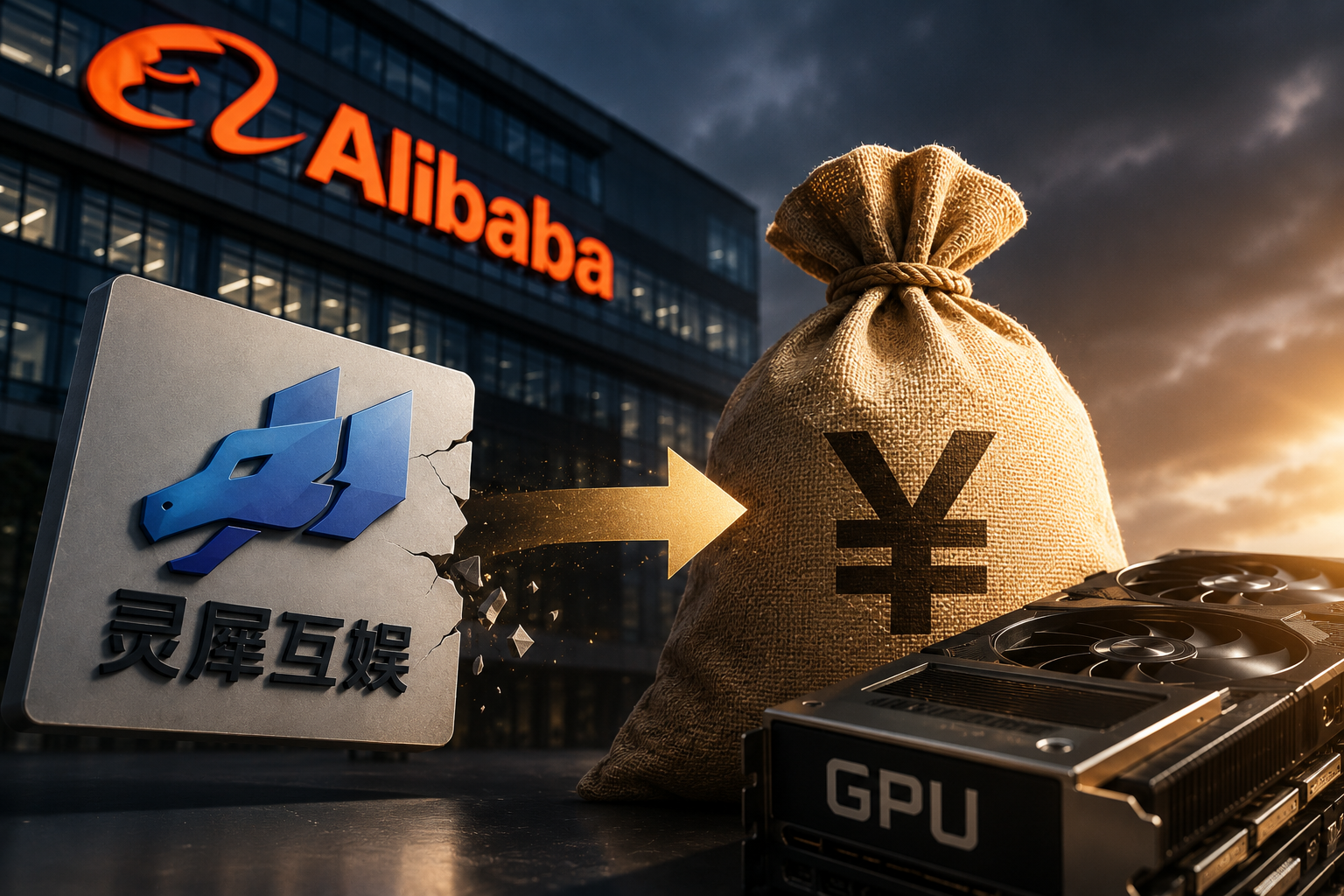
Ali sells his “son” who earns 2 billion dollars a year: All in AI to buy GPUs in exchange for money

Ali sells his “son” who earns 2 billion dollars a year: All in AI to buy GPUs in exchange for money

Source | Pencil Dao Author | Huang Xiaogui Original title: Ali sells his son who earns 2 billion dollars a year: In exchange for 10.1 billion yuan to buy a GPU, Alibaba sold a “chicken that can lay eggs.” On August 17, Zhou Bingshu, CEO of Lingxi Mutual Entertainment, issued an internal letter stating that Alibaba will sell its shares in Lingxi Mutual Entertainment, Xinchen Capital will become the new shareholder, and the original management team will continue to be responsible for the company's operations. According to the 21st Century Economic Report, Alibaba sold Lingxi Mutual Entertainment for at least 1.5 billion US dollars (about 10.1 billion yuan). Currently, Alibaba and Xinchen Capital have not officially disclosed the transaction amount. Lingxi Mutual Entertainment is a high-quality asset, with an annual net profit of 1.5 billion to 2 billion yuan; with “Three Kingdoms Strategy Edition”, a stable cash cow, the number of global users surpassed 100 million. “Exchange money to buy a card (GPU).” Huang Wei (pseudonym), a person familiar with Alibaba, told Pencil that the sale at this time was to concentrate resources and invest in computing power, and Ali, who is all in AI, has already entered a state of “full agent and model development, and scene access.” - 01 - Sold cash cow and invested in AI Lingxi Mutual Entertainment in Guangzhou. Its predecessor, Jian Yue Technology, was founded by Zhan Zhonghui, a former NetEase executive. In 2017, Ali acquired Jianyue Technology at a valuation of about 1 billion yuan and became a subsidiary. In September 2020, it officially launched the “Lingxi Interactive Entertainment” brand. What really gave this company a foothold in the Chinese game industry was “Three Kingdoms: Strategy Edition”, which was launched in 2019. According to Sensor Tower's previous data, the game's revenue in the first two years of its launch was over 1 billion US dollars. In recent years, Lingxi Mutual Entertainment's annual revenue is about 3 billion yuan to 4 billion yuan, which is roughly equivalent to the revenue scale of game manufacturers in central China. Also, according to industry media estimates such as “Game Grapes”, Lingxi Mutual Entertainment's profit in 2025 will be about 1.5 billion to 2 billion yuan. Ali sells a profitable business to invest in a direction that is still burning money — AI. In fiscal year 2026, Ali's capital expenditure reached 126.063 billion yuan, a record high. Most of this is AI computing power infrastructure and data center expansion. This input is directly reflected in the financial statements. In fiscal year 2026, Ali's revenue reached 1.02 trillion yuan, up 3% year on year, but operating profit fell 64%; adjusted EBITA fell 56%. Free cash flow declined from positive 73.9 billion yuan to negative 466 billion yuan. But this isn't a gamble without a future. Ali CEO Wu Yongming revealed, “(Ali) almost none of the cards are empty.” As of the end of March this year, Alibaba Cloud's revenue reached 41.6 billion yuan, an increase of 38% over the previous year, of which external commercialization revenue increased 40%; revenue from AI-related products was close to 9 billion yuan in a single quarter, accounting for about 30% of external revenue, and has maintained three-digit growth for 11 consecutive quarters. Ali predicts that in about a year, AI-related revenue may account for more than half of cloud business revenue. Today, growth is limited by supply, not demand. The ceiling of demand is far from being reached, but the ceiling of supply is just around the corner. At a time when cash is in high demand, but computing power continues to be exchanged for income, it's like “the family has an emergency, lacks money, and sells something for the family.” Huang Wei described Ali's sale of Lingxi Mutual Entertainment in this way. Lingxi Mutual Entertainment's annual profit is 1.5 to 2 billion yuan. It is a good asset, but it is not a core asset. The game business has a limited strategic relationship with AI, cloud, and e-commerce. Retaining it makes more than 1 billion dollars in profits; selling it will take back more than 10 billion dollars in cash at once and invest in AI. And this isn't the first time. In fiscal year 2026, Ali has successively disposed of many assets such as Gaoxin Retail, Yintai Department Store, and Trendyol Local Lifestyle Services. Each of these businesses has its own situation, but the underlying logic is the same: shrink non-core and concentrate resources on the main line of AI. Lingxi Mutual Entertainment sold 10.1 billion yuan, which is a bit higher than the 7 billion to 9 billion yuan expected by the market. Xinchen Capital's premium bid shows that in the eyes of buyers, this is a high-quality asset. For Ali, being able to sell at a high level is also considered a good time to sell. - 02 - Give me some more cards, I can make more money. The whole industry is buying cards. Overall, the 2026 GPU procurement budget of leading domestic manufacturers was raised from 160 billion yuan at the beginning of the year to about 230 billion yuan, a sharp increase of 44% within half a year. The industry's outlook for 2027 is more aggressive — GPU-related investment is likely to double to 500 billion yuan. The world is more exaggerated. According to data from Jibang Consulting, the total capital expenditure of the world's nine largest cloud vendors will exceed 886.7 billion US dollars in 2026, an increase of nearly 90% over the previous year. Amazon $220 billion, Google...

4d ago铅笔道#AI #GPU #Alibaba