Johann Kerbrat · 21

Robinhood crypto chief: Not issuing coins is our huge advantage

According to Twitter, Robinhood's crypto department head Johann Kerbrat was recently interviewed on a podcast by Threadguy. In an exclusive interview, Kerbrat said, “One of our key differences compared to other blockchains is that we only issue chains, not coins. For us, blockchain is pure technology, the infrastructure that supports all of our new businesses. We don't need to constantly adjust our strategic priorities to maintain rising or sideways token prices. This avoids huge disruptions and is a huge advantage for us.”

7d ago

Robinhood executive: Robinhood Chain's position is to balance formal financial products with meme coins

Comparing news, according to Decrypt, Johann Kerbrat, head of Robinhood's crypto business, said in an interview that Robinhood Chain performed strongly in the month it went live. He pointed out that the chain's position is to balance formal financial products (tokenized stocks, derivatives) with meme coins — this is exactly what CEO Vlad Tenev's “Two Wolves” post expressed. One month after its launch, Robinhood Chain's total hedged volume (TVL) is close to $800 million and has processed more than 200 million transactions. Kerbrat said Ethereum Layer-2 was chosen to focus resources on product development while relying on existing security and decentralization. Robinhood's ultimate goal is to reach users who have never used cryptocurrency, rather than competing with other chains for existing users. “If we could see tens of millions of customers try this chain, that would be a huge success for us.”

14d ago
The head of Robinhood Crypto personally stated: Meme+ tokenizing US stocks is a “barbell” customer acquisition strategy, and all business lines have already achieved hundreds of millions of dollars in revenue

The head of Robinhood Crypto personally stated: Meme+ tokenizing US stocks is a “barbell” customer acquisition strategy, and all business lines have already achieved hundreds of millions of dollars in revenue

Original title: Johann Kerbrat: Inside Robin Hood's Crypto Strategy (Full Coverage) Original Article Source: TheRollup Compilation: Shenchao TechFlow Interest Statement Johann Kerbrat is a Robinhood executive responsible for the entire crypto business product line (including Robinhood Chain, tokenized stocks, pledge services, and perpetual contracts), Its compensation and equity incentives are directly tied to $HOOD's share price. All discussions on the Robinhood Chain in this issue relate to the business it is directly responsible for. The title uses an “insider's perspective” rather than an “analysis” to reflect this interest. Abstract Three weeks after the main network of Robinhood Chain was launched, the weekly DEX volume exceeded $3 billion, the number of transactions exceeded 105 million, and the TVL exceeded 300 million dollars. Johann Kerbrat explained the chain's strategic logic in detail for the first time in a podcast: why the “barbell” layout (meme tokens + real-world assets in parallel) was chosen, why the Arbitrum technology stack was used instead of self-built L1, and how to gradually move Robinhood's 27 million deposit account onto the chain. He made it clear that the competition is focused on “expanding the cake” rather than grabbing shares with Base, and revealed that tokenized stocks have covered 120+ countries and 90+ targets, and will expand to international stocks and private equity markets in the future. Key quote “Our philosophy is to make the chain permissionless and open to everything. Whether it's a meme or an RWA, there are many products that people can't resist. We are deeply integrating with the chain.” “Robinhood has 27 million deposit accounts. For these users, DeFi is still too complicated and requires too much technical knowledge. We're thinking about how to bring in a good DeFi product while making it easy to use and use without creating a wallet or managing private keys.” “I think competition is ultimately beneficial to the customer. We cut fees by a large margin when the crypto exchange went live. It's still too early on the chain, and it's too early to discuss market share.” “We've only been online for three weeks. If you're thinking about bringing tens of millions of users to the chain, bringing more utility, and bringing something that people actually use (not just a moment of fluctuation), then you're thinking about a long-term revenue stream.” “We don't want to see all of Robinhood's trading activity going to the chain next year. That was a bit of a dream. But if you can find things you can't do with traditional methods, such as international stocks and 24/7 trading, chains can be the solution.” 1. Data for three weeks of launch: The $3 billion weekly trading volume is only the starting point. After the launch of the Robinhood Chain mainline, the weekly DEX volume reached $3 billion, more than 50 million transactions, more than 1 million addresses, and a TVL of over $300 million. Kerbrat's response was straightforward: this data has already been surpassed. He said that the number of transactions that morning had already surpassed 105 million. He described the state of the team as “very excited”. The core idea is that this figure reflects the intensity of market demand for products on the chain. He specifically emphasized that the ecosystem was ready to accept developers from the beginning, rather than build it first and then wait for others to come. This is different from many paths where L2 goes live and then slowly drains. 2. “Barbell” Strategy: Why do memes and RWA go hand in hand The host mentioned an interesting phenomenon: Robinhood CEO Vlad Tenev described the on-chain ecosystem as a “barbell” structure on social media. One end is a meme token, and the other end is a real world asset (RWA), and said “you have two wolves in your heart.” Kerbrat explained the internal thinking. From day one, the chain was set to be permissionless (permissionless) and open to all types of apps. Meme tokens bring in market makers and DeFi users, while RWA serves users around the world who are unable to easily buy US stocks and ETFs. There is no contradiction between the two; rather, they each attract different groups. He also mentioned several integrated products that have already been launched: Robinhood Earn (receiving stablecoin earnings through on-chain agreements within the main app) and tokenized stocks (through Robinhood W...

26d agoWendy#Johann Kerbrat #MEME #Robinhood #Tokenized US stocks
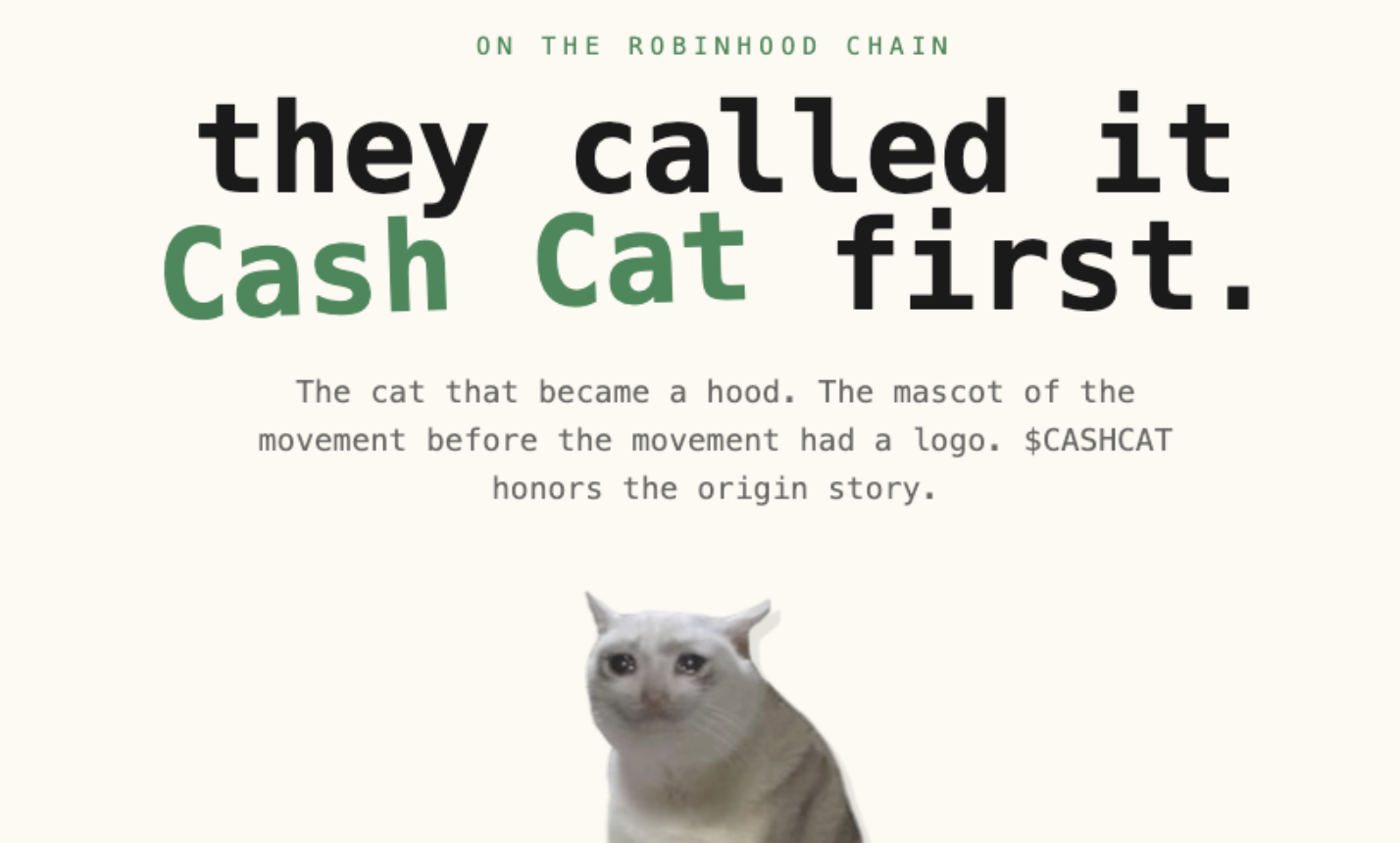
US stocks on the Robinhood chain haven't come out of the ring yet; a “banknote cat” first became popular

US stocks on the Robinhood chain haven't come out of the ring yet; a “banknote cat” first became popular

Author: Claude, TechFlow Original title: Robinhood Chain's first hit was Meme Cat: Retail investors unearthed CashCat's “former name,” and the CEO ended up playing tricks. One week after the Robinhood Chain mainnet went live, the officially promoted US stock token hasn't come out of the market. A Meme cat called CASHCAT first became popular. At one point, the 24-hour increase was over 1700%, and the market capitalization surpassed 120M. The whole story is just one sentence. Robinhood's job name when it was founded was CashCat. CEO Tenev himself talked about this history, and he was still tweeting and playing on the day of the boom. Meanwhile, copycat accounts and shouting accounts impersonating “barking kittens” have been set up simultaneously. To attract traffic and retail attention, you also need to rely on memes. Robinhood spent a year paving the way for his blockchain and telling the core story of tokenizing US stocks. However, the first real asset on the chain was a cartoon cat holding a banknote. According to GMGN monitoring, on July 8, the market value of CASHCAT, the meme token on the Robinhood Chain topped $120 million, an increase of more than 1,700% in 24 hours. Over the next few hours, the readings given by various data platforms continued to rise. According to CoinGecko data, CASHCAT mainly traded Uniswap V3 on Robinhood Chain, and the CASHCAT/WETH trading pair traded around $28 million in 24 hours. For a new chain that has only been online for a week and has only a handful of ecological applications, this cat is the current traffic itself. On the 7th day of the main network launch, the first asset that came out of the ring was Meme's background. On July 1, Robinhood officially launched the Robinhood Chain public mainnet at a press conference in London, an Ethereum Layer 2 based on Arbitrum technology, which was jointly unveiled by CEO Vlad Tenev and crypto business leader Johann Kerbrat. The official position of this chain is quite “serious”. The core product Stock Tokens tracks the price performance of more than 200 US stocks and ETFs, is open to more than 120 jurisdictions (excluding US users), and was deployed on the first day of DeFi agreements such as Uniswap and 1inch. Robinhood also promised to pay all gas fees for the first 90 days. According to the official script, the protagonists of this chain should be tokenized US stocks and RWA (real world asset chain), but the script didn't go as expected. In the first week after the launch of the main network, the most active trading pair on the chain was not any US stock token, but CASHCAT. Retail investors first set the tone for this “retail brokerage chain.” The tips for position holders are very direct. CASHCAT's current trading depth is focused on a single DEX trading pair. The new chain has poor liquidity, price readings vary greatly between platforms, and entry and exit slippage and pin risk are far higher than memes on mature chains. “Formerly known” archaeology, Tenev himself told the story of CashCat. CASHCAT was able to run, relying on a real company history. When interviewed in his early years, Tenev recalled how the company was named, “The original job name was actually CashCat, but people didn't think the name was powerful enough. When my wife introduces me to her friends, she says that they are Robin Hoods in the financial world, working for little people. That's how the name Robinhood came to be.” This oral statement was quoted in multiple company review articles after the GameStop incident, and is a well-documented “archaeological material”. This is also the biggest difference between CASHCAT and other Dogecoin stories made out of space. The structure of the token itself is extremely simple. According to the official website of the project, the total amount is 1 billion, the transaction has zero taxes and fees, and the liquidity pool tokens have all been destroyed, positioning itself as “zero utility, 100% cats.” At the same time, the official website clearly states that the project has nothing to do with Robinhood, “this is a fanfiction with a ticker” (fan fiction with a ticker). The story is true; the product is irrelevant. Readers need to separate these two things, Robinhood's history gave this cat a message...

45d agoburnking#MEME #Robinhood
The parent company of the NYSE personally declines: the battle for the entry of tokenized US stocks begins

The parent company of the NYSE personally declines: the battle for the entry of tokenized US stocks begins

Author: Claude, Shenchao TechFlow Original title: Crypto trading layout “entrance” to US stocks, NYSE parent company exits Shenchao Guide: ICE and OKX set up a 50:50 joint venture with the goal of allowing OKX's 120 million users to directly trade ICE futures and NYSE tokenized stocks. But this isn't just joint venture news. Nearly half of Kraken's new tokens launched this year are tokenized stocks. Robinhood has launched more than 200 US stock tokens in the European Union, and the NYSE itself is building a 24/7 blockchain trading platform... A battle over “who will be the front desk for global retail investors to buy US stocks” has begun. Who will be the front desk for global retail investors to buy US stocks in the future? A brokerage app, a crypto exchange, or the NYSE itself? This question has gone from hypothesis to reality in the past six months. On June 22, NYSE parent company Intercontinental Exchange (NYSE: ICE) and crypto exchange OKX announced the establishment of a joint venture with ICE senior vice president Trabue Bland and and former New York Governor Andrew Cuomo, to enable OKX's 120 million global users to access ICE futures and NYSE tokenized stock markets. According to the BusinessWire announcement, the joint venture is 50:50 and will operate as a US registered broker and futures commissioner subject to regulatory approval. Seen separately, this is a collaboration between a big exchange and a big crypto platform. In the context of the industry in the first half of 2026, this is another step in the tokenization portal dispute, and it is also a step for traditional finance to seize its own position. NYSE personally declined: 24/7 trading, instant settlement, stablecoin deposit In January of this year, the NYSE announced that it is developing a blockchain-based tokenized securities trading platform with plans to enable 24/7 trading, instant on-chain settlement, dollar-denominated orders, and stablecoin deposits. According to a report by CoinDesk on January 19, the platform combines NYSE's Pillar matching engine with a blockchain settlement system to support a multi-chain architecture. Tokenized stocks are fungible (fungible), and shareholders' dividends and voting rights are not affected. Michael Blaugrund, vice president of ICE's strategic initiatives, put it bluntly: “Supporting tokenized securities is a critical step in ICE's strategy to operate on-chain market infrastructure in a new era of global finance.” This is tantamount to saying that the NYSE does not plan to hand over the distribution rights of tokenized stocks to crypto platforms; it has to build its own trading place. But the question is: where do NYSE users come from? It excels at institutional infrastructure and matchmaking engines, and is not good at attracting customers from global retail users. OKX's 120 million users are one of the solutions. The essence of a joint venture is products from the NYSE and OKX traffic. CEX's collective shift: From cryptocurrencies to full-asset trading OKX isn't the only crypto exchange doing this. In the first half of 2026, almost all leading crypto platforms are moving in the same direction. According to CoinGecko data, of Kraken's 147 new spot tokens launched from January to April this year, 66 were tokenized stocks (xStocks) or RWA related assets, accounting for about 45%. Kraken acquired tokenized stock issuer Backed Finance in December 2025, then launched tokenized trading of over 60 US stocks and ETFs in the European Union. As reported by DL News on April 2, tokenized stocks have become “the fastest-growing sub-sector in the crypto industry's $25 billion RWA circuit.” Kraken also launched commission-free US stock trading and crypto futures in the US, essentially becoming a multi-asset trading platform. Robinhood is going the other way. In June 2025, Robinhood launched more than 200 tokenized US stocks and ETFs in the European Union, running on the Arbitrum chain, and is developing its own Layer 2 (Robinhood Chain) based on the Arbitrum technology stack. As reported by CoinDesk on May 5, Robinh...

60d agoburnking#ICE #OKX #NYSE #US stocks

Robinhood executive: Crypto investors see the present as a “bottom cut opportunity” and are starting to focus on crypto assets other than BTC and ETH

Comparatively, according to Cointelegraph, Robinhood's crypto department head Johann Kerbrat recently stated that against the backdrop of the continued downturn in the market, crypto investors are gradually turning their sights on assets other than Bitcoin and Ethereum. He pointed out that many investors see the current market as an “opportunity to break the bottom” and are beginning to look at more options other than the top two or three major crypto assets. Meanwhile, Kerbrat revealed that cryptocurrency holders on the Robinhood platform are not only holding tokens, but are also actively exploring use cases such as staking and DeFi. These fields are still showing strong appeal amid market uncertainty. However, Altcoin Season Index data shows that the market still mainly favors Bitcoin, with a Bitcoin season score of 33/100. Furthermore, the US Bitcoin Spot ETF has had net outflows for five consecutive weeks, totaling around $3.8 billion, reflecting the continued “extreme fear” of market sentiment since the beginning of February.

181d ago
Pushing stocks on-chain but retaining replacement rights: Robinhood's foray and exit experiment

Pushing stocks on-chain but retaining replacement rights: Robinhood's foray and exit experiment

Author: KarenZ, Foresight News Original title: Robinhood invades L2, focusing on RWA tokenizing at the end of January 2026, Robinhood CEO Vlad Tenev recounted the “GameStop collapse incident” that shocked Wall Street five years ago on social media, and bluntly stated: if blockchain technology had real-time settlement capabilities at the time, that “unplug the cable” moment that made countless retail investors angry could have been avoided. Just two weeks later, Robinhood officially announced the launch of the Robinhood Chain public testnet based on Arbitrum, which will support tokenized real-world assets, including stocks, ETFs, private equity assets, and other financial instruments. Architectural Choice: Why Arbitrum? In terms of architecture, Robinhood chose to build the Ethereum Layer 2 network Robinhood Chain based on Arbitrum Orbit, use Ethereum blobs to guarantee data availability, and use ETH as the native gas token. Robinhood knows he doesn't need to reinvent the wheel himself. Arbitrum provides EVM compatibility, and existing DeFi protocols and wallet infrastructure can be migrated almost at zero cost. More importantly, Arbitrum Orbit allows Robinhood to build a “private chain” that not only has independent governance and custom logic (such as compliance reviews), but also shares the unbreakable security consensus of the Ethereum mainnet. This is critical for Robinhood, which is required to meet financial regulatory requirements. It can implement compliance rules on the chain, restrict access to specific wallet addresses, and not leave Ethereum, the largest pool of funds. More importantly, as early as mid-2025, Robinhood piloted its tokenized stock business on Arbitrum. Now the launch of its own chain on Arbitrum is just a matter of course. Robinhood tokenized stocks tested before the launch of the Robinhood Chain testnet, Robinhood had been experimenting with “tokenized stocks” in the European market for 8 months. Johann Kerbrat, general manager of Robinhood Crypto, said at the Consensus 2026 conference that Robinhood has launched about 2,000 tokenized stocks and ETF products in the European market, covering mainstream US stocks and ETF products. In the future, it plans to tokenize real-world assets such as private equity, real estate, and art to achieve 7*24 hour trading and instant settlement. According to Dune data, as of February 9, the total value of Robinhood tokenized shares is currently US$15.1 million, with a cumulative trading volume of US$74.43 million. Of course, this size doesn't look big. Operational truth: How do Robinhood tokenized stocks “load” US stocks into the chain? Underlying structure: These tokenized stocks were initially issued on Arbitrum and will be fully migrated to Robinhood Chain in the future. Essential properties: These tokenized stocks are not actual documents of ownership, but derivatives contracts linked to the price of the underlying stock or ETP. This means that tokens held by users will target the trend of US stocks, but users do not own the corresponding stocks. Issuance and destruction mechanism: When a user buys a US stock derivatives contract on Robinhood, the platform will immediately generate a corresponding homogenized token on the blockchain. This token represents your ownership of this contract, but this token cannot be transferred to others. After you close this contract, the platform will directly destroy the corresponding token on the blockchain. The blockchain will immediately update the records, and the token will be completely invalidated. Dividend penetration: Robinhood has achieved dividend penetration even though users don't own shares. When the underlying stock dividends are paid, the system automatically distributes the dividend in cash to the investor's account. Compliance Armor: Robinhood was able to legally launch tokenized shares in Europe, thanks to its full regulatory preparations: In June 2025, Robinhood spent $200 million in cash to acquire...

191d agoburnking#Bitstamp #Robinhood #RWA #token #stocks

Crypto trading software provider Talos raises $45 million, Robinhood, a16z and others participate

In comparison, according to CoinDesk, Robinhood participated in the Series B financing expansion of crypto trading platform Talos, with a valuation of around $1.5 billion. The funding round totaled $45 million, adding strategic investors including Sony Innovation Fund, IMC, QCP, and Karatage, as well as returning investors such as a16z crypto, BNY, and Fidelity Investments. Johann Kerbrat, senior vice president and general manager of Robinhood's crypto business, said Talos' flexibility and quick adaptability will help Robinhood deepen liquidity and provide more advanced features for crypto customers.

205d ago

Robinhood: Self-built L2 based on Ethereum because it values its security and liquidity

Comparing news, Johann Kerbrat, head of Robinhood's crypto business, said that the company chose to build an Ethereum Layer-2 network based on Arbitrum rather than launch an independent Layer-1. The core reason is that it wants to directly obtain Ethereum's security, decentralized attributes, and EVM ecological liquidity, so it can focus on core products such as stock tokenization. Robinhood's own L2 is currently still in the private testnet phase. Tokenized stocks have been first deployed on Arbitrum One, and assets and liquidity can be seamlessly migrated when the new chain is launched in the future. As of now, Robinhood's tokenized stock count has expanded from the initial around 200 to over 2000. (CoinDesk)

223d ago
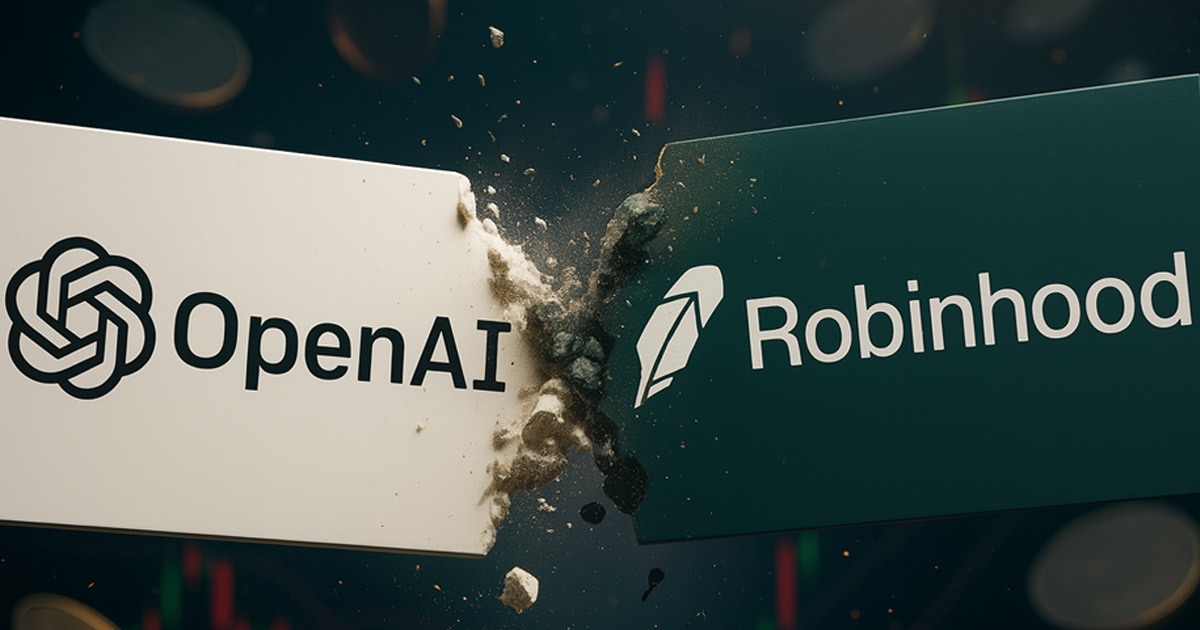
OpenAI directly dismantled, who did Robinhood's “tokenized equity” irritate?

OpenAI directly dismantled, who did Robinhood's “tokenized equity” irritate?

European cryptocurrency investors recently received a special “gift” — RobinHood gave away 5 Euros worth of OpenAI and SpaceX “equity tokens” to eligible EU users. This seemingly ordinary promotion sparked a heated debate about the nature of tokenized equity. OpenAI's strong cut, in particular, brought this deep discussion on financial innovation, market access, regulatory boundaries, and the principles of decentralization to a climax. Tokenized Equity: Innovation or Word Game? Vlad Tenev, co-founder and CEO of Robinhood, announced that the platform will provide EU users with stock tokens from more than 200 private companies, including OpenAI and Elon Musk's SpaceX. These assets are issued through Robinhood's crypto platform under the EU's relatively loose investor restrictions, but are currently unavailable to US users due to US regulation. Robinhood explained that these “stock tokens” are not actual shares of the company, but derivatives that track the prices of publicly traded stocks and ETFs, and their transactions are recorded on the blockchain. Johann Kerbrat, senior vice president and general manager of Robinhood's crypto division, emphasized that through tokenization, their goal is to “enable anyone to participate in this economy” and thereby “expand market access” and provide retail investors with opportunities to participate in previously unattainable private markets. However, RobinHood's move soon drew strong opposition from OpenAI, a core stakeholder. OpenAI issued a statement on its X platform stating, “These 'OpenAI tokens' are not OpenAI's shares. We haven't partnered with Robinhood, aren't involved in it, and don't endorse this practice.” OpenAI further stressed that any transfer of its shares requires the company's approval, and that they “did not approve any such transfers,” and also specifically reminded investors to “polish their eyes”. This wave of operations directly left Robinhood in an awkward position. Supporters: The wave of financial democratization is irreversible Despite clear opposition from OpenAI, many industry figures and investors still support the trend of tokenizing private equity and view it as an irreversible wave of financial democratization. Proponents generally agree that tokenized assets provide 24/7 trading, enhance liquidity, and lead to a more transparent price discovery process. It helps break down barriers to private investment by removing traditional barriers such as high minimum investment amounts and low liquidity. Senior macro investor and fund manager Raoul Pal praised this innovation on the X platform: “The end of the boundaries of public and private markets has begun. “Pal believes that capital formation and borrowing are more efficient in the crypto market, and calls this market trend “financial democratization” and that it will grow faster and faster. Investor Amit Kukreja believes that the statement issued by OpenAI was more due to “security considerations because they had to do it.” He argued, “What Robinhood did was just build a token to track OpenAI's valuation in private markets. You're not literally buying shares in these companies, but the shares themselves are just a form of proof; the digital representation of these assets is the most important thing.” In addition to Robinhood, crypto platforms including Kraken and Backed Finance are also actively laying out tokenized stocks. Kraken Co-CEO Arjun Sethi insisted that the move was “not a gimmick, but a direct effort aimed at returning financial power to individuals and breaking down geographical and institutional barriers.” Furthermore, traditional financial institutions, from BlackRock (BlackRock) to JPMorgan (JPMorgan), are also promoting the tokenization of various financial assets, such as bonds and carbon credits, which further confirms the pervasiveness of tokenization as a trend. Europe has become a testing ground; is America afraid to play? Robinhood made it clear that US users are unable to participate in the transaction due to regulatory restrictions. This geographical selectivity has raised questions about “regulatory arbitrage,” and the EU's relatively relaxed investor protection regulations provide a testing ground for tokenized products. According to the product description, these assets are issued through the Robinhood crypto platform, settled in Euros, and cannot be transferred to other wallets or platforms. US Attorney's Office...

415d agoWendy#OpenAI #Robinhood #SEC #tokenize #original #Coin stock topics #stocks