TUSD · 345

BlackRock's Tokenized Reserve Fund received the highest principal stability rating from S&P Global Ratings

Comparatively, S&P Global Ratings awarded BlackRock Daily Reinvestment Stablecoin Reserve Vehicle (BRSRV) a “AaAm” rating to BlackRock, a new tokenized money market fund on Monday, as its highest principal stability fund rating. The rating is based on investment and counterparty credit quality, term structure, and management's ability to maintain a stable net asset value. S&P Global Ratings said it found no weaknesses in the management and organization of BlackRock consultants, credit research and analysis, risk management and compliance. It also said that the fund's tokenization framework is operationally resilient and uses a permissioned architecture to limit transactions to whitelisted wallets to reduce network, smart contracts, and blockchain cyber risks. BRSRV launched Monday as an open managed investment company with the goal of making its shares meet the eligible reserve asset requirements to pay stablecoin issuers under the GENIUS Act. The fund will hold cash, US Treasury bonds maturing within 93 days, and overnight repurchase agreements secured by treasury instruments, maintaining a weighted average term of no more than 60 days and a weighted average lifespan of no more than 120 days. S&P Global Ratings released a separate stablecoin stability assessment summary on Tuesday, saying that 6 of the 11 stablecoins it covers have “sufficient” or better ability to maintain fiat currency anchoring. USDT is still level 5 “weak”; TUSD and USDe are level 5; USDC, EURC, USDG, and USDP are level 2 “strong”. This article is sponsored by GENG, Build Your Fortune on GENG (https://geng.one)
17d agoburnking
Circle catches compliance dividends, and USDC ushered in top moments in Europe

Circle catches compliance dividends, and USDC ushered in top moments in Europe

Author: Asher (@Asher_ 0210) Original title: MiCA landed, Tether withdrew from Europe, Circle caught compliance dividends starting this month, and USDC ushered in a moment of victory in the European crypto market. As the MiCA transition period comes to an end, unauthorized crypto asset service providers will not be able to continue operating in the EU. For crypto exchanges, if they want to stay in the European market, not only must the platform itself be compliant, but the assets and trading pairs supported by the platform must also be readjusted, with stablecoins bearing the brunt. In the past, the default answer for US dollar stablecoins was often USDT. However, Tether did not apply for a MiCA license, and Tether CEO Paolo Ardoino explained why USDT did not apply for an EU MiCA license, saying the regulation was “very dangerous for stablecoins.” This means that USDT voluntarily abandoned the European stablecoin market. But demand for US dollar stablecoins in the European market is not going away. Users need US dollar stablecoins, the platform needs US dollar trading pairs, and institutional funds also need on-chain US dollar assets with a clear compliance path. It's just that part of the demand, which was mainly carried out by USDT in the past, is now beginning to be transferred to compliant stablecoins. Long before the MiCA transition period ended, Circle obtained the French EMI license and put USDC and EURC into the MiCA framework. For Circle, this is USDC's chance to take the lead in Europe. USDT trading portals have shrunk, and USDC is taking over the actions of European crypto exchanges, which is more direct than regulatory documents. Binance, for example, has previously removed non-MiCA compliant stablecoin trading pairs such as USDT, FDUSD, TUSD, and DAI from European Economic Area users, while retaining USDC, EURI, and Euro trading pairs. Coinbase has also stated that it will restrict stablecoin services that do not meet MiCA requirements and provide European Economic Area users with the option to switch to compliant stablecoins such as USDC and EURC. These adjustments don't mean that USDT is completely banned in Europe. Users can still hold USDT on the chain and continue to use it in some scenarios, but USDT's trading portal on compliant exchanges is indeed being compressed. In the past, the advantage of USDT came from a positive cycle of scale effects — the more trading pairs, the more users got used to it; the more users got used to it, the more the exchange became inseparable from it. After MiCA, this cycle was interrupted in Europe. For exchanges, the prerequisite for continuing to serve EU users is to reduce compliance risks as much as possible. Therefore, in choosing stablecoin trading pairs, they will prioritize retaining assets with a clear path to compliance. Open USD is booming, but USDC's moat is still on June 30. Open Standard officially announced the launch of Open USD, a new US dollar stablecoin, which is supported by more than 140 companies including Visa, Stripe, Mastercard, BlackRock, and Coinbase; Open USD is free to mint and redeem, and plans to distribute reserve proceeds to partners after deducting management fees. As soon as this news came out, Circle's stock price plummeted on the same day, falling more than 16% during the intraday period. The market's concerns are not hard to understand. Open USD's lineup looks luxurious enough, and the model is almost in favor of USDC. On one side, payment giants, trading platforms, and asset management institutions stand together; on the other side, there is a revenue-sharing mechanism. If this model actually works, it may indeed take away some of the stablecoin shares originally belonging to USDC. But the list of “over 140 partners” was quickly questioned. Shortly after the official announcement of Open Standard, some of the listed Korean companies successively clarified that they are not officially involved in the Open USD project. According to related reports, Samsung Electronics said there were no formal negotiations surrounding the OUSD project; Dunamu said it had only reviewed the relevant proposals; Upbit went further and clearly denied participating in the OUSD offering; and K Bank also denied that there was a formal agreement. For details, see “Is OUSD's “100 People's List” actually a “Letter of Intent”? “Marketing under the name causes a crisis of trust”. Stablecoins can run without putting up a partner's logo...

46d agoburnking#Circle #USDC #compliance

Data: Binance's current $1 billion SAFU funding was ready a year ago

Comparative news, according to on-chain data, historical announcements, and tweets, Binance's current $1 billion SAFU fund funds were transferred from the old SAFU address to the new SAFU wallet address (0x420) mentioned in the announcement a year ago, all of which are USDC, and there has been no action yet. According to the official announcement, Binance announced in January 2022 (early to mid-term of the previous bear market) that its SAFU fund address holdings reached $1 billion, with BNB, BTC, USDT, and TUSD at the time. As the market declined further, Binance announced on November 9, 2022 (bottom of the previous bear market) that the market decline reduced the value of its SAFU fund holdings to US$735 million, and that it would increase its assets once again to return the fund size to US$1 billion (BUSD and BNB US$700 million, BTC US$300 million). Since then, the market has gradually picked up, and Binance announced in April 2024 that all funds in the SAFU fund will be converted to USDC to maintain stability. According to reports, the SAFU Fund was initially established in July 2018 to protect user assets in extreme situations (such as hacking attacks, security breaches, or other incidents). The fund is mainly used to compensate affected users for losses rather than daily operations. It was used to fully reimburse affected users in the May 2019 hacking incident (7,000 BTC) and the December 2020 unlimited release attack (10.1 million U).

204d ago
The case where TUSD reserve assets were misappropriated by the custodian ushered in positive developments: the institutional torture behind Sun Yuchen's assistance in defending rights and winning the lawsuit

The case where TUSD reserve assets were misappropriated by the custodian ushered in positive developments: the institutional torture behind Sun Yuchen's assistance in defending rights and winning the lawsuit

Recently, regarding the case where the 500 million US dollar reserve assets of TrueUSD (TUSD) were illegally misappropriated by the custodian, the successful suspension section of TechteryX's rights protection supported by Bochang Tron founder Sun Yuchen; a global ban and freeze order issued by the Dubai International Financial Center Court (“DIFC Court”) has achieved phased results for the global recovery of TUSD reserve assets. In late October 2025, the DIFC court made a key ruling, issuing a global freeze order on funds involving approximately US$456 million in TUSD reserves. The funds were previously transferred by the custodian to the Dubai entity without full disclosure, triggering a crisis involving the trust. The DIFC court's ruling means that illegally misappropriated reserves are officially included in the legal protection framework, and it also injects strength into TUSD's continued stability and market trust. In the history of stablecoins, such cross-border judicial intervention is not uncommon, but the complexity of TUSD's scale and structure has made it a key event for the industry to re-examine “off-chain reserves” and custodian risks. 1. Reserves have been illegally transferred: According to the design of a black box structure combining trust loopholes and cross-border fraud, TUSD is a dollar-anchored stablecoin, and its reserves must be stored in a highly liquid and payable form, and managed by a third-party custodian. In 2020, after Techteryx completed the acquisition of TUSD, in accordance with the principle of business continuity, the management of reserves was entrusted to Hong Kong digital asset trusts First Digital Trust (FDT) and Legacy Trust under the arrangement of the original operator TrueCoin (TUSD side), which should have been a standard practice to implement the principle of “separate accounts and careful custody”. However, according to the indictment documents of the Hong Kong High Court and materials publicly disclosed by the Dubai courts, the actual operation of funds by the above trust institutions completely contradicts the public promise of “transparent escrow.” Following the TUSD reserve relationship chart, Techteryx “invested” hundreds of millions of dollars of reserves into a Cayman fund Aria Commodity Finance Fund (“ACFF”) under FDT's advice. Between 2021 and 2023, FDT and Legacy Trust continued to transfer funds to the accounts of Aria DMCC, a private Dubai company, without authorization from Techteryx and falsifying investment instructions. The relevant account holder had a family relationship with ACFF's fund manager Matthew Brittain, which meant that reserve assets were eventually transferred to a private entity linked to the manager. After Techteryx discovered that this batch of funds had been illegally misappropriated and transferred, Sun Yuchen provided financial support of 500 million US dollars to Techteryx with personal funds to protect the interests of TUSD holders. The DIFC court stated in the reasons for the judgment that the defendant was unable to reasonably explain why the funds were transferred to the affiliated company in an unauthorized manner. The true ownership of the funds lacked evidence to support them, and there was a real risk of “being further transferred.” As a result, freezing has become the only option that can “stop the bleeding first, then try.” 2. “Responsibility” at a critical moment sets a new benchmark for the industry. In order to prevent off-chain risks from spreading to the holder level, Sun Yuchen certainly chose to adopt the idea of “first ensuring stable operation, then fully prosecuting and collecting funds” before the judicial process was completed. Its core goal is not to replace custodian responsibilities, but rather to limit risk within the custodian side so that TUSD's payment order is not impacted by reserve disputes. Similar treatment methods have also played a key role in the history of traditional finance. For example, in 2008, J.P. Morgan Chase bought Bear Stearns (Bear Stearns) on an emergency basis under the coordination of the US Treasury Department. At the time, Bearsden faced bankruptcy due to rapid depletion of liquidity, and its default could quickly spread to the wider financial system. J.P. Morgan completed the undertaking in a very short time, stabilizing the asset security and market order of the relevant counterparty. The TUSD case had similar characteristics: the escrow system had a structural failure under the chain, and users were the most vulnerable. Under such circumstances, the third party undertakes funds at the crisis point, which not only protects users' rights and interests, but also gains a time window for subsequent cross-border prosecution. Therefore, the significance of Sun Yuchen's action lies not only in the specific amount of support, but also in establishing a logic of responsibility for the stablecoin industry that lacked clear practice before: when the chain is underpinned...

267d agoWendy#Techteryx #Tron #Tron #TUSD #Sun Yuchen

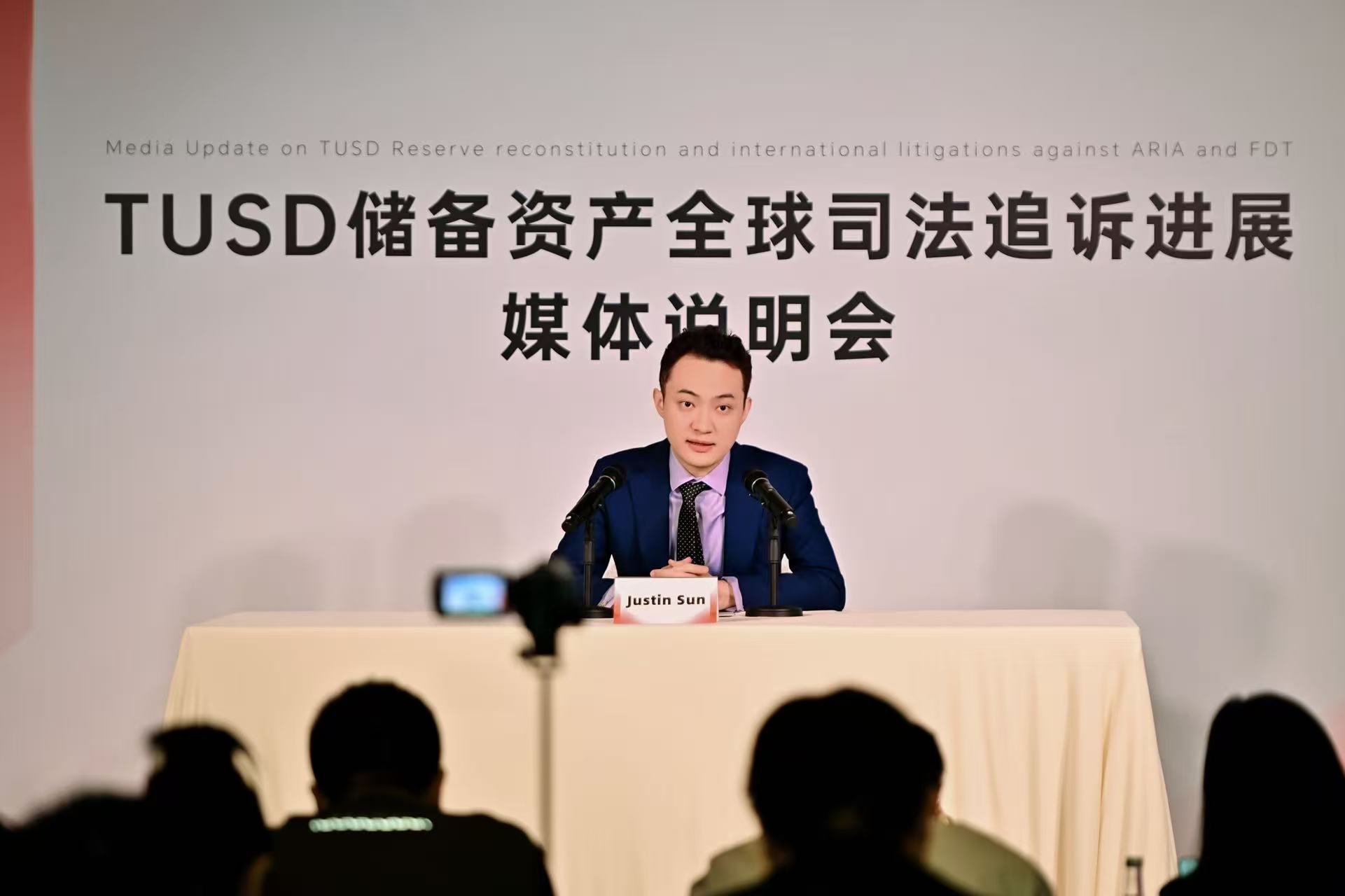
A media briefing on the progress of global judicial prosecution of TUSD reserve assets was held in Hong Kong. Sun Yuchen: Missing funds are being recovered globally

Comparing news, Sun Yuchen, founder of Bochang TRON, attended the “Truth and Justice Revealed — Media Briefing on the Progress of Global Judicial Prosecution of TUSD Reserve Assets” at the Hong Kong Peninsula Hotel and revealed key facts and phased results on the illegal occupation and misappropriation of TUSD reserves, which attracted great attention from the fintech and blockchain industry. Sun Yuchen expressed her sincere thanks to the Dubai International Financial Center Court (DIFC Court) and its Digital Economy Court for their fair and decisive rulings. Currently, they are actively tracking the whereabouts of missing funds globally. The goal is to recover the full amount and demand that any lawbreakers return the corresponding reserve assets. According to reports, according to the latest judicial documents, DIFC Courts issued an indefinite global asset freeze order against Aria Commodities DMCC on October 17, involving an amount of up to 456 million US dollars. The court stated that the funds involved in the case “have important matters requiring trial”, including acts such as falsification of authorization, violation of fiduciary obligations, illegal transfer of reserves, and cross-border money laundering. All relevant individuals and entities are required to fully disclose the flow of funds, otherwise they will face severe legal consequences.

268d ago

Binance will remove some spot trading pairs

In comparison, Binance will remove the following spot trading pairs: C/BNB, C/FDUSD, DOGE/TUSD, and NIL/BNB at 11:00 on November 14, 2025. Users can still trade related underlying assets and quoted assets on other trading pairs. Please note that the trading robot service will stop on the same day. Users are advised to close the relevant trading robot early to avoid potential losses.

283d ago

A small TRX and TUSD transfer occurred at an address linked to the US government, involving two criminals seizing funds from wallets

Comparatively, following the transfer of 667.67 BTC of funds seized by the US government two days ago in the Potapenko/Turogin case, two of its wallets that have seized criminal funds transferred funds again, but the amount was small. One wallet involved Sergei Makinin, who was serving a prison sentence for developing and spreading malware, and transferred approximately $381.44 worth of TRX; the other wallet involved Brian Krewson, who was jailed for money laundering crimes, and transferred TUSD worth 393, which is suspected to be a small test before transferring large sums of money.

310d ago
14 billion dark horse USDE blood-laundered stablecoins! DAI and FDUSD became stepping stones

14 billion dark horse USDE blood-laundered stablecoins! DAI and FDUSD became stepping stones

Original title: USDe frenzy? Deconstructing the “Satoshi Nakamoto Dollar” practice behind the 140 billion dollar volume Source: Bullshit says who is the third most stable coin in your opinion? There is little doubt that USDT and USDC occupy the top two, but today the third one is not DAI, FDUSD, or TUSD, but a new face that was launched less than two years ago — USDE. According to CoinGecko data, as of September 23, usDE's circulating supply has exceeded 14 billion US dollars, ranking third in the stablecoin market after USDT and USDC. More importantly, if USDT and USDC are excluded, USDE has occupied almost 40% of all other stablecoin markets, strongly squeezing the living space of established stablecoins. Why did such a rising star rise to prominence in such a short period of time? What are the profit logic and hidden risks behind it? At the same time as USdE is rapidly rising, what new variables are being nurtured on the stablecoin circuit? Source: CoinGecko 01 to $14 billion, USDE's nonlinear rise to the stablecoin circuit has always been a lucrative super-big cake. In horizontal comparison, the “money printer” attributes of the leading player, Tether, are even as good as the top CEX. According to the 2025 Q2 audit report released by Tether, Tether's total US Treasury bond holdings exceeded 127 billion US dollars (an increase of about 8 billion US dollars from the first quarter), and the total net profit for the second quarter was about 4.9 billion US dollars, and the total net profit for the first half of this year reached 5.7 billion US dollars. You need to know that Tether only has about 100 employees, and its profit margins and operational efficiency are astonishing. Compared to crypto trading platforms and traditional Web2 financial giants, it's almost an order of magnitude lower! However, on this lucrative table, not all players can sit at ease. With the exception of USDT, the performance of established stablecoins in recent years has not been perfect: USDC was once unanchored during the 2023 banking crisis due to reserve risks, and the impact has not completely subsided; after the transformation of DAI to MakerDAO, it is gradually moving towards “super-USDC”, and its size has also fallen into a bottleneck; although rookies such as TUSD and FDUSD have experienced short-term growth, it is difficult to shake the pattern. Source: Ethena's official website It is against the backdrop of the slowing growth of traditional stablecoin giants and the solidification of the model, that USdE came out of nowhere and embarked on a completely different “nonlinear” growth curve. Since its official launch in November 2023, USdE has rapidly grown from 0 to 14 billion US dollars in less than two years. It has experienced only two retractions during this period, and has been able to quickly resume growth. Especially since July of this year, it has nearly tripled from about 5 billion US dollars in just 2 months, and has been deeply integrated by many leading CEXs. Arguably, in the long run, USdE's growth curve is almost entirely flawless. And this almost counterintuitive growth curve is also inseparable from its well-known high-yield flywheel — when the stablecoin competition entered the “stock game” stage, USDe's extremely high annualized returns, the practical scenario of trading margin, and the “delta neutral” story really helped it quickly open up the incremental market and became the most controversial and watched rising star. 02 Deconstructing USdE: Where do high returns come from? The biggest impact of usDE on the stablecoin market is undoubtedly its high yield attribute — users can obtain all the benefits generated by the protocol by pledging usDE as susDE. According to data from Ethena Labs's official website, at the time of publication, susDE's annualized yield was still as high as 7.83%. Previously, it had remained above 20%. So what kind of stablecoin mechanism is USDe, and why is there such a high annualized return? To understand USdE, we must first clarify the essential difference between it and the thunderous UST before — UST is an unsecured, algorithmic stablecoin, and USDe is a synthetic dollar that is fully collateralized and uses a “delta-neutral” (delta-neutral) strategy to maintain stable value. The reason behind this is actually BitMEX founder Arthur Hayes as early as 2023...

332d ago布噜说#TUSD #USdE #Nakamoto Satoshi dollar #Bullshit said