


What do the bosses think of Filecoin? Filecoin Mining Pre-Closed Meeting Roundtable Discussion Transcript
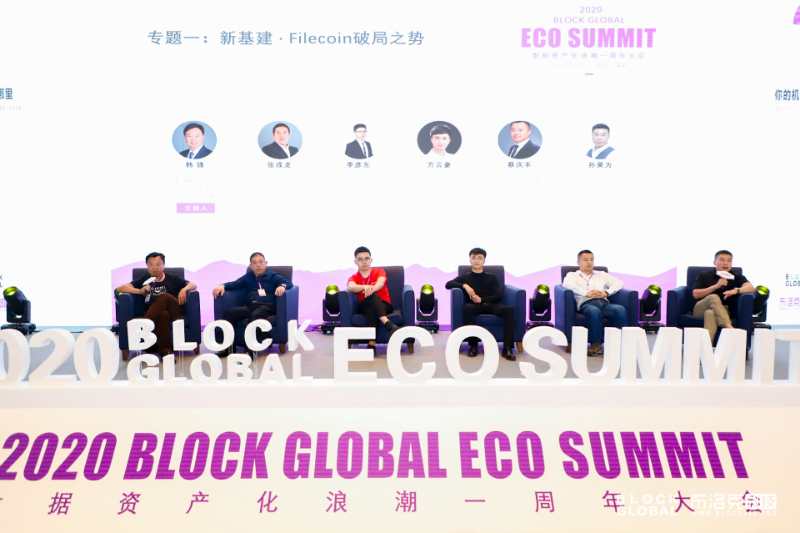
The first anniversary conference of the data capitalization wave was held in Shenzhen. The FiLDA industry alliance also joined forces such as Cloud, IPFS Power Zone, Starland, and UKEX to use core resources to create leading advantages, build a bridge between FIL and DeFi, and create a one-stop financial services alliance around Filecoin.
Prior to the Filecoin Mining closed-door meeting, Han Feng, co-founder of Yilaiyun, presided over a round-table discussion organized by Bullock Finance. The following is a transcript of the discussion.

Moderator:We invited our special guests, Zhang Chenglong, founder and CEO of IPFS Yuanli Zone; Li Yandong, chairman of Shenzhen Starland Technology Co., Ltd.; Fang Yunhao, open source mining pool partner; Cai Qingfeng (voice), CEO of Starsky Data (voice); and Zheng Xiping of 1024IPFS and Auto Miner.
Han Feng:Today's round table is very significant, because everyone knows how popular Filecoin is these days. About three days ago, the main Filecoin network went live, and the Filecoin hit 200 US dollars that night. At the time, “Guo Erbao” called me from Silicon Valley. They all said excitedly that it was bad, saying that Filecoin's market value had already surpassed Bitcoin. Of course, this is a momentary financial phenomenon. The most fundamental thing is that Filecoin represents decentralized storage. This is why it is particularly important in the future, causing so much excitement and popularity in the global capital market. The most fundamental thing is that it can support data capitalization.
Because of data capitalization, the data itself must be privatized and protected. This is Yilaiyun's Chen Rong's consistent philosophy, which is what Yilaiyun will support in the future. Therefore, the Internet of the future, the Internet that supports the capitalization of data, must have decentralized storage. In order to hurry up, there will soon be a closed-door meeting next. This is the focus of everyone's attention in the entire mining industry. Because of the price of Filecoin these days, I think everyone knows more or less that the whole roller coaster is full of clouds and rain. Various comments are flying all over the internet. Exactly at 2 o'clock, our mining bosses had a closed-door meeting, and they basically took up 50% of the computing power, so in order to hurry up, I won't let them introduce them all by themselves. I'll just introduce them; let's just talk about opinions.
This is Zhang Chenglong, the founder of the famous Force Community. The industry is known as Dragon King. I really admire the Force Community. Starting in 2018, they began to pay attention to IPFS very early. This kind of decentralized storage concept still started with the community, and now it has made such a big deal, accounting for almost 20% of the entire network.
On the Starland side, CEO Li Yandong also accounts for more than 20% of the computing power. Juan (voice) seems to have personally visited your company when he arrived in Shenzhen. He has shown me all the photos. He is definitely a leader in the industry.
Fang Yunhao, the open source mining farm, always invested by Du Jun, is also very good in terms of technology.
Cai always used to be responsible for server storage at Huawei. He was a senior figure. He was later selected by the listed company Yiyatong. Now he is working on a Star Palace data and is also mining Filecoin, and it started very well. 1024 was invested by Block Finance. I heard that it is also quite famous in the industry, ranking in the top three in a space race.

Basically, they are all representative figures in the Chinese mining industry. The first question, of course, is that you have been cooperating with the Filecoin Official Agreement Laboratory for almost two years. What kind of problems have arisen in Filecoin's overall economic model, including what problems have arisen in cooperation with them, what solutions do you think can be solved, and what are your expectations for their government?
Zhang Chenglong:One is that the mechanism was set up and that the pre-collateral was released for 180 days. According to these rules, many miners had no place to find collateral coins in the early stages. In the past two days, everyone also paid attention. Before the main network went live, it had basically exceeded 33.5 PB every day at its peak, but the daily increase in computing power was 33.5. Up to now, yesterday it grew by 1.9, less than 2. Today I looked at the entire network, which is relatively a bit more. In other words, this computing power can only reach 1/8 or 1/7 of the original situation. It mainly comes from miners not having collateral coins. Currently, the number of machines in the entire Filecoin mining circle cannot be used enough. This is a mine for current miners.
Now 25% has been released, which may relatively ease the pressure on some miners. After 25% release, you may be able to increase your BP computing power every day, which will be much better. At the same time, as the circulation of coins increases, the increase in computing power is likely to be relatively stable.
Next, Professor Han Feng said that the major domestic mining industry, including us, will have a closed-door meeting. Whether this is bad or good? I think today we will have a preliminary conclusion. Everyone can pay some attention. Thank you.
Han Feng:Azuma.
Li Yandong:Speaking from several aspects, we still think that Protocol Labs is still a rare team. After six years of development, it is undeniable. Many people feel that the economic model has many limitations, but it is actually a short act, mainly a brief phenomenon caused by an imbalance in the corresponding supply relationship at the beginning. After a month or two, this phenomenon has actually abated a lot. In this case, assuming that 1.5 million transactions have been used, what are the operations of Protocol Labs? In fact, many people are also spreading false information. Of course, this release was very early, and a certain percentage of the early releases already had to do this.
Judging from the market's currency price performance, Protocol Lab sees 60, 50, and 40 slowly slowing down due to this market liquidity. I think it's just the opposite process. From the perspective of mining machines, everyone probably doesn't understand it. The agreement lab basically has an explanation after every day for the past few years, saying that it doesn't recommend everyone to buy a mining rig or what, but our investors have their own choices, which doesn't mean who is right or wrong. From this perspective, we still believe that the team is still a very positive team. Some of the economic models currently taking place seem to be unintelligible to everyone. I don't think there is a standard answer. If the coin is released to the miners, the miners smash the coin to 5 US dollars, and everyone is not happy. If you don't release it, you won't be happy. Anyway, there are no satisfactory answers. Anyway, each has its own standards, but the entire ecosystem is constantly in balance. We believe the balance will arrive soon. Thank you all.
Han Feng:Mr. Fang.
Fang Yunhao:I agree with Yandong's opinion on the agreement laboratory and project just now. Currently in China, storage is a very important racetrack. Filecoin is currently at the top of so many tracks we have seen. Although we have seen its launch in recent times, we have seen the fluctuation of Filecoin's price in the market, but this is actually a situation in a short period of time. One of the main issues now is the issue of pre-staking and post-release. This is also an issue with the manufacturer's machine performance, so we think that Filecoin's pre-staking is too high. Future adjustments may require coordination between each company and the Filecoin government, as well as issues relating to the immediate interests of every miner, so whether it is pre-staking or post-release, these two are the most important for the miner community and protocol lab to reach a balance. This balance may be a month, possibly longer, but I think from The current so-called shutdown is a temporary situation. These problems can all be solved; it is only a matter of time sooner or later.
Han Feng:Please Mr. Tsai.
Choi Hing Fung:I want to explain my understanding from another perspective. We know that the Filecoin project is actually a blockchain project. Mr. Li also mentioned the Filecoin team just now. The Protocol Lab team actually has hundreds or thousands of people, including many volunteers. It's a very top-level team, which is really nice. But for the project we want to confirm, what we need to think about is whether it's good, but rather the community. What we are doing is a decentralized, distributed blockchain project, so it's not a protocol lab, but rather whether the power of everyone in this community is decentralized enough, decentralized enough, and not controlled by the protocol lab itself. This is my first opinion.
Second point of view, let's take a look at the Filecoin project. In fact, it is basically under the banner of blockchain, but at present, the governance structure is a contradiction of being more centralized or controlled. Let's take a look at these issues, such as the open competition. The first phase began on August 25 and suddenly went to the second phase. Only a few people knew about this, but there was no community consensus. When does Open Contest 2 start and end? It was an official announcement, a one-sided announcement. The most important thing is that all of the computing power accumulated by our test coins and open contests has been transferred, including all the official free rewards and support coins that come out of the faucet, and the officially certified robots, all of which were given out for free without any prior explanation, and finally the official website went live. Judging from this matter, if we wanted the Filecoin project to go further in the future, I personally would still be very optimistic about this project. Otherwise, I wouldn't be sitting here today.
In terms of our governance mechanism, we need to think about what direction our community will go in the future and where exactly the path is. Our team needs to make a fundamental change before we can do it. This is my opinion. Thank you all.
Han Feng:Mr. Zheng.
Zheng Xiping:We mainly do technical services. Basically, we stand in the background and do technical work. Let me just talk about the background. From our point of view, thinking about it from a different perspective, I agree with President Tsai. Since this is a blockchain project, it should be decentralized and decentralized enough. We have been involved in traditional mining since 2015, including chips and algorithms. We believe that every community's rules are not transparent enough and can continue to play, but once a better one appears, it will follow that consensus, so every time the government makes a decision, including decentralized projects, it will actually have an impact.
Blockchain's operating methods and participation ideas are very mature. Let's not talk about past events. There are indeed many things that caught all participants off guard. Mr. Cai just mentioned it, but everyone is responding positively. In the early days of the project, we observed it, but it was still unclear how its economic model and system participated. By September of last year, the entire consensus mechanism and method, we thought it was an economic activity we could participate in.
Up to now, in this development process, we haven't been able to find a reasonable point. We are particularly optimistic about the future development of the IPFS circuit and will actively participate, but the problems that arise in the middle should indeed be between the entire government and the community, including the need for equal power. For the current model, it's actually not important. If the entire ecosystem of this project is built, its currency price will naturally rise. Now for the entire storage provider that provides basic computing power, or our most basic storage provider on the racetrack, for example, we need to do a project, and now I have to invest again after completing the first phase. My investment isn't cost-effective; I just need to do a lot of high investment and low output. If you compare the cost and benefits of innovative computing power now, if you compare it to engineering, you'll find it inappropriate, and my future profit is uncertain. If it's a traditional business, you probably won't choose. This limits our development today. Everyone involved in the project has both ideal long-term and short-term benefits. Including the current situation, everyone will recalculate the entire company's development strategy account. All of this, just say that, thank you.
Han Feng:Thank you. I just mentioned the second question, because the current token model has inherent problems, and it has to be pledged and mined, and the excavated mine can still be released within a limited period of 180 days. In the middle of this, there is a need for financial support. The previous period coincided with the global DeFi boom. It should be said that a new wealth consensus of more than 10 billion US dollars was reached. This is an achievement; there is no doubt about it. However, we now believe that future DeFi development must really dig deeper into the scenario. Filecoin mining itself is a ready-made scenario, so we hit it off. Guo Erbao, etc. from the coin industry later, will work together to create a DeFi project dedicated to FileCoin. But it's not just an imitation of DeFi; countless people are doing it, and the cycle is getting shorter.
The most fundamental thing is to help people solve actual problems. Brother Long Wang just talked about it. The most fundamental thing, for example, is the Filecoin mine, which has a large investment in mining machines and has computing power, but in the future, you need to pledge Filecoin. If you expand and continue mining, where will the capital come from. In fact, you have to talk about pledged loans; this cannot progress. Therefore, the core problem solved in DeFi, which will also be launched by Cloud in the future, is how to capitalize on the large-scale computing power they have, worth tens of billions of dollars. This is the biggest problem. So I'd like to hear everyone's opinions on this one.
Zhang Chenglong:Mr. Han Feng promoted Filecoin a lot. In fact, we talked about it a few times. Indeed, because of its economic model, this wave of Filecoin requires miners to be mortgaged, investors also need to cash out and circulate, including exchange payments. This is indeed a problem. This question just provides FileCoin with a very good idea in DeFi, and also relieves the pressure of many miners. This is my opinion, thank you.
Li Yandong:Time is tight. Simply put, if DeFi is for hype in other fields, then it actually solved the problem in the Filecoin field. It's a natural scenario; in Han Feng's words, it's a natural scenario.
Fang Yunhao:The first time I talked to Mr. Han Feng about Filecoin was a few months ago. Mr. Han Feng actually had a very detailed observation on the Filecoin ecosystem. We also talked with Mr. Han Feng, including Huobi and OK, about tokens, how to make coins and let mining friends collateral them, so that the machine can generate computing power and continue to grow upward. Our loan actually requires a collateral pledge. For example, when we lend, we need to have assets. Where do these assets come from? This is probably also an issue to consider for a DeFi platform core project.
As far as we are concerned, for some reason, we have considerable financial resources to support the issue of a second mortgage, and we are also willing to actively share it. Thank you.
Choi Hing Fung:I think Mr. Han Feng's proposal is particularly good. First, DeFi is very suitable for solving the FileCoin pre-collateral problem. I want to support Han Feng's DeFi idea from a data perspective. First of all, we know that at present, the cost of one pre-pledge is about 10 files. Currently, the profit is between 0.3 and 0.4. If calculated at 0.4, it can basically be transferred in about 25 days. This is also a very important prerequisite for us to do DeFi. That is, for miners, we need such a mechanism. The DeFi business has a very important premise, that is, you just use DeFi to return DeFi, not many other things at present. It must be a rule that can support the miner ecosystem. A great support.
As far as miners are concerned, they can mine coins, be rewarded, and be able to continue playing this game. Otherwise, this is a Ponzi game. I think it's very good to support Mr. Han's proposal from this perspective.
Zheng Xiping:I think the traditional mining industry itself is like this. It's a very mature way to expand everyone's investment opportunities. The natural integration of this in Filecoin is very natural. Today's method, the DeFi method is unfair, and the rules of the game are not transparent. Especially when solving the current problem, there are several aspects. One is to talk to the government, including community protests, and let everyone act. This is a possibility. There is another possibility. DeFi does provide a way out of several ways. I believe as long as we are optimistic about this development, this direction is correct. Its DeFi will play a big role in the long term and in expanding the use of our funds, thank you.
Han Feng:Due to time constraints, the closed-door meeting is about to begin. Finally, everyone greets them. You hope to reach a better consensus in the closed meeting. Also, Laiyun will definitely strive to use its technical advantages to better develop the decentralized storage and Filecoin industry circuit, so that Mr. Chen Rong's ideal of the second-generation Internet can be realized as soon as possible. Thank you all.
Moderator:Thank you, we invited guests to stay. Next, we have a very important part to start our launch ceremony.
Source: Brock Finance
