


Betting on sidechains and Lightning Network, 'Blockstream' wants to improve Bitcoin's future

Many people believe that Bitcoin is the future of the financial system. However, as the blockchain audience expands and application scenarios expand, early hidden problems such as performance are unquestionably preventing Bitcoin from becoming the future.
The method of creating competitive coins can indeed promote innovation, but it will dilute the value of Bitcoin to a certain extent; if the upgrade is carried out directly on the Bitcoin blockchain, possible failures and security risks have a great impact; in addition, due to the characteristics of Bitcoin's network structure, it is also necessary to obtain consensus from miners if large-scale changes are made. As a result, developers are trying to improve Bitcoin's scalability problem through sidechains (sidechains).
As a new blockchain based on anchoring the Bitcoin main chain, developers can upgrade the main chain performance and add new features on the sidechain without affecting the performance/latency/TPS of the main chain. Currently, the most famous Bitcoin sidechains include BTC Relay, Rootstock, and Elements.
Blockstream, which Star Daily previously contacted, is a blockchain software and hardware solution service provider. It focuses on expanding the functions of the Bitcoin protocol layer, while also leading the development of sidechain expansion mechanisms. Continuing with the developer team's publication of a sidechain white paper in 2014, Blockstream created the sidechain Elements project in 2015.
The element chain brings many innovative technologies to Bitcoin, including features such as private transactions, separation of evidence, relative lock time, new operation codes, signature coverage amounts, etc. As an open source project, developers can use any combination of new technologies in Elements to build and test their own Bitcoin sidechain products.
liquids
Based on the Elements open source project, in October 2016, Blockstream announced the research and development of Liquid.Liquid, a sidechain for commercial applications facing the financial market. It is the first affiliate chain in the Bitcoin sidechain to provide fast, confidential and secure Bitcoin transfer services for exchanges, companies and traders. Participating exchanges and Bitcoin commerce companies can deploy corresponding software and hardware to form the Liquid network. Currently, Liquid has reached 13.3 TPS, and Bitfinex, Unocoin, Bitso, Xapo, and dozens of other unannounced exchanges have deployed Liquid.
At the beginning of July this year, Blockstream launched the “Issued Assets (IA)” program. Users can create their own tokenized assets on the liquid side chain. These asset types can be traditional financial instruments such as stocks, bonds, vouchers, and debits; in addition to enabling confidential and secure Bitcoin transfers, users can also atomically exchange Bitcoin and IA, which means that in a transaction, Bitcoin can be exchanged for assets without a trusted third party.
Lightning Network “c-Lightning”
Although many merchants are accepting Bitcoin payments, it is still difficult for Bitcoin to become a currency in everyday life due to payment delays, block size restrictions, and slow transaction speed. In response to this pain point, Blockstream has created a Bitcoin micropayment system, the Lightning Network “c-Lightning”, which has now been updated to the beta version (there are three types of lightning networks: Eclair, LND, and C-Lightning in the blockchain world, all of which have been updated to beta versions). c-lightning allows transactions to be completed off-chain, and an expandable micropayment channel network is established based on consensus between the two parties. Both parties can make instant payments multiple times through payment channels, which can effectively resolve delays. Capacity expansion, the ultimate problem. According to the latest data from Blockstream, the Lightning Network currently has about 10,479 open channels with a capacity of 77.2 BTC.
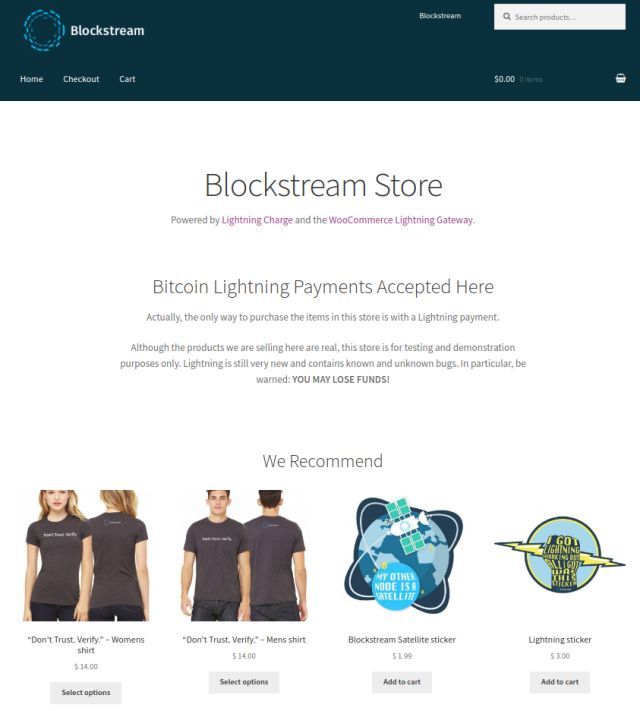
In January of this year, Blockstream launched Lightning Charge, a micropayment processing system. By using this software package, developers can use the Java and PHP libraries in the element project and connect to the REST API to implement C-Lightning functions, making it easier to create their own independent network payment facilities. Currently, Lightning Charge has been applied to the Blockstream e-commerce website, and store users can use Lightning Network payments to purchase some stickers and T-shirts on the Bitcoin main network.
Blockstream satellite
In addition, Blockstream launched the Blockstream satellite in August 2017. In its satellite network, a ground station (transmission port) can upload data from the public Bitcoin blockchain to the satellite in the network and then broadcast the data to all parts of the world. The purpose of satellite networks is to ensure, on the one hand, that the use of Bitcoin is not interrupted due to network interruptions, to further increase Bitcoin's participation, and on the other hand, to provide additional reliability for blockchain data when the network is partitioned.
Digital currency data briefing service
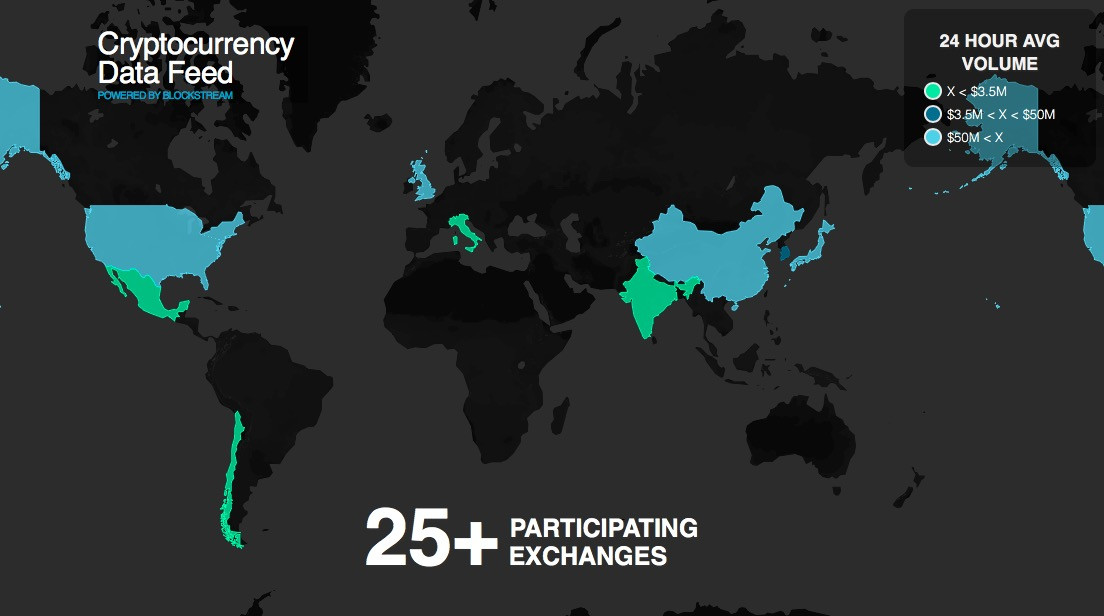
In January of this year, Blockstream reached a strategic partnership with the Intercontinental Exchange (ICE) to launch a cryptocurrency data briefing service (Cryptocurrency Data Feed), which is distributed by ICE Data Services. According to Blockstream, the newsletter provides historical and real-time digital currency data, as well as other relevant delegated ledger data such as quantity, price, currency, and timestamps. The data comes from partner exchanges around the world. Currently, it covers 25+ exchanges and 133 digital currency and fiat trading pairs.
According to Blockstream's chief strategy officer Samson Mow (Samson Mow), Blockstream was founded in 2014 and has accumulated quite a bit on Bitcoin-related technologies such as sidechains. Currently, it mainly faces the B-side and achieves profits through sidechain liquid and data briefing services.
Blockstream received $21 million in seed funding in 2014 and $55 million in Series A financing in 2016. Up to now, the total financing has been approximately US$80 million (nearly 600 million yuan).
The team's background is remarkable. Dr. Adam Back, the co-founder and CEO of Blockstream, is a British cryptographer and inventor of hashcash (hash cash mechanism), and is one of the references in Satoshi Nakamoto's Bitcoin white paper; co-founder Pieter Wuille is one of the Bitcoin core developers; infrastructure engineer Rusty Russell is an Australian free software programmer and advocate who specializes in the Linux kernel's network subsystems and file system hierarchical standards. He also drafted most of the Lightning Network protocol specifications; Chief Strategy Officer Samson Mow (Samson Mow) is a well-known contributor to the Bitcoin community. Previously, he was the chief operating officer of BTCC, a major digital currency exchange and mining pool, responsible for business operations, product development, and marketing.
Source: Firewood Chopping Network
