


Li Lihui: Blockchain Technology Innovation and Industrial Upgrading
“Blockchain technology accelerates innovation, expands applications, and shows broad prospects in promoting industrial upgrading.”
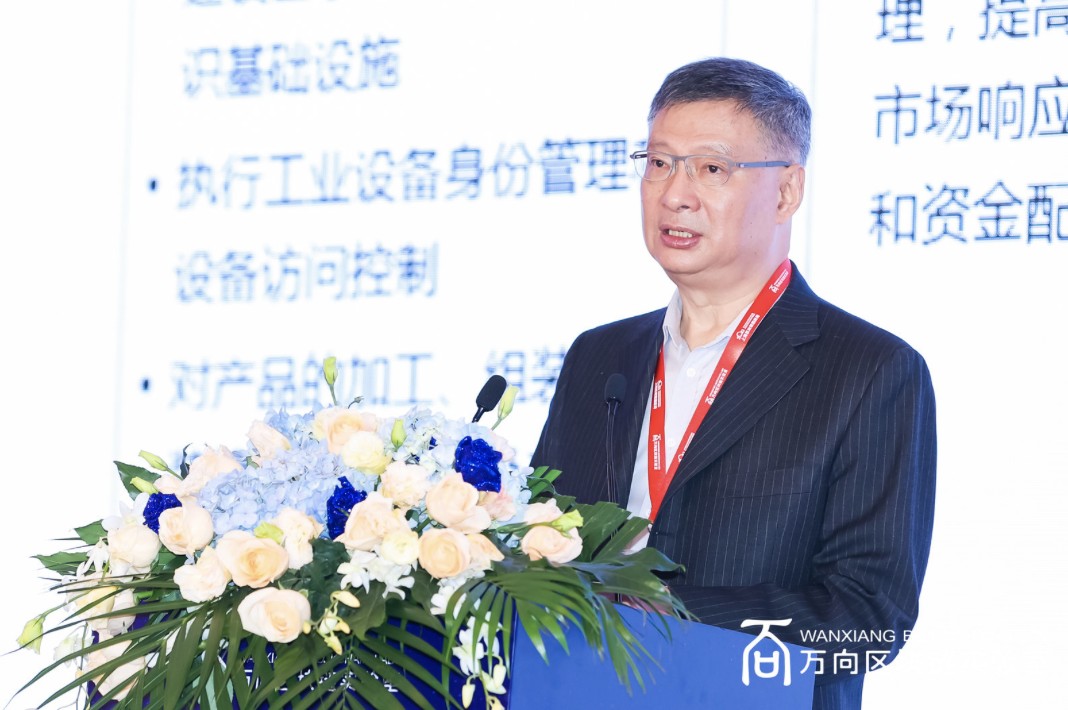
Mars Finance News: On October 26, the 7th Blockchain Global Summit hosted by Wanxiang Blockchain Lab officially opened in Shanghai. Li Lihui, former governor of the Bank of China and head of the Blockchain Research Working Group of the China Internet Finance Association, delivered a keynote speech on “Blockchain: Technological Innovation and Industrial Upgrading”. The full text of the speech is as follows:
General Secretary Xi JinpingIt was stated two years ago:Blockchain should be used as an important breakthrough for independent innovation of core technologies, clarify the main direction of attack, increase investment, focus on overcoming a number of key core technologies, and accelerate the development of blockchain technology and industrial innovation.The “National Standardization Development Outline” issued by the Central Committee of the Communist Party of China and the State Council proposes to simultaneously deploy technology research and development, standard development, and industrial promotion in technology fields with broad application prospects, such as integration of the two, next-generation information technology, big data, blockchain, health, new energy, and new materials, to accelerate the pace of industrialization of new technologies.
In the past two years, blockchain technology has accelerated innovation and expanded applications, showing broad prospects in promoting industrial upgrading.
1. Blockchain technology innovation strengthens digital trusted interaction.
Blockchain solves trust problems through mathematical methods, and rules are expressed through algorithmic programs. As long as common algorithm programs are trusted, mutual trust can be established. This kindDigital trust has high efficiency, low cost and inclusiveness. The first is to form a trusting bond in an environment where trust is unknown or trust is weak,Save the time and cost required for credit formation, and support commercial credit;The second is to establish an authentication tool with zero time difference and zero distance in wide-area, high-speed networksto improve the efficiency and reliability of the Internet of Things.
Recent blockchain technology innovations focus on expanding interaction and storage capabilities. Cross-chain technology enables interoperability between blockchains and between blockchains and the Internet, and information and assets can circulate on a wider scale in a way that cannot be copied, falsified, or tampered with. Blockchain's distributed storage technology can store files in different spaces and generate proof of file storage authorization, which has certain advantages over traditional cloud storage in terms of reliability, edge storage costs, and data privacy protection.
The information technology architecture we are familiar with is highly centralized and locally closed. The commercial society we are familiar with is where market players are independent and flat and interactive, and the traditional credit mechanism we are familiar with is self-contained and segregated. By establishing a digital and trusted three-dimensional interactive architecture, blockchain technology has the potential to reinvent industries and business models and promote economic upgrading.
The first is industrial logo analysis and equipment management.Achieve global unique identification management, solve the problem of equal communication between different identification and coding systems on the industrial Internet, build blockchain-based industrial identification infrastructure, implement industrial equipment identity management and equipment access control, and manage the entire life cycle of production processes such as product processing, assembly, and distribution, as well as product circulation, consumption, and recycling.
The second is industrial chain collaboration.In an industrial chain collaborative network composed of core enterprises, suppliers, dealers, customers, etc., simultaneous data sharing and management coordination are realized, supply chain management is optimized, collaboration efficiency is improved, market response efficiency is improved, and product and capital allocation efficiency is improved.
The third is supply chain finance.Establish a multi-party collaboration structure and trust mechanism to overcome the limitations of traditional commercial credit and transfer core enterprise credit to more levels; establish an ecosystem of mutual trust and exchange, reduce financing thresholds and financing costs, speed up logistics and capital turnover; and incorporate commercial agreements into smart contracts to prevent misappropriation of funds and malicious default.
Fourth, rural revitalization.Build a digital platform for physical assets, digitize physical assets, map physical assets and their ownership and value at different points in time and location on the blockchain, form traceable, and tradable digital digital assets, carry out full-process operation and management, revitalize the value of physical assets, and help revitalize the countryside. For example, beef cattle have become tradable, traceable, and traceable digital assets on biological asset trusted supervision and financial service platforms. On the Pu'er tea blockchain platform, Pu'er tea can be verified and traced back to its roots, and can be stored centrally and traded separately, solving the problems of counterfeiting, difficult preservation, and inflated value of tea cakes in the Pu'er tea market.
Fifth, smart cities.Integrate digital technologies such as blockchain, artificial intelligence, big data, and the Internet of Things to build the bottom layer of trusted data standards to support the digital upgrading of cities, and achieve real-time visualization of the entire state of the city. Achieve trustworthy personal identity, trustworthy asset ownership, trustworthy health status and effective privacy protection in the field of citizenship; realize intelligent public services, intelligent public management, and intelligent public supervision in the administrative field; achieve distributed real-time monitoring, measurement and emission rights trading of carbon emissions in the green economy; and achieve intelligent route guidance and parking guidance in the transportation sector to form an efficient, low-carbon, harmonious and safe urban ecology.
II.Accelerate the development of blockchain technology and industrial innovation.
China's experimental application of blockchain technology is at the forefront of the world. In February 2021, the US “Forbes” selected the top 50 global blockchain companies, and Tencent Blockchain entered the list. Wanxiang Blockchain provides customers with blockchain+ industry solutions, covering supply chain finance, automotive supply chain logistics, industrial Internet, biological assets, digital cities, etc., to enable industrial upgrading.
Blockchain technology innovation is a global hot topic. It has made great progress, but it has not yet reached the level of large-scale reliable application in the high-concurrency market, and the new cross-chain technology still has security risks. We are in a period of great opportunity for the development of blockchain technology and industrial innovation. In this period of development opportunities,Calm institutional innovation can eliminate possible local bubbles in a timely manner, while active technological innovation can continue to create expandable commercial wealth.
First, technological nation-building in geopolitics.
China is a country with large data resources and a large digital market, but currently it is still a weak software country. According to the number of international patent applications issued by the World Intellectual Property Organization WIPO, compared with 2001, the share of the United States fell from 40% to 21.8%, China's share increased from 1.6% to 22.3%, Japan remained around 20%, Germany decreased from 13.0% to 7.3%, and South Korea rose from 2.1% to 7.2%. Although China's share of international patent applications has surpassed that of Western countries such as the US, the intellectual property rights for core technologies are still mainly controlled by Western countries such as the US and Japan. A 2020 study by the German Bertelsmann Foundation found that out of 58 cutting-edge technologies, the US holds the most patents in 50 of them.
Equality in digital technology is the cornerstone of equal competition in the digital economy and digital finance. In the field of core digital technology, our country can only truly establish equal and mutually beneficial relationships with Western countries if it makes up for its shortcomings.
In October 2020, the US released the “National Strategy for Key and Emerging Technologies”. The list of 20 items includes high-end computing, data storage, and distributed technology, etc., making it clear that “the US must develop these technologies, protect these technologies, and cannot provide these technologies to competitors.”
In terms of core digital technology, we can't borrow, can't buy, and can't wait. The only path is to be self-reliant, work hard, and seek breakthroughs.
Second, data protection in the Internet of Everything.
Data resources are individual wealth and collective wealth. In the digital economy era, it is even more necessary to effectively protect data privacy. The basic right of data owners to private data should be emphasized. For example, it is stipulated that an enterprise must obtain the express consent of the data owner to collect and process data, stipulate that the enterprise must not collect, process, and use data beyond the scope of the agreement, and give the data owner the right to request that the data holder delete data involving their own private data.
Data resources are a country's wealth, and data security is a guarantee for data development and utilization and the development of the data industry.For example, the financial industry must establish a technical environment where users trust each other and information is true and symmetric, requiring reliable transmission of data and protecting personal privacy; it requires the use of mutual authentication technology to establish an identity authentication system to perform characteristic identification, spatio-temporal positioning, and identity authentication of people or objects, perform user authorization verification and information data verification, and confirm end-to-end control rights.
The state supports data development and utilization, and supports data security technology promotion and commercial innovation.Through technological innovation, data resource sharing and secure application can be realized. For example, the China Internet Finance Association took the lead in developing a data element integration application system for the financial industry. This system integrates technologies such as multi-party computing, federated learning, data masking, differential privacy, and trusted computing to protect data privacy while enabling data sharing, and protecting data security while enhancing the value of data resources.
Third, penetrating supervision in industrial integration.
Digital technology innovation is changing the financial service model, gradually forming a new financial business format of interaction, intersecting, and intersecting. For example, the future digital asset market will include not only digitized financial assets, but also capitalized patent data and copyright data. It will form a complex structure where asset owners, investors, property rights registration, property certification, financial intermediaries, regulators, tax agencies, and arbitration institutions meet.
Financial innovation calls for regulatory innovation. The digital financial supervision system should be jointly built and shared by financial supervisory authorities. It should cover all financial institutions. It should penetrate different financial markets and financial services, achieve all-round intelligence in the entire financial supervision process, go beyond complex and resource-intensive on-site supervision, and reduce the cost of supervision and supervision.
Fourth, security barriers in distributed architectures.
Decentralized finance has the potential to penetrate a country's financial infrastructure barriers and monetary sovereignty and regional financial regulatory boundaries. Decentralized finance is not only a hot topic of future international financial competition, but also a hot spot for future global financial regulation.
As a major economic power, China's implementation of a higher level of economic openness and financial openness, including capital market opening, is a basic national policy; maintaining overall economic and financial stability and actively preventing systemic financial risks is the bottom line of finance.
Therefore, it is necessary to thoroughly analyze the existing and potential “disruptive” performance of digital technologies such as distributed peer-to-peer architectures and decentralized architectures, focusing on studying possible paths for decentralized financial instruments based on new digital technology to overcome financial infrastructure barriers, studying technical countermeasures and policy plans, and constructing digital financial security barriers.
Fifth, security responsibilities in the open source landscape。
Open source is penetrating more and more software products. Some experts believe that open source has become the mainstream of digital technology innovation, and that open source can cross corporate borders and national borders, and enable industrial transformation and upgrading. It should be noted that open source will also form system binding and technical dependency. Some open source software lacks clear security responsibilities and authoritative security certification, and may have security flaws.
In the open source pattern, the first is to establish software security technology standards, establish software audit and certification systems to prevent open source software with security risks or even malicious Trojans from entering China; the second is to increase investment and policy support to encourage China's own scientific research institutions, science and innovation enterprises, and digital technology talents to develop software with independent property rights to optimize and balance the basic performance, extended performance, and security performance of core software, and promote the progress and growth of China's software industry.
author:Li Lihui, former governor of the Bank of China and head of the Blockchain Research Working Group of the China Internet Finance Association
