


IOSG Weekly Brief | Unbreakable, Why We Need Better NFT Protocol Standards #141
Part 1 Insight
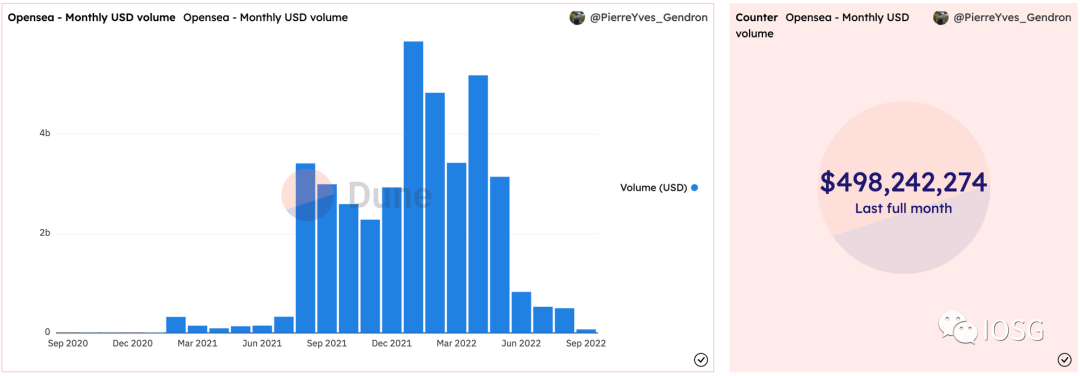
The NFT market is no exception, and the floor price of blue-chip NFTs has dropped significantly. Meanwhile, OpenSea's August trading volume was less than 500 million US dollars, a record low in a year. Despite this, in the face of sluggish market conditions, Paradigm and A16Z, which are the two major trendsetters for crypto funds, have not “recovered” and have recently published articles on topics such as NFT pricing and copyright. On August 31, A16Z published “The Can't Be Evil NFT Licenses”, defining the six major copyright categories of NFTs. Paradigm published VRGDAS and GOO on August 24 and September 6, respectively, to discuss the innovative auction mechanism and community value of NFTs. This article will focus on introducing readers to these three new standards and mechanisms built around NFTs.
notions: VRGDA is a new auction mechanism for NFTs, suitable for non-linear release of illiquid assets logic: NFT issuers can use VRGDA to customize the auction schedule for NFTs other than one-time release or linear release. and fit the schedule through dynamic price adjustments significance: Empower creators, not miners, to gain more consumer surplus; slow and extend the life cycle of an NFT project
VRGDAS, the full name in English, Variable Rate Targeted Dutch Auctions, is a new NFT auction mechanism proposed by Paradigm. Before we discuss VRGDA, let's take a look at the GDA concept. GDA in ChineseProgressive Dutch AuctionsAs the name suggests, its working principle is to break up an auction into a series of Dutch auctions (note: Dutch auctions are a commonly used auction mechanism. The auction starts with a high asking price, then gradually reduces the price until the buyer is willing to accept it). Because sales do not depend on market liquidity, GDA is particularly suitable for assets that lack liquidity.
VRGDA is a derivative of GDA. It allows the NFT issuer to set an auction schedule, such as selling 100 NFTs every day, or selling 10 NFTs less every day than the previous day. The life cycle of an NFT is very similar to the Gartner Hype Cycle (Technology Maturity Curve). The price of NFTs was very low when there wasn't much volume in the early days. After gaining community and popularity, the price skyrocketed, and then fell like crazy in the past due to the boom. Most of the NFT projects will return to zero, and very few NFTs that have received consensus will survive and gradually stabilize at an equilibrium price in a market.
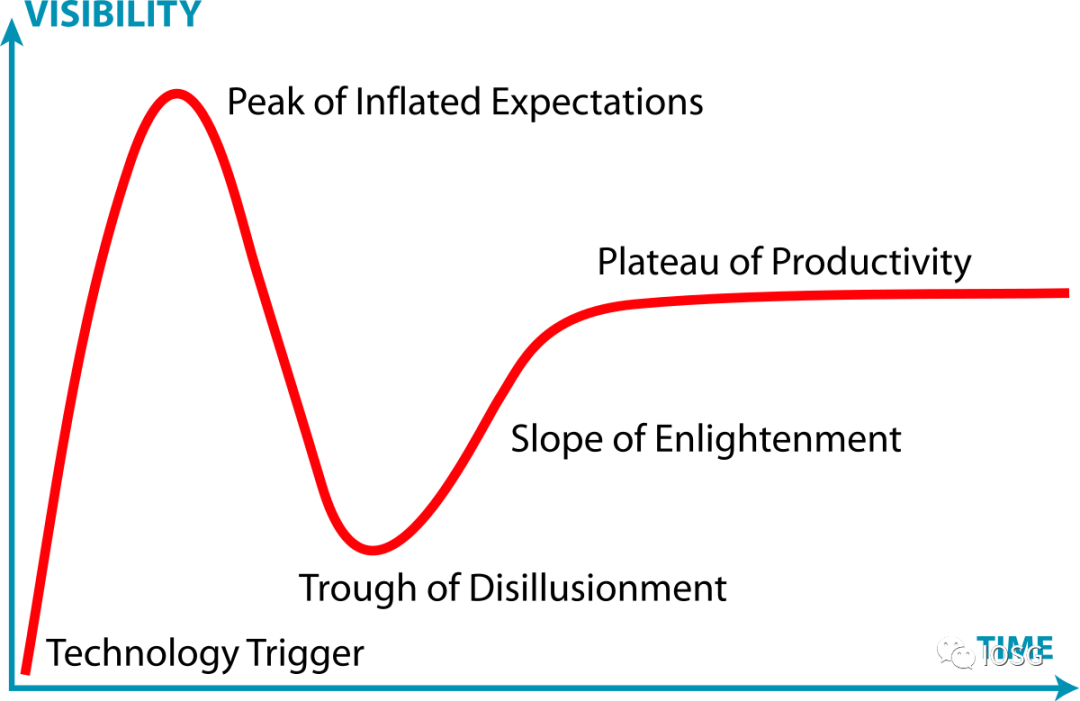
Photo Credit: Wikipedia - Gartner Hype Cycle
So VRHow can GDA extend the NFT cycle through the auction mechanism?Paradigm provides such a function:

Among them, P0 is the target price of the NFT; k is the decay factor of the NFT price when the expected sales volume is not reached; f (t) is the timeline, and n NFTs are expected to be sold at point T in time. By substituting different f (t), we can obtain different sales mechanisms. Paradigm only discusses three situations in the article, but theoretically any kind of schedule can be achieved. If the issuer chooses to release NFTs linearly at a constant rate, such as releasing 10 per day, this is a simple GDA. VRGDA is required if issuers expect to adjust the number of releases over time. For example, the issuer wants to issue an unlimited supply of NFTs, and it is expected to generate more popularity at the beginning of the release, so they plan to release more NFTs in the early stages. The number of NFTs released decreases over time, so they can choose to substitute the formula function. If issuers want to release NFTs more aggressively in the early stages and don't want unlimited NFT inflation, then they can choose a logarithmic function to achieve it.

Picture source:https://www.paradigm.xyz/2022/08/vrgda
Once the expected schedule is in place, the second step is to adjust the price dynamically to fit the expected schedule. The most basic theory of demand in economics is applied here: when the price of a commodity rises, demand decreases; when the price of a commodity falls, demand increases. Therefore, we can adjust the price of NFTs by adjusting k. If sales are higher than expected, then raise the price of NFTs to control excess demand; if sales are lower than expected, then lower the price of NFTs to stimulate demand. Adjust the expected schedule by intervening in prices.
What are the benefits of adopting VRGDA? Most directly, creators rather than miners can get more profit.If the issuer can adjust the total amount of NFTs issued each day, there will be no gas war caused by one-time issuance, leaving a large portion of the consumer surplus in the miner's pocket. Second, this distribution method can also make the life cycle of NFTs smoother and avoid sharp price increases and falls. At the same time, it extends the life cycle of NFTs to a certain extent.
GOO, the full name of Generalized Ownership Optimization, means progressive ownership optimization for communities that issue NFTs and tokens at the same time. GOO's main problem is that many projects' NFT issuance and token issuance are independent and untied, so token holders and NFT holders will separate over time. For example, the ENS community, the group that holds the ENS domain name does not match the group that holds the ENS token. Goo's solution to the problem is to bind additional tokens to NFTs. Simply put,Users need to hold a certain percentage of NFTs and tokens at the same time to maximize their benefits. The issuance of tokens is highly inflated, and over time, more and more tokens will be issued per unit of time. The allocation of tokens at the same time is related to two conditions: 1. Must hold an NFT, 2. The number of tokens held. As the number of tokens held increases, more tokens will be issued accordingly. Issuing additional tokens based on NFTs can also be understood as having the ability of NFTs to generate tokens. If the user has only tokens and no NFTs, it is equivalent to only eggs and no chickens, and users have no ability to generate tokens. Well, as the number of tokens issued increases, the value of tokens in users' hands will be diluted. Therefore, holding only tokens and not NFTs is a very unwise decision; users will be more motivated to hold both assets at the same time. So the more complicated question is when users hold NFTs, how much of GOO can they hold to maximize utility? As mentioned earlier, the more tokens you hold, the more additional tokens you will receive. However, in order to avoid situations where there is only one NFT in one account (to obtain the right to issue additional tokens) and a large number of tokens (to obtain as many additional tokens as possible). Paradigm will set regulations based on the rate at which NFT tokens will be issued. The function of the NFT production token is:

where M is the multiplier for tokens generated by the NFT, and g (t) is the number of tokens held at t point in time. Therefore, the efficiency of NFT generating tokens is related to two factors. One is the NFT's own multiplier (initial endowment), and the other is the amount of tokens held (later adjustment). A formula function is used here. The meaning is that the marginal efficiency of generating tokens for NFTs in hand decreases for each additional unit of tokens held. Therefore, when the NFTs and tokens in the hands of the holder have reached the optimal ratio, the utility of continuing to increase tokens is less effective than constructing a new portfolio of NFTs and tokens.
So a new question has arisen. If there is a motive to hold multiple NFTs, do users need to continuously dynamically adjust the token ratio to achieve the best balance? The answer is no. Under Paradigm's mechanism, once the token and NFT multipliers reach the optimal ratio, there is no need to adjust them. Also, under the best ratio, holding an NFT with a multiplier of 10 is the same as holding two NFTs with a multiplier of 5. This means that there is no unfair situation between people who only own one NFT and those who hold multiple NFTs, because the rate at which tokens are issued is only related to the NFT multiplier, not the number of NFTs that are held. Detailed mathematical formula deductions are not explained here; interested readers can refer to the original Paradigm article.
The meaning of GOO, in a nutshell, isForced asset lock-up is achieved through high token inflation. Secondly,Bind NFT holders and token holders by binding the relationship between NFTs and token issuance to avoid problems caused by inconsistent interests between the two communities. For example, holding an NFT means agreeing with the cultural attributes brought by this NFT, and holding a token is more for investment reasons. However, the distribution of community governance rights is generally distributed based on the number of tokens held. These token holders may not identify with the community itself or be interested in participating in governance. Therefore, it is necessary to maintain the unity of the two groups of NFT and token holders, but I don't think it is sustainable to achieve mandatory lock-up through high inflation.
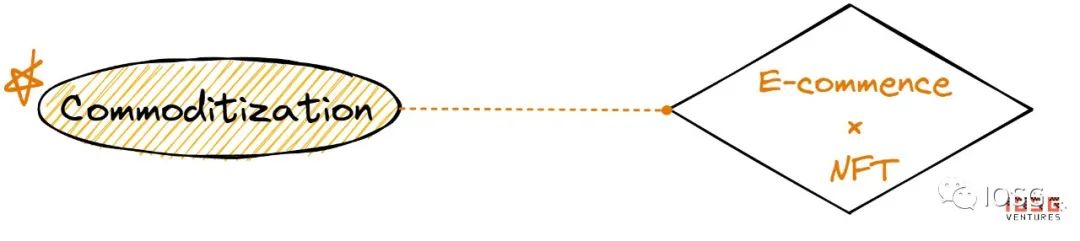
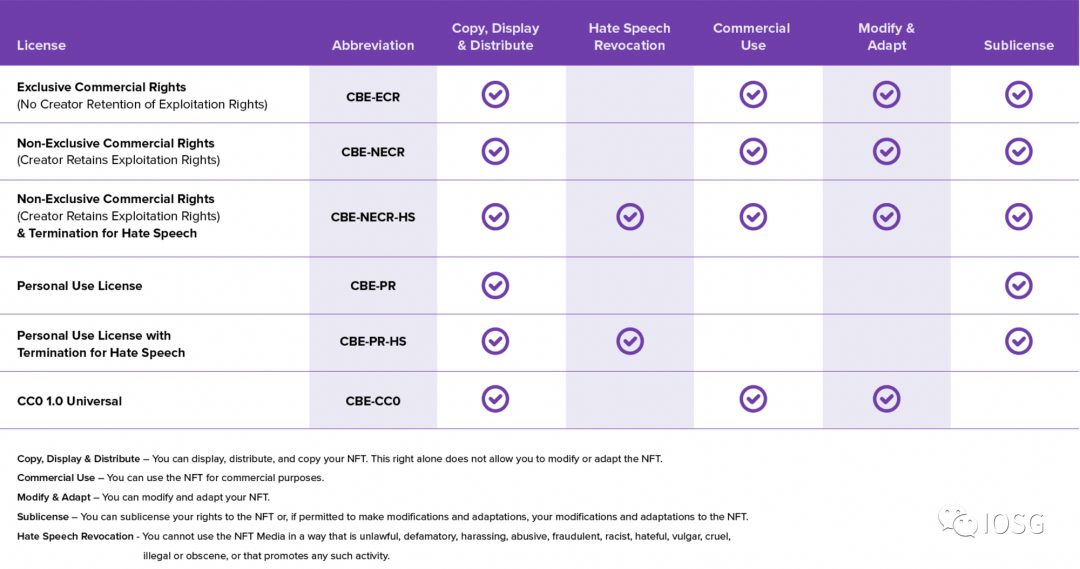
The traditional copyright licensing system has many rules and regulations for creators, which greatly limits the participation of creators or more people in cultural and intellectual production. Especially in the context of Web 3.0, past rules can no longer solve new problems. Many NFT projects have caused many disputes and even legal issues due to unclear copyright definitions. In response to this phenomenon, A16Z issued “Can't be Evil NFT Licenses.” These licenses clearly stipulate the buyer's rights with respect to their NFT artwork, and the design mainly covers three aspects:1. Are these rights exclusive (the creator waives all licensing rights, only the buyer has the right to decide how to use the NFT); 2. Whether to include commercial rights (opening the buyer's right to use for commercial purposes); 3. Whether to allow the buyer to re-modify, re-create, etc. (modify or re-create an NFT and use it). Other rights include whether the buyer has the right to copy, display, and distribute, and the right to remove hate speech, etc. Picture source:https://a16zcrypto.com/introducing-nft-licenses/ Based on the six types of NFT licenses, it is very clearly defined which rights the creator relinquishes to the buyer and which rights are reserved at the same time. This set of rules can help the NFT community better obtain intellectual property protection and help establish a fairer, more effective, and more creative NFT ecosystem. It is worth noting that the A16Z set of guidelines was not directly accepted by the community after it was introduced, and there were many voices of opposition in the market. One of them, for example, involved the right to hate speech, sparked heated debate. Because how to define the nature of “slander, harassment, fraud, vulgarity, cruelty,” etc. is entirely the creator's subjective judgment, the lack of objective standards may lead to disputes, especially the “cancellation culture” common in Europe and the US. Despite this, regardless of whether specific regulations are reasonable, the attitude and enthusiasm of the Web3.0 community in discussions and research is very encouraging. A16Z also mentioned in the article that the above rights only relate to the simplest and most basic rights, and they may not apply to every project or resolve all copyright disputes. The author believes this is a good starting point, and it also encourages more practitioners to add bricks and tiles to industry standardization. Today's NFTs have spawned many ways to play, and many NFT-Fi projects are constantly emerging. Our previous article “Sudoswap-led NFT-FI Summer is hereIt was described in detail in”. whileNFT-Fi has one of the most basic presuppositions - the underlying value of NFTs is widely recognized. Based on this, a series of ways to play with NFTs, such as collateral lending, derivatives, and fragmentation, are only meaningful. So where does the underlying value come from? The author believes that NFTs have two basic attributes — content attributes and financial attributes. These two attributes reflect the two underlying values of NFTs — cultural value and practical value. The first is cultural value. NFTs can be used as carriers for cultural products such as text, images, audio, and video. However, in reality, selling NFTs at such a high price is still accepted by the public. “Aren't NFTs just a JPEG, why are they so expensive?” Similar questions continue to be heard. In fact, the question itself implied a value judgment: cultural products should be cheap because the services and content of the Web 2.0 platform are free. And this kind of thinking is a consumption habit cultivated over the years by an attention-economy business model. Whether it's images, articles, music, or videos, consumers are used to cheap cultural products. Therefore, being able to sell a JPEG at a very high price is an outrageous thing in the eyes of the public. However,The value and price of a commodity are two attributes. Price is a monetary expression of value, but this mapping is not always correct. The low pricing of cultural products has led consumers to mistakenly believe that cultural products have no value. Therefore, NFTs as cultural carriers are alsoThere's no value. Once consumers have developed this mindset, it will be extremely difficult for creators to monetize it. The author was in the previous article “Pop music chronicles——How does the creator economy make the greatest works?” also explained this view:monopolyThe end result is not a monopoly on technology, but an absolute voice over economic models. The attention economy has stripped creators of pricing power and fostered consumer erroneous consumption ideas and habits. To change this status quo, Web 3.0 is first and foremost a cultural movement that allows the cultural value of NFTs to be widely recognized and properly priced. However, the concept of consumption has been cultivated over a long period of time, and changes in the concept of consumption cannot be achieved overnight. In a context where the cultural value of NFTs is not recognized, the second attribute of NFTs — financial attributes — is particularly important.If an NFT has practical value, then consumers will naturally pay for the NFT. For example, NFTs are being used as tickets, memberships, identities, game items, investment targets, etc., and the use cases of NFTs continue to innovate. If NFTs are widely used in various fields and their practical value is continuously verified and promoted, consumers' perception of NFTs will not stop at the JPEG level. Only when the underlying value of NFTs becomes a consensus will NFT-derived gameplay be meaningful, and NFT-Fi will likely become a new narrative. Currently, there are many NFT-Fi projects on the market, but there are few discussions surrounding the underlying value of NFTs. As a “beacon for Web 3.0,” A16Z and Paradigm have recently conducted numerous studies on the value of NFTs. VRGDA proposed a better auction mechanism so that the value of NFTs can be reflected more effectively in price. The Can't Be Evil License clears barriers for NFTs as copyright carriers for cultural products. In contrast, the author believes that the most popular GOO of recent times is less far-reaching - the motivation for holding an NFT should ultimately come from value rather than forced lock-up. However, until the underlying value of an NFT becomes a consensus, GOO can be used as a palliative measure. In this bear market, we would like to see more and more discussions about the underlying value of NFTs emerge. Let NFTs really play their role, not just at the level of speculation. IOSG is confident about the future of NFTs. Please continue to follow IOSG's official account in the future, and we will bring you more in-depth discussions.
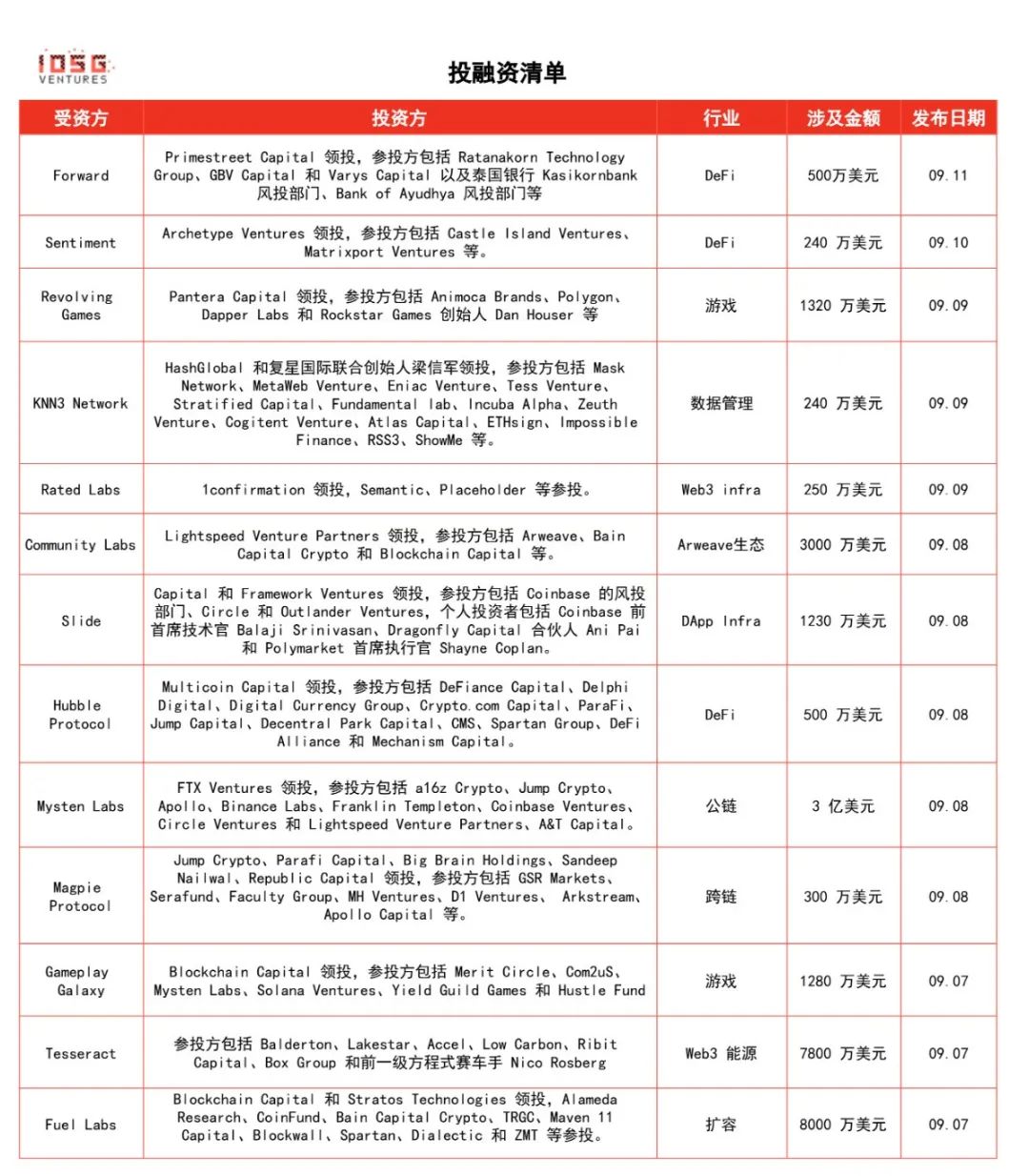
Decentralized derivatives trading protocol Forward completed a $5 million seed round, led by Primestreet Capital, with participants including Ratanakorn Technology Group, GBV Capital and Varys Capital, as well as the venture capital division of Bank of Thailand Kasikornbank and Bank of Ayudhya.
Chanon Charatsuttikul, founder and CEO of Forward, said Forward is focused on developing a decentralized derivative platform that is non-custodial and the system will ban transactions from sanctioned countries and addresses.
DeFi lending protocol Sentiment announced the completion of a $2.4 million seed round led by Archetype Ventures, with participants including Castle Island Ventures and Matrixport Ventures.
Sentiment allows borrowers to create leveraged debt positions against their assets, which can be used to interact with other apps across the ecosystem. The lender provides liquidity to the agreement.
Mysten Labs raised $300 million, led by FTX Ventures, with investors including a16z Crypto, Jump Crypto, Apollo, Binance Labs, Franklin Templeton, Coinbase Ventures, Circle Ventures, and Lightspeed Venture Partners, and A&T Capital.
In July, sources were quoted as reporting that Mysten Labs was previously managed by FTXA Series B round of at least $200 million led by Ventures is being negotiated, with a target valuation of $2 billion.
Cross-chain trading infrastructure Magpie Protocol completed a $3 million seed round, led by Jump Crypto, Parafi Capital, Big Brain Holdings, Sandeep Nailwal, and Republic Capital, with participants including GSR Markets, Serafund, Faculty Group, MH Ventures, D1 Ventures, Arkstream, Apollo Capital, etc.
Magpie Protocol establishes stablecoin liquidity pools on multiple chains. When users initiate cross-chain transactions, assets on the source chain are traded as stablecoins and messages are delivered through Wormhole. After the target chain accepts and confirms the message, stablecoin transactions with the corresponding value on the target chain are used as target tokens to complete cross-chain transactions. Magpie Protocol currently supports Ethereum, Polygon, BNB Chain, and Avalanche, and will support Fantom, Solana, etc. in the future.
Web3 energy startup Tesseract, founded by former Revolut Chief Revenue Officer Alan Chang, closed $78 million in financing, of which $30 million was equity financing, with the remainder being completed through token sales. Participants in the funding round include Balderton, Lakestar, Accel, Low Carbon, Ribit Capital, Box Group, and former Formula 1 driver Nico Rosberg.
Tesseract is a vertically integrated renewable energy company that buys energy from power plants at a fixed price and then supplies it to consumers. Tesseract plans to tokenize power purchase agreements (PPAs), with one token corresponding to one watt of electricity in the network.
Fuel Labs, the developer of Ethereum scaling solutions, announced a $80 million funding round led by Blockchain Capital and Stratos Technologies, Alameda Research, CoinFund, Bain Capital Crypto, TRGC, Maven 11 Capital, Blockwall, Spartan, Dialectic and ZMT and others participated.
Fuel was the first Optimistic Rollup that was first deployed on the Ethereum mainnet. At the end of 2020, version V1 was launched on Ethereum. It is mainly suitable for payments-centric applications. Fuel Labs previously closed a $1.5 million funding round led by CoinFund in September 2021 to provide the best experience for developers in the blockchain space through its modular execution layer (MEL).
Part.3 IOSG post-investment project progress
Part.3 IOSG post-investment project progress
