


Kai: The tipping point of technological evolution has arrived!
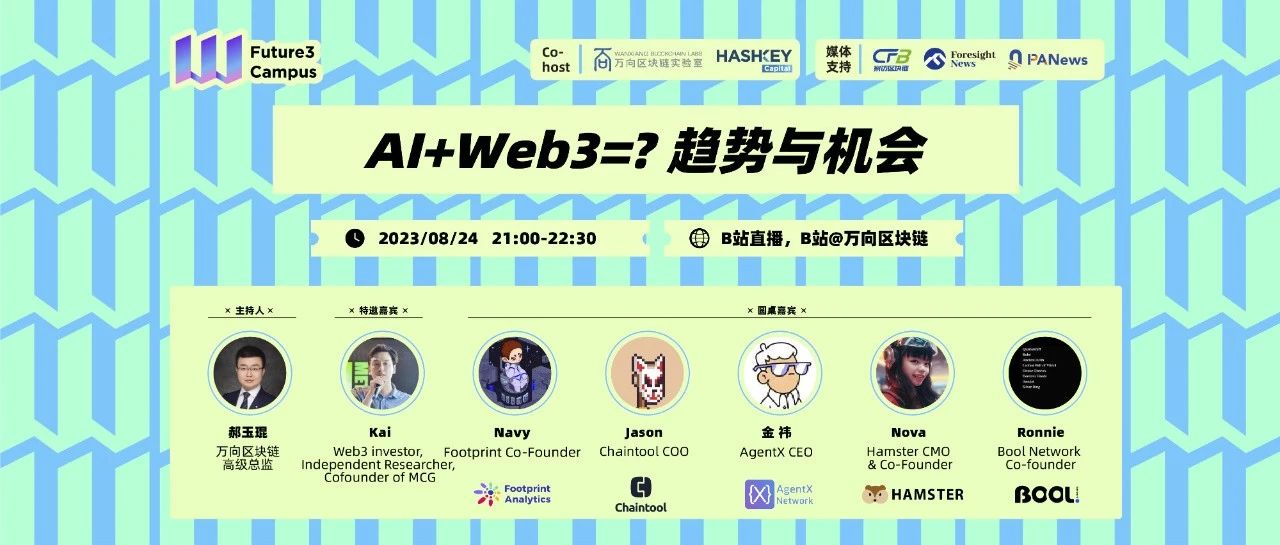
This article is based on the keynote speech by Kai (Web3 Investor/ Independent Investor/ Cofounder of MCG), the 7th edition of Future Salon, an event owned by Future3 Campus, and the revisions did not affect the original intention. It only represents the views of the guests and does not represent Wanxiang Blockchain's position.
Today is at Future3 Campus. Compared to discussing technical details, what I want to do more is “recharge my faith.” So today's topic is more conceptual, which is equivalent to making a declaration.
The tipping point of technological evolution has arrived
There have been many technological advancements in the past few decades, including electric vehicles, 5G networks, mobile phones, etc. Since quantum mechanics was proposed, including the birth of physical and biological knowledge related to condensed matter, in fact, in addition to some technical success, it has also gone through a lot of trial and error. In the process of scientific development, it is the continuous accumulation of these trial and error and error paths as the cornerstone that has enabled today's technology to explode.
In recent years, everyone has felt the stagnation of cutting-edge technology. Speaking of which, they are all still old narratives, and nothing new has come out. But suddenly one day, the big language model LLM appeared to give us a new direction. This is an important characteristic of the technological explosion. It proves to us that it must have stemmed from decades of technical trial and error and the accumulation of experiments in different paths.
Furthermore, in recent years, there have been more technological innovations brought about by collaboration between different technologies, which is a very important sign of the tipping point of science and technology. In the previous AI cycle, the development of all image recognition and deep networks depended to a large extent on the continuous improvement of chip technology. Today, LLM is able to run GPT-3.5 on 1.75 billion parameters, mainly due to the technological integration of the entire industry chain represented by GPU chip computing. There are similar examples in other fields, such as the successful ignition of America's second positive energy output for controlled nuclear fusion. The reason behind this success is the integration of more technology. The integration of different technologies is the second very important characteristic of technology reaching a tipping point. This is also a logical support that is very important for us to discuss the integration of AI and Web3 here.
Third, since the birth of the Big Language Model (or GPT), there has been a lot of controversy about how to define the role of GPT in overall technology. Does it count as an industry, or is algorithm innovation a short-term change? Our view is very clear. The big language model is at the core of the Fourth Industrial Revolution, and its effects will spread widely to other fields and play a more important role. That's why Web3 practitioners, internet practitioners, and real economy practitioners are starting to try to incorporate big language models into their industries.
Well right now, we think this is the perfect time to innovate. We have the chance to make something that was once unimaginable.
Why now is the best time to innovate
Three directions explain why we think this is the best time to innovate.
First, take software as an example. Over the past 20 years, whether it is AI, the Internet, or Web3 technology development, a large number of results have been accumulated. Coupled with GitHub-based Open Source evolving at an unprecedented speed, these can deploy what we want to do more quickly. There are several excellent entrepreneurs on the scene today. Hamster has actually paved the way for this matter more quickly and quickly. You don't even need to directly obtain its source code; you can use a faster way to encapsulate what people have done before and apply it directly to your own products.
Second, an important factor is the ability of big language models. Compared to traditional software and AI, the big language model has two major changes. First, in the past, interacting with AI was a static process. We all used it as a tool. Whatever instructions you use, it can complete any task, and their ability is relatively limited. Today's LLMs have initial human intuitive abilities, and can complete more intuitive and predictive tasks based on the knowledge obtained through in-depth data training. Also, since the parameters have exceeded the critical value, it is no longer a simple static interactive tool, but can interact with you continuously.
In every industrial revolution in the past, we freed many people from heavy physical labor to do mental work. One of the most important results of today's LLM is freeing humans from complex intellectual tasks to engage in more advanced tasks, such as scientific discovery and artistic creation. This is the first time the big language model has brought us without the previous industrial revolution. Take starting a business as an example. In the last 20 to 30 years, if you want to start a business, in addition to yourself, you will need a large number of talents to help you complete other intellectual tasks, such as coding, finance, legal affairs, business management, etc. Today, this kind of work will be directly replaced or assisted by big language models or higher-level agents. This has greatly lowered the threshold for starting a business. When you have an innovative idea, your demand for people and other resources drops exponentially. For a long time in the past, everyone liked to say that an idea is cheap. Opinions have no value; only making a product is the final king. This view will change somewhat today, which has also created a better environment for innovation.
Third, this is the beginning of a new industrial revolution. LLM and AI agents will definitely rewrite a large part, or even all, of the forms applied to the Internet. This will create countless opportunities. When the industrial revolution came, the most important thing for humans was not only to solve existing problems, but also to discover more new needs, narratives, and ways of acting. This is also the most important source of innovation.
The industrial revolution will bring more new demands and narratives
We believe that the industrial revolution will bring more new demands and narratives, not only to solve the problems we face today. It is also the source of progress and growth in the human world. Under this premise, what matters most? Whether starting from a technical or commercial level, they will have their own needs and ideas. I want to get people to think from the perspective of first principles, or let people know how we understand innovation from a methodological point of view. I'll give you three “Don't” s:
First, break out of the old framework of thinking and manufacture. Don't be limited by the technical framework set by yourself or others. There's a concept called “holding a hammer to find a nail.” For example, I only write smart contracts, so I'm going to think about what smart contracts can do; if I only use zk, I just want zk to do anything. In fact, you can completely break out of your own technical framework, start from your own technical framework and integrate with other technologies to do more interesting things.
Second, don't be bound by your own empiricism. We all know the concept of “path dependency”. The Internet was in a very chaotic state at the beginning of its development. Everyone made all kinds of experiments and innovations. Some failed, and some were successful, then solidified into the shape and operation method of today's major Internet companies. So people always predict the next world based on internet logic. For example, what do we need other than Douyin, WeChat, and Twitter? As a result, so-called immersive worlds were born, and VR and the like were to be done. I'm not saying that these industries can't do it, but rather that it completely follows the logic of the Internet.
Similarly, many people are copying Web3's logic. Everyone is talking about the Internet being centralized. There is a problem with this, so we must make a decentralized cloud cloud, but few people think about whether decentralization is a necessity in all scenarios. These are all your own empirical theories and external experiences that bind you. Why should I emphasize not being bound by empirical theory? In a steady path of technological advancement or the development of an industry, empiricism is very useful because you can extract previous data or make full use of it to launch later results. However, what we are emphasizing now is to overcome the tipping point of science and technology. The future world is completely different from the world of the past. Simply using past experience to deduce the future will often result in unnecessary restrictions and mistakes.
Third, don't be limited by inherent sci-fi and existing imagination. You might think imagination knows no boundaries, but in fact, many of our narratives today are limited by imagination. For example, recently we've been talking about Stanford's Generative Agent. They used 25 villains to make a sandbox. The villains can do their own activities inside, and they've even shown some behaviors of human social behavior. When many netizens and self-media saw this incident, their first reaction was to do “Westworld.” Few people have thought that there are actually more things they can do other than Westworld. And these things are far more meaningful than building a western world and building a world where AI and humans coexist.
Many of our ideas are actually bound by sci-fi and the imagination of our ancestors. After watching movies like “The Matrix” and “The Terminator,” your imagination of the future of AI is nothing more than putting people in captivity like The Matrix or the Terminator restraining all of humanity. This is a kind of framework that your inherent imagination sets for you, making you unable to think outside of this framework. Similarly, with regard to the development of VR/AR, everyone also limited their imagination to imaginations already made up by top players and players who lost control.
This is something I really want to share with you. I think many people, on the first day they saw the birth of Generative Agent, thought that its most important goal was to make it an adult and more human-like. Many projects now emphasize making AI more human-like and emotional. Of course, these projects are all great, and the direction is interesting, but I think I'm still limited by the current imagination of Westworld. Since it's an industrial revolution, we need to think more outside of this framework.
How do we work to achieve the above three points? When experience no longer guides us, only first principles can help us find our way. This is an essential methodological problem. Due to the convenience of abilities brought by agents or big language models, it is very important to be able to quickly implement ideas, so we need to think from first principles. If you want to innovate in this day and age, I think this is a very valuable way to think.
The development direction and prospects of AI+Web3
Finally, I'll share the opinions and predictions from our recent research.
First, we believe that in the next few years, disruption and innovation will be born in the form of agents. We proposed the concept of Augmented AI Agents, which emphasizes the reshaping of traditional generative agents by LLM and generative models. At the same time, we have also made some categories for AI agents. We feel that many categories of AI agents are types of collaborators (co-pilots), which can help you complete some tasks and more complex tasks. However, in addition to simple autonomy (autonomy), Generative Agents made by Stanford also have quite strong adaptability (adaptive) capabilities.
This is just the beginning; even the technical and theoretical framework hasn't come out yet. In this direction, if the big language model is layer 1, then we call all agents or things above the big language model's ability layer 2, and the forms shown above layer 1 and layer 2 are augmented AI agents. Their capabilities surpass traditional AI-driven agents, and they will be more widely used. This is what we think is the most central story in every field in the next five years.
Second, when it comes to AI+Web3 tracks that are commonly talked about, they are generally talking about two directions.
The first direction is very popular, which is decentralized computing, which began in 2018, including decentralized training, data martketplace, and computing power sharing. The solution is to use blockchain for decentralization, data security, etc. It's a very important direction, but it's just an old story for me. I personally think some of the technical problems here are not something Web3 can solve, but rather rely more on cryptography, homomorphic encryption, MPC, and even federal computing.
Second, since LLM can process all data on the Internet, and today's open data for Web3 is all open, we can completely repeat those business models, and you can do many more interesting things.
Third, we believe that blockchain will be a new digital world timeline, a global timeline that cannot be replaced by other technologies. Its role is to record every step of the evolution of the virtual world. This is also the core role of blockchain in the future AI-driven virtual world. Everyone has taken the name of this virtual world, called Autonomous World, Autonomous World.
To this, I'll add a word about the concept of virtual worlds. The virtual world before the advent of AI, that is, the virtual world of the Internet, essentially corresponds to the real world one by one; it is a reflection or transformation of the real world.
However, AI/AIGC includes the virtual world after the big language model Agent. Its dimensions, quantity, and richness far surpass the real world; to some extent, it is a new universe that surpasses the real world. In this new universe, we need to redefine some of its most basic concepts. Starting from the first principle, the most important of all concepts is “time,” and this can only be recorded by means of “blockchain.” This is also one of the most important fundamental foundations for our belief that the combination of AI+Web3 will unleash the possibility of more innovation.
We believe that humanity is in a new era of industrial revolution. Whether from the perspective of researchers or investors, we hope to embrace the industrial revolution and create the future with more young people.
