


MT Capital: Learn about Ethereum's Cancun upgrade this year
authorship | MT Capital
summary
· One of the core of Dencun's upgrade is the introduction of a new data structure blob through EIP-4844 to store L2Ethereumsubmitted transaction data,This significantly reduces Ethereum L2 transaction costs, increases L2 transaction throughput, and benefits the L2 ecosystem.
·The Dencun upgrade also introduced a new instantaneous storage operation code through EIP-1153, which allows smart contracts to read and call temporarily stored data.This reduces Ethereum's storage costs and gas consumption, enhances the expandability of the main network, and facilitates the application of the main network ecosystem.
· According to the Shadowfork test report released on December 19 and the 178th Ethereum Core Developer Executive Meeting held on January 4, the current status of the Ethereum Dencun upgrade test is good.The Dencun mainnet upgrade is expected to be completed by the end of February.
· The Dencun upgrade will promote the prosperity of the L2 ecosystem and drive demand for Infra tracks such as decentralized storage, DA, and RaaS. For the application layer, tracks such as Perps, LSD, ReStaking, and FOCG will also benefit from Dencun upgrades.
Cancun upgrade
Cancun upgrade background
On December 28, 2023, Vitalik published Make Ethereum Cypherpunk Again to talk about what it believes is a crypto vision. Among them, Vitalik emphasized that one of the core reasons why blockchain is currently limited to asset speculation is the rise in transaction fees. High network transaction fees have turned people from blockchain network users to blockchain network speculators. In order to realize the application value of blockchain, the transaction fee of the blockchain network must be reduced by another level. Even though the advent of L2 has reduced network fees compared to the Ethereum mainnet, this is far from enough.
Similar, late 2023SolanaThe rise of the ecosystem also has a lot to do with its extremely low network transaction fees. Compared to Ethereum's L2 gas cost of $0.5, Solana's gas fee as low as 0.0005 is almost negligible. Extremely low network gas has boosted the booming meme hype on Solana,DeFiApp interaction and DePin app migration. In particular, cNFT on Solana can reduce minting costs by 1000 times compared to NFTs on Ethereum, which has also brought prosperity to some Depin-like projects and creators' economic projects with NFTs as the core of the economy. It can be seen from this that low online transaction fees have a significant effect on the prosperity of online trading activities and ecological applications.

Ethereum L2 still has high gas fees (Source:https://l2fees.info/)
Of course, Ethereum has long been aware of this issue. According to Ethereum's upgrade roadmap, the next upgrade “The Surge” after the merger is aimed at increasing Ethereum's TPS and reducing transaction fees in the Ethereum ecosystem. Ethereum's upcoming Dencun upgrade is part of “The Surge” and aims to further increase Ethereum's transaction throughput and scalability through the introduction of Proto-Danksharding.

One of the core elements of Dencun's upgrade is the introduction of the Proto-Danksharding module. Proto-Danksharding is also preparing for the ultimate shard expansion of Ethereum. The earliest Ethereum expansion plan was to split Ethereum into different shards and distribute the computational load of the main network to each shard. Each independent shard holds a subset of transaction data occurring on Ethereum and processes transactions in parallel, thereby increasing Ethereum's TPS. The original ETH2.0 plan eventually divided the main network into 64 shards to achieve a TPS of 100,000+.

(Source: Crypto.com Research)
However, the development complexity of the shard expansion itself is high, and the development progress is slow. In contrast, the Rollup expansion scheme, which takes on Ethereum's transaction execution on the second-tier chain and relies on Ethereum for settlement, consensus, and data availability, has developed rapidly at an extremely fast speed, and has achieved lower transaction costs and higher throughput, which to a certain extent has met some of Ethereum's expansion needs. This has caused Ethereum to gradually abandon the sharding-centered expansion path and instead use data sharding for Rollup.
Compared to the traditional method of sharding chain sharding and scaling, Danksharding's expansion implementation path is relatively simpler. One of the core elements of the upcoming Dencun upgrade is the introduction of Proto-Danksharding, pioneering the introduction of blobs into the block space, optimizing data availability costs through blobs, and improving the scalability of L2. Proto-Danksharding introduced by Dencun will also be the first step in the full expansion of Ethereum, laying the foundation for further complete Danksharing in the future, introducing the separation of block proponents and builders, and achieving data usability sampling.
Cancun's upgraded kernel
Proto-Danksharding
Proto-Danksharding, also known as EIP-4844, is the most critical module in Dencun's upgrade. Proto-Danksharding takes its name from two researchers who proposed this expansion idea: Proto Lambda and Dankrad Feist. Name the upgrade as part of their respective names. Proto-Danksharding reduces L2 costs and optimizes L2 performance by introducing a new data storage structure blob.
Types of transactions that carry blobs:
Previously, all transactions on Ethereum L2 were stored in L1's Calldata. However, the space size of Calldata itself is relatively limited, and all data on Calldata is processed by Ethereum nodes and stored permanently on the chain, which causes high data availability costs. Theoretically speaking, L2 transaction data does not need to be stored permanently on the expensive Ethereum L1; it only needs to be stored for a certain period of time to meet verification requirements such as proof of fraud. In other words, Ethereum L2 transaction data lacked proper storage space in the past. In terms of data, 80% of L2 transaction costs and gas fees all come from the expensive data storage costs in Calldata.

(Source:https://dune.com/optimismfnd/optimism-l1-batch-submission-fees-security-costs)
Proto-Danksharing will introduce a new data storage structure in the Ethereum block: blob. The blob will be dedicated to storing transaction data submitted by L2 to L1.

(Source:https://hackmd.io/@luozhu/SyleCcpti)
Each blob introduced by Proto-Danksharing is 128 KB in size, and each Ethereum block is planned to contain 3-6 blobs (0.375 MB - 0.75 MB), gradually expanding to 64 in the future.

In contrast, currently each block of Ethereum can hold less than 200KB of data. After the introduction of blobs, the amount of data that an Ethereum block can hold will increase significantly.

(Source:https://etherscan.io/chart/blocksize)
With the introduction of blobs, transaction data submitted by L2 will no longer require competing Calldata's storage space, but will be submitted directly to the blob for storage. Also, the blob's data is automatically deleted after about a month, further reducing the unnecessary storage burden. The introduction of blobs means that transaction fees for L2 will be greatly reduced (~ 90% reduction), and since blobs are equivalent to additional block space for L2, the transaction throughput that L2 can submit at the same time will also increase significantly. If Dencun successfully achieves the average goal of 3 blobs for a block after the upgrade, L2's throughput will increase by nearly 2 times. If the goal of 64 blobs in the block is finally achieved, L2's throughput will increase by nearly 40 times.
Additionally, blob has an independent fee market. Proto-Danksharing also introduced a new type of gas called blob gas. The Blob Gas fee mechanism in EIP-4844 is rooted in the previously introduced EIP-1559 mechanism, where the blob's storage space will be auctioned according to its own fee market. This means that the blob usage market is completely independent of the requirements of block space, thereby increasing the flexibility and efficiency of network resource allocation. The cost of storing data in a blob is approximately 1 data-gas per byte (one data-gas per bype), while Calldata is priced at 16 data-gas per byte (16 data-gas per byte). In contrast, blob's data storage costs are significantly lower than Calldata's data storage costs.

(Source:https://foresightnews.pro/article/detail/38853)
After the introduction of blobs, the operation process of L1 and L2 block networks will also change. First, L2 needs to publish its commitment to transaction data on-chain. L2 then needs to submit the actual transaction data to the blob. At the same time, the node can check whether the promise is valid and verify the data. Consensus-layer nodes prove that they have seen the data and that the data has spread across the network. After about a month, the node will delete the data in the blob, and this part of the data can be stored in other DAs.

(Source: OP in Paris: OP Lab's Protolambda walks us through EIP-4844)
KZG promises
EIP-4844 also introduced the KZG (Kate-Zaverucha-Goldberg) commitment scheme as part of the blob verification and certification generation process. KZG promises are a polynomial promise method that enables submitters to use a string of short strings to promise polynomials, and supports validators to use short strings to confirm declared promises. Simply put, KZG can simplify the task of verifying large amounts of data to verifying small cryptographic promises.
Data blocks can be represented as polynomials and then used with polynomial submission schemes to submit data. Promises to data are generated using a polynomial promise scheme, so that specific attributes of data blobs can be effectively validated without having to read their contents completely. The fulfillment of KZG's promises also paved the way for implementing data availability sampling (DAS) in Danksharding. With DAS, validators can verify the accuracy and availability of data blobs without downloading the entire blob, increasing efficiency and scalability.
Other EIP upgrades:
In addition to EIP-4844, the Dencun upgrade includes the following four focused EIP improvement proposals.
1. EIP-1153: EIP-1153A new state of storage has been introduced: instantaneous storage. Previously, all storage on Ethereum was permanent storage, and permanently stored data not only took up block space, but also required gas fees. However, for some unnecessary data, such as data that is only valid during a single transaction, permanent storage is unnecessary and a waste of resources. Therefore, EIP-1153 introduced instantaneous storage of operation codes, which allows smart contracts to read and call temporarily stored data. Once the complete execution cycle of the thing is over, the storage of this part of the data will be erased.This reduces Ethereum's storage costs and gas consumption.

(Source:https://consensys.io/blog/ethereum-evolved-dencun-upgrade-part-4-eip-7514-and-eip-1153)
2. EIP-4788: EIP-4788 will introduce the beacon block root into every EVM block. Previously, the two core parts of Ethereum, EVM and the beacon chain, operated independently and were unable to communicate directly. In other words, EVM could not directly access the data and state of the beacon chain, and could only capture the beacon chain state through an external trusted oracle. EIP-4788 is essentially similar to the introduction of protocol-level oracles, relaying Ethereum's consensus state to the Ethereum mainnet. EIP-4788 will introduce a new field “parent_beacon_block_root” in the execution block header. EVM can directly export the state of the Ethereum consensus layer from it to obtain consensus layer data. The parent beacon root will be stored in a circular buffer and will only be kept on the main network for about 1 day. Once a new parent beacon root is added to the buffer, and when the buffer capacity reaches a critical value, the oldest parent beacon root will be overwritten to enable efficient and limited consensus storage.The introduction of EIP-4788 allows the Ethereum mainnet to obtain data from the Ethereum consensus layer in a way that minimizes trustIt eliminates dependency on external oracles, thereby reducing potential security risks, oracle failure, and malicious manipulation risks.
3. EIP-5656: EIP-5656 introduces a new EVM opcode known as MCOPY, and the MCOPY instruction is designed to optimize the process of copying data from memory during smart contract execution. Previously, if developers needed to copy memory data, they needed to reference the two operation codes MSTORE and MLOAD. MCOPY was essentially a combination of these two opcodes, filling the previous operational gap in the field of memory replication in EVM. The MCOPY opcode can significantly reduce the cost of copying 256 bytes of memory data from 96 Gas to 27 Gas. The introduction of MCOPY will make the process of copying memory data faster, cheaper, and more efficient, and developers can further optimize smart contracts involving memory operations based on this.
4. EIP-6780: EIP-6780 will limit SELFDESTRUCT opcode functionality. By limiting self-destruction, Ethereum can better manage the size of its state, resulting in a more stable and predictable blockchain. This is critical to the long-term scalability and maintenance of the network as it will simplify future Ethereum upgrades.
Cancun upgrade status
12.19 Shadowfork Test Report
According to the test report of Shadowfork, which was launched on the 19th, the current Ethereum Cancun upgrade test situation is good, and the Ethereum Foundation will continue to fork Shadowfork for intensive testing within the next two weeks. Goerli, Sepolia, and Holsky nodes will also be tested at 1.7, 1.30, and 2.7. If the testnet works well thenThe Cancun upgrade of the mainnet is expected to be completed within 2 months.
Judging from the Shadowfork test report, the node's resource usage, overall network usage, network health, and blob distribution and transmission during the test period were as expected.
Judging from the CPU and RAM usage, the resource usage rate did not fluctuate significantly before and after the Cancun test fork, and the overall situation remained stable.

(Source:https://notes.ethereum.org/@ethpandaops/dencun-gsf-1-analysis)
Judging from the network usage situation, compared to the Shadowfork baseline, network usage increased significantly as expected after the Cancun test. With good blob usage, network usage is expected to increase by approximately 200 kbps.

(Source:https://notes.ethereum.org/@ethpandaops/dencun-gsf-1-analysis)
The overall network remained stable during the test. There were no client outages, and the client ran smoothly.

(Source:https://notes.ethereum.org/@ethpandaops/dencun-gsf-1-analysis)
During the testing period, most blocks contained 3 blobs, which was consistent with the target number of blobs.

(Source:https://notes.ethereum.org/@ethpandaops/dencun-gsf-1-analysis)
Blobs propagate to 95% of the nodes in less than 2s, and on average, most blobs propagate through the full network in 500 ms. Ideally, block propagation time is expected to increase by approximately 250 ms.

(Source:https://notes.ethereum.org/@ethpandaops/dencun-gsf-1-analysis)
1.4 Conference call
On the evening of January 4, the 178th Ethereum Core Developer Executive Conference was held online. The meeting finalized the testnet Dencun upgrade schedule. The developers agreed to conduct Goerli, Sepolia, and Holesky testnet upgrade tests on January 17, January 30, and February 7, respectively.
At the same time, in order to quickly respond to and resolve possible problems during the testnet upgrade process, the developers decided to quickly hold the 179th meeting on the day after the completion of the Goerli testnet test on January 17 to discuss the test content and decide whether to update the testnet upgrade test schedule as appropriate.
Although the developers did not reach a final agreement on the timing of the main network upgrade, judging from the current Shadowfork test data, test network test schedule, and time progress, the Dencun upgrade of the Ethereum main network is likely to be carried out at the end of February.
Potential opportunities and favorable tracks
L2
One of the most directly beneficial tracks for Dencun's upgrade is the L2 track. The introduction of blobs has significantly reduced L2 transaction costs and increased throughput to a certain extent. Dencun's motivation for L2 is that it can further compete with other Alt L1s and attract high-quality projects and users in other L1 ecosystems with lower costs and better performance.

(Source:https://www.techflowpost.com/article/detail_14912.html)
The Dencun upgrade is good for all Ethereum-based L2s, but under the general benefits, we will focus on observing which L2 projects have more unique competitive advantages and can reap more dividends from the Dencun upgrade.
L2 Ecosystem
Arbitrum
The current Ethereum L2 leader is stillArbitrum 和 optimismHowever, the competitive advantages of the two and the competitive direction of the segments are slightly different. Arbitrum is ahead of the diversity of protocols based on Arbitrum One, and Optimism is ahead of the diversity of inter-chain ecosystems based on OP Stack.
Arbitrum is still the L2 with the widest variety of protocols. According to DeFilLama's incomplete statistics, the number of protocols on Arbitrum is about 520, far surpassing the 216 of the second-ranked Optimism. According to L2beat data, Arbitrum's TVL is currently around 11.26B, accounting for nearly half of Ethereum's Rollup's TVL.

(Source:https://l2beat.com/scaling/summary)
Additionally, online trading activity on Arbitrum is also booming. In terms of online transaction volume rankings over the past 30 days, Arbitrum has a trading volume of about 36M, ranking second only to zkSync, which has yet to issue coins and still has a lot of jerking activity. If you remove L2, which has airdrop interactions, just compare Arbitrum, which has already issued coins, with Optimism. Arbitrum is also far ahead in terms of online transaction volume 3 times that of Optimism.

(Source:https://l2beat.com/scaling/summary)
Taken together, Arbitrum, which has the highest online transaction volume, can clearly reap more dividends brought about by lower transaction fees, and TPS optimization is also conducive to the prosperity of protocol ecosystems that require higher performance, such as GMX and GNS on Arbitrum. From the perspective of network fundamentals, Arbitrum is undoubtedly one of the biggest beneficiaries of Dencun's upgrade. Additionally, Arbitrum is actively promoting the Arbitrum Orbit and Stylus languages, enabling developers to use Orbit to simultaneously build Rollups based on EVM and WASM VMs to create network effects based on Arbitrum.
optimism
Unlike Arbitrum, Optimism's competitive focus is more on the Optimism SuperChain network built on OP Stack, and the value of Optimism depends more on the network value of Optimism SuperChain.
Since the release of OP Stack, a number of projects such as Base, Lyra, OpBnB, Redstone, Zora, Mode, and Debank have built their own L2 based on OP Stack. The upgrade to the OP Stack Bedrock version also further optimizes transaction costs, in-block transaction processing, and node performance, making it more attractive to build L2 based on OP Stack. According to Optimism SuperChain's plan, all Rollups using the OP Stack will be integrated into a standardized OP chain. These chains can directly communicate via cross-chain messaging protocols and share a common Ethereum cross-chain bridge and sequencer network.
If the Dencun upgrade can benefit all L2 at the same time, then the upgrade premium enjoyed by Optimism is the network value combination brought by all Optimism's ecosystem. If the Dencun upgrade can spawn more new L2s, then the upgrade premium that Optimism enjoys is that more L2 chains may be built using OP Stack, and Optimism will also get closer and closer to the ultimate vision of the Optimism SuperChain superecosystem.

(Source:https://app.optimism.io/superchain)
Decentralized Sequencer
Metis
The competition between Arbitrum and Optimism is more about competition in terms of agreements, network activity, and ecological value. However, another major problem that needs to be solved is the L2 Sequencer's decentralization problem, which has now become the elephant in the room. As the Dencun upgrade brings about the explosion of more L2, problems such as single point of failure, malicious arbitrage, MEV value capture, and review of user transaction space brought about by centralized sequencers may become more and more serious.
Metis is the first to make changes in this area, and will be the first Ethereum L2 to run a decentralized PoS sequencer.
Metis breaks the centralized sequencer pattern and allows nodes that have pledged at least 20,000 METIS tokens to enter the sequencer pool to become the sequencer operator. The sequencer that enters the sequencer pool is responsible for determining the packaging order of transactions, and at least 2/3 of the sequencer signatures are required to upload the data package to the L1 main network. Additionally, to further prevent the sequencer from being misled, Metis also introduced the role of a validator to sample the blocks to ensure that the sequencer sorts the transactions in the correct order.
Metis chose to take the initiative to make concessions and voluntarily relinquished the most profitable sequencer revenue to staking nodes. In the future, with the advent of more staking agreements for sequencers, we can also anticipate that a wider range of users will also be able to participate in sequencer staking and share sequencer profits. Metis's innovation in the decentralization of sequencers and the empowerment of METIS tokens have boosted the price of METIS tokens, the METIS token's pledge rate, and the inflow of funds into the Metis network. With the prosperity of the METIS network ecosystem and the growth of sequencer revenue, more and more METIS will be pledged to sequencer nodes, and there will also be fewer and fewer METIS in circulation. Instead, there will be more and more demand for METIS in the market, thus promoting a positive cycle of rising TVL, ecology, and currency prices.
Decentralized sequencer competition may become the core theme of L2 competition after Dencun's upgrade.

(Source:https://docs.metis.io/dev/decentralized-sequencer/overview)
Token Empowerment
Another key factor that determines the price of L2 tokens is none other than L2 token empowerment. Currently, almost all Ethereum L2 uses ETH as a gas token, and its own L2 token has no use other than governance. Without a stable value consumption scenario, tokens in the hands of users can become pawns that can be thrown away at any time. However, tokens with actual power, such as METIS, are more likely to move towards a positive spiral between L2 fundamentals and a sharp rise in currency prices.
In addition to the METIS token mentioned earlier, which can be used as a decentralized sequencer staking token to share sequencer revenue, another example worth learning from is ZKF. ZKFair's token ZKF can not only be used as a gas token, but can also be staked to share the zkFair network's gas revenue. Similar to METIS, enabling tokens that pledge dividends is also more likely to promote a spiral rise in the ZKF market price. Additionally, Arbitrum Orbit has added the ability to support custom gas tokens.
As mentioned above, all Rollups that share the OP Stack will share a common sequencer network. Imagine if Optimism also used Metis to introduce a module for staking OP as OP Stack's decentralized sequencer, which would bring great market demand and buying power to OP. The rise in currency prices will in turn attract more capital and users for applications within the ecosystem, and feed back the prosperity of the ecosystem. Ethereum L2's move to empower the token after the bumpy upgrade is also one of the core topics to focus on.
other
As mentioned earlier, the reduction in transaction fees and the increase in L2 TPS brought about by the Dencun upgrade will benefit every Ethereum L2. In addition to the projects we discussed above, there are a few other projects that are worth looking forward to.
Base can be considered one of the best-performing L2s in 2023. The strong binding relationship with Coinbase enabled Base to take on a large number of users and funds from Coinbase, making it the Ethereum L2 ranked 3rd in TVL today. The rise of Base is inseparable from hype about popular projects such as Friend.tech and FrenPet on Base. However, one of the major features of the above project is that the frequency of interaction is high and the return of a single interaction is low. Moreover, the number of users handled is also relatively large, and the application requires higher performance. The benefits of the Dencun upgrade are in line with the needs and characteristics of this type of project. We may see more pan-social and gaming light apps appear on Base, bringing in more users and funds to the Base ecosystem and stimulating the vitality of Base's ecosystem.
In addition, there are more L2s that have not yet been issued, such as Mantle and Blast, that are still accumulating energy. This type of L2 attracts users to participate in ecological interaction through gameplay such as token issuance expectations and superimposed revenue marketing. The Dencun upgrade can greatly reduce the cost of user interaction and further promote the prosperity of such L2 on-chain activities. However, it is worth noting that we still don't know where this type of L2 will go after the airdrop; we can only remain cautiously optimistic about this type of project at this stage.
Data availability layer
One of the core modules of Dencun's upgrade was the introduction of blob storage for data submitted by L2 to L1. However, the blob's data storage is not permanent; after about a month or so, the stored data will be discarded. However, this part of the data still has potential value for use and analysis. Therefore, the storage of this part of the data will also drive the demand for decentralized storage services.
ETHstorage
EthStorage is the first two-tier solution to provide programmable dynamic storage based on the availability of Ethereum data, and it can scale programmable storage to hundreds of terabytes or even petabytes at 1/100 to 1/1000 times the cost.
EthStorage is highly integrated with ETH. EthStorage's client is a superset of the Ethereum client Geth, which means that when running an ethStorage node, it can still participate normally in any Ethereum process. A node can be both an Ethereum validator node and an ethStorage data node.
Furthermore, EthStorage is more interoperable with EVM, and is fully compatible with EVM. Taking the Mint NFT image as an example, an image stored on Arweave Mint as an NFT image on Ethereum requires three smart contract operations, while ethStorage only needs to be completed once.

(Source:https://www.techflowpost.com/article/detail_12801.html)
EthStorage uses a key-value storage paradigm and supports complete CRUD operations (create, read, update, delete stored data). Positioned from EthStorage as the first storage L2 in the Ethereum ecosystem. Thanks to its seamless interoperability with EVM and low storage costs, ethStorage is expected to handle L2 state data discarded by blobs.
Covalent
Another decentralized storage project worth watching is Covalent. Covalent first smelled business opportunities in Cancun's post-upgrade data availability and launched the “Ethereum Wayback Machine (EWM)” in November 2023 for long-term storage of L2 state data discarded by blobs.
Of course, storing data alone is of limited value to Covalent, so Covalent is not only simple storage, but also integrates L2 data into its existing decentralized data analysis infrastructure services. Covalent enables users to seamlessly access blockchain data and provides data service support for specific user groups such as arbitrage traders, MEV brokers, AI traders, blockchain data websites, etc.
No matter how the execution layer, settlement layer, consensus layer, and short-term data availability layer are interpreted in the future of modular blockchains, Covalent hopes to become a long-term data availability layer for all project parties, providing permanent data storage and availability services.
With the implementation of the Cancun upgrade, it is expected that the data storage and usability circuit will usher in a new round of hype. However, Covalent, which has endorsements from well-known exchanges such as Binance, Coinbase, 1kx, Delphi Digital, and first-tier investment institutions, and has a solid business, will not fall behind the competition.

(Source:https://www.covalenthq.com/docs/covalent-network/ewm-paper/)
Established decentralized storage projects such as Filecoin, Arweave, and Storj
The Cancun upgrade will also bring more practical decentralized storage business requirements to established decentralized storage projects such as Filecoin, Arweave, and Storj. It is expected that the above projects will also take on some of the L2 state data discarded by the blob. Since this part of the data is only valuable to some special groups oriented to data analysis and research, there is no need for frequent status changes. Therefore, in comparison, Arweave, which focuses on one-time payment and permanent storage, may be able to win more growth in the L2 state data storage business.
If we look at the long term, L2 also requires a dedicated data availability layer. In the long run, what is stored in the blob may not be the data and state submitted by L2, but the Merkel root of this part of the calculation. Let Ethereum not be responsible for any additional data storage, and return to the most fundamental consensus.
eiGenda
eiGenda is a major DA solution worth looking forward to. eiGenda decouples data availability and consensus. First, Rollup needs to use an erasure code and KZG promise to encode the data blob and publish the KZG promise. Subsequently, the eiGenda node, which consists of re-staking, needs to proofread and verify the KZG commitment and finally confirm the consensus. Finally, only data that has been confirmed by consensus will be submitted to the Ethereum mainnet. The core of eiGenda is that it reuses Ethereum's consensus, abstracts out the verification and final consensus confirmation process in DA, and completes this part of the work through reuse of consensus.

(Source:https://docs.eigenlayer.xyz/eigenda-guides/eigenda-overview)
Polygon Avail
Polygon Avail is a project proposed by Polygon that focuses on solving data availability in Ethereum's expansion route. Avail aims to provide data availability services for different scaling solutions such as L2 and sidechain. Avail supports EVM-compatible Rollups to publish data to Avail. Avail can efficiently sort and record transactions and provide data storage and validation of validity. In terms of proof of effectiveness, Avail uses KZG polynomial promises, which can provide a more concise proof and reduce the node's memory, bandwidth, and storage requirements compared to Celestia. Since the beginning of its design, Avail has been consistent with the Ethereum upgrade and expansion route, enabling developers to store data in Avail and choose to settle on the Ethereum mainnet. In the trend of modular blockchains, Avail is expected to become the underlying data availability service provider for more EVM rollups.

(Source:https://blog.availproject.org/the-avail-vision-reshaping-the-blockchain-landscape/)
RaaS
RaaS providers can abstract out the complex technology of building blockchains and help users quickly deploy L2 with one click through simple to use tools and even no-code forms. As mentioned earlier, the Cancun upgrade will bring about an explosion of L2. Improved L2 ease of use and performance will also promote the emergence of more L2, thereby benefiting the underlying Rollup as a Service infrastructure.
In current RaaS solutions, there is no shortage of discussions about whether to choose OP or ZK. OP-based solutions have better compatibility, richer ecology, and lower barriers. ZK-based solutions have a higher degree of customizability and greater security. Although in the long run, ZK-based solutions can be customized to a higher degree, have stronger misalignment competitiveness, and can bring unique capabilities to the project in terms of functionality and performance. However, in the short term, OP-based solutions can amplify the cost and performance advantages of Dencun's upgrade to L2 with their low threshold and high compatibility advantages, reuse the existing complete EVM infrastructure more quickly, and achieve rapid expansion of early users and capital. The short-term leverage effect is more obvious.
Caldera
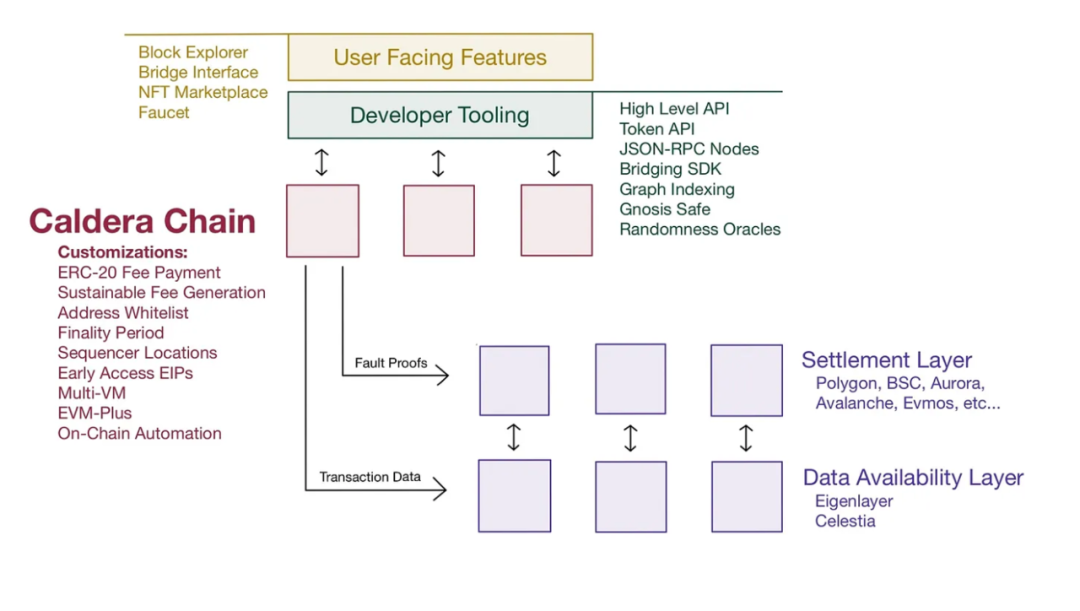
Caldera is a RaaS service provider built on OP Stack, which enables users to quickly build an Optimism L2 without code. L2 released by Caldera can achieve full EVM compatibility, greatly reduce the development threshold for developers, and facilitate direct reuse of existing EVM ecosystem projects, thereby providing L2 with a more complete infrastructure. In addition to L2 itself, Caldera also provides users with a series of blockchain infrastructure, such as blockchain browsers, test network faucets, etc., to further reduce chain costs and usage thresholds, and plug and play.

Altlayer
Altlayer is another notable RaaS solution under Optimism. Altlayer supports no-code L2 deployment. Developers only need a simple graphical interface to quickly create a rollup chain. Additionally, AltLayer also supports elastic rollups — Flash Layers. When demand for mainnet applications surges, such as when popular NFT projects start minting and popular DeFi projects issue airdrops, developers can quickly deploy a Rollup Chain through Altlayer to respond to the short-term surge in performance demand. When the event is over and the state and assets are transferred back to the underlying chain, the Flash Layer can be directly deleted. Altlayer provides an instantaneous scaling solution that avoids waste of resources, and can meet more complex business requirements.

(Source:https://docs.altlayer.io/altlayer-documentation/rollup-types/flash-layer-rollups)
Lumoz
Lumoz (formerly Opside) is a RaaS solution built on ZK. It allows developers to deploy their own zk-rollups with one click and generate a customized zkEVM application chain. At the same time, the advent of a large number of zk-rollups will also spawn huge computing power requirements for ZKP calculations. Lumoz has also built a decentralized ZKP marketplace to support ZK mining and generate zero-knowledge proofs for ZK-Rollup. As far as actual use is concerned, developers don't need to know anything about ZK; they only need simple front-end operations to quickly deploy a ZK-rollup. The computing power requirements involved in the operation of zk-Rollup can also be solved through the zk-PoW service provided by Lumoz, which can greatly reduce the project party's operating threshold and operating costs. In particular, Lumoz also supports 0 gas fee contracts, which can bring users a smooth Dapp experience without interaction costs. ZKFair, which recently caught fire, is one of the L2s built on Lumoz.
Application layer
Previously, we discussed in detail the benefits of the Dencun upgrade on Infra tracks such as L2, DA, and RaaS. The Dencun upgrade will improve L2 cost and performance, and will also promote the development and innovation of the application layer. Next, we'll briefly analyze the application-layer circuit that can significantly benefit from Dencun's upgrade.
Perps
Overall, interactions in the DeFi circuit are characterized by low interaction frequency but high returns from single-point interactions. Therefore, in a sense, DeFi is not particularly dependent on high performance, and the benefits from a single DeFi operation can cover the cost of interaction very well. However, decentralized derivatives are a relative exception. The limitations of performance bottlenecks and excessive network transaction fees will be infinitely amplified during the operation of decentralized derivatives agreements.
Due to the performance limitations of the L2 network, Perps projects are almost unable to run an on-chain order book and are unable to respond efficiently to real-time order matching requirements. Furthermore, excessive network fees will greatly limit high-frequency transactions for market makers and high-frequency trading users. The existence of the above problems has led to Perps trading efficiency being lower, trading slippage is relatively higher, unable to attract deep liquidity and professional trading users, and unable to bring users a trading experience comparable to CEX.
We believe that the Dencun upgrade can solve these problems to a certain extent. In particular, performance improvements are critical for derivatives trading. Compared to Perps in the Pooled and AMM modes,Dencun upgrades are more beneficial to L2 Perps such as Apex Protocol, Aevo, and Vertex ProtocolA decentralized derivatives exchange with an order-book model. Similarly, the reduction in network transaction fees will further stimulate transactions with more mature peer-to-peer pool models such as GMX, Synthetix, and GNS.
LSD
In addition to EIP-4844, the Dencun upgrade includes the introduction of EIP-4788. EIP-4788 will introduce the beacon block root into every EVM block. This allows the Ethereum mainnet to obtain data from the Ethereum consensus layer in a way that minimizes trust, eliminating dependency on external oracles, thereby reducing potential security risks, oracle failures, and malicious manipulation risks. The introduction of EIP-4788 can further improve the security of staking agreements. Although this improvement is not direct for users, this is a potentially significant benefit for LSD and the REStaking circuit. EIP-4788 enables liquid staking protocols such as Lido, Rocketpool, and Swell and re-pledge protocols such as Eigenlayer to directly access critical data such as validator balances and status from the consensus layer, thereby significantly improving their security and operational efficiency.We still have high expectations for Dencun's upgraded LSD, especially the development of the ReStaking circuit represented by Eigenlayer.Eigenlayer has also been active recently, supporting various LSTs one after another, collaborating with Altlayer to launch Restaked Rollups. Renzo, an ecological re-staking agreement, has already been launched, and Eigenda has also launched a second-phase test network. Eigenlayer's TVL has also reached 1.7B and continues to rise. The restaking narrative has only just begun, and EIP-4788 will provide a solid layer of security for re-staking.
FOCG
Full chain games are one of the biggest beneficiaries of Dencun's upgrade. Unlike Web2.5 games where only assets are on-chain, where the game subject is still off-chain, the game content, logic, rules, and assets of full-chain games are all on-chain. On-chain gas fees determine the interaction cost of each game operation, and on-chain performance determines players' user experience. Obviously, due to performance limitations, previous full-chain games were limited to simpler turn-based strategy games. The high cost of interaction and the game's demand for high-frequency interaction also discourage many players.
The Dencun upgrade can intuitively improve the development dilemma of existing full-chain games, and even spawn more full-chain game types. We are hopeful that more full-chain games will be built on full-chain game engines such as Mud and Dojo, and run on L2 Redstone and StarkNet. Existing full-chain games such as Sky Strife, Loot Survivor, Issac, Influence may also capture more real players due to improvements in the user experience brought about by Dencun upgrades.
The implementation of the Dencun upgrade will once again inject new vitality into the Ethereum ecosystem. Of course, in addition to benefiting the tracks described above, the Dencun upgrade will also reduce the attractiveness and core competitiveness of some tracks, such as sidechains and non-EVM expansion plans. The drastic reduction in L2 and L3 costs and performance improvements in the EVM ecosystem will further overshadow sidechain solutions such as Polygon, and non-EVM scaling solutions such as BSC will also reduce their appeal due to cost and performance advantages. The Dencun upgrade will refocus the market focus on the Ethereum ecosystem with L2 and L3 as the core.
Summarize:
1. As part of “The Surge” in the Ethereum upgrade roadmap, the Dencun upgrade aims to further reduce the cost of use of the Ethereum ecosystem and improve the scalability of the Ethereum ecosystem. The Dencun upgrade will introduce instantaneous storage operation codes through EIP-1153, reduce storage costs and gas consumption on the Ethereum main network, and improve the expandability of the main network. The Dencun upgrade will also introduce EIP-4844, which will significantly reduce Ethereum L2 transaction costs and increase L2 transaction throughput by introducing a new data structure blob.
2. Judging from the current Shadowfork test report and the 178th Ethereum Core Developer Executive Meeting held recently, the testing status of the Ethereum Dencun upgrade is currently good. The three major test networks will conduct separate testnet Dencun upgrade tests from January to early February. If the testnet tests go well, the Dencun upgrade of the mainnet is expected to be completed within 2 months.
3. The Dencun upgrade will further boost the L2 ecosystem; Optimism, Arbitrum, and Metis are particularly noteworthy. The Dencun upgrade will also drive demand for Infra tracks such as decentralized storage, DA, and RaaS. The development of ecosystem projects such as EthStorage, Covalent, Eigenda, Polygon Avail, Caldera, Altlayer, and Lumoz is worth watching.
4. The Dencun upgrade will also promote the development and innovation of the application layer, and Perps, an order book model represented by Apex Protocol, Aevo, and Vertex Protocol, will benefit significantly. EIP-4788 will improve the underlying security of LSD and ReStaking protocols, and in particular will drive the development of re-staking tracks represented by EigenLayer. Full-chain games will also bring users a better interactive experience due to Dencun upgrades.
