


IOSG Weekly Brief|From wBTC to BTC-LST on ETH: Early Exploration of the BTC-LST Ecosystem #245

This article is forLearning to exchange and use does not constitute any investment advice. Please indicate the source for reprinting and contact the IOSG team for authorization and reprinting instructions. None of the projects mentioned in the article are recommendations or investment suggestions.

1.introduction
Why choose BTC-LST?
Along withBabylonThe birth of, added additional revenue to BTC by providing a secure service called a timestamp. This re-staking service makes staking BTC possible by increasing the cost of attacks, protecting protocols built on Babylon, and using a time lock mechanism.
Although there were no actual staking rewards in the first stage, but points were given, the potential for BTC earnings has sparked a wave of BTC liquidity re-staked tokens (BTC-LST), such as Lombard, Babypie, fBTC, and SolvBTC.
Compared to wrapped BTC, which acts as a native BTC cross-chain representation, BTC LST uses the Babylon protocol to introduce cross-chain BTC representation with benefits.
At the time of writing, the BTC LST market has reached $1.07 billion (excluding 9BWBTC assets on Ethereum). The market is mainly dominated by SolvBTC and Lombard, and the growth momentum shows no signs of slowing down.

On the other hand, many DeFi or re-staking platforms on Ethereum (such as Symbiotic, Karak, etc.) saw the opportunity brought by the influx of BTC assets with returns and began integrating these assets into their protocols to guide total locked value (TVL) and transaction volume.
This kindThe phenomenon is extremely promisingBecause the inflow of assets can strengthen Ethereum's position as a liquidity center in the DeFi sector and continue to create a flow of economic activity.
As BTC becomes more accepted by institutions and the public, as can be observed from recent news such as BTC ETF and cbbTC, not to mention the dominant position of BTC (about 58%), it is expected that BTC adoption will continue to grow until new innovations appear. Therefore, a clear understanding of the current BTC LST-Fi landscape is necessary.

The purpose of this study is to comprehensively sort out the existing BTC-LRT, BTC wrappers, and DeFi protocols that follow the emerging trend of the BTC wave on Ethereum to make it easier to navigate in the future.

2.BTC-LST Ecosystem
Source: IOSG
The Bitcoin LST Wrapper is a “new addition” to this cycle, designed to unlock the liquidity of staked tokens in the BTC re-staking protocol Babylon.
There are generally three forms of BTC flow encapsulation:
One is a unidirectional cross-chain wrapper, supported by BTC staked by Babylon in the BTC main network in a 1:1 ratio. A “revenue-generating token” minted on ETH serves as a receipt for staking BTC. Examples: LBTC, PumpBTC, BabyPie's MBTC, etc.
A wrapper that uses LBTC or ordinary BTC (such as WBTC) as collateral and then pledges the assets to re-pledge platforms such as Symbiotic and Karak.On Ethereum, LBTC or ordinary BTC (WBTC) is used as collateral, and these assets are then re-staked to re-staking platforms such as Symbiotic and Karak. Examples: eBTC for EtherFi, swBTC for Swell
The “reverse model” uses WBTC as collateral on ETH and passes proof of staking to Bitgo through an oracle, allowing BTC unlocked from Bitgo to be pledged into Babylon to generate revenue. ”“Reverse Mode” users can use WBTC as collateral to unlock native BTC on the Mainnet (Mainnet) and stake it to the Babylon platform. They passed the proof of staking to Bitgo through oracles, which unlocked the BTC and used it to stake on Babylon to reap the benefits. Example: Bedrock
While the first two types focus on bridging or unlocking more BTC assets from the BTC main network to the ETH ecosystem, the latter type extracts WBTC assets from ETH and “reverse” stakes the assets to the Babylon protocol. In terms of architecture, one thing these wrappers have in common is that BTC is stored with a custodian (such as Cobo or Copper) on the BTC mainnet to protect their assets, which is the cheapest and most convenient way. To show the entire BTC LST/LRT pattern more clearly, here's a summary of how some BTC LST/LRT works:

BTC LST Market Size
As of writing, LBTC dominates the market with 37% market share, followed by SolvBTC's 26% and PumpBTC's 9.5%. 79.6% of BTC LST is on the Ethereum main network, while the remaining 21.4% is scattered across networks such as the BNB chain, Arbitrum, and Avalanche.
The two biggest players in the BTC LST market have taken a different approach. Lombard is focused on Ethereum, while SolvBTC has adopted a multi-chain approach and opened up various networks including BNB, ARB, etc.

Source: @yandhii, dune dashboard
2.1 ETH BTC derivatives (Wrapper and synthetics)
ETH BTC derivatives are encapsulated BTC bridged from the BTC main network to the ETH network, usually implemented through a custodian. These wrappers are not competitors to BTC LST, but rather as key factors driving LST's growth.
Unlike BTC LST, these derivatives are not staked into the Babylon protocol and do not inherently generate revenue. Instead, they are the normal performance of BTC on the ETH blockchain. Despite not being inherently a yield-generating asset, ETH BTC derivatives have become a key component of today's ETH DeFi landscape.
Most DeFi and restaking platforms accept wBTC because:
They have been battle-tested
Occupy a high market dominance position in the 2024 cycle
As of this writing, Bitgo's wBTC has been bridged from BTC to ETH in over $9 billion of assets since 2018. Of these, 21.5% (approximately US$1.9 billion) were deposited into Aave for loans, accounting for about 20% of Aave's total assets on ETH.
Most DeFi and restaking platforms accept wBTC because:
They have been tested in action It has maintained a high market dominance for many years

Source: @yandhii, dune dashboard
On the other hand, the new-generation Wrapper (e.g., FBTC) has also accumulated more than US$152 million on ETH, with a monthly growth rate of 38%, according to DeFilLama's data. SolvBTC, another wrapper, has also attracted more than 800 million US dollars in TVL on BSC and BTC L2 such as Merlin.
These numbers not only demonstrate the importance of BTC assets in the ETH ecosystem, but also highlight the huge potential of ETH DeFi to capitalize on this opportunity.
As mentioned above, WBTC's main issue is trust in the custodian.
Recently, there has been growing concern about WBTC's relationship with Justin Sun, leading Sky (former Maker) to consider removing the WBTC variant from their vault. BA Lab has outlined the main concerns, mostly around Justin Sun's arguments that may have significant influence or control over the joint venture that manages WBTC. However, Justin Sun himself claims that he has no control over WBTC or the assets it holds. This transfer should also be considered a risk for WBTC.
2.2BTC redeposit
BTC re-staking refers to BTC-related assets (in the form of encapsulating BTC or BTC LST) on ETH that have been re-pledged to generate revenue.
The following table shows each asset accepted on the staking platform and the respective TVL:

Overall, around $150 million of BTC is being re-staked on ETH. Most of the stakes are Symbiotic, and some are being deposited into SatLayer. Symbiotic alone holds $124 million worth of BTC products, including wBTC and tBTC, and $10 million worth of pledged BTC LST. Karak's BTC assets, on the other hand, are only around $100,000. Together, these BTC assets contributed 7% to Symbiotic's TVL.
On the other hand, Pell Network has successfully attracted a large number of BTC LST to be re-staked through various BTC layer 2 solutions such as BitLayer and B2network. These assets will be used to provide shared security services and generate revenue, similar to the model adopted by Babylon Finance and Eigenlayer.
While BTC LST has already received first-tier revenue from Babylon, some protocols (such as EtherFi) utilize BTC-LST by re-staking LST to other re-staking platforms (such as Eigenlayer, Symbiotic, and Karak) to generate second-tier revenue.
Although this strategy allows stakers to enjoy leveraged returns and maximize the capital efficiency of a single asset, they also face the same risk as ETH LST, that is, being cut by multiple platforms at the same time (Babylon, Symbiotic).
The anti-slashing policy could prevent some cuts on ETH, but further information about Babylon is unclear.
2.2.1 BTC-DeFi
Undoubtedly, DeFi has always been one of the most important areas driving blockchain economic activity. As the BTC asset market worth $9.5 billion on ETH grows, DeFi on ETH can benefit from the stability, institutional approval, and potential revenue provided by BTC.
In general, apart from exchanges, BTC/BTC-LST related DeFi can be divided into two main areas:
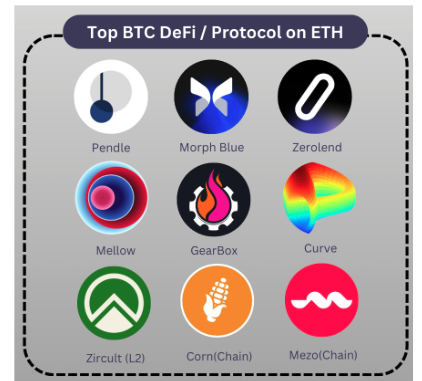
Money Markets & Interest Swaps: Morph Blue, Aave, Pendle, Zerolend, Curve BTC Staking/Credit Strategy: Corn, Meso, Gearbox, Mellow
2.2.2 Money Market
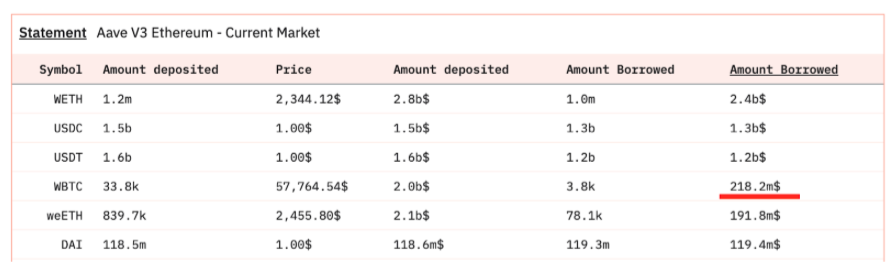
As the most “safe” asset, BTC is often used as collateral in the ETH DeFi landscape. Aave is the oldest and most prestigious money market, with over $2 billion in WBTC deposits, but only $218 million in loans. Compared to stablecoins (86.7%) or WETH (85%), its utilization rate is relatively low (7.69%).
Furthermore, Curve is not only a safe haven for stablecoin exchanges, but also a popular destination for BTC-related assets to store assets. On Curve, BTC providers can do two things: First, they can provide liquidity to the three pools. Second, they can use tBTC and wBTC as collateral to borrow crvUSD. At the time of writing, around $50 million worth of BTC assets have been deposited to borrow crvUSD. On the other hand, among the available pools, the tBTC - WBTC pool stands out with $25 million in assets and $2.24 million in daily trading volume. Unfortunately, while BTC-related assets are active on Curve, $CRV incentives have yet to be offered to attract users. 2.2.3 Interest Rate Swap (IRS) Exchange In addition to the money market, the interest rate swap (IRS) product offered by Pendle is also one of the most popular places for BTC LST DeFi. Pendle used BTC LST's future earnings and speculation on points to create multiple dedicated markets: PT/YT for SolvBTC.bbn, LBTC, and eBTC. In total, these markets attracted more than $136 million in capital, growing 150% month-on-month, driven by credits and incentive farming. 2.2.4 TVL Bootstrapping Treasury/Credit Strategy


Although Money Market and IRS products generate additional revenue for BTC assets based on the demand and supply of BTC on the ETH mainnet, TVL guides treasurers to prioritize the use of BTC to boost the TVL of their respective chains to promote ecosystem growth. Additionally, some vaults provide leveraged point farm strategies by revolving or borrowing BTC to maximize returns with the same capital.
Gearbox provides up to 27x Lombard points to borrow WBTC through leverage (up to 7x). However, this service is unpopular because the supply in gearbox is very limited (only about $3 million).

Source: gearbox.fi
In addition to credit strategies, some second-tier networks, such as Thesis's Mezo and Binance Labs supported Corn, are using the value of BTC by allowing nodes to “stake” bridged BTC LSTS as collateral. In return, nodes earn $BTC fees by participating in the verification process. This is a great attempt to use BTC and guide the TVL of these networks to promote future ecosystem growth. So far, Mezo has attracted $121 million in BTC-related assets and $20 million in corn.
So far, it's clear that most of the DeFi activity associated with BTC LSTS is mostly motivated by incentives. While BTC adoption is growing, in the long run, the actual demand to generate BTC LSTS will be highly dependent on Babylon's earnings performance, which may make BTC LSTS a more attractive asset than ETH.
2.2.5 Liquidity issues
Despite having a TVL of $300 million, the deepest pool has a liquidity of only around $10 million in the Uni v3 pool (according to nansen). Exchanging $345,000 in ETH for LBTC would cause a slippage of 1.06%, which is 4 times that of WBTC (about 0.4%). This difference reflects a key problem that BTC LSTS must overcome: liquidity issues when exiting LBTC positions on a large scale.

Source: Uniswap

Bridging BTC can take two main forms: ordinary BTC, such as Wrapped BTC (WBTC), and BTC re-staked in Babylon, called BTC-LST.
The BTC LST/LRT-Fi landscape is in its early stages, but shows healthy signs of bridging more TVL from BTC to the ETH DeFi ecosystem.
Due to BTC's growing acceptance and market dominance in the current cycle, BTC adoption is expected to increase. The opportunity to generate revenue for BTC has also created a market for speculative and trading activities on ETH.
WBTC remains one of the most widely adopted forms of BTC on ETH. However, tBTC or lBTC is expected to gain more adoption due to recent challenges associated with Justin Sun's association.
It is increasingly common to see BTC restaked tokens re-staked again in Symbiotic or Karak for leveraged farming. While this may generate higher returns, users must take the risk of facing multiple cutbacks.
Money markets and interest rate swaps are the most in-demand BTC DeFi activities on ETH, and the second-tier attempt to use BTC as a fee in the verification process is also quite interesting.
Currently, most BTC-related DeFi activity on ETH is mainly motivated by points or rewards. In order to generate actual demand, BTC LSTs need to create value (possibly in the form of revenue), and this value needs to be greater than ETH LSts.
Custody risk, risk mitigation, and liquidity risk are major concerns in the BTC LST landscape.
If I've overlooked it, reach out to @poopmandefi on Twitter and I'll do my best to keep this research up to date.
https://www.diadata.org/bitcoin-ecosystem-map/
https://www.footprint.network/@Higi/Bitcoin-Bridge-BTC-to-Ethereum-WBTC? %253e%253d_date-98774=2021-01&%253c_date-98777=2024-09-09
