


Exchanges collectively grab Xiaohongshu: the main battleground for crypto incremental users
By Ada, Deep Wave TechFlow
Original title: Crypto exchanges hunt for Xiaohongshu
“I heard that Xiaohongshu requires 10,000 fans to apply for Binance School Recruitment?”
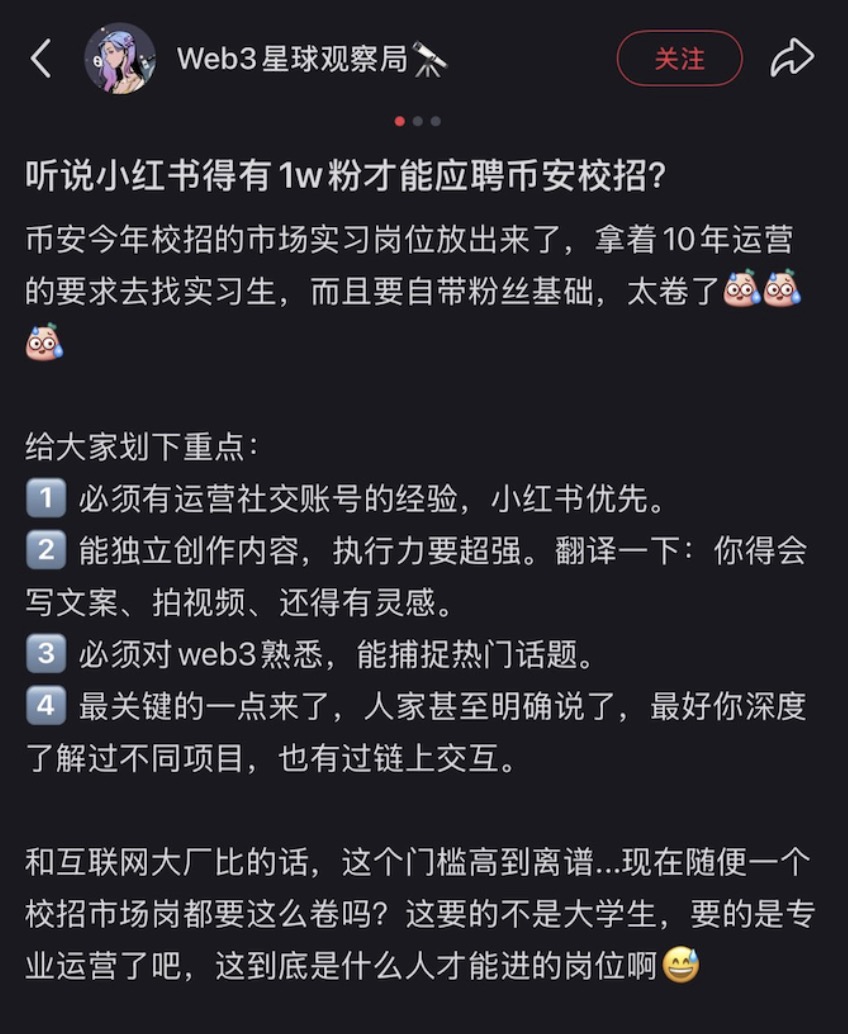
A screenshot of Xiaohongshu blew up in an encrypted job search group.
“It's harder than 985 degrees,” some people ridiculed in the comments section.
In fact, in Binance's official JD, there is no “hard fan threshold,” but it clearly states: “Experience in running successful social media accounts is preferred, especially in the direction of videos, Xiaohongshu, and AI-related content.”
This is no joke. Crypto KOL “AB Kuai.Dong” bluntly stated on X (Twitter):
“The attitude of major exchanges towards Xiaohongshu has changed from 'if you want to do it' to 'can you grow big', and now they even specifically recruit fresh graduates with Xiaohongshu's initial experience.”
From Weibo, Twitter, and Douyin to today's Xiaohongshu, the marketing battlefield of exchanges is quietly shifting.
This shift was not an impulse.
In 2023-2024, Xiaohongshu's user profile changed significantly: investment and financial management, overseas living, and telecommuting content increased exponentially; users aged 25-35, in Tier 1 and 2 cities, and with a bachelor's degree or above accounted for more than 60%.
These people happen to be the core users that cryptocurrency exchanges want to compete for the most.
On this platform, which started with beauty and clothing, exchanges carefully tested the boundaries of the platform and packaged their “ambitions” with street videos, work stories, and wealth notes.
Is Xiaohongshu really a new growth park for the crypto industry?
The history of cryptocurrency flow migration
To understand why exchanges are betting on Xiaohongshu, we must first understand a “History of the Migration of Encrypted Traffic.”
In the memory of many people in the cryptocurrency industry, Weibo has long been the center of public opinion in the Chinese crypto world.
From 2017 to 2022, executives from major exchanges split up, robbed people, and harshly spoke out on Weibo, which seemed like an “open ring” for the industry. A large number of newcomers also completed their first transactions in their lives in the Weibo crypto blogger's popular science and shouting list.
Back then, every time Bitcoin soared, an exchange would spend money to buy popular searches on Weibo, making entries such as “Bitcoin skyrocketing” hit the list, attracting countless retail customers to watch.
However, everything came to an abrupt end when regulations were implemented. As policies were tightened, OG accounts in industries such as Sun Yuchen and He Yi were shut down, and a large number of KOLs were also completely cleaned up. People from all walks of life were forced to migrate and eventually converged on today's X (Twitter) to form a new Chinese-language crypto social circle.
Today's X (Twitter) is of course the biggest “square” in the crypto world — Vitalik is posting the progress of the Ethereum upgrade here, CZ is here to respond to questions, and various KOLs are talking loudly here. But that's exactly where the problem lies: it's too “in the circle.”
After years of competition for traffic, potential new crypto users have long been split up by KOLs with invitation links, and today's market is more like a tug-of-war between existing users.
However, for the vast majority of Chinese-speaking users, Twitter has always been separated by a glass wall, unable to reach the sinking market, and it is also difficult to leverage a wider audience.
Douyin was also seen as a potential “gold mine of encrypted traffic.” It has unparalleled content explosiveness, but the problem is: this explosion is hard to sink in.
Fast food-style content consumption makes it difficult to establish the sense of trust that financial products require.
“The life cycle of Douyin content is too short,” commented new media analyst Yumizhi. “It was designed for exposure and traffic rather than trust. With Douyin, vitality will quickly dwindle, and it is difficult for influence to settle into users' daily lives.”
Station B once carried the educational content of the exchange. From “currency science popularization” to “strategy teaching”, it was a window for gaining newcomer traffic.
Similar to the difficulties faced by Weibo, as regulations became stricter, terms such as “Bitcoin” and “exchange” were systematically limited. Creators were tired of dealing with it, and the launch of exchanges gradually lost stability.
Unlike these old battlefields, Xiaohongshu has completed a quiet yet thorough evolution in the past two years.
It's not just a beauty and clothing sharing community anymore. The content on investment and financial management, technological exploration, and overseas life is growing exponentially, accounting for more than 60% of users aged 25-35, with a bachelor's degree or above, in Tier 1 and 2 cities.
This group of people is exactly the core customer group that crypto exchanges dream of.
More importantly, Xiaohongshu's traffic distribution method is completely different from Douyin.
It doesn't rely on the monopoly of leading bloggers, but allows KOC with only 1000 fans to gain significant exposure. For example, the post “Bybit can still open a card, hurry up” posted by an ordinary user on Xiaohongshu can garner thousands of approvals and interactions.
Another secret weapon of Xiaohongshu is its natural “chain of trust.”
Unlike public domain traffic platforms, Xiaohongshu's community is centered on people's feelings. Users interact with bloggers in the comment area, send private messages, and even pull into group chats. The whole process is like word-of-mouth recommendations from friends rather than cold advertisements.
For cryptographic products with high thresholds and high learning costs, this kind of chain means a shorter conversion distance.
The Xinwang Research Report even called Xiaohongshu a “trust engine for social e-commerce”:
It combines influencer traffic, sales information flow, and consumer opinion leader attributes. Traffic relies more on active user searches rather than platform recommendations, which makes sales conversions more accurate and less likely to cause disgust.
Therefore, when we saw that Binance, OKX, and Bitget started betting resources on Xiaohongshu, this was not a “miracle trick” on a whim, but a strategic bet that conforms to the new traffic logic.
Exchanges' secret growth techniques
“OKX cut more than half of the KOL campaign budget on Twitter and started working hard on Xiaohongshu. There are many internal departments working on Xiaohongshu at the same time, and almost all of the staff in the Chinese-speaking department are working on Xiaohongshu.”
Crypto bloggers are fearless in breaking the news on X.
On Xiaohongshu, OKX's “Beidian School Flower” theme street received over 87,000 likes for videos. Similar street-picking themes can easily get rave of praise almost every time, and the Nezha series of AI short films can also get thousands of favorites.
OKX obviously doesn't just shoot videos. Its style of play on Xiaohongshu is more like a carefully planned marketing layout: official names create topics, employee numbers lurk in various content circles, and penetrate in a matrix.
In addition to official accounts, employees such as Jiumei, Mercy, and Mia have amassed a large number of fans using workplace narratives such as “Experience of Switching to Web3” and “Everyday Life at an Exchange Workplace.” They seem independent, but they frequently interact with official names in the comments section, creating double exposure for the brand and bringing them closer.
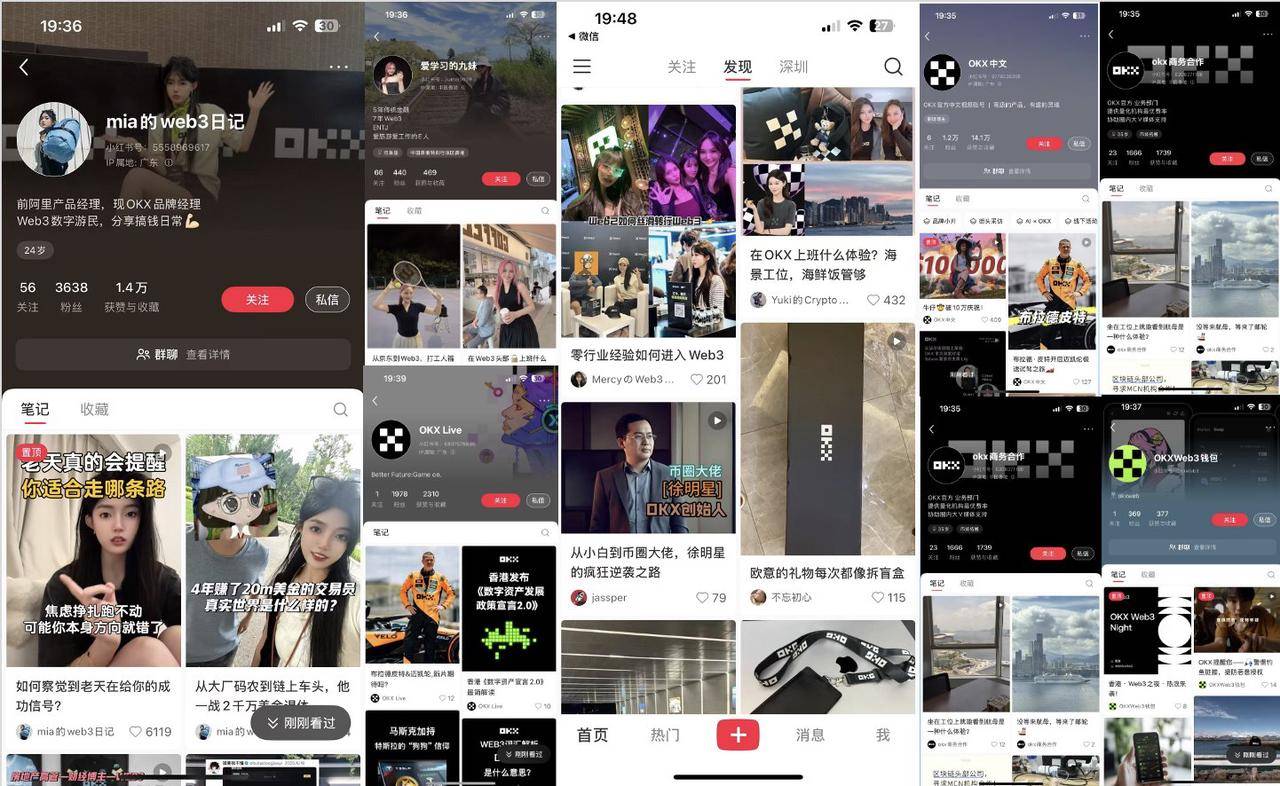
On the one hand, this kind of matrix play can hedge against the risk of blocking, and on the other hand, it also allows brands to sneak into more segmented groups of people, such as young workers who want to enter Web3, or freelancers pursuing a “digital nomad” lifestyle.
However, for exchanges, the role of Xiaohongshu may not only be to obtain directly registered users. More often, it plays the role of a “brand display window” — making potential users familiar with and approving exchange brands through content penetration, and being able to think of it as soon as users have real trading needs.
Really efficient transformation is often done in the “underworld.”
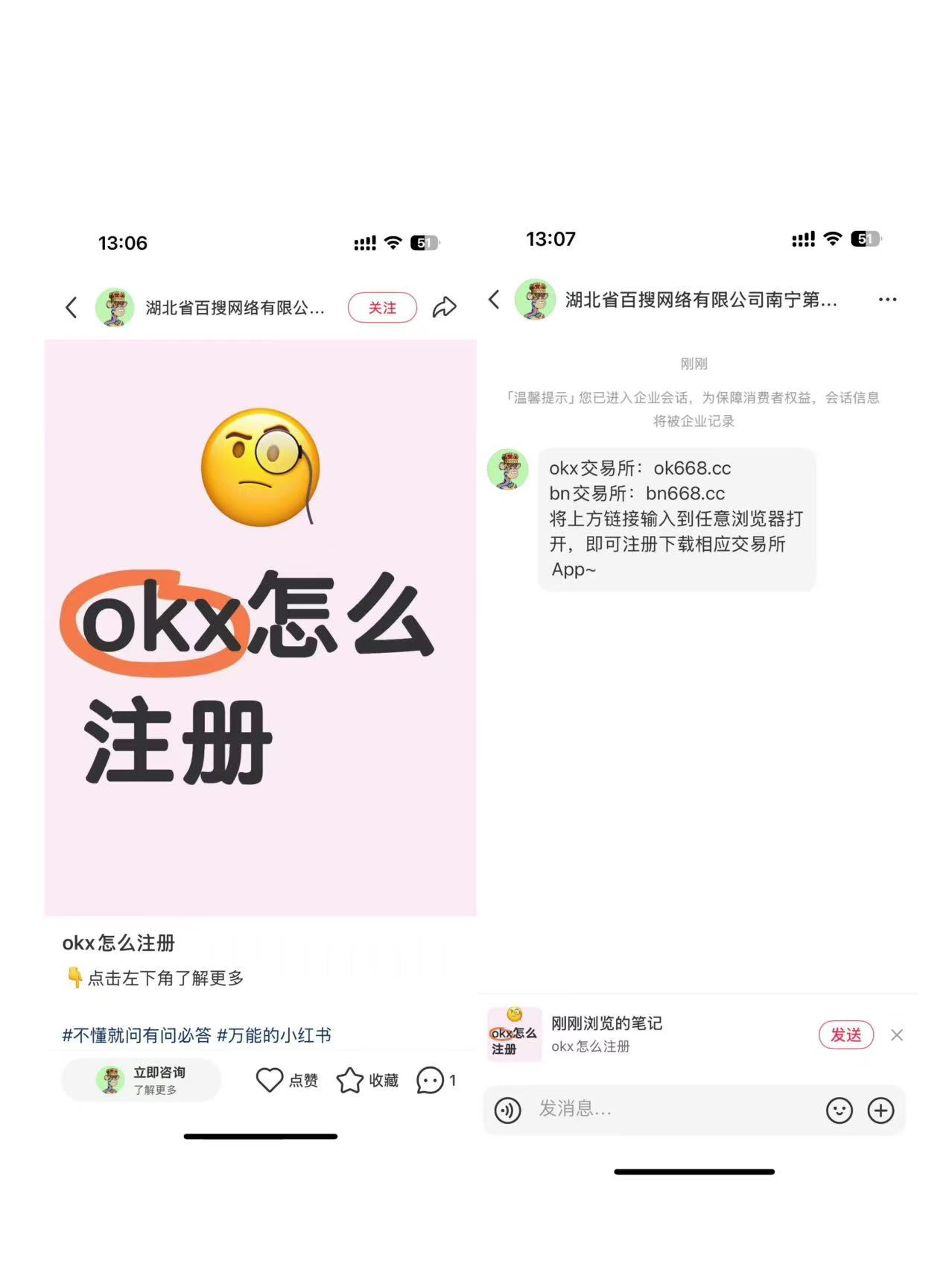
Many folk studios have been active in Xiaohongshu for a long time and are working tirelessly to publish drainage notes.
These notes are usually covered by “Pitfall Avoidance Guide,” “Financial Diary,” and “Xiaobai's Introductory Tutorial” to attract users to join groups, chat privately, and then throw up registration links. Once users deposit money and start trading, these promoters can earn rebate income for a long time, and some studios even directly place registered advertisements on Xiaohongshu — this is also one of the most stable grey businesses in the coin industry.
At Xiaohongshu, cryptocurrencies are often not a cold financial instrument, but are packaged as a lifestyle choice.
Not talking about “investing in cryptocurrencies,” but “how do I achieve a monthly passive income of 10,000 plus”; not talking about K-line charts, talking about the financial management experience of digital nomads; not about technical analysis, about the path to wealth freedom after 00...
This kind of “lifestyle” packaging perfectly fits the content ecology of Xiaohongshu, and also lowers the psychological threshold for users.
Crypto blogger Viki has summarized the types of Web3 accounts that currently have commercial value on Xiaohongshu:
Career consulting category: sharing career transition experiences to attract job seekers;
Investment experience category: Seemingly a life record, it is actually an investment tutorial;
Lifestyle category: stories of digital nomads, remote work, and overseas life;
Personal IP classes: Build trust through strong identity tags.
“Exchanges will cooperate with KOLs or KOCs that have these four types of accounts, and eventually follow the path of leading into the community and registering a rebate link to complete the conversion,” Viki explained.
Behind this, the exchange is trying to complete a long-term rebrand: from a cold trading tool to a community, companion, and even a “story leader.”
Dance on thin ice
The influx of crypto exchanges into Xiaohongshu seems like the first step to break out of the “dark talk of the coin industry” and enter the mainstream social context, but this path is not an easy one.
Trader “CoinDrug”, who has 50,000 followers on Twitter, said bluntly that making Xiaohongshu is “extremely inefficient.” He had to pay more than 20 accounts to figure out the rules due to repeated launches and repeated bans.
“Well, the community hasn't caught up yet. Now that various exchanges are frantically entering, traffic is no longer a blue ocean.” Another KOL “Digital Frenzy” claims that now working as a Xiaohongshu is like a “Siege of the City Scrolls,” and the bonus period has disappeared.
In addition to fierce competition, the platform's review mechanism is also a high wall.
“Low traffic has no effect; high traffic triggers manual review.” Viki concluded, “If you break the rules too many times, the stream will be restricted if it is light, and the heavy one will be blocked. Making content is like dancing in shackles.”
In order to avoid stepping on thunder, many creators had to focus on different aspects, from copywriting and layout to draining unique styles of design, and the input-output ratio was further reduced.
Even trickier are compliance and user perception risk. The mainstream user base of Xiaohongshu is mostly young people. They lack awareness about contracts, leverage, and on-chain assets. A slight carelessness may cause financial loss due to misunderstanding, which in turn triggers the tightening of regulations. Even if the platform currently maintains a certain amount of vague space for encrypted content, with the standardization of financial content management, any time public opinion explodes, it may lead to a global ban.
The risks are obvious, but the exchange is still willing to invest heavily.
“If you don't rush, your competitors get ahead,” said an exchange marketing manager.
It's like a classic “prisoner's dilemma”:
If only you do it, you can really grab the dividends
If everyone does, the dividends are diluted and the risks are amplified
If you don't do it, watch your opponents harvest users
So even if you know there are traffic traps and potential risks, jump in.
Breaking a circle always has a cost; the question is, is it worth the cost?
The exchangers' adventures on Xiaohongshu are like dancing on thin ice — every step may be the last step, but no one wants to stop when the music sounds.
How long will this traffic frenzy last? No one knows the answer.
The only sure thing is: today, when traffic is getting more expensive and regulations are getting stricter, the era of “easy money” is over. Exchanges need to think about not only how to acquire users, but also how to truly create value under the premise of compliance and sustainability.
Otherwise, today's Xiaohongshu might be tomorrow's Weibo.
History never repeats itself, but it always follows its rhythm.
Twitter:https://twitter.com/BitpushNewsCN
Compare the TG exchange group:https://t.me/BitPushCommunity
Compare TG subscriptions:https://t.me/bitpush
