


The crisis of multi-chain architectures: Thinking from Cosmos to Polkadot!
Source: PolkaWorld
Original link: https://mp.weixin.qq.com/s/i-21DJ_EZg0rGjet2WN1VQ
For a long time in the past, the term “multi-chain architecture” was once regarded as the golden story of Web3: each chain can be flexibly expanded according to its own needs, collaborate with each other, share security and connection values, and build a truly open and interoperable cyber universe.
This is the story of Ethereum L2, Cosmos, and Polkadot.
However, the ideal has yet to be realized, and the dilemma has quietly arrived.
As we review the current state of development of mainstream L1 and L2 networks, a common problem comes to mind:
There are more and more chains, but users are unable to keep up;
Technology continues to break through, but the product experience is still far away;
Capital is pouring in rapidly, yet it is difficult to accumulate sustainable value.
Public chains with a multi-chain architecture have always been caught in a dangerous “incentive cycle” in the past: issuing coins, airdrops, pulling, shipping, and crashing. Short-term heat can be easily created, but long-term trust is increasingly scarce.
The Cosmos crisis is not an exception, but a microcosm
Take Cosmos, for example. Once upon a time, this ecosystem was considered one of the best practitioners of multi-chain architectures.
Through the path of staking ATOM → getting airdrops → supporting sub-chain projects, Cosmos once established the earliest and most active batch of “ecological flywheels” in the Web3 world:
Projects such as Osmosis, JUNO, Evmos, and Celestia are all “incubated” under this mechanism;
Users actively participate in ATOM's staking (staking), receive airdrops of sub-chain tokens, and further participate in the governance or trading of these new projects;
The project side, on the other hand, quickly attracted traffic and attention through airdrop, and completed the cold start tasks in the early stages of startup.
This “stake-to-earn+ airdrop” mechanism has activated the vitality of the Cosmos community in a short period of time, and has also enabled many projects to gain initial users and markets.
The problem, however, is that the mechanism itself is not sustainable.
As more and more projects “take off with airdrop”, airdrop gradually no longer represents long-term construction, but only a one-time benefit:
Users participate in staking only for arbitrage;
The project side destroyed the market immediately after the airdrop, and there was no long-term incentive mechanism;
ATOM's staking was diluted by high inflation, and long-term holders' interests were damaged;
The value of the sub-chain cannot feed back to ATOM itself, leading to a “vibrant ecology and a downturn in the main chain”.
Eventually, when the market heat faded and the bubble of the airdrop economy burst, the ecology quickly moved from peak to collapse.
From Evmos and Stride to Celestia and Osmosis, this “Airdrop Takeoff → Hot Sale → Crash to Zero” script was performed over and over again.
This is exactly what we're saying: incentive cycle ≠ business model. The airdrop brings one-time attention rather than product retention; staking does not protect the value of the token, nor can it support the long-term survival of the project.
Today's Cosmos is paying a heavy price for what seemed like a “value binding” growth path in the past:
The core asset $ATOM fell more than 90% from its all-time high;
On-chain projects such as Osmosis, JUNO, INJ, etc., fell between 70% and 99%;
The crisis of multi-chain architectures
We can't blame “speculators” for all the problems. There is nothing wrong with the incentive mechanism itself; what is wrong is the project side's misuse of incentives and evasion of business logic.
The problems faced by Cosmos also exist in more multi-chain ecosystems:
The value of the sub-chain is fragmented, making it difficult to form a unified backflow mechanism;
Native tokens lack usage scenarios, and long-term inflation dilutes trust;
The governance system is divided, and the community lacks stable consensus;
The airdrop economy destroys the long-term culture and harms the builders;
There is no revenue model to support user growth, and a closed loop of products cannot be formed.
This isn't just a Cosmos problem, it's not just an L1 or L2 problem; it's a deep challenge that Web3 projects generally face: most projects only get through the incentive system, not the business logic.
In any industry, healthy growth follows the same path:
The project solves real problems for users;
Users are willing to pay for services;
The project earns revenue and continuously optimizes products;
Form a sustainable positive cycle.
This set of logic has been tried and tested over and over again in Web2, but it has become invaluable in Web3. Most projects have not yet taken the first step and are in a hurry to pursue the “market capitalization” of the second step.
What about Polkadot? How to get out of the “strange circle” you have set up?
Polkadot has faced similar questions, including now. Over the past few years, it has invested a lot of resources to build the underlying architecture, but it is often criticized by the outside world for “no users,” “no traffic,” and “slow growth.”
But because of this, Polkadot never indulged in the illusion of an “airdrop economy,” but instead continued to refine the infrastructure layer — until nearly two years, it gradually turned to “commercialization” and “closed loop economic” exploration.
But that doesn't mean there are no issues with Polkadot:
Parachains with high transaction volume, such as Mythical, peaq, etc. cannot recoup DOT value
DOT tokens lack usage scenarios, and staking hopes supported by high inflation have been diluting the value of holders' tokens
A large percentage of inflation rewards have been paid to pledgers, causing the cost of network security to increase year by year
High staking earnings have always limited the development of Polkadot Defi, causing the overall TVL of the Polkadot ecosystem to be squeezed out of the top ten
Voting rights are priced according to the number of DOTs, making governance easily controlled by large players
The price of the core Core was once too cheap to be any cheaper, leading to an imbalance in the value of Polkadot's core products
The development threshold is high, the ecosystem is closed, and it is impossible to attract developers in the Ethereum ecosystem, but developers in the Polkadot ecosystem can easily escape directly to other ecosystems
The Polkadot ecosystem as a whole lacks product thinking, and both developers and ordinary users lack user-friendly products
However, I think it's a good thing to find these issues. Only by being able to accurately detect problems can they be solved. Therefore, in response to the above problems, the Polkadot community has recently proposed a series of solutions.
DOT supply side: managing inflation, limiting total volume
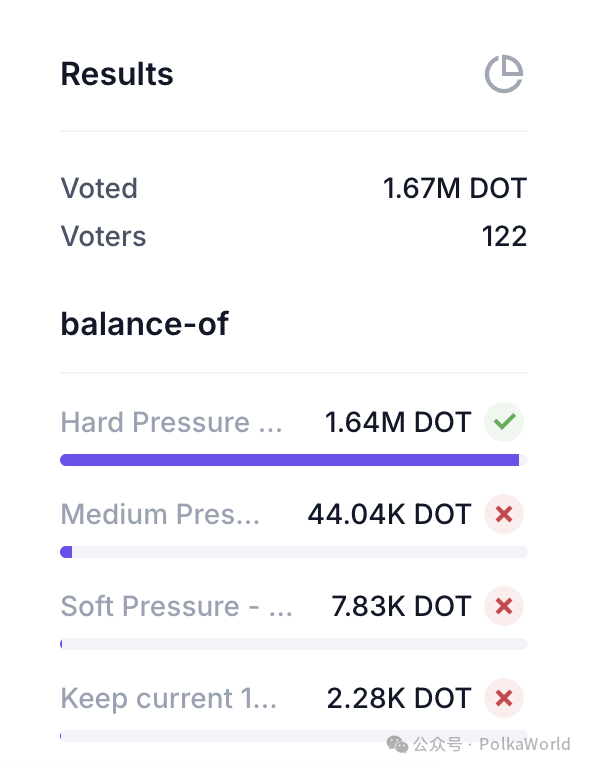
The community has initiated off-chain voting to push DOT to shift to a fixed total cap and reduce DOT inflation in a stepwise manner to protect the interests of long-term holders and prevent incentives from getting out of control.
You can check out more news and vote here“Proposal to reduce DOT inflation is finally here! Whether cutting inflation and blocking the total volume can reverse the decline depends on this vote!”
Currently, 122 addresses with a total of 1.67M DOT have participated in the voting! Also, the first option had the highest turnout! In other words, the plan to set the total amount of DOT at 2.1 billion and reduce inflation by 50% every two years currently has the highest number of votes!
DOT demand side: create real use cases
Coretime market mechanism: commercialize computing resources, and users use DOT to buy Coretime to run services;
Polkadot Hub will be launched in mid-December: as a smart contract platform, supports 100% EVM + PVM, and DOT becomes the default payment token;
Liquidity incentive programs stimulate the recovery of DeFi: vDOT, Hydration and other protocols drive DOT's central position in on-chain finance; and as staking returns decline, a large portion of DOT is expected to flow into Defi;
Polkadot App: This is also worth mentioning. As a reflection of Parity's product mindset shift, the Polkadot App can expand DOT usage scenarios in real payments through Polkadot Pay and unmanaged VISA cards.
Underlying protocol: Advancing the development of the JAM protocol
JAM is positioned as the world's supercomputer platform, providing users with more powerful computing power and performance, and bringing more imagination to more application fields we have yet to touch;
Also, developers can more easily deploy their own products on JAM, at a lower cost, and a better experience.
Cybersecurity mechanism: PoP model may replace PoS and reshape security logic
Polkadot is exploring “Proof of Personhood” to replace the traditional staking model. The goal is to reduce the annual security cost of 500 million US dollars to 90 million US dollars, and even achieve “self-supporting safety” through Coretime earnings.
Furthermore, once launched, the PoP mechanism will help Polkadot OpenGov move from “token governance” to “personality governance.”
Currently, Polkadot's OpenGov governance system is still mainly based on DOT weight. Whoever holds more coins has more governance weight. The introduction of the PoP mechanism will add the dimension of “identity uniqueness” to governance, so that every real user can speak out independently.
Furthermore, there is no governance with an identification mechanism, and it is easy to misuse — for example, swiping proposals, swiping tickets, manipulating opinions, and anonymously posting false information through multiple addresses. The core value of PoP is to provide unique authentication, prevent governance from being maliciously manipulated at the source, and make every vote and proposal more authentic and credible.
Well, based on the above changes, Polkadot may form a new main line logic and value capture mechanism: DOT → rent Coretime → launch services → obtain revenue → expand resources → use more DOT → continue to grow the network.
In this model, DOT is no longer an “incentive dispenser,” but rather a unit of measurement and fuel for the operation of the entire ecosystem. The project relies on DOT to start business. Users enjoy services due to DOT, so DOT forms a positive accumulation of economic value.
Instead of generating growth through hype and airdrops, use creates value.
Written at the end: The way out for Web3 is not a change in narrative, but rather a use
The current state of Cosmos, Ethereum L2, and Polkadot are a few examples worth remembering to reflect on.
Polkadot is not flawless; as we mentioned earlier, it also faces slow promotion and high product understanding barriers. But at least we see that it's actively exploring a more solid path:
Don't rely on airdrops to create momentum;
Do not rely on pulls to fertilize;
Build value through products, users, and actual use.
If Web3 wants to break out of the motivational cycle, it must go beyond the illusion of narrative and return to the essence of commerce.
Providing services → Users are willing to pay → Projects receive revenue → Feed back products → Continual growth.
If Web3 finally comes to fruition, will this Polkadot change provide an economic paradigm that can be validated?
