


Harvard and Yale join the market: Top universities on the new crypto battleground

Source: Shenshao TechFlow
By Yanz, Liam
Original title: When Harvard and Yale enter the market, the crypto powerhouse of top universities
In August 2025, the price of Bitcoin surpassed 120,000 US dollars, and the former “marginal assets” were once again brought into the mainstream, and this driving force was not only Wall Street hedge funds, but also the most conservative and savvy fund managers on the Ivy League campus.
On August 9, the US Securities and Exchange Commission (SEC) 13F filing revealed a market-side detail: the Harvard University Endowment Fund (approximately $53.2 billion) held a Bitcoin ETF (IBIT) worth $116 million in the second quarter of 2025. This position ranked its fifth largest investment, after Microsoft, Amazon, Booking Holdings, and Meta, and even surpassed Google's parent company Alphabet and Nvidia's share of positions.
Harvard is no exception.
Brown University, Emory University, and the University of Austin have all publicly disclosed their cryptocurrency positions.
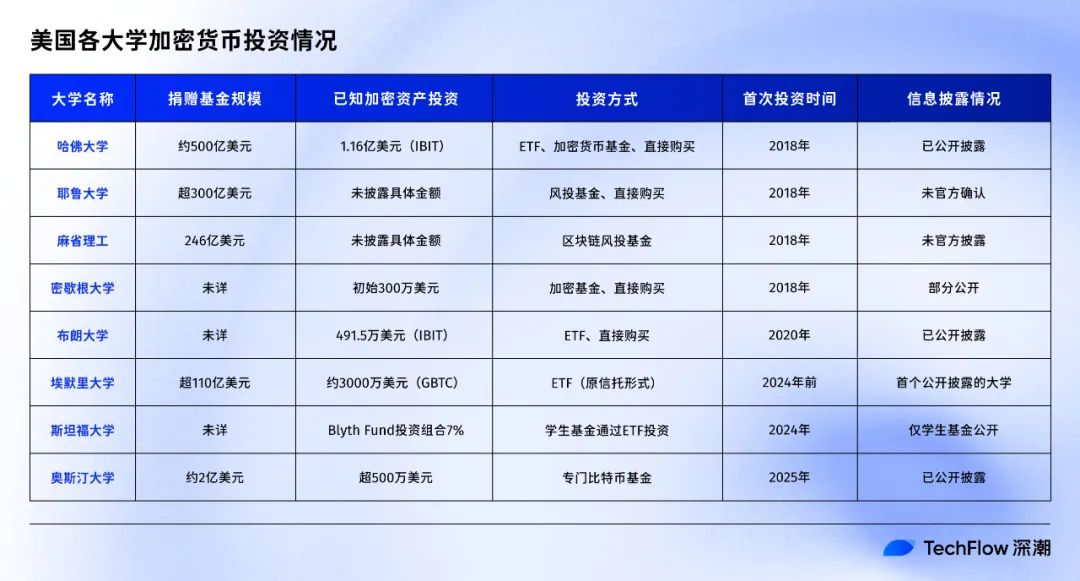
It wasn't an impulse for these “savages” in ivory towers to start embracing cryptocurrencies; it was just a moment in the face of a multi-year layout.
The capital, talent, and technology of famous universities have long been deeply rooted in the crypto industry.
Just this time, they were pushed to the front of the stage.
Investing in crypto amid a bursting bubble
2018 was the darkest hour for the cryptocurrency industry.
With the collapse of the ICO bubble, the global market value of crypto assets evaporated more than $630 billion to less than $200 billion, Bitcoin fell to $3,000, Ethereum fell to $80, retail investors left the market one after another, cryptocurrencies were labeled a “Ponzi scheme,” and even Facebook announced a ban on crypto-related advertisements.
At a time when no one could avoid it, the Yale University Endowment Fund made a decision that seemed to “go against ancestral teachings.”
Under the leadership of legendary investor David Swensen (David Swensen), in October 2018, Yale University, in collaboration with top institutions such as Harvard and Stanford, invested in Paradigm's first $450 million crypto fund, which was founded byCoinbaseIt was founded by co-founder Fred Ehrsam and former Sequoia Capital partner Matt Huang. Meanwhile, Yale is also involved in the first $4 billion crypto fund set up by a16z.
Looking back, this investment at a low point not only affected the development trajectory of Paradigm and a16z, but also accelerated the historical progress of the crypto industry to a certain extent.
According to the original plan, Paradigm will invest 60% of its capital into crypto assets and 40% into shares in crypto startups. However, after receiving funding, Paradigm chose to take a risky step — through the investment trading platform Tagomi, undercut Bitcoin and Ethereum, and it cost about $4,000 to open a Bitcoin position. Just a few months later, in the first half of 2019, the price of Bitcoin once surpassed 10,000 US dollars.
As far as university endowments were concerned, it was impossible to directly buy Bitcoin at the time, and there were no compliant ETF products, so having Paradigm hold crypto assets on their behalf was considered a “curve entry” strategy. Even in the event of a loss, the foundation was able to achieve risk isolation at the level of compliance and responsibility.
At the time, it seemed like a mystery how Matt Huang convinced Yale Fund to invest in a newly established crypto fund to invest in cryptocurrencies.
Although Matt Huang's mother, Marina Chen, is a former computer professor at Yale University, there is no information to prove that Marina Chen influenced Yale's investment paradigm.
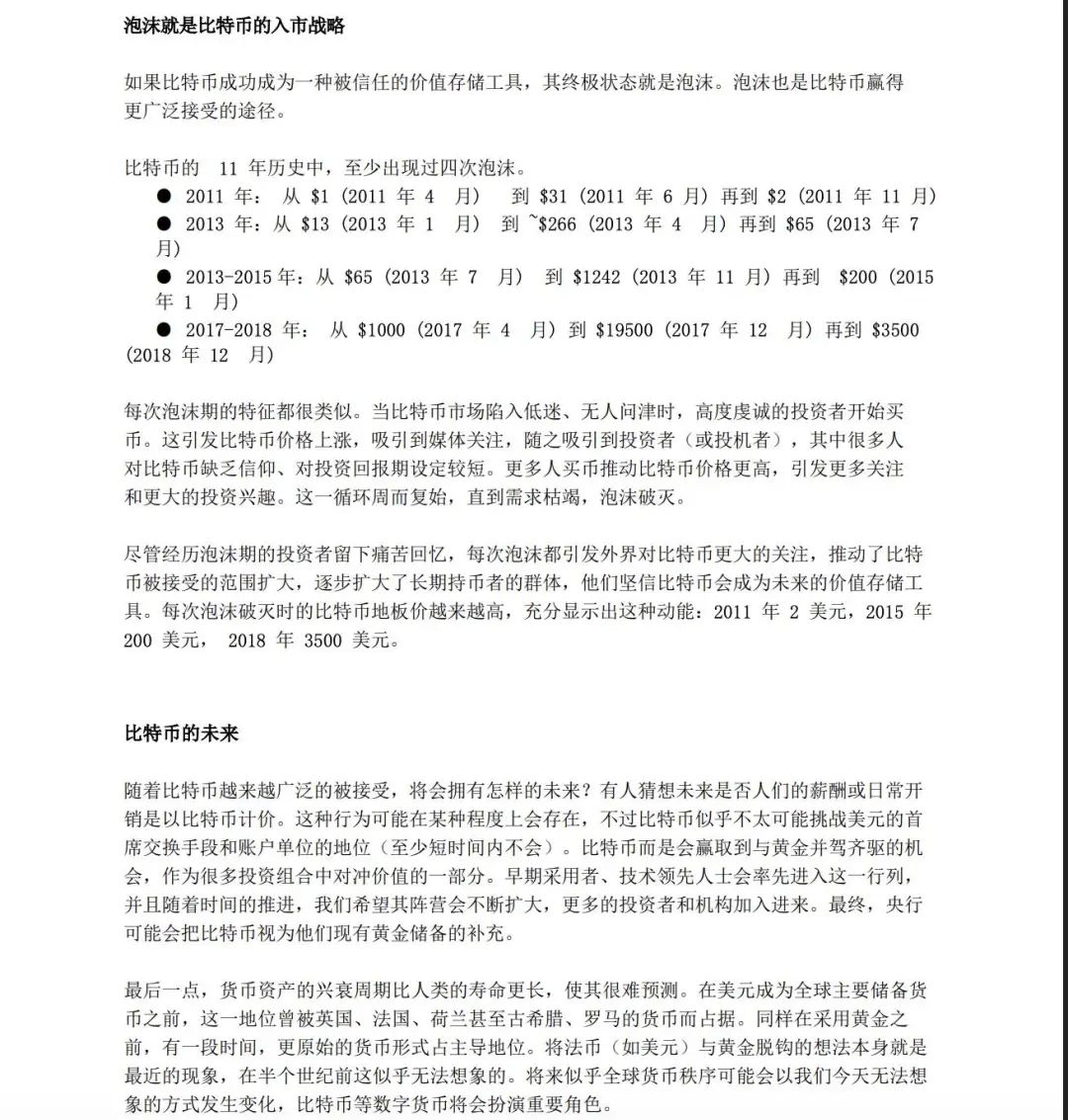
Through Matt Huang's 2020 article “Evangelizing Bitcoin for Enlightened Skeptics,” we may be able to get a glimpse of how Matt Huang persuaded investment leaders of various university funds back then.
In Matt Huang's view, the bubble is not a flaw, but rather a necessary path for Bitcoin to gain wider acceptance. Each bubble expands Bitcoin's awareness and acceptance. Bitcoin will not challenge the US dollar's medium of exchange in the short term. In the future, it will go hand in hand with gold, become a hedge tool for investment portfolios, and will be held by institutional investors until finally, the central bank may use Bitcoin as a reserve.
For the crypto industry, Paradigm is not just an investment agency that brings capital, but also an important builder.
In April 2019, Paradigm invested $1 million in Uniswap as the seed round leader. Uniswap didn't even set up a company at the time; the only developer was the founder Hayden Adams, a mechanical engineer who had just been laid off by Siemens and only started teaching himself the Solidity language in 2017.
More than just investing, Dan Robinson of the Paradigm research team is on the Uniswap Discord almost every day to help solve difficult problems with liquidity and smart contracts.
Thanks to the collaboration between the two parties, the AMM model came out, detonating the summer of DeFi.
Paradigm's star projects abound, from StarkWare, Mina, Uniswap, Compound, MakerDAO, Yield to Optimism, Amber, Fireblocks, Synthetix, Opyn, TaxBit, BlockFi, Chainalysis, Gitcoin, Lido, dYdX, etc.
Another crypto fund that Yale University initially invested in, a16z crypto also shaped the development of the industry. In addition to investing in well-known projects such as Coinase, Solana, Aptos, Avalanche, Arweave..., a16z also participated deeply in industry development through public policy influence. It donated tens of millions of dollars to the super PAC Fairshake that supports cryptographic issues and bet on Trump's victory, thus obtaining a more friendly crypto policy environment.
Back in the end of 2018, it all began without legendary investor David Swensen.
As the highest-paid person at Yale, he has managed a multi-billion dollar endowment fund for the past 34 years, expanding the size of the fund from $1 billion to $31.2 billion, with an average annual return of nearly 17%.
The “Yale Model” he pioneered became the gold standard for university endowments around the world. Today, many of the heads of endowments at top institutions such as Princeton, Stanford, MIT, and Penn are his former employees and are known as “Yale School.”
Yale's entry quickly triggered a ripple effect. Vine schools such as Harvard, Stanford, and MIT also followed suit during the same period. “The Information” reported in late 2018 that Harvard University, Stanford University, Dartmouth College, MIT, and the University of North Carolina have all invested in at least one cryptocurrency fund through their respective endowments.
In a sense, Yale's investment in 2018 was not only a blessing in the midst of the industry's cold winter, but also a high-profile vote of confidence in the future of the crypto industry.
Crypto gangs in prestigious schools
Beyond capital and endorsements, the world's top universities have a more profound impact on the crypto industry in people.
Where there are people, there are rivers and lakes, and most of the many “helpers” and backbone forces in cryptographic rivers and lakes come from famous universities, gradually forming invisible and powerful “university gangs.”
In the Chinese-speaking world, the Tsinghua Department is unquestionably the most influential entity. Li Lin, the founder of Huobi, graduated from the Department of Automation at Tsinghua University; the core team of the high-performance Layer 1 blockchain Conflux comes from Yao Ban, Tsinghua; Gu Ronghui (CEO) and Shao Zhong (CTO), two co-founders of blockchain security company CertiK, are also undergraduate students in Tsinghua.
Sun Yuchen, founder of Bochang, and Wu Jihan, founder of Bitmain, both graduated from Peking University.
Zhejiang University's alumni projects are spread all over the Web3 application side, from the NFT trading platform Magic Eden to the NFT data platform NFTGo, from the popular chain game Stepn to the hardware wallet Keystone, covering almost all tracks of C-side applications.
Overseas, a background in a prestigious school is standard for founders in the crypto industry.
Relying on its position in the heart of Silicon Valley, the Stanford Gang has great influence in the crypto industry, cultivating well-known industry leaders such as the founder of star projects such as OpenSea, Alchemy, Filecoin, and Story, as well as Lily Liu, chairman of the Solana Foundation.
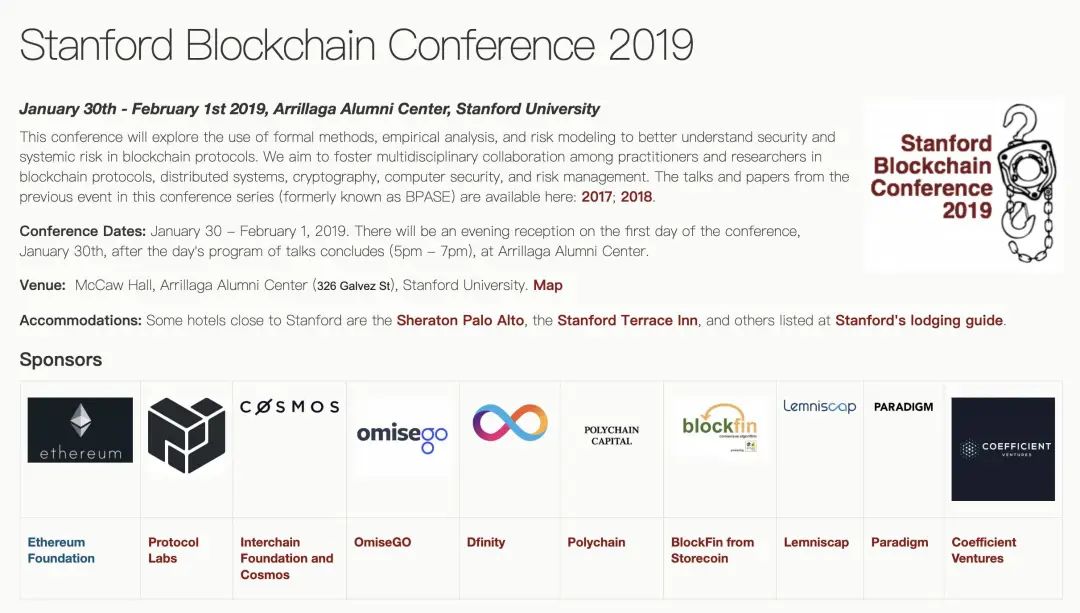
At Stanford University's Blockchain Conference in 2019, celebrities gathered as sponsors. Well-known projects and institutions such as Ethereum, Cosmos, and Polychain were clearly on the list, and there is a trend of catching up with many large-scale crypto conferences.
The MIT gang, on the other hand, excels at technology research. MIT's Digital Currency Initiative team participated in the development of Zcash. Zcash was selected by the Massachusetts Institute of Technology as one of the top ten breakthrough technologies in the world in 2018. After all, Zero-Knowledge Proof (ZK), a cryptographic milestone technology, was proposed by MIT researchers in the 1980s.
MIT professor and Turing Award winner Silvio Micali personally stepped down and founded the high-performance public chain Algorand in 2018.
The MIT alumni lineup can be called the “Crypto Star List”: Paradigm founder Matt Huang, MicroStrategy founder Michael Saylor, StarkWare co-founder Uri Kolodny, Litecoin founder Lee Kai Wei, and FTX founder SBF are all from MIT.
UCB (University of California, Berkeley) is very active in entrepreneurship and incubation.
In January 2019, Berkeley established Berkeley Blockchain Xcelerator, a blockchain startup accelerator. It is operated as a joint venture between Berkeley Haas Business School, Berkeley Engineering SCET, and Berkeley Blockchain. Every year, it incubates a number of early cryptographic projects, and has now accelerated hundreds of companies. Computer professor Song Xiaodong also personally founded Oasis Network, a public privacy chain. Other well-known UCB projects include Galxe, Osmosis, Sei Network, Opyn, Ampleforth, Kadena, etc.
The Princeton Gang, on the other hand, had a profound influence in the field of investment. In 2022, four 1987 alumni, Ethereum co-founder Joseph Lubin, Pantera Capital founder Daniel Morehead, Galaxy Digital founder Michael Novogratz, and Fortress Investment Group's Peter Briger, jointly donated $20 million to their alma mater to launch a blockchain research program.
It's worth mentioning that Morehead received early support from Briger and Novogratz when he founded Pantera, and now Pantera is a top crypto fund with over $5 billion in assets under management.
In an industry that emphasizes “Don't Trust, Verify,” trust between people is invaluable. Alumni relationships are just this natural bond of trust: founders prefer to hire alumni, and investors are also more willing to invest in alumni, thus forming an invisible barrier to a “gang culture.”
After Li Lin founded Huobi, he recruited his classmate Lan Jianzhong as vice president. More than half of the senior management were from Tsinghua. Former CEO Grandpa Qi and CFO Zhang Li also graduated from Tsinghua. Wu Jihan also heavily used the support of Peking University students in Bitmain.
Today, blockchain courses have become standard in colleges and universities, and student blockchain clubs and alumni networks are intertwined into an invisible network of talent and capital.
The Stanford CBR conference, Berkeley's Xcelerator, and MIT's DCI hackathon are continuously sending fresh blood to the crypto world.
More than just “early investors” in the industry, universities have become the “martial arts faction” that encrypts the river.
Twitter:https://twitter.com/BitpushNewsCN
Compare the TG exchange group:https://t.me/BitPushCommunity
Compare TG subscriptions:https://t.me/bitpush
