


Research Report: Why did SOL lose out to Ethereum, and when will it gain momentum again?
Source: SevenUp DAO
Original link: https://mp.weixin.qq.com/s/RyLbegx0S1IPtOWqMjOOEg
In mid-August, ETH broke through $4,700 and hit a four-year high, while SOL swayed in the $180-$200 range for most of the same period, far below the performance of BTC and ETH prices. Looking back on the meme frenzy launched by Solana on platforms such as Pump.fun in 2024, it was once seen as the terminator of ETH. On January 19, 2025, SOL reached a new all-time high of around $293, then retracted, traded sideways, and repeated sentiment, which diverged from ETH's “getting stronger” trend. Behind the appearance, there are hidden systemic differences in capital entry, value anchors, and online narratives. So what's the reason behind this? Can the Solana ecosystem be brilliant again, and can SOL tokens take off again?
This article will analyze Solana's on-chain data and ecological performance panorama, break down the core reasons why SOL's phased defeat of ETH, and analyze the advantages and disadvantages of SOL taking off again. Based on this, we look forward to Solana's likely trend in Q3-Q4 of 2025 to provide readers with a systematic reference.
I. Panoramic analysis of Solana's ecological performance in 2025
Solana's growth path is clearly different from Ethereum: it does not rely on “high gas fees+deflation” to capture value, but rather relies on a single chain with high throughput + ultra-low fees to handle massive long-tail and high-frequency transactions.
1. Core on-chain indicators
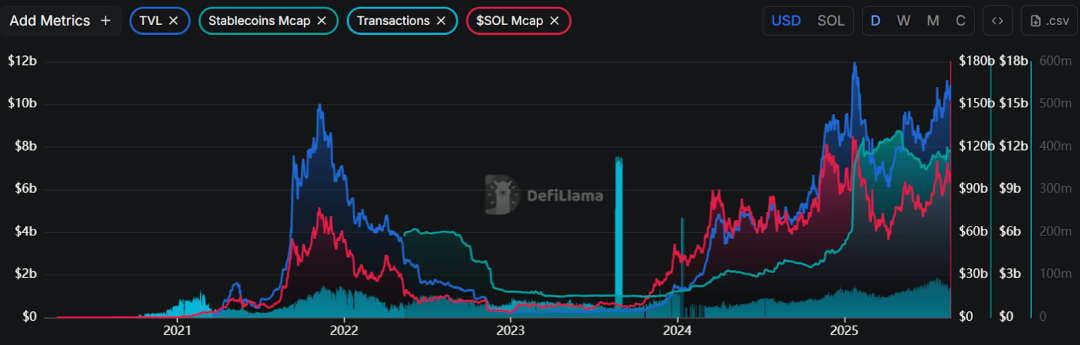
Since this year, the Solana ecosystem has shown a trend of “falling back from a high level and then fluctuating upward”. TVL and stablecoin stocks showed a gradual upward trend. Currently, TVL is about 10.42 billion US dollars, and the stablecoin market value is about 11.62 billion US dollars, indicating that the “bottom dollar liquidity pool” on the chain has returned to the 10 billion dollar level and stabilized in the 10 billion dollar range; the number of on-chain transactions remains high, maintaining an active “high-frequency/long-tail” transaction state; the total market value of $SOL declined sharply in Q1, but it showed a wave-like upward trend starting in Q2; judging from structural changes, the return of meme popularity has had a marginal upward trend for DEX/chain fees Improved, but has not yet returned to the peak of the year .
Source: https://defillama.com/chain/solana
2. Meme coin sector
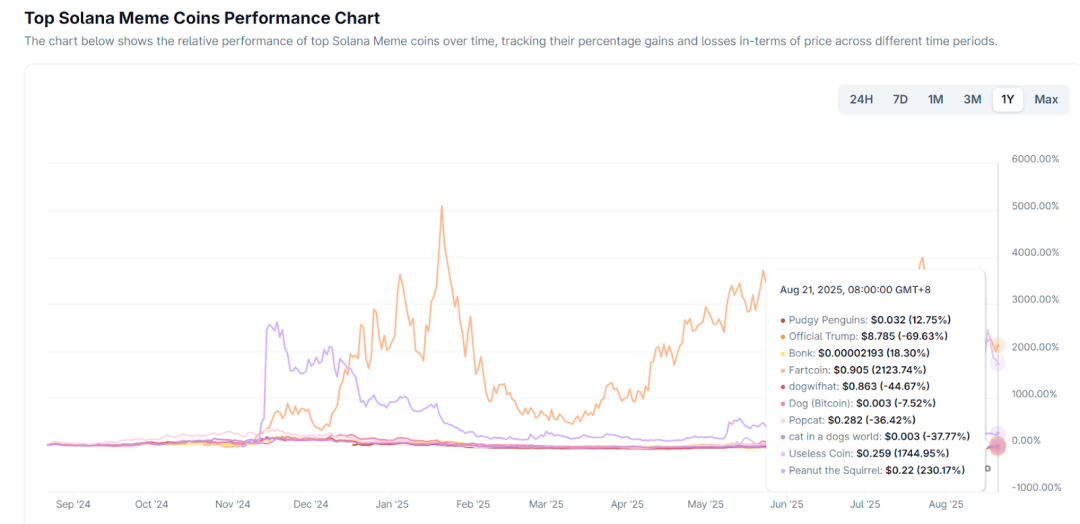
As the leading meme network, Solana has launched popular meme coins such as BONK, WIF, POPCAT, MOODENG, PNUT, TRUMP, PENGU, FARTCOIN, and. Solana memes have a common characteristic of “high volatility + strong rotation + strong event drive”. Currently, the total market value of the Solana Meme sector is about 11.7 billion US dollars. The top 5 most popular meme coins since the beginning of the year are as follows:
PENGU: A “brand coin” strongly tied to popular NFT IPs, with physical toy sales exceeding $10 million, covering more than 3,100 stores. Canary Capital has submitted a PENGU ETF application to the SEC. It has strengthened significantly during the year, and its market capitalization is at the top of Solana Meme.
BONK: Solana is a “veteran” and community traffic entrant. As LetsBonk.fun's outrage has also increased markedly, there has now been a marked retracement.
TRUMP: Trump's meme, an emotional currency driven by political topics, has fluctuated overall since its launch in January. Trump's crypto dinner led to a round of recovery in May. Currently, it is still in a state of decline and is sensitive to the catalytic effects of the incident.
FARTCOIN: Its popularity stems from humorous themes and viral spread: users submit fart jokes or memes to earn coins, and each transaction generates digital fart sounds. Combined with AI storytelling (created by AI Truth Terminal), it is an AI-meme hybrid, which can easily cause FOMO.
USELESS emphasizes “uselessness” as a selling point, satirizes the empty promises of other coins, and becomes the most honest meme coin. The higher the price of the currency, the more useless it is, the easier it is to attract speculation.
Source: https://www.coingecko.com/en/categories/solana-meme-coins
3.Launchpad section
The Launchpad dispute on Solana has been upgraded from “who is cheaper/faster to sell coins” to a “creator economy, token buyback, and community governance” contest.
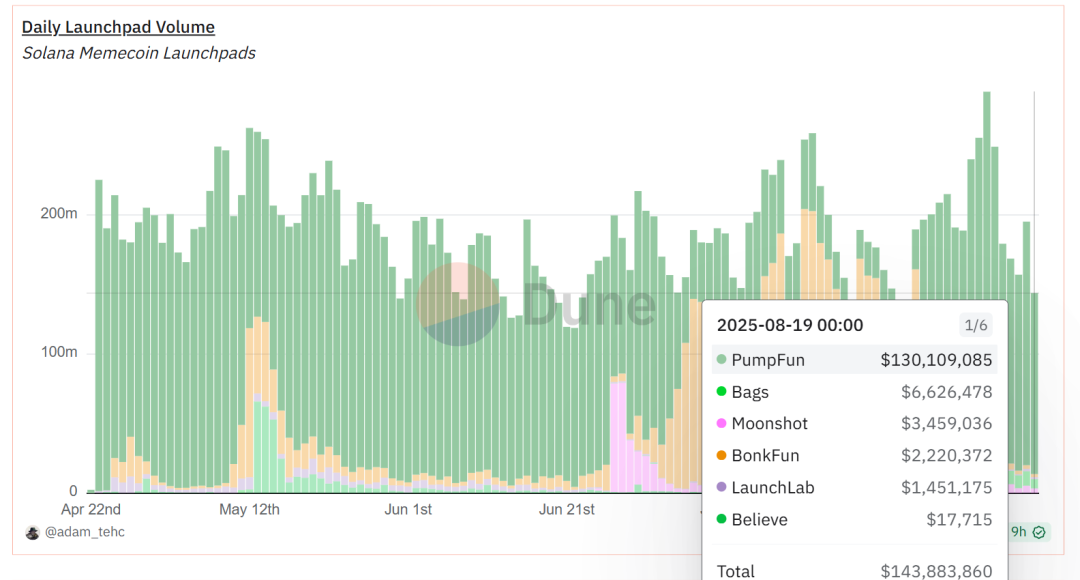
Pump.fun: A full-chain meme fueled by 1% transaction fees and “dumb distribution”. In mid-August 2025, the weekly revenue was about 13.48 million US dollars, returning to a high level; cumulative revenue had already exceeded 800 million US dollars; at the same time, the “market share reversed from 5% to ~ 90% in two weeks”, which attracted the attention of the entire network.
LetsBonk.fun: It rose rapidly after launching in April 2025. It once won 78% + distribution share in July, then declined. Its “community mobilization+low threshold distribution” path is still one of Pump.fun's core rivals.
Bags: Focusing on the “Creator Profit/Royalties” route, emphasizes creator revenue and continuous distribution, and enters a segmented circuit tied to opinion leaders/creators. The transaction volume has surpassed $1 billion in the past 30 days.
Moonshot: A fiat entry-level app that supports Apple Pay direct deposit and fiat deposit. It once topped the US App Store's “Free Financial Apps” list, drastically lowering the entry threshold for newbies.
Believe: The “Reply and Send Money” social media portal has caused controversy since June due to the suspension of some on-chain spliting/switching to offline payment, and adjusted automatic coin listing to “manual review.”
Source: https://dune.com/adam_tehc/memecoin-wars
4. DeFi sector
Solana's DeFi is more like a “high-frequency/long-tail transaction infrastructure.” Raydium/Orca undertakes DEX transactions and liquidity, and Jupiter/Drift undertakes derivatives transactions and routes fragmented liquidity. Kamino improves capital efficiency, and Jito/Marinade provides the underlying asset of “stable interest + liquidity.”
Raydium (AMM+ Ecological Startup Pool): Solana's established DEX/AMM, undertakes most of the long-tail spot liquidity and startup pool functions; fees and revenue are at the top of the same category in the medium to long term, showing positive feedback on “platform cash flow - token value”.
Jupiter (aggregator + transaction portal): Solana's default router, integrating multiple DEX liquidity such as Raydium; the JPL pool has gathered a large amount of liquidity and announced the upcoming launch of a lending section.
Kamino (unified liquidity/loan/market-making position management): Famous for its “active marketmaking+borrowing”, TVL has long been at the forefront of Solana and has become a “distribution center” for LP and capital.
Jito (LST + MEV infrastructure): MEV is made explicit through the Jito client/block engine/ “Bundles”, and part of the MEV is distributed to stakers with JitoSol. Jito tips already account for a large share of the “real economic value (REV)” on the chain.
II. Analysis of the reasons why SOL lost to ETH
ETH uses spot ETFs to open up a complete closed loop of “compliant capital → secondary liquidity → marketmaking/derivatives”, and then superimposes a larger corporate treasury volume with the “on-chain financial hub” network narrative to form a stronger capital absorption and valuation anchor; Solana focuses on a “high-frequency/long-tail application” transactional ecosystem, and price elasticity is more dependent on subject matter trends (Meme/Launchpad, etc.), making it easier to “lack anchor” when risk appetite declines or hot spots rotate.
1. ETF funding growth gap
SOL: US stocks already have a Solana ETF (SSK) with pledged earnings, but the structure is complex, and the non-SEC registered spot ETF has a cumulative net inflow of only about 150 million US dollars since listing, which is far less than the ability of an ETH ETF to absorb gold. The short-term market focus is on VanEck and Grayscale's SOL spot ETF applications. If approved around October, it will only be possible to open up compatible models and passive funding channels similar to ETH.
ETH: The size of spot ETFs has surpassed $220 billion and has become the main entry point for institutional funding. Leading institutions (such as BlackRock) are promoting “stakable ETH ETF” applications. If implemented, they will combine “staked income” and “compliance channels” into one to further secure long-term allocation plans.
2. Gap in the volume of corporate holdings
SOL: Upexi, known as the “SOL Microstrategy,” currently has an NAV of about $365 million, holds 1.8 million SOL, and invited Arthur Hayes to join the advisory board to strengthen strategy and volume; other listed companies (such as DFDV and BTCM) are also slowly increasing their holdings, but there is still a big gap between the overall size and the ETH treasury strategy.
ETH: The BitMine Immersion (BMNR) program, which claims to be an “ETH microstrategy,” raised the funding scale to $20 billion. Currently, NAV is about 5.3 billion US dollars, which is second only to Bitcoin's MicroStrategy; at the same time, along with “endorsements” from influential global opinion leaders such as Tom Lee, it has significantly strengthened the market narrative and funding call.
3. Differences in online narrative positioning
Solana: More focused on “single chain high throughput + extremely low fees” consumer-grade applications and speculative hotspots (meme, launchpad). Although many attempts were made to enter RWA this year, most of them ended without a hitch; in August, CMB International × DigiFT issued a US dollar money market fund token (CMBMINT) on Solana, which is a rare positive example of compliance with RWA. On the same day, SOL stood at $200, which is viewed by the market as the starting point for a potential narrative switch.
Ethereum: Ethereum is building a compliant and sustainable on-chain financial infrastructure and clearing layer status, and has received “structural subscription” from institutions. Half and a half of the stablecoin issuance volume and about 30% of gas are on Ethereum; at the same time, Robinhood launched stock tokens on Ether L2, and Coinbase is making every effort to develop Base.
4. Different value capture mechanisms
Solana: Low fee+high throughput in exchange for ultra-high interaction density. Value capture is more dependent on total transaction volume and application layer fees/MEV, etc.; when meme/long-tail activity declines, chain fees cool down at the same time, and the valuation anchor weakens.
Ethereum: EIP-1559 directly burns basic fees, shows net deflation/ low inflation during busy periods, and then superimposes pledge benefits to form a “supply-side contraction+ cash flow” valuation anchor.
5. Historical risk memory and “trustworthiness discount”
Solana: The approximately 5-hour outage on 2024-02-06 and the subsequent decline in individual phased consensus nodes have been fixed, but are still risk factors in institutional pricing tables.
Ethereum: “no downtime” and a broader developer/compliance ecosystem, leading to lower trustworthiness discounts — as macro-fluctuations increase, this discount is amplified by the market.
3. Can SOL take off again: analysis of advantages/disadvantages
SOL has a basic market of “high activity+low rate+MEV sharing+application layer cash flow”, which is combined with catalysts such as spot ETFs and RWA compliance implementation, and has every chance of resuming the trend; however, when ETF increments have not been implemented, treasury volume and narrative are still weaker than ETH, and the shadow of historical stability has not been completely absorbed, the price is still highly “event-driven”.
1. SOL's advantages and multi-head logic
Single chain throughput + low rates = natural soil for active and long-tail assets
Solana undertakes tens of million-level interactions per day on a single chain. It is naturally active in trading and market making, and the fees are extremely low, which is conducive to the continuous trial and error and spread of memes, long-tail assets, and high-frequency DeFi.
Compliant RWA is being proofed
CMB International (CMBI) × DigiFT tokenized and simultaneously deployed dollar money market funds to multiple chains such as Solana/Ethereum, claiming to be the first publicly compliant MMF on Solana, bringing in “cash assets that can be interpreted by institutions” and fiat/stablecoin entrances. This is a potential “long-term funding narrative.”
The inflation curve is predictable
Solana's established inflation model: initial 8%, 15% reduction per “year” (~180 epochs), 1.5% long-term. The actual annualization range is about 4.3% to 4.6% in 2025, and there are community discussions on proposals to accelerate de-inflation. The expected decline in inflation is conducive to medium- to long-term valuation anchoring.
If a spot ETF is approved = the “funding gate” opens
VanEck and many other institutions have submitted or updated SOL spot ETF S-1 documents to the SEC; once released, they will copy ETH's “compliant funding → passive allocation → marketmaking/derivatives” path and attract more corporate treasury to join.
2. SOL's Disadvantages and Bearish Logic
ETF real growth is still on the way
ETH's spot ETF size > $22B has formed a closed loop of institutional funding; however, SOL is still in the application/communication period. Currently, “pledged” products in the US are not standard SEC spot ETFs, and their ability to attract money is far weak. Fulfilled vs. still expected, directly reflected in relative earnings.
The gap between treasury strategy size and “spokesperson”
The “treasury company” of the ETH camp (such as BMNR, etc.) is significantly larger than that of the SOL camp (such as Upexi), and is supported by first-line opinion leaders such as Tom Lee; however, the SOL treasury is still in a “catch-up period.” This means who has more bullets in times of turmoil.
The “financial hub vs. consumer/speculative chain” of online narratives
ETH firmly occupies a high position in the narrative of stablecoin/liquidation/compliant finance; Solana relies more on Meme/Launchpad/long tail to drive activity and expenses. Subject rotation directly affects on-chain fees and cash flow, and price anchors “fluctuate” even more.
“Fee reduction competition” from ETH itself
Reduced fees on the Ethereum main network and competition from networks such as BSC, Base, and Sui have made “low fees” no longer Solana's only selling point and have a diversion effect on new developers and capital.
IV. Outlook and summary of SOL trends in Q3-Q4
The essence of Solana is still a consumer-grade high-frequency chain with “high activity, low fees, and application monetization.” Whether Q3-Q4 can “take off again” depends on whether the ETF brings in compliance increments, whether RWA can break through the closed loop of scale, and whether network stability continues to improve.
Baseline scenario: Q3 enters the volatile upward phase of “trading recovery+narrative waiting”. On-chain activity and DEX/perpetual transactions remain high, and Meme is in a pulse-like activity-spit-re-active cycle. At the price level, SOL generally pulls back and forth between the “upward shift in the valuation center due to rising fundamentals” and the “contraction of risk premiums anticipated by the event”, and the pace fluctuates upward.
Bullish scenario: If spot ETFs are approved or enter a clear entry into force window before and after Q4, adding the formal issuance of RWA (not only individual MMF, and the emergence of more treasury bonds/notes/fund products), SOL's three elements of “capital gateway, sustainable cash flow, and network resilience” will be strengthened at the same time, and the price is expected to break through a period of upward trend and is expected to break through previous highs.
Bearish scenario: ETFs are delayed or rejected again, Meme/Launchpad is clearly declining, and innovative features or hot topics appear in other main chains, which may trigger a loosening of valuation anchors and a collapse in trading beta; if macroeconomic tightening is superimposed or Ethereum mainnet/L2 is again significantly reduced and diverted, SOL will enter a “high fluctuation downward - weak rebound” structure.
5. Conclusions
Solana experienced rollercoaster heat ups and downs in 2025. The market's position on Solana fluctuated several times, from the glittering Meme carnival at the beginning of the year to being relatively bleak in the face of aggressive pressure on ETH in the middle of the year. What is certain, however, is that the unique value of Solana's high-performance public chain is still prominent, and its ecosystem has not stagnated due to temporary cooling. In the long run, whether Solana can take the lead again depends on whether it can turn the advantages of high-speed networks into continuous user value: it must not only retain users after speculation has subsided and open up broader application boundaries; it must also win the trust of mainstream capital and share a share in the compliance process. Fortunately, we're already seeing signs: Whether it's institutional layout, technology upgrades, or ecological narrative transformation, Solana is building up strength. Perhaps the current pullback is more like getting ready to take off again.
