


When Polkadot's $500 million security cost becomes a burden, Gavin Wood offers three ways out!
Source: PolkaWorld
Original link: https://mp.weixin.qq.com/s/xLlnTgs9jUOkiHVI6g2euQ

This article is the Chinese version (part 2) of Gavin Wood's presentation at the July Web3 Summit. Due to the huge content of the speech, we will divide it into four articles and publish them one by one to make it easier for everyone to gradually understand and digest. Although the big information about Gavin at the Web3 Summit has been widely disseminated by the community, more details in the original article are still worth knowing!
Part 1“Gavin Wood's speech: JAM delivery and medium- to long-term strategies for introducing ZK into JAM!”
In the second installment, Gavin focuses on the economic woes of Polkadot staking:
1. The huge gap between $500 million in annual security expenses and meager revenue;
2. Staking rewards were sold off on a large scale due to tax issues, and staking costs continued to spill over;
3. To deal with this long-term structural deficit, he proposed three main paths:
Enhancing the value of Coretime — making the “products” sold by Polkadot more useful and attractive;
Reduce costs and reshape the distribution curve — reducing annual costs from 500 million to less than 100 million;
Explore native stablecoins and proof of identity (PoP) — optimizing payment methods and reshaping cybersecurity mechanisms while reducing security costs.
At the core of all this is Fiscal Discipline (Fiscal Discipline), which is the key to Polkadot's long-term sustainability.
Next, keep reading to learn about the second part of Gavin's talk.
The economic difficulties faced by Polkadot staking
Let's take the topic back to the cost of staking, which can be called fiscal discipline (fiscal discipline).
One of the most intuitive numbers is: $500 million. That's roughly what Polkadot is currently spending on cybersecurity each year. In other words, Polkadot invests such a huge amount of money each year to keep itself safe.
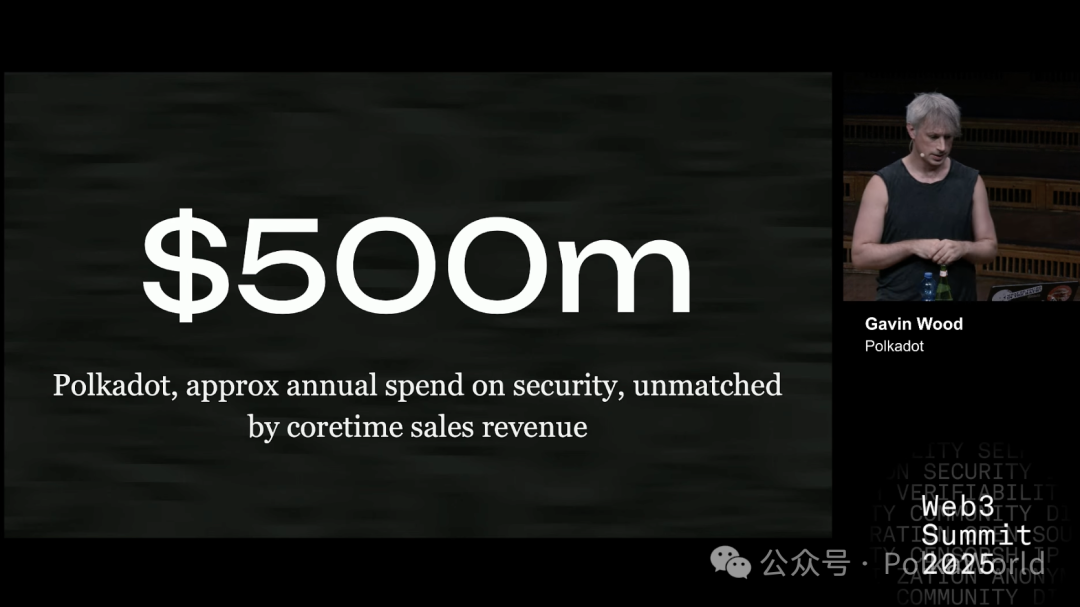
However, this expenditure did not match the revenue. The revenue stream is almost negligible, mainly coretime's sales revenue. And if this money continues to circulate within the DOT system, it won't necessarily be a problem. The problem is that we know that quite a bit of money is going outside of the system. The reason is simple — many stakers are in high tax jurisdictions.
Here's an example from the scene:
How many people have participated in the pledge? ——Almost everyone.
So, how many people have paid taxes on pledge rewards? ——Almost everyone.
Paying more than 10% in tax? ——Almost everyone.
More than 20%? ——There are quite a few more.
Over 35%? ——Probably one or two.
So overall, pledgers are generally in the 20% to 30% tax range.
By contrast, the mining situation is completely different. The mining industry is highly concentrated and highly institutionalized, making it easier to optimize taxes. Common methods include putting the mining machine under the name of an offshore company or using grey methods to unblock relationships.
In other words, mining rewards are more likely to evade taxes through institutional channels; while pledge rewards are distributed to ordinary people distributed across various normal jurisdictions. The government finances in these places are tight, so of course they will not let go of any opportunity to collect taxes. Especially now, the financial situation in various countries is becoming increasingly tight, and taxing staking, which “looks like profits are being taken in vain,” has become a logical choice.
As a result, staking rewards have almost become an obvious tax target.
I'd like to ask everyone to think about a question: if you're paying taxes on staking rewards, how many people would be willing to specifically move to a lower tax jurisdiction to avoid this tax?
The answer: there was only one person present.
This shows that most people don't have a strong desire to relocate to avoid taxes. In other words, everyone's investment in keeping pledged assets within the system for a long time is actually not very deep.
This is the problem, and it is also an economic dilemma facing staking.
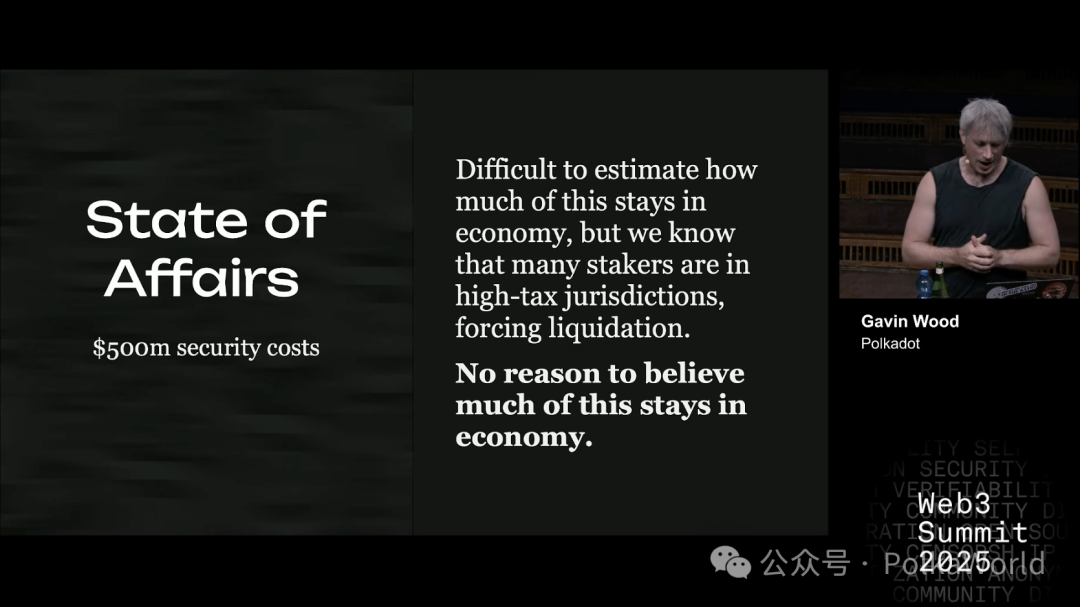
Of course, I can't assert that all staking rewards will be immediately cashed out. But we already know that a significant portion of rewards is quickly sold off due to tax pressure. Frankly, I can't see why the remaining rewards aren't sold at the same time. This is of course just an inference, but there aren't many reasons to refute it. If interested, you can continue to ask questions during the final discussion session.
The first step in dealing with structural deficits: increasing the value of Coretime
The question is, how can we deal with such a major structural deficit that has been around for a long time?
In my opinion, the current state of affairs is clearly difficult to accept in the long term. The first thing we can do is hedge — increase revenue. In the logic of commercial enterprises, the way to increase revenue is to make products better and more valuable.
In Polkadot, what we actually sell is coretime (core time). The reason the network is spending $500 million a year is to produce secure, trusted coretime. Therefore, increasing the value of coretime is a very reasonable path.
This matter has actually been unfolding, and it's been going on for quite some time.
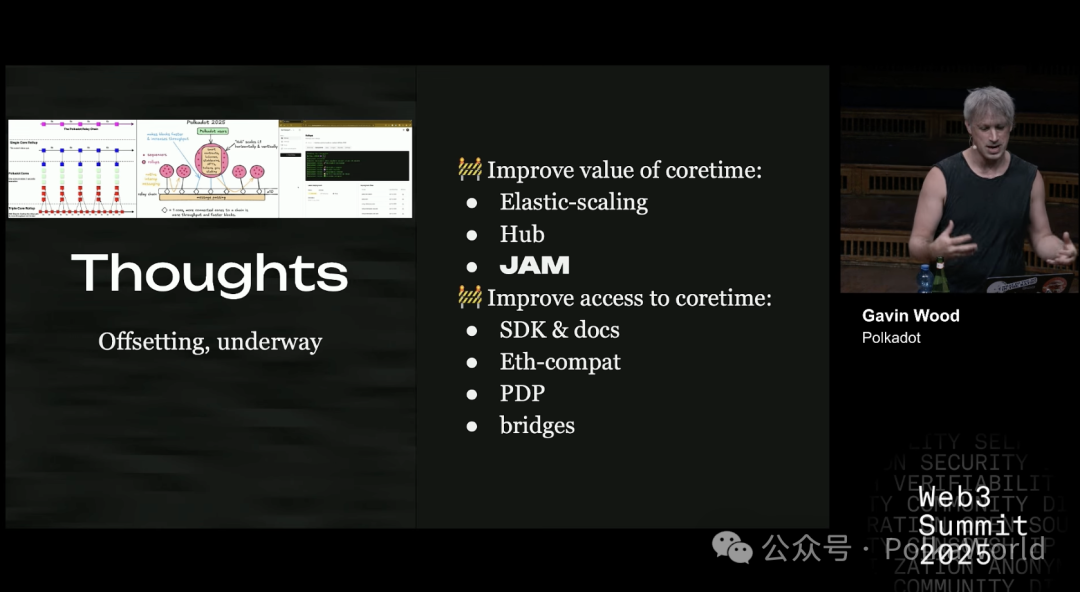
Elastic Scaling, Polkadot Hub, JAM—their goal is to make coretime more useful and more valuable.
Improving accessibility is just as important, such as SDKs, documentation, and the easy-to-use Polkadot Deployment Portal. In addition, there are initiatives such as Ethereum compatibility and cross-chain bridges (not all listed here).
All of these efforts are constantly trying to increase the value of the “products” we sell.
The second step in dealing with structural deficits: reducing costs and reshaping the issuance curve
In addition to increasing revenue, another logical direction is to reduce costs.
One option I support is to reduce annual costs from $500 million to less than $100 million. Specific measures include:
Nominator slashing (nominator slashing): This nomination is essentially risk-free, reduces payments to nominees, and balances risk by raising the entry threshold for validators.
Validators self-collateralize to allow anonymity (part of the opinion comes from Jeff).
Validators receive fixed fiat rewards: because they do have fixed costs (food, lodging, hardware, etc.). Since they will eventually be exchanged for fiat currency for consumption, it is more reasonable to pay directly in fiat currency.
The pledger receives a fixed return: the reward amount is determined and fixed by the system, and set with reference to the opportunity cost. For example, if the fully self-collateralized cost is $1 million, assuming a risk-free interest rate of 3%, then a reasonable fixed return would be $30,000 per year.
In this way, a predictable and controlled reward model can be established.
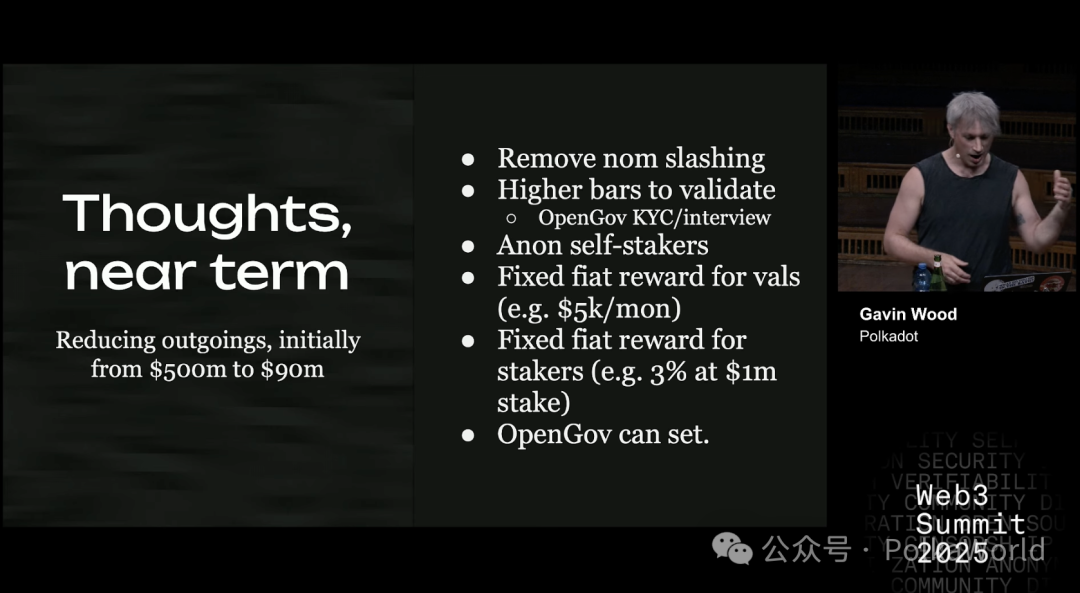
As for fine-tuning these parameters, it is up to OpenGov to decide. It is even possible to set up an expert group composed of economists to take responsibility to make such governance decisions more professional and have more reference value.
The point is that this matter requires deep insight, and I believe it will require significant changes. We must take on long-term responsibilities, such as implementing fiscal discipline through a fixed issuance curve. This may sound very controversial, but I think it's reasonable.
First, we need a clear maximum circulation. It's best to choose numbers that are easy to understand, easy to remember, and both rational and reasonable. For example, “Pi billion” is a simple and elegant solution.
The introduction of an attenuation curve is also necessary when designing for distribution. This curve can be as direct and cruel as Bitcoin's halving curve, but I personally prefer stepped decay. I don't think there's any reason to rule out the stepped style; at least in Bitcoin, it has proven to be an effective signaling mechanism. So I'm willing to take that risk. The decay cycle can be every two years, or of course it can be set to every 12 months.
It should be emphasized that a fixed issuance curve does not mean that there must be a fixed interest payment.
Bitcoin actually binds the two together: it stipulates that the halving cycle means that the block reward is halved. As a result, every ten minutes a block is released, and the corresponding amount of rewards is reduced in a fixed amount. But in my opinion, this practice doesn't need to be implemented in Polkadot.
Polkadot has a governance mechanism that can be adjusted flexibly as needed. I think it's reasonable to have a clear issuance curve because it represents a long-term commitment; but at the same time, decoupling the issuance curve from interest payments is also very valuable.
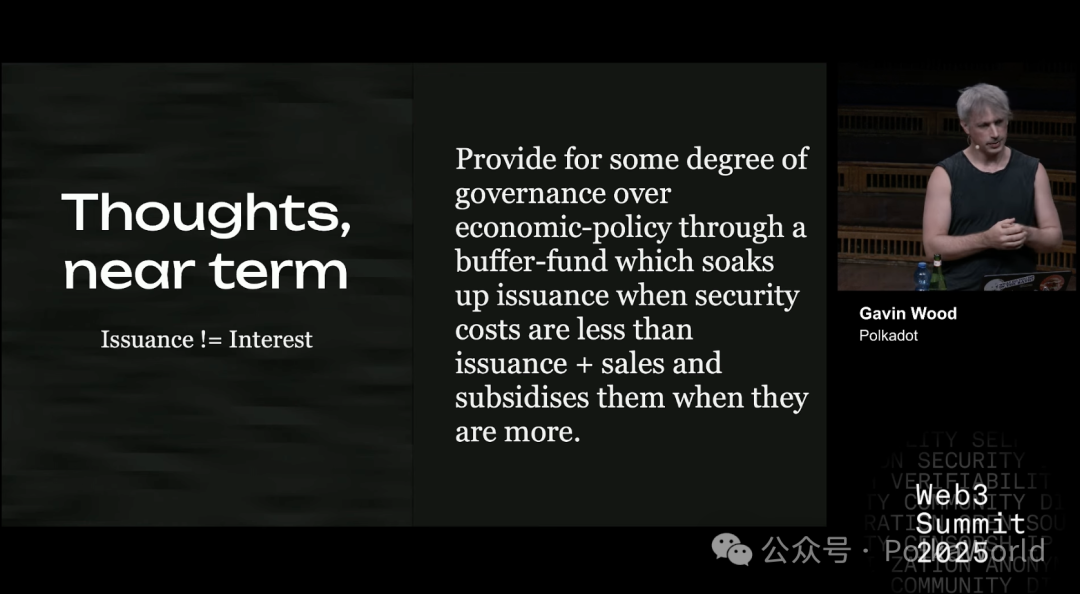
The amount of staking rewards and the level of security required for the system are not necessarily linked to a “rigid distribution curve.” Therefore, there is absolutely no need to require interest payments to strictly correspond to the circulation volume at a certain point in time.
In my opinion, it makes more sense to separate the two. We can rely on governance to make adjustments:
Probably a committee of economists,
Maybe a fellowship,
Probably OpenGov,
It could also be submitted directly to a referendum.
You can even rely on algorithms to do this.
Either way, the core goal is to establish a dynamic mechanism to adjust the level of interest or rewards paid to validators.
The source of funding may be a pool of funds filled by issuance, and not necessarily from the national treasury. You can think of it as “unspent inflation.”
In principle, if sales increase, or if circulation exceeds safety cost requirements, then this pool will be filled; if sales are insufficient, or distribution volume cannot cover safety costs, then this pool will decrease.
That way, governance will have plenty of time to re-evaluate:
Are we setting our safety goals too high?
Or in another case, was the safety threshold set too low?
The third step in dealing with structural deficits: native stablecoins and PoP
In the medium term, issuing native stablecoins on Polkadot will bring huge benefits, especially in the payout process.
It makes sense for the revenue portion (that is, purchasing coretime) to continue to use DOT for settlement; however, the situation is different with the expenditure portion. We know that most of these expenses are compensation for market-based services, which are essentially immediately redeemed and spent in the real world — food, hardware, lodging, or other costs. Therefore, it is clearly more reasonable to let the system itself (i.e. Polkadot governance) decide when and how these funds are converted into stablecoins.
If we can issue native stablecoins, it means we can pay in a way close to “fiat” without putting the same cost pressure on the DOT ecosystem, which is certainly meaningful.
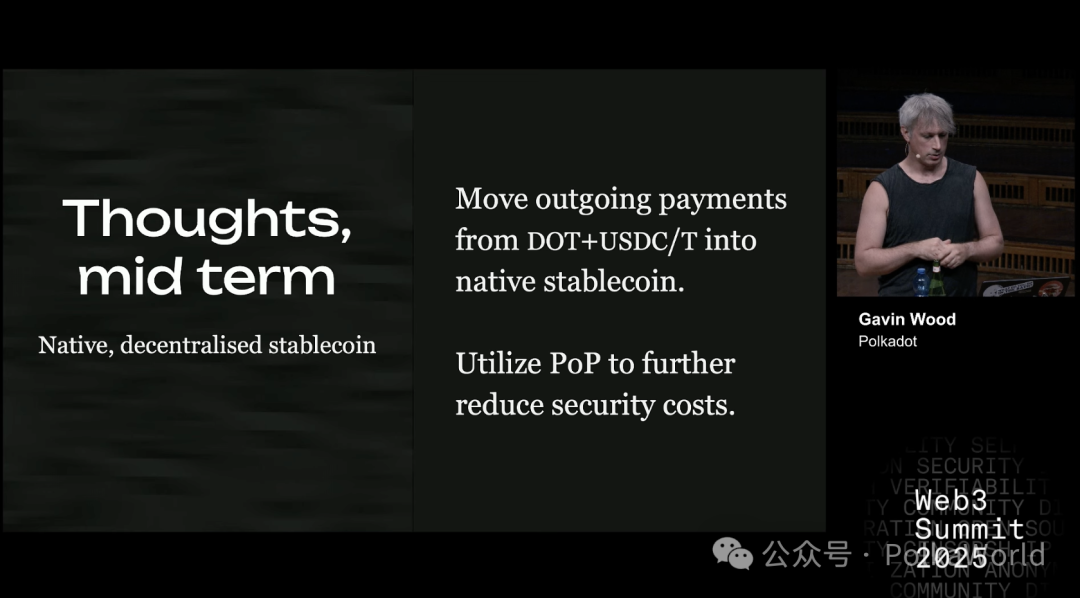
Furthermore, security costs can be further reduced through Proof of Personhood (proof of individuality, anti-witch mechanism).
This is a project I mentioned last year. It was proposed as early as the summer of 2022, and it has been ongoing for three years now. Progress is slow, not because of a lack of effort, but because the mechanism must be nearly perfect.
I believe a mature and powerful anti-witch program can make a significant contribution to cybersecurity and significantly reduce the overall operating costs of the core protocol.
So, how exactly can this be achieved? This plan has just come out of the conceptual stage and has just been written, but the basic idea is as follows. Today, the system relies on nominators (nominators) to pledge risk capital and then vote to select validators to run the network.
Under the new mechanism, validators would still exist and would continue to be paid to guarantee hardware and day-to-day expenses; however, “nominees” would be replaced by ordinary voters. In other words, users no longer take risks by staking DOT, but instead express their support for validators by “voting.”
The specific rules are:
Support quality validators → Your voting weight will be increased.
Support poor validators → Your voting weight will be reduced or even directly zeroed out; and you may be banned for a period of time and can no longer vote.
If the validator itself is of poor quality → then the validator will be permanently disabled or severely punished.
Limit the number of votes validators can accept → This forces voters to scatter their votes instead of voting in droves to only the most popular validators.
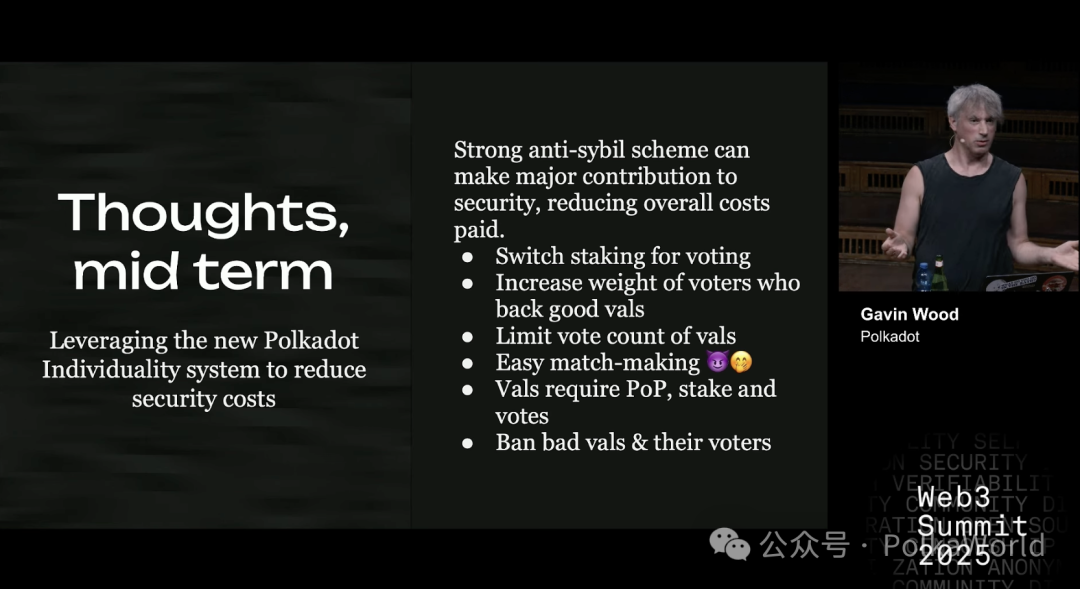
The hardest part to solve is the matchmaking mechanism (matchmaking): how do ordinary users identify high-quality validators? This requires designing a new solution. Currently, I have some ideas, which essentially involve UI-level integration, but they are still in development and not suitable for disclosure.
However, under this mechanism:
The certifier must pass an individual certificate to ensure that it can be disabled if necessary;
Validators are still required to pledge to maintain a minimum foundation of trust;
The core driving force of the system comes from voting.
If this design can be implemented, we can expect to significantly reduce the cost of staking, which could be as much as half.
So what else can be done? The answer is that it is possible to introduce core disabling (core disabling).
One reason why Elves, JAM, and Polkadot work so efficiently is that they can rely on the same set of validators and distribute the security provided by those validators across multiple parallel tasks. In other words, they can “amplify” the efficiency of the use of security.
The problem, however, is that this “amplification” itself requires high basic security costs. If the number of users is insufficient, in the end, there will be a situation where the cost is huge, but the corresponding value is not received.
The core effect of disabling is to reduce the actual workload of the system, thereby reducing the number of validators required and, accordingly, the rewards to be paid.
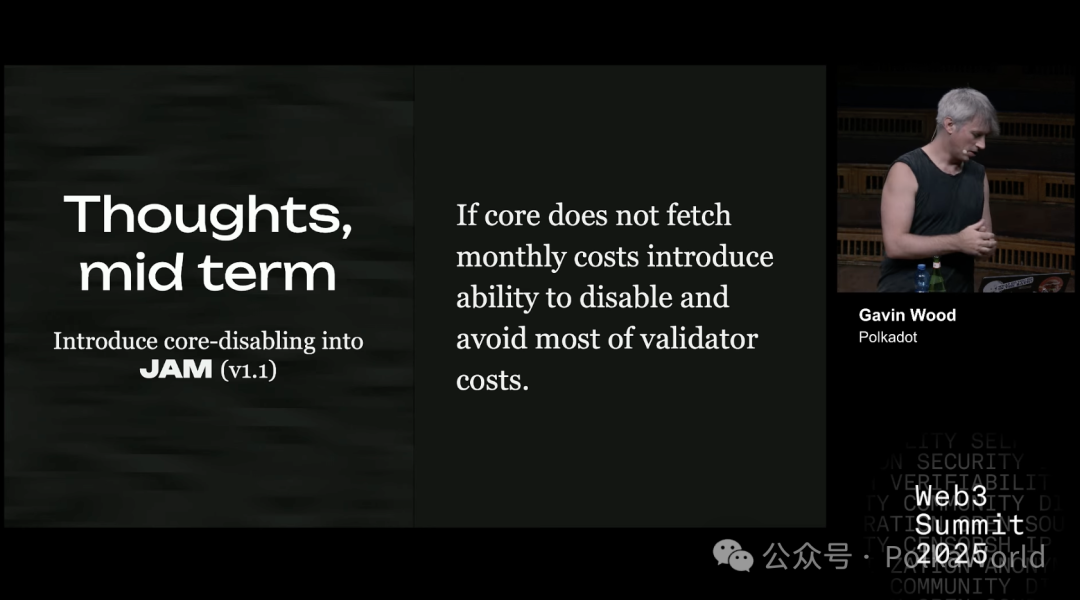
This mechanism hasn't been implemented yet — it won't appear in JAM v1, but future upgrades (such as JAM v1.1) are likely to be introduced.
By disabling the core, we can keep costs to a minimum while maintaining the required level of security.
That's the first half of the talk. Next, in the second half, I'll share some of the new directions we're exploring — topics that aren't just me personally, but the entire Parity team and even the Web3 space are focusing on.
PolkaWorld Note: In the future, we will share it on PolkaWorld's official account. Follow us to learn more about Polkadot!
