


Behind Tether's $500 billion valuation, a group of low-key players are creating the biggest wealth in crypto history

Author: David | Deep Tide TechFlow
Original title: Behind Tether's 500 billion valuation, the shareholders' wealth past is hidden
On September 24, 2025, according to Bloomberg, Tether Holdings (Tether Holdings), the world's largest stablecoin issuer, is negotiating a new round of financing with investors and plans to sell 3% of its shares to raise US$15 to 20 billion.
At the upper limit, the deal would value Tether at around $500 billion, making it one of the world's most valuable private companies.
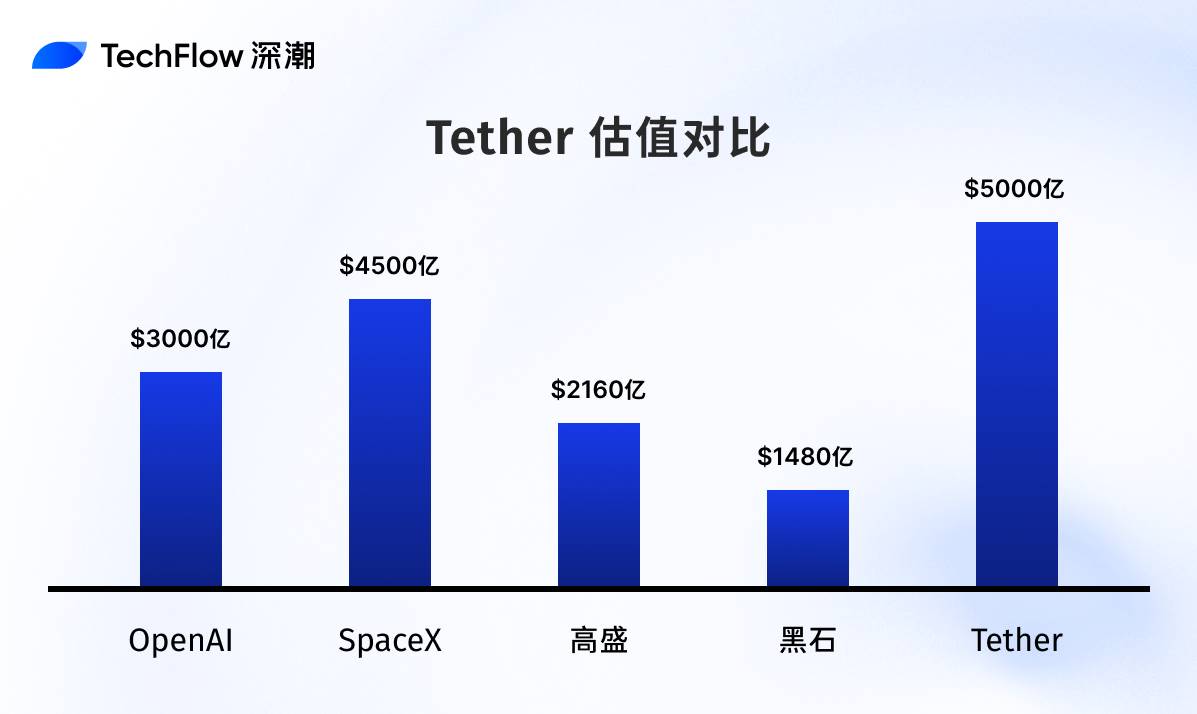
What is the concept of a $500 billion valuation?
For comparison, OpenAI was valued at around $300 billion in March this year, while SpaceX was worth about $450 billion. Tether's $500 billion target valuation even surpasses the combined market capitalization of the two top Wall Street giants Goldman Sachs and Blackstone's $148 billion.
But what's really remarkable is not the company's valuation itself, but the people behind this number.
The actual controllers who directly or indirectly hold Tether shares could become the richest people in the cryptocurrency industry's history if the deal is reached.
As a private company registered in the British Virgin Islands, Tether has never voluntarily disclosed its shareholding structure. The company, which controls $170 billion in USDT circulation and almost has a monopoly on the global cryptocurrency trading infrastructure, has always kept the actual controller behind the scenes.
Until 2021, investigation documents from the New York State Attorney General's Office and the US Commodity Futures Trading Commission (CFTC) unexpectedly revealed some equity information; in 2024, well-known US media Forbes further added to this puzzle through multiple sources.
Based on this fragmented yet relatively reliable information, we were finally able to outline the wealth map behind Tether.
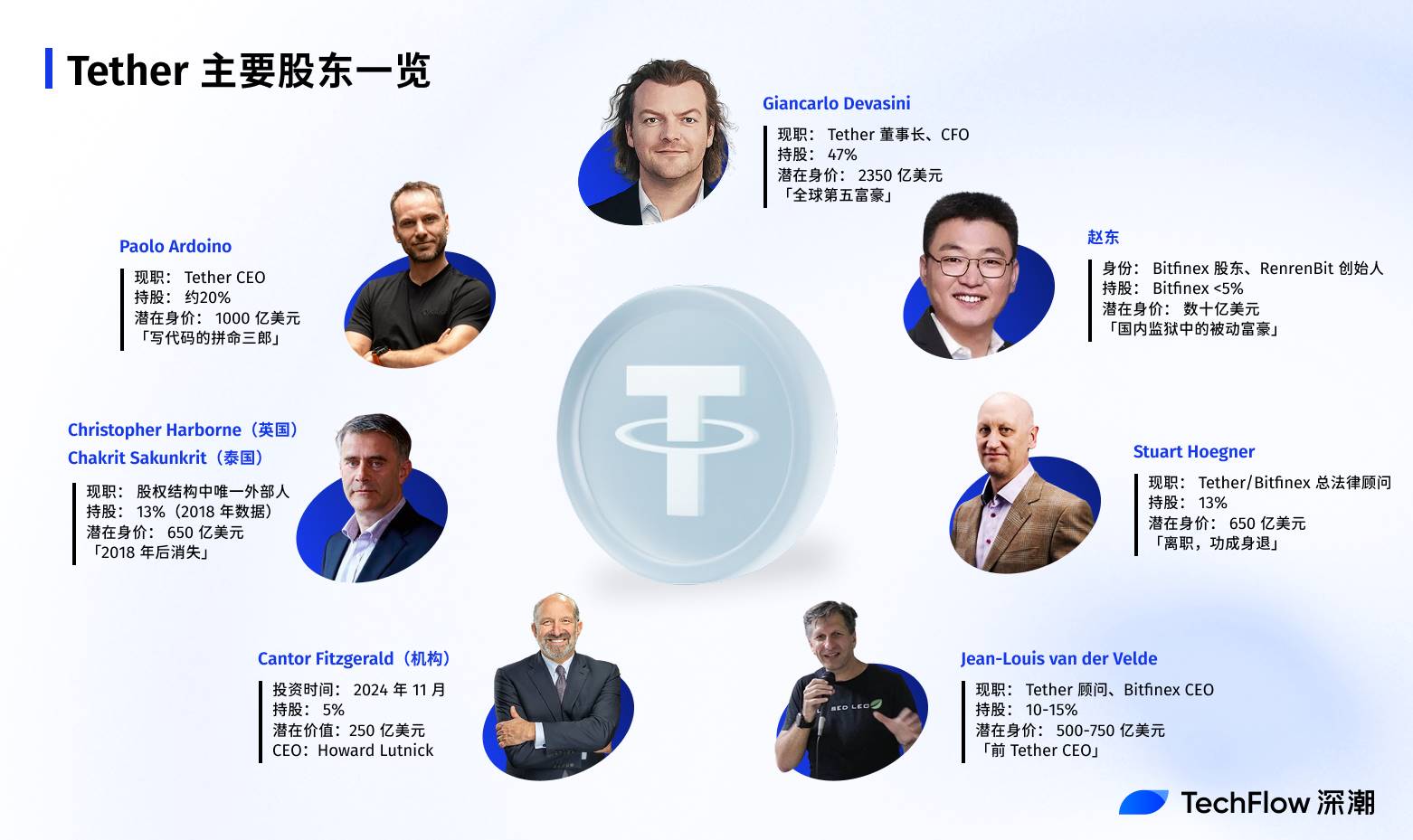
At a valuation of $500 billion, Tether's largest shareholder, a 61-year-old Italian, will have a fortune of over $200 billion, surpassing Buffett to become the fifth richest person in the world.
Meanwhile, several other core shareholders will also join the 100 billion or 10 billion dollar millionaire club, respectively.
These long-hidden super-rich people finally have specific names and faces. Among them are former plastic surgeons, programmers who write code until the early hours of the morning, Dutch people studying Chinese in Taiwan, and even Chinese businessmen who are serving a prison sentence.
Behind every person, there is an unknown history of wealth accumulation.
Chairman: From plastic surgeon to the top five richest people in the world
Giancarlo Devasini
Current position: Chairman and CFO of Tether
Shareholding: 47%
Potential worth: $235 billion (5th richest person in the world)
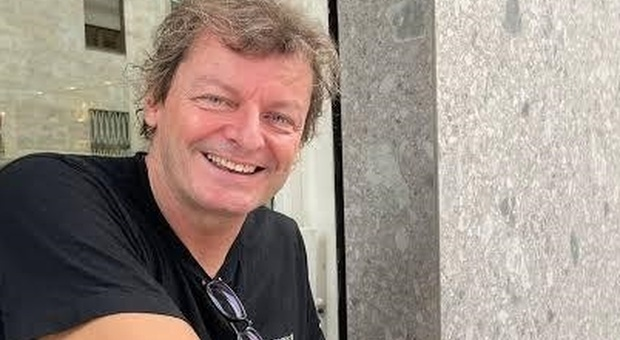
Giancarlo Devasini is probably the crypto world's most mysterious supermillionaire.
The 61-year-old Italian has very few appearances, no social media, and few public photos, yet he controls 47% of Tether's shares.
According to the Bloomberg Billionaires Index, if the $500 billion valuation comes true, he will surpass Buffett as the fifth richest person in the world, after Musk, Ellison (Oracle), Zuckerberg, and Bezos.
However, compared to the stable value of wealth, Devasini's life trajectory seems even more detached.
In 1990, Giancarlo Devasini graduated from the University of Milan Medical School as an orthopedic surgeon. After two years, he gave up this stable and decent job that outsiders viewed as stable and decent.
After leaving the hospital, Devasini entered the IT trade field, importing computer accessories, selling electronic products, and doing what to make money. In 1995, he was asked by Microsoft to pay a settlement of 1 million lira for selling pirated software.
In 2008, a fire destroyed his warehouse and the company went bankrupt. Devasini was 44 years old at the time and went back to almost nothing.
But it was this bankruptcy that propelled him into the crypto world. In 2012, he invested in the then obscure Bitfinex exchange and gradually took over operations.
At the time, the crypto market was as volatile as it is now. Devasini was also keenly aware of the problem: prices such as BTC fluctuate too much to be used as a means of payment.
In 2014, Devasini and tech genius Paolo Ardoino launched a solution: Tether, a stablecoin pegged 1:1 to the US dollar, but the process wasn't all smooth sailing.
At the time, the market was far less willing to accept stablecoins than today. Concerns about stablecoin reserves, audits, and crowding are also pervasive. Devasini personally cleared the ground and flew to the Bahamas, Switzerland, and Hong Kong, knocking on the door of a bank to find financial institutions willing to open accounts for this “suspicious” project.
In 2016, Bitfinex was hacked and lost 120,000 bitcoins, and everyone thought the company was finished.
Devasini proposed a solution to issue debt tokens BFX to distribute to damaged users, promising repurchases while ensuring Tether's normal operation. The market accepted this plan, which seemed like a pie, and USDT began to explode.
In 2018, Bitfinex faced a liquidity crisis when $850 million was frozen by payment provider Crypto Capital.
Devasini chose to directly withdraw funds from Tether reserves for emergency relief. This decision drew the attention of the New York State Attorney General, believing that it affected the integrity of USDT's dollar reserves.
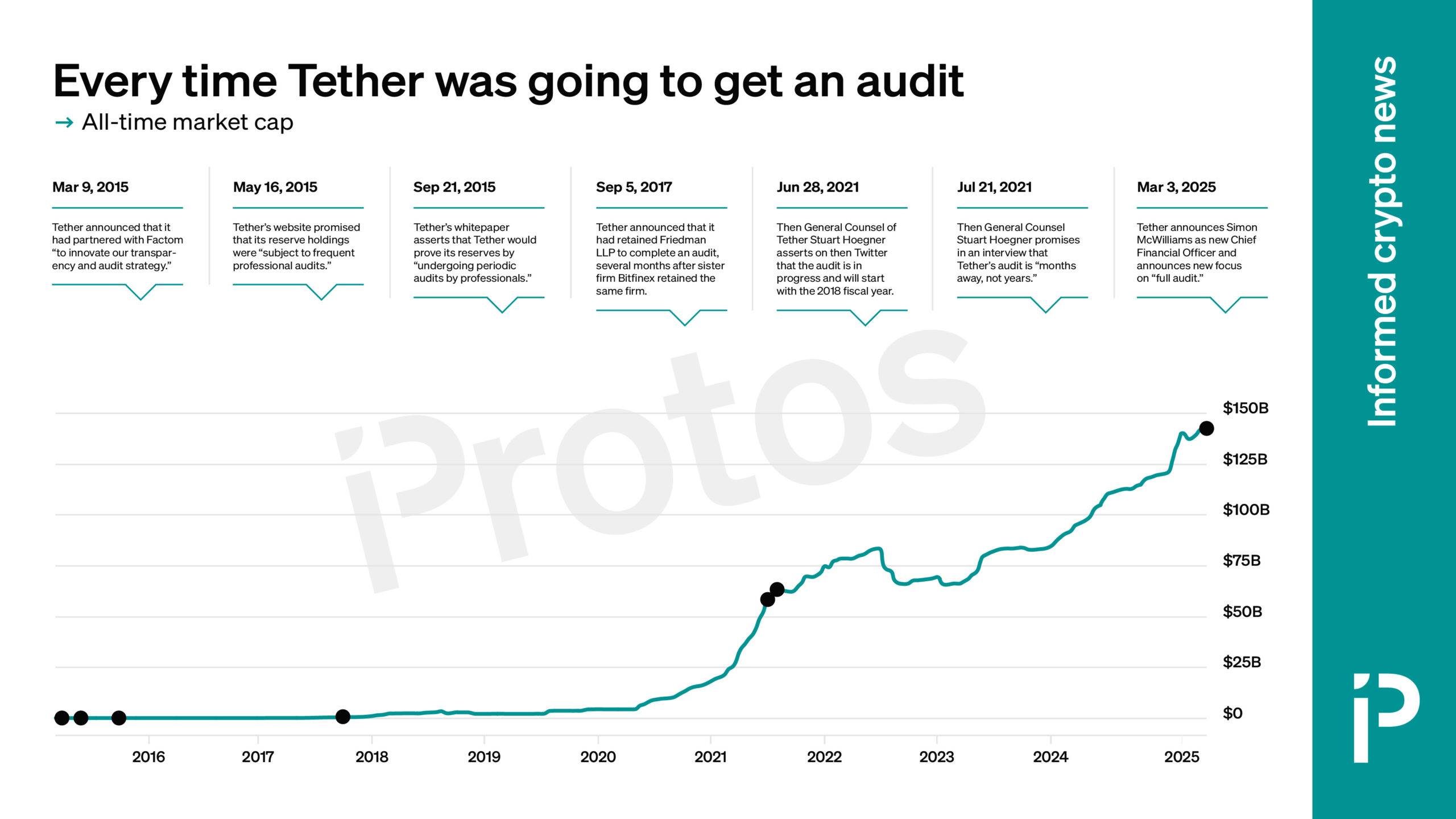
The investigation continued for two years, and Tether eventually paid $18.5 million to settle, but did not admit wrongdoing.
After several crises, Devasini's position became more stable. According to public news and data, his shareholding ratio rose from 43% in 2018 to 47% in 2024.
In March 2025, he was promoted from CFO to Chairman, further consolidating his control.
Today, 61-year-old Devasini remains extremely low-key. There is no social media, few media interviews, and few public photos. From 2017-2023, he reportedly lived mainly in Lugano, Switzerland, where Tether signed a memorandum of cooperation with the city government to promote cryptocurrency applications.
(Related reading:The Satoshi Nakamoto statue sinks to the bottom of the lake, and the anxiety of the “European Crypto Capital” surfaced)
According to the New York Attorney General's 2021 investigation documents, Devasini plays a central role in Tether and Bitfinex's operations, including handling critical matters such as banking relationships and reserve management.
In 15 years, Devasini completed the transformation from a doctor to a 200 billion millionaire.
CEO: Desperate Saburo who writes code
Paolo Ardoino
Current position: CEO of Tether
Shareholding: Approximately 20%
Potential worth: $100 billion
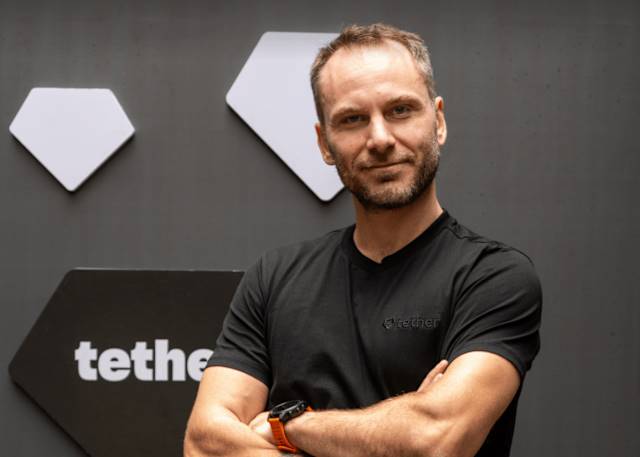
If Giancarlo Devasini is the mysterious brain behind Tether, then Paolo Ardoino is the company's public face.
One never shows up, one speaks out on Twitter every day; one gains control through capital operations, and the other uses codes in exchange for shares.
In 2017, Ardoino submitted 40,000 code times on GitHub, averaging over 100 per day. The almost paranoid intensity of work defined the Italian programmer's upward path.
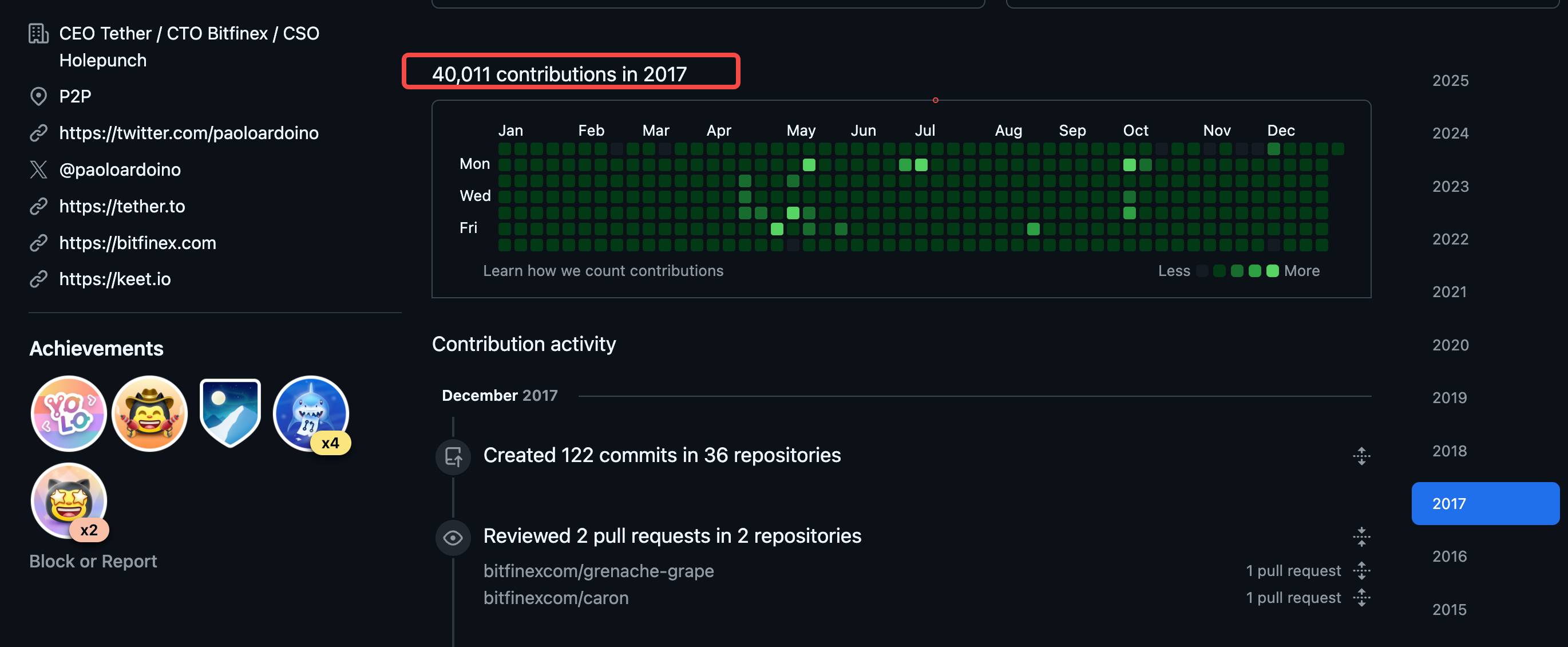
He joined Bitfinex as a senior software developer in 2014, when the stock situation was unknown; by 2024, Forbes reported that he already held approximately 20% of Tether's shares. If the $500 billion valuation were to come true, that would mean $100 billion in wealth.
Ardoino's relationship with Devasini began in 2014 in London. According to CoinDesk, Devasini was running Bitfinex at the time and was interested in Ardoino's technical capabilities.
From regular developer to CEO, Ardoino's path to promotion is clear: CTO in 2017 and CEO in December 2023.
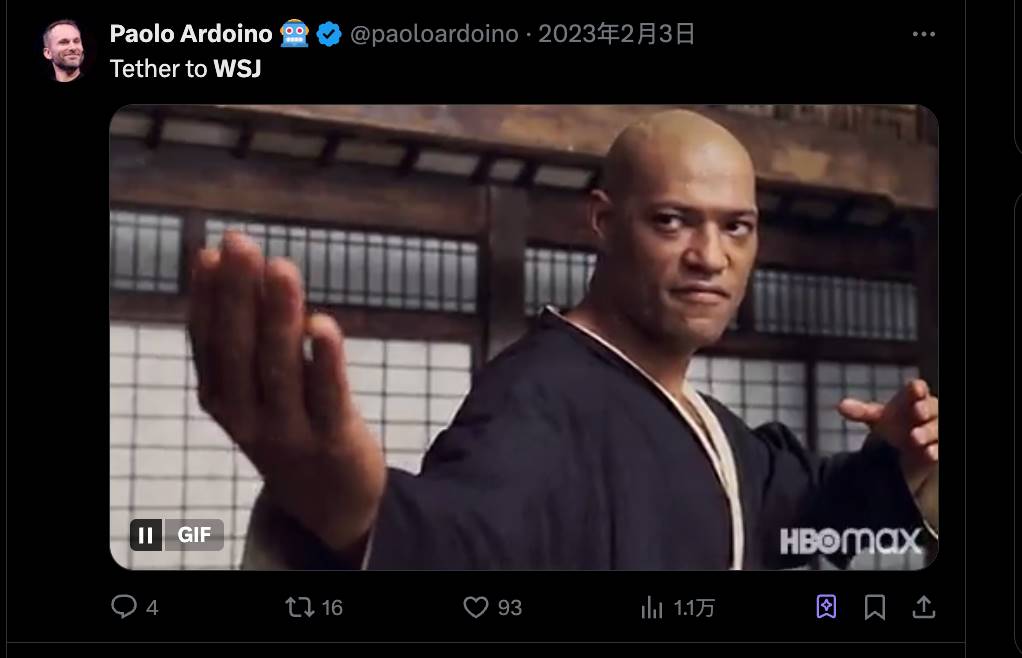
But even when he became CEO, he was still the one who worked until the early hours of the morning. His Twitter account, @paoloardoino, is often still responding to technical questions late at night. When the media questioned Tether, he immediately refuted it, such as directly calling the Wall Street Journal's critical article a “clown article.”
This style of frequent vocalization filled the information vacuum left by Devasini in a low-key manner. In a stablecoin business that requires trust, Ardoino has become the one that users can “see.”
In addition to Tether, he founded the peer-to-peer technology company Holepunch in 2022. Even though he has held several jobs, he admits that he hasn't taken an official vacation in almost ten years.
“I've never been to Japan,” he saidinterviewingIt mentioned, “It's the hometown of game consoles and anime, and I've always wanted to go there.”
In April 2024, Forbes added Ardoino to the Global Cryptocurrency Billionaires List, valued at $3.9 billion. But if Tether reaches a valuation of 500 billion, that number would be multiplied by 25. At that time, he will join the global 100 billionaire club.
Former CEO: Taiwan's son-in-law often visits temples to pray for blessings
Jean-Louis van der Velde
Current position: Tether Advisor, CEO of Bitfinex (former CEO of Tether)
Shareholding: 10-15%
Potential value: $50-75 billion
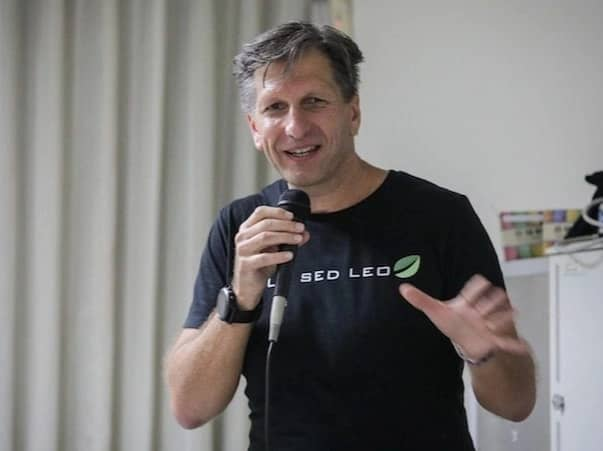
Jean-Louis van der Velde is probably the most elusive of Tether's executive team.
This Dutchman's Asian story began in 1985. At the time, he left his hometown and went to Taiwan Normal University to study Chinese. According to hisLinkedIn profileAfter graduating in 1988, he never returned to the Netherlands; instead, he took root in Asia.
Nearly 40 years from now, this international student studying Chinese may have tens of billions of dollars in wealth.
Van der Velde's rise in the crypto world has been relatively low-key. In 2013, he became the co-founder and CEO of Bitfinex. According to the company blog, his role at the time was to “establish a holding structure to focus on developing and investing in fintech and big data related technologies.”
In layman's terms, he is responsible for building the company's framework and external relationships.
According to 2018 regulatory filings, he holds approximately 15% of Tether's shares. By 2024, his exact shareholding ratio was not disclosed, but Forbes still included him on the crypto billionaires list, valued at $3.9 billion. If he still holds 10-15% of the shares, his wealth would reach $50-$750 billion at a $500 billion valuation.
Unlike Devasini's mystery and Ardoino's activism, Van der Velde chose a different way of being: being present but invisible.
He has jobs and shares, but has made few public statements. Search his name and you'll find plenty of job information, but very little personal information.
In October 2023, Van der Velde stepped down from Tether's CEO position and handed over the baton to Ardoino. But instead of leaving, he moved into an advisory role while continuing as CEO of Bitfinex.
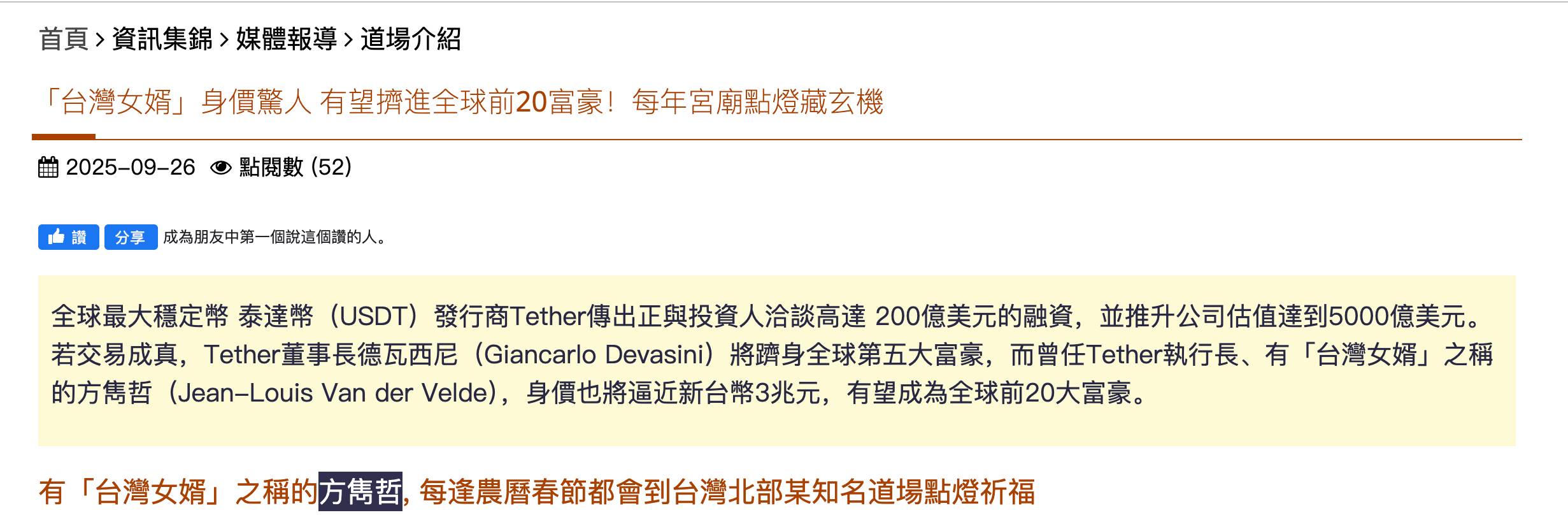
There is paucity of public information about his personal life. According to his LinkedIn, he is fluent in five languages: Dutch, English, Chinese, German, and French. Other than that, one of the most widely circulated details comes from Taiwanese mediaReport:
His wife is Taiwanese, so she is also deeply influenced by the local culture. Because of the difficult process of starting a business, every year he goes to a temple in northern Taiwan to light up the lights and pray for blessings. Even if he can't visit him in person, he asks someone to act on his behalf.
It's hard to discern whether this detail is real or false; it really fits his image.
A Westerner, deeply influenced by Asian culture, is low-key and pragmatic, gradually building a crypto empire in the commercial soil of the East.
What's interesting is that even people actually question whether Van der Velde actually exists. There was also a Twitter user who quipped the question “Has anyone actually met the CEO of Bitfinex?” This is of course an exaggeration, but it also reflects his level of understatement.
Unlike most KOLs in the current bustling crypto ecosystem, strong players probably don't need to be high-profile, vocal, or even seen.
Of course, only if you're in the right position early enough.
Legal Adviser: Resigned, retired due to merit
Stuart Hoegner
Previous post: General Counsel, Tether/Bitfinex
Shareholding: 13%
Potential value: $65 billion
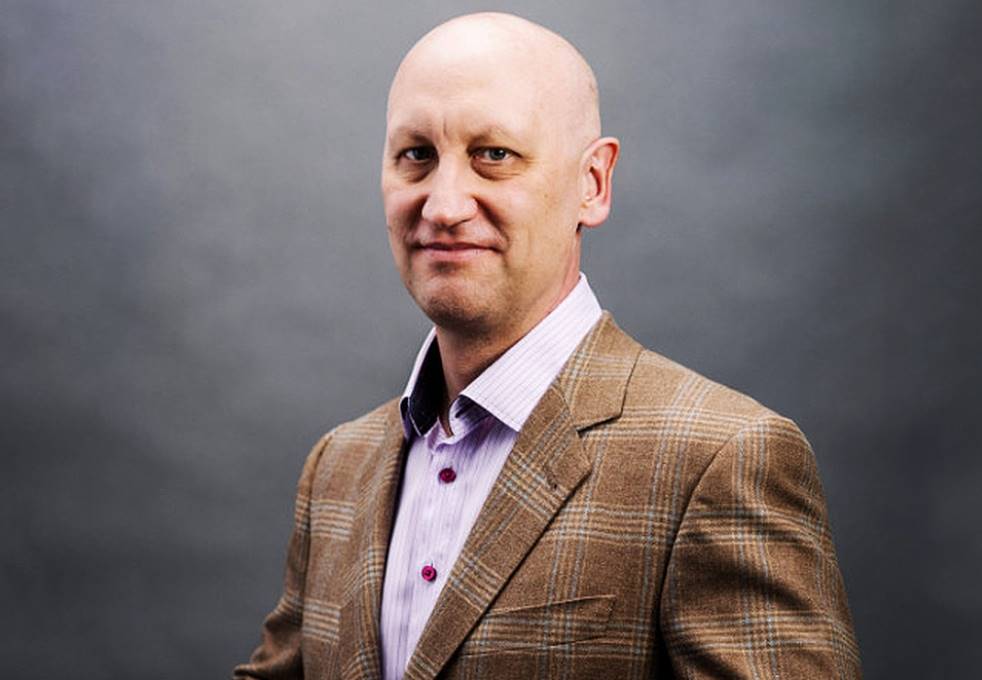
“In January 2025, Stuart Hoegner updated his Twitter profile: “" General Counsel of Bitfinex and Tether "” to “" Former General Counsel "”.”
Hoegner has a unique identity tag in the crypto world: @bitcoinlawyer. This Twitter account has been active since 2011, three years before Tether was born.
While most lawyers are still investigating whether Bitcoin is legal, he is already providing legal services to the industry.
Hoegner joined Bitfinex in 2014, then became Tether's general counsel. In this position, he guarded both companies for 11 years. According to 2018 regulatory filings, he holds approximately 15% of Tether's shares. By 2024, Forbes reports this percentage will drop to 13%.
As an attorney, Hoegner's job is often at the center of the storm. In 2019, when the New York Attorney General investigated Tether's $850 million funding issue, he led the legal team to deal with it. In 2021, when the CFTC issued Tether a $41 million fine over reserves, he was also responsible for the negotiations.
But unlike the typical corporate lawyer, Hoegner is extremely active on social media.
In addition to discussing legal issues, his Twitter frequently retweeted pro-Bitcoin content to counter questions about Tether. This fighting attitude made him a well-known figure in the crypto community.
His background also has quite a story. Prior to joining the crypto industry, Hoegner worked in the online poker industry. In 2008, during his tenure at the Ultimate Bet poker site, a scandal broke out where insiders used superuser accounts to cheat.
Interestingly, Daniel Friedberg, the other attorney in the Ultimate Bet case, later became FTX's chief regulator, played a controversial role in FTX's collapse.
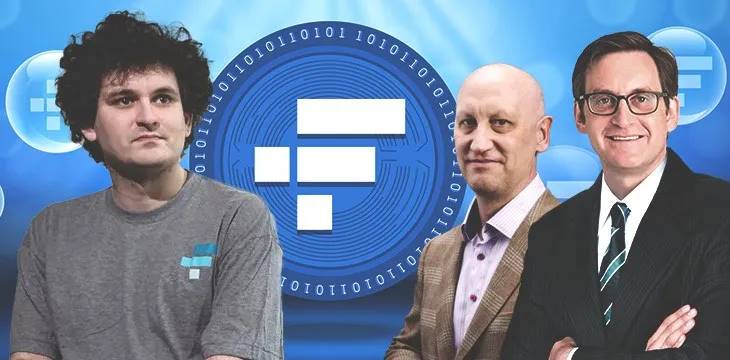
Two former colleagues have had different endings in the crypto world.
One escort company headed for a $500 billion valuation, and one saw the collapse of the biggest crypto empire in history.
Retiring in January 2025, Hoegner chose a delicate point in time. The EU's MiCA regulations have just come into effect, and stablecoin regulation in the US is also accelerating.
As the head of law, he knows better than anyone else about the upcoming regulatory challenges. Retiring, probably by retiring from the rapids.
If he still holds that 13% of the shares, the “former legal adviser” name doesn't affect his potential to become the richest lawyer in the crypto industry.
The fourth most mysterious shareholder who disappeared
Christopher Harborne (UK)/Chakrit Sakunkrit (Thailand)
Shareholding: 13% (2018 data)
Potential value: $65 billion
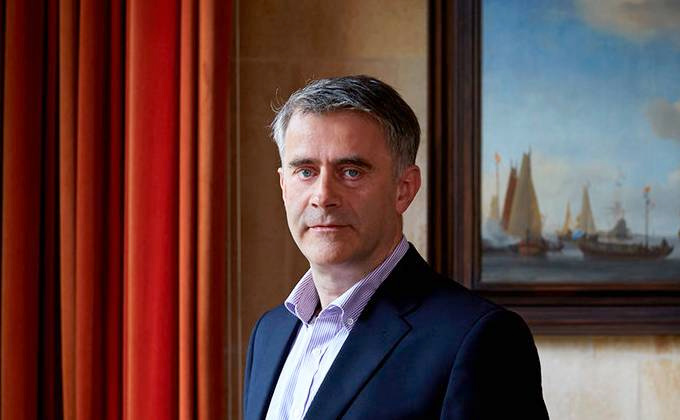
On Tether's shareholder list, there's one person more mysterious than Van der Velde; he even has two names.
According to the 2021 New York Attorney General's investigation documents, in 2018, a businessman with dual British and Thai nationality held approximately 13% of Tether's shares. In the UK, his name is Christopher Harborne; in Thailand, his name is Chakrit Sakunkrit.
This is the only “outsider” in Tether's shareholding structure. It is neither a founding team nor an executive, but it holds shares equivalent to that of a general counsel.
Public information about Harborne/Sakunkrit is extremely limited. According to UK company registration records, he is involved in various fields, from aviation to technology investments. There is even less information on the Thai side; it is only known that he uses the name Chakrit Sakunkrit for commercial activities.
How did he get Tether shares, when did he invest, and how much? None of these critical questions have been answered.
What's even more puzzling is that after 2018, the name completely disappeared from all Tether-related documents and reports.
Forbes's 2024 Crypto Richest List lists the aforementioned Devasini, Ardoino, Van der Velde, and Hoegner, except Harborne.
Nor can he be seen in the 2025 funding news. A 13% share would be worth $65 billion if calculated at a $500 billion valuation. Assuming he's still holding shares, it's clear that he'll be the most successful hidden investor on Tether.
In a company full of secrets, this person is probably the biggest secret.
Wall Street Capital and the US Secretary of Commerce
Agency: Cantor Fitzgerald
Investment period: November 2024
Shareholding: 5%
Investment: $600 million
Potential value: $25 billion
In November 2024, Wall Street financial services company Cantor Fitzgerald purchased 5% of Tether's shares for $600 million.
At this price, Tether was valued at just $12 billion at the time. By comparison, competitor Circle has a market capitalization of around $30 billion, while Tether's USDT circulation is more than double Circle's USDC.
Why is it so cheap? The answer may be hidden in timing and relationships between people.
The key figure in the deal was Howard Lutnick, CEO of Cantor Fitzgerald. Shortly after completing the investment in November 2024, Lutnick was appointed US Secretary of Commerce in January 2025.
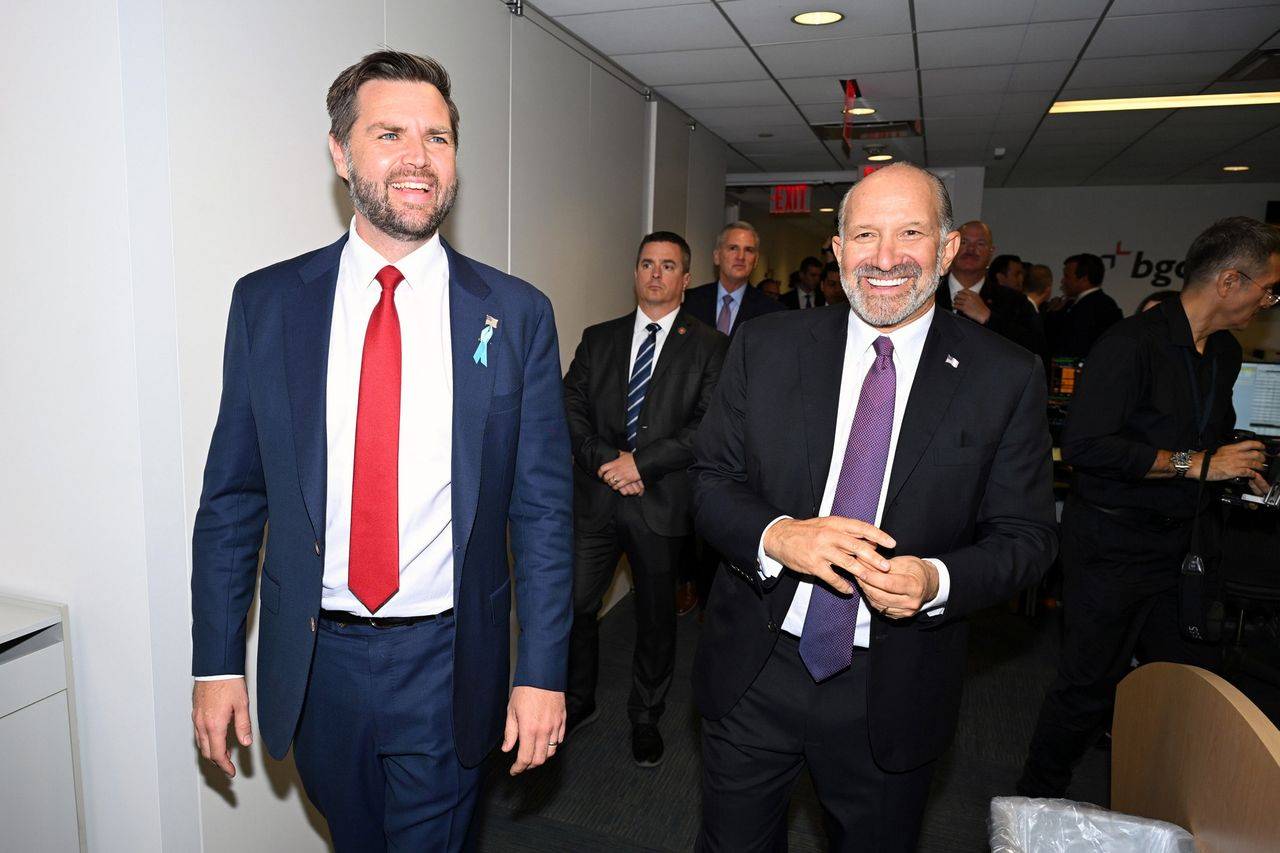
This timeline cast a special color on the deal to acquire Tether shares. Critics believe this is a “friendship price” deal, and Tether uses an undervaluation to send benefits to Lutnick, who is about to enter the government.
More interesting details are, according to Fortune magazineReport, Lutnick's son, Brandon Lutnick works for Cantor and previously interned at Tether Switzerland.
Regardless of the motivation, in terms of return on investment, this is probably one of the most successful deals in Cantor Fitzgerald's history. If Tether reaches a $500 billion valuation, $600 million would become $25 billion, a return of more than 40 times. Even at a valuation of only $250 billion, the return was 20 times greater.
Founded in 1945, Cantor Fitzgerald is an established Wall Street financial institution. Their investment is significant for Tether: it is the first major US financial institution to become a Tether shareholder. In the context of increased regulatory pressure, the value of endorsements is difficult to measure.
Meanwhile, over the past 3 years, Cantor Fitzgerald has been providing escrow services for treasury bonds that support Tether stablecoins. These treasury bonds account for more than 80% of the $132 billion assets that support the stablecoin.
According to the Wall Street JournalReport, the company earns tens of millions of dollars in commissions for providing this service.
Perhaps more practical value lies in Cantor's financial network. One of the biggest challenges Tether has faced in the long run is banking relationships. As a regulated financial institution in the US, Cantor's addition could open up new banking channels for Tether.
Seen from another perspective, Cantor's investment represents a shift in Wall Street's attitude towards cryptocurrencies. Don't just wait and see or provide services, but directly become a shareholder and share the dividends of growth.
Howard Lutnick has a dual status. He was CEO when he invested and is now Secretary of Commerce.
Whether or not this affected the transaction price, what is certain is that Tether now has an indirect link at the highest level of the US government.
Passive millionaires in domestic jails
Zhao Dong
Status: Bitfinex shareholder, RenrenBit founder
Shareholding: Bitfinex < 5%
Potential wealth: Billions of dollars, indirect benefits through the iFinex architecture
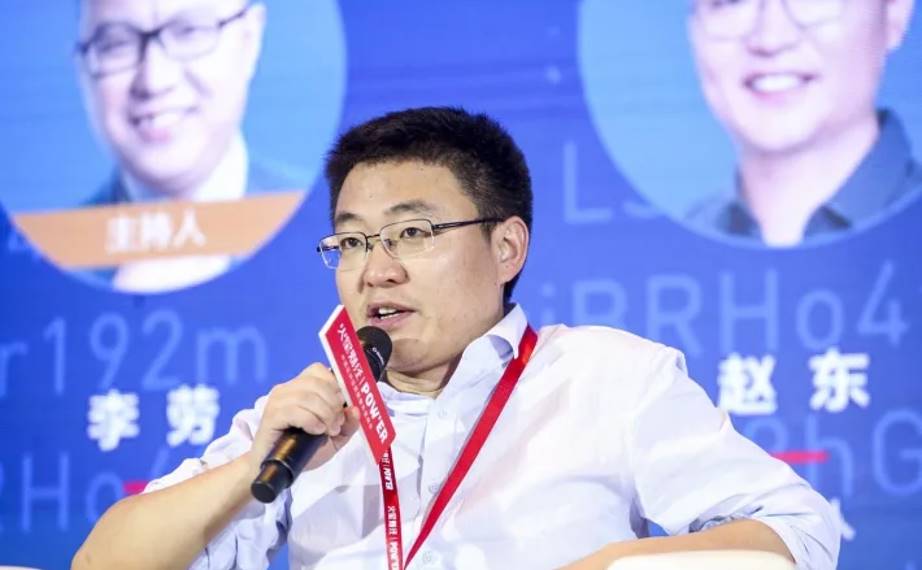
Zhao Dong is probably the most dramatic one of Tether's rich stories.
In August 2016, Bitfinex was hacked and 120,000 bitcoins were lost. In the midst of this crisis, this large Bitcoin owner from China became an unexpected protagonist.
Bitfinex proposed a compensation plan for losses and issued BFX tokens to damaged users, each representing a loss of $1. Zhao Dong was one of the damaged users at the time, but instead of leaving the market, he accepted the debt-for-equity swaps offered by Bitfinex.
He bought more tokens from other users and eventually converted them all into iFinex shares. The decision turned him from a victim to a Bitfinex shareholder.
In April 2017, Bitfinex completed the redemption of all BFX tokens, and users who chose debt-for-equity swaps became permanent shareholders of the exchange. With the rapid development of Bitfinex and associated company Tether, the value of these early stakes has doubled tens of times.
pursuantPublic reportsBitfinex CTO Paolo Ardoino once said that Zhao Dong's shareholding ratio in Bitfinex is less than 5%.
Although the ratio is small, considering that Bitfinex and Tether are part of iFinex and share a shared management and shareholder structure, the value of this equity may far exceed surface figures.
Zhao Dong's position in the domestic crypto industry is special and sensitive.
He is the co-founder of Ink Weather and successfully cashed out in 2012. Entered the Bitcoin world in 2013, and is said to have held 10,000 bitcoins at its peak. He founded the OTC trading platform RenRenBit and was once one of the largest OTC traders in China.
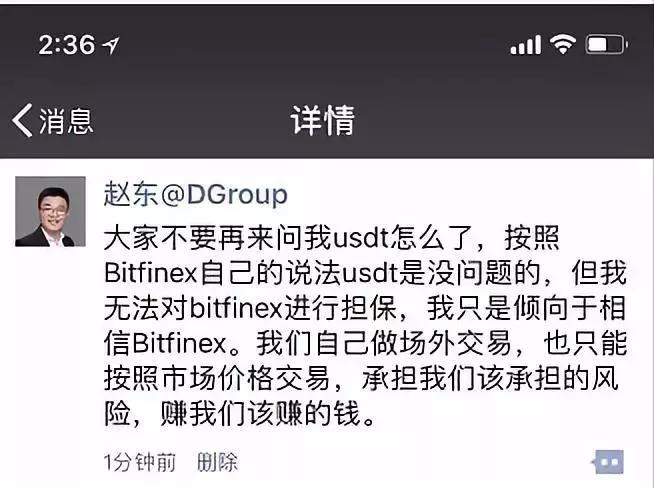
More importantly, he is Tether's unofficial “spokesperson” in China.
In January 2018, Zhao Dong posted on Weibo that when he met with Tether CFO Giancarlo in Tokyo, he saw a bank account balance of over $3 billion. As a well-known figure in the coin industry, his statement attracted widespread attention.
It all came to an abrupt end in June 2020.
According to various media reports, Zhao Dong was taken away by the police on charges involving money laundering and illegal operations. In 2021, it was reported that he was sentenced to many years in prison. The details of the specific case have never been disclosed, but the industry generally believes it is related to OTC business.
Ironically, the last few years that Zhao Dong was imprisoned happened to be the craziest period in the cryptocurrency market.
From 2020 to 2024, Bitcoin rose from $10,000 to over $70,000, and the circulation of USDT grew from $10 billion to $170 billion. If his Bitfinex shares were still around, the value might have doubled tens of times.
If Zhao Dong's Bitfinex shares are not disposed of, he may indirectly benefit from Tether's valuation growth through iFinex's structure. Even an indirect equity of less than 5% would mean billions of dollars in wealth at a $500 billion valuation.
But this is all hypothetical. His “passive position” is more like fate making a choice for him.
Finally, Tether, if funded, would be the largest wealth creation in the crypto industry's history.
Less than 10 people control the vast majority of Tethter's $170 billion stablecoin empire. Of these, Giancarlo Devasini alone holds 47%; while most of the remaining big players aren't even in the spotlight of the crypto industry.
This is probably the password for wealth in the crypto era:
It has nothing to do with decentralization, but rather a low-key stand at the center of the outlet at the right time.
Twitter:https://twitter.com/BitpushNewsCN
Compare the TG exchange group:https://t.me/BitPushCommunity
Compare TG subscriptions:https://t.me/bitpush
