


Bitwise: Institutions have controlled 12.5% of Bitcoin, and this wealth migration is just beginning

Author: André Dragosch, Head of European Research at Bitwise;
Translation: Golden Finance Xiaozou
Original title: Institutions already control 12.5% of Bitcoin? Bitwise Report: This Big Wealth Transfer Is Just the Beginning
“If you have any doubts, please take a long time to observe”
This is the essence of the key charts in our latest Bitwise Quarterly Market Report.
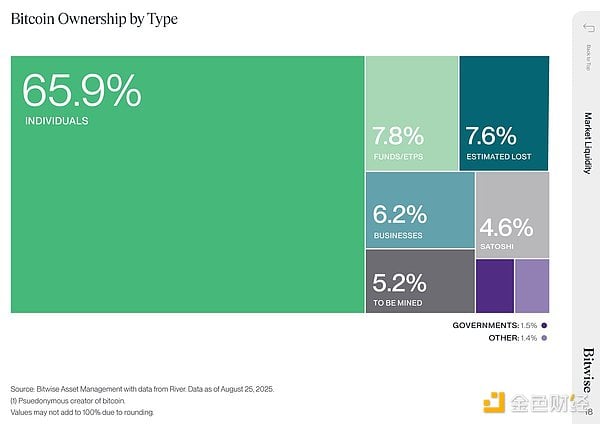
The data clearly reveals current general trends, and can even explain the special nature of the current Bitcoin cycle (data provided by River).
1. Interpreting the essence of the “big transfer of wealth”
The key point is that Bitcoin is flowing from early retail investors to institutional investors (funds/exchange-traded products), enterprises, and even government entities.
Unlike other traditional asset classes in history, Bitcoin's popularity path began with retail investors such as cryptopunks and early participants, and then ushered in the initial deployment of institutional investors such as family offices, fund managers, and ETFs.
Even now, retail investors still account for around 66%, which means that the vast majority of Bitcoins are still controlled by non-institutional investors (see matrix distribution in the chart above)! In comparison, the latest data from the US 13F file shows that the allocation ratio of institutional investors in traditional asset classes is significantly higher.
Observe the share of institutional holdings in mainstream traditional financial ETFs:
iShares 20-year treasury bond ETF (TLT) institutions hold 79% of their positions;
SPDR S&P 500 ETF (SPY) institutional holdings are 58%;
The SPDR Gold ETF (GLD) institutional holdings are 36%.
Compared to Bank of America's latest survey of global fund managers: Currently, the average allocation ratio of crypto assets (including Bitcoin and other tokens) is only 0.4%. (Note: IBIT currently accounts for only 26% of institutional holdings...)
It can be seen from this that, as the industry often says, “We are still in the early stages”, institutional adoption is still in its infancy.
But it is undeniable that a large-scale transfer of wealth from retail investors to institutions is taking place. Wealth migration from early retail coin holders to institutional investors will have multiple impacts, which may be far beyond imagination:
2. Bitcoin Popularity: Trends and Cyclical Rules
(1) Trends
First, be clear: this shift will not happen overnight; it is a long-term trend.
The reality is that most bitcoins are in an illiquid state and are being held for a long time. Only about 14.5% of the Bitcoin supply is relatively liquid stored on exchanges such as Coinbase or Binance, while the rest of the assets are stored in off-chain wallets and remain illiquid.
Without financial incentives, Bitcoin wealth will not automatically transfer.
Many early holders set a psychological price level (such as $1,000,000 per BTC) or economic goals (such as “home purchase capital”) as a trigger for selling Bitcoin, which is far higher than the current market price of around $115,000. To attract these illiquid tokens to the market (that is, exchanges), the price of Bitcoin would need to rise sharply.
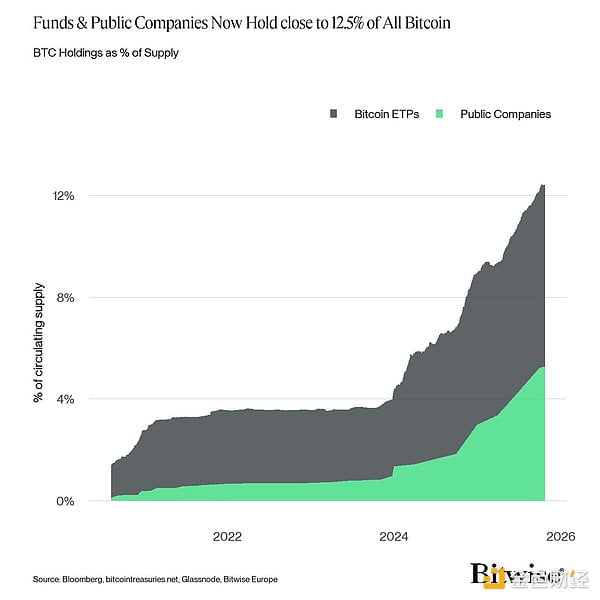
In the process, Bitcoin's popularity will expand as ETFs hold assets for millions of individual investors in the form of trusts. The financial reports of listed companies also show that they are being held by hundreds of thousands of different investors. At the time of writing, institutional investors (ETPs and publicly traded companies) controlled around 12.5% of the Bitcoin supply — and it's still rising fast.
(2) Cycle rules
Most analysts may agree that the early Bitcoin bull and bear cycle was mainly dominated by halving events that occurred every 210,000 blocks (about 4 years). This mechanism halved Bitcoin output (therefore called “halving”).
But the impact of the halving event is diminishing with each event — whether in absolute terms or in proportion to circulating supply. With the increase in institutional adoption rates and changes in the demand structure, the halving effect has clearly weakened.
According to 2025 data, the scale of institutional demand has reached about 7 times the supply gap caused by the halving!
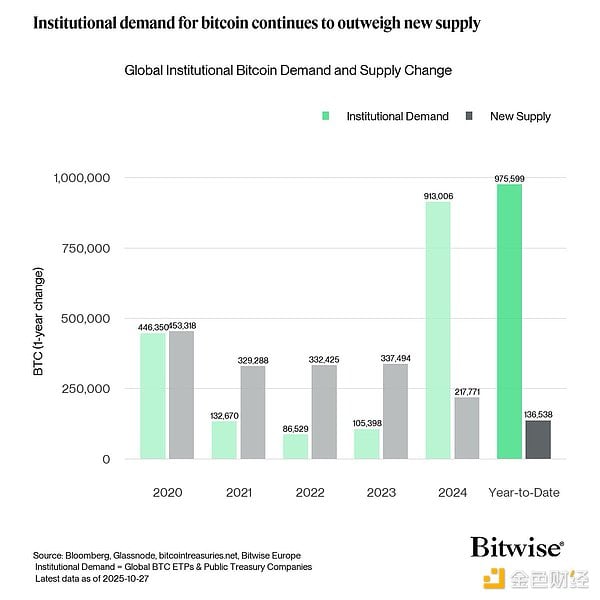
In the process, the influence of traditional macro cycles has increased relatively — Bitcoin has become a real “macro asset.”
Our quantitative analysis also shows that more than 80% of Bitcoin price fluctuations over the past 6 months were driven by macroeconomic factors such as global growth expectations and monetary policy, and token-specific factors influenced less than 5%.
However, the dominance of macro factors also means that the future Bitcoin bull-bear cycle will fluctuate in sync with the macro/business cycle, and the four-year cycle driven by “halving” is likely to “fail.”
This ultimately indicates that the accumulation and distribution of Bitcoin will depend on the dominant macroeconomic environment (expansion/boom vs. contraction/recession), thereby triggering short-term price fluctuations due to risk appetite/risk aversion patterns.
3. Conclusions
The fundamental meaning of a “big transfer of wealth” is that the price of Bitcoin needs to reach a higher level — far higher than it is today — in order to stimulate further popularity and complete the transfer from early retail investors to institutional investors.
The continued influx of institutional investors means that Bitcoin has become a real “macro asset,” indicating that future bull-bear cycles will increasingly be dominated by macro/business cycles (rather than halving events).
Twitter:https://twitter.com/BitpushNewsCN
Compare the TG exchange group:https://t.me/BitPushCommunity
Compare TG subscriptions:https://t.me/bitpush
