

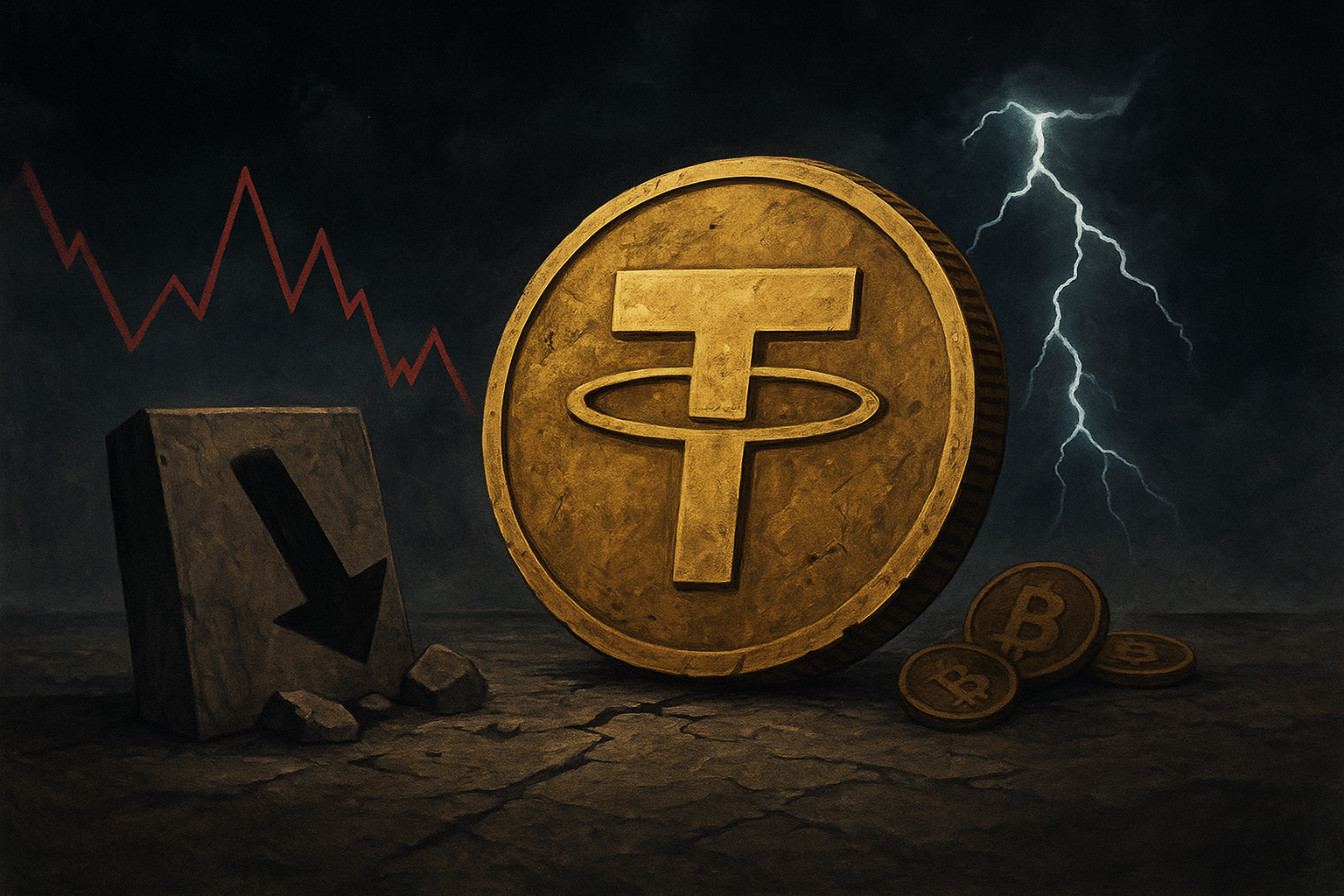
Tether's decade-long gamble: From stablecoins to the crypto world's “shadow central bank”
Author: BlockWeeks
Original title: Tether's 10-Year Gambling Game: How to transform from a “stablecoin” to a “shadow central bank” in the crypto world?
What supports the liquidity of the $2.6 trillion crypto market is not a country's sovereign credit, but rather a private company headquartered in Hong Kong and Switzerland, and eventually settled in El Salvador — Tether. The US dollar stablecoin USDT it issues accounts for more than 70% of the market share. Over the past decade, it has grown amidst crises and questions, and now it is trying to define the boundaries of the industry with profit.
But a “weak” rating warning from S&P Global once again revealed the core contradiction of this grand experiment: a monetary instrument aimed at “stability” itself is becoming the system's biggest risk point.
It's like an elephant dancing on a steel wire. The base is 100 billion US dollars in US debt, but the dance steps are an adventure invested in AI, brain-computer interfaces, and farmland in Argentina. —— This is what the BlockWeeks editorial department said.
Part 1: The Chronicles of Crises: The Weak Foundation of Trust
The history of Tether is a cyclical history of continuous questioning and continuous response to questions with greater volume. Each crisis was viewed as its “end moment,” but the result was a ladder for consolidating its position.
In 2017, the prelude to “hacking” and “money printing” is questionable. On the eve of the big crypto bull market, Tether claimed to have been hacked and $31 million worth of USDT was stolen. It then exercised its centralized power — hard forking to freeze assets. This incident revealed two key facts to the market for the first time: Tether has the power to live and kill assets on the chain; the outside world knows nothing about whether it actually holds full dollar reserves. In the same year, academic research first established a statistical correlation between the increase in USDT and the rise in Bitcoin prices, and the “conspiracy theory” of “Tether printing money boosts the market out of thin air” planted the seeds.
In 2019, New York's “real hammer” and $850 million hole. This is the darkest time for Tether to trust. An investigation by the New York State Attorney General's Office (NYAG) revealed a crack under Tether's gorgeous appearance: its parent company iFinex misappropriated at least $700 million in user reserves to cover the deficit caused by the freezing of the associated exchange Bitfinex as a result of the freezing of payment service provider Crypto Capital. The survey confirmed that USDT was only backed by about 74% cash and equivalent at the time, not the “1:1” it claims. In 2021, Tether settled with a $18.5 million fine and cessation of operations in New York. “Although misconduct is not acknowledged, allegations of fraud have gone from market rumors to judicial files.”
In 2021, the “commercial paper” mystery and regulatory iron fist. As the market capitalization surpassed tens of billions of dollars, one question became acute: where is the money? Tether revealed that it holds a large number of commercial paper (CP), which is large enough to make it one of the world's largest holders. The market panicked and suspected that it held a large number of short-term bonds from high-risk companies such as Evergrande. The US Commodity Futures Trading Commission (CFTC) then fined Tether $41 million for “making false or misleading statements about reserves.” Under pressure, Tether emptied all commercial paper in 2022 and switched to more transparent US Treasury bonds.
2022: Market turmoil and a “brief period of failure.” In May 2022, in the midst of a chain panic triggered by the Terra/UST collapse, Tether once fell below the US dollar anchor on some exchanges (the lowest transaction price was about $0.95 or even lower), and large-scale redemptions and fluctuations occurred. Although USDT stabilized in the end, this incident showed that under extreme market pressure, “mainstream” reserve-backed stablecoins will also experience brief market distortions
“Looking back at this history, you'll find that Tether's 'increased transparency' was forced by crises and regulatory lawsuits.” According to the BlockWeeks analysis, “Every time it was pulled back from the edge of a cliff and then it got bigger. This has shaped its unique culture of risk: extremely averse to external audits, yet extremely good at surviving regulatory gaps.”
Part 2: Dangerous Metamorphosis - From “Stable” to “Aggressive”
If past crises were about “not enough reserves,” then current concerns have turned to “what are reserves” and “where are profits going.” Tether is completing a dangerous strategic transformation: from a conservative currency custodian to an aggressive crypto-era “chaebol”.
1. Balance Sheet Restructuring: When Stablecoins Fall in Love with Bitcoin and Gold
According to its latest third-party assurance report (issued by BDO Italia), Tether's reserve composition has changed qualitatively:
Cornerstone: US Treasury bonds of about 135 billion US dollars, making it the 17th largest holder of US debt in the world, surpassing most countries.
Controversies: Over $129 billion in gold and nearly $100 billion in Bitcoin. This has made it itself one of the largest Bitcoin “listed company” holders.
This is the core reason S&P Global downgraded its stability rating to “weak” (5 points) in November 2025. S&P pointed out that although Tether reports “excess reserves” of about 6.8 billion US dollars, if the price of high-risk assets such as Bitcoin, gold, and corporate bonds plummets 30%, this safety cushion will be instantly broken down, which may cause the collateral ratio to fall below 100% again.
2. Tether Evo: Betting on the future with stablecoin profits
Tether is no longer satisfied with earning spreads. Using $10 billion in annualized profits, it launched an aggressive investment program called “Tether Evo,” and its portfolio read like a “future technology inventory”:
Brain-computer interface: Holds Blackrock Neurotech ($200 million) and targets Neuralink.
AI computing power: Focus on the German listed company Northern Data and promised to buy a $150 million GPU.
Physical assets: Bid for shares in a fertilizer company owned by Argentine agricultural giant Adecoagro with a bid of 600 million US dollars to enter the lifeblood of Latin American agriculture.
Bulk trade: Quietly entering the field of oil trade finance.
Arguably, this completely transcends the narrative of traditional financial institutions. It uses low-cost funds similar to the “minting tax” to directly end the market for the highest risk and longest cycle equity investment. This blurs the line between a 'safety cushion for user reserves' and the 'principal amount of a company's venture capital'.
3. Relocating to El Salvador: the ultimate regulatory arbitrage
In early 2025, Tether moved its headquarters to El Salvador, where Bitcoin has been made legal tender. This move has been widely interpreted as a “strategic retreat” in the face of the EU's Crypto Asset Market Act (MiCA) and increasingly strict US legislation.
El Salvador will not require it to conduct PCAOB (American Public Company Accounting Supervisory Board) standard audits. BlockWeeks believes this is a typical form of regulatory arbitrage, using the leniency of sovereign states to counter the rules of mainstream jurisdictions. The cost is that it is further away from the goal of 'mainstream financial recognition'.
Next: Systemic Paradoxes - “Too Big to Fail” and “Dare to Investigate Deeply”
Tether is deeply embedded in the financial capillaries of the crypto world. Its survival is no longer a corporate issue; it is a systemic issue.
Its resilience stems from a paradox:
Terrible profitability: In an environment of high interest rates, 100 billion US debt reserves bring billions of dollars in annualized risk-free returns, creating a huge capital buffer.
The “big but impossible to fail” network effect: the liquidity of almost all major exchanges is built on USDT. Once it collapses, it will cause more than 80% of the market's liquidity to evaporate instantaneously. Giants such as Binance and OKX are even motivated to jointly provide liquidity support during times of crisis. This is not out of goodwill, but rather a survival instinct.
Stress test records: During the FTX crash, Tether processed over $16 billion in redemptions within 48 hours without breaking the anchor, which became its strongest credit advertisement.
But its fatal risk is just as clear:
Custody risk — America's “nuclear option”: Tether's fate is not that there is no money, but that the money may be frozen. Its US bonds are held by Wall Street institutions such as Cantor Fitzgerald. Once the US Department of Justice files criminal charges against it due to anti-money laundering or sanctions compliance issues (such as recent Huione-related investigations) and freezes escrow accounts, USDT will instantly return to zero.
Mismatch between assets and liabilities: Use short-term, readily redeemable stablecoin liabilities to invest in long-term, illiquid equity and physical assets. This is the most classic recipe for crisis in traditional finance.
“Rashomon” of audits: Ten years on, Tether still provides “assurance reports” rather than “audit reports” that meet the standards of global listed companies. The former only checks the existence of assets at a given moment, while the latter requires an assessment of internal control, asset quality, and ability to operate continuously. It's like just showing you a screenshot of your balance without letting you check your statements and contracts.
Conclusions and Prospects: Perpetual Dance on a Steel Wire
The story of Tether is the ultimate expression of the crypto world's self-contradiction: a decentralized ecosystem, but its lifeline is tied to an extremely centralized and opaque entity.
It has evolved from an initial “dollar token” to a crypto superhybrid integrating central banks (issuing currency), commercial banks (creating credit), sovereign wealth funds (strategic investments), and hedge funds (allocating high-risk assets).
In the short term, due to its deep profitability and network effects, the possibility of an endogenous collapse due to “insufficient reserves” has been reduced. The real “black swans” come from outside, especially at the intersection of geopolitics and regulation. The US authorities' attitude will be a key weather vane: as long as its US bond escrow account is safe and sound, Tether will remain the de facto “Federal Reserve” of the crypto world; once this license is withdrawn, it will be the harshest winter for the entire industry.
For millions of users, Tether provides unparalleled convenience and has itself become an infrastructure risk. Diversifying risk (using multiple stablecoins), focusing on spreads (the USDT/USD exchange rate in the secondary market is a real-time thermometer of confidence), and understanding their non-banking nature are survival lessons that must be learned in this era.
Tether's gamble continues. It is betting that the sword of Damocles of global regulation will not fall until its vast ecological empire, which it has built with profits, is sufficient to circulate. This dance move is still thrilling.
Twitter:https://twitter.com/BitpushNewsCN
Compare the TG exchange group:https://t.me/BitPushCommunity
Compare TG subscriptions:https://t.me/bitpush
