


Why hasn't Bitcoin become “digital gold” yet?
By Krieger, Castle Labs
Compiled by Saoirse, Foresight News
Original title: Why is Bitcoin not digital gold yet?
From the legend of the Golden Fleece to South Africa's gold mines, humans have been relentlessly chasing this noble and mysterious treasure.
Gold is like captured sunlight, but in fact, it probably actually originated in space — scientists believe that gold was created by the collision of dying stars (or supernovae). Most of Earth's gold is trapped in the planet's core, and the rest is carried to the surface by meteorites.
Throughout human history, gold has always been the core commodity of commercial activity.
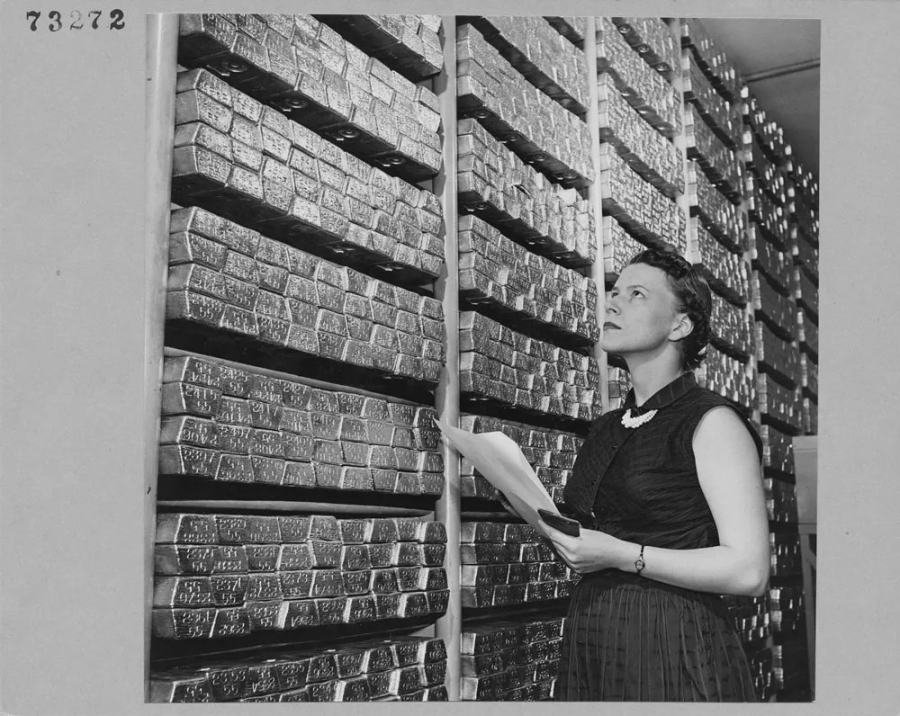
If all the gold ever mined by humans were to be collected, it would form a cube of about 20 meters on each side and weigh about 176,000 tons.
It's amazing how such a huge amount of wealth can be stored in a warehouse. Stocks, works of art, oil, or collectibles often require huge geographic or administrative resources, yet gold is uniquely portable.
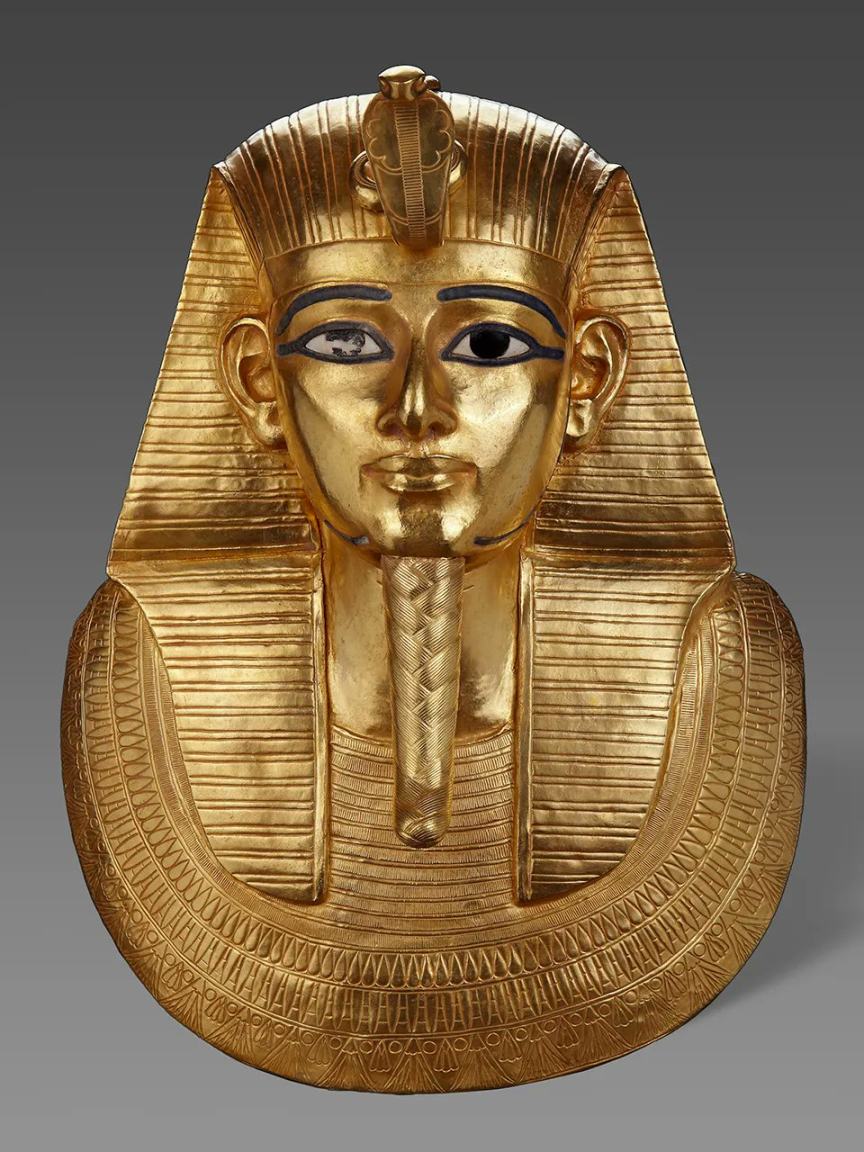
Gold is the ultimate store of value because it has no counterparty risk and is the only asset that is not a liability to anyone. J.P. Morgan once said, “Gold is money; everything else is credit.” Gold's high stock-to-flow ratio ensures its scarcity and protects it from arbitrary devaluation of fiat currencies. From ancient Lydian coins to modern central banks' reserve assets, gold has maintained the function of storing value for thousands of years, acting as a highly liquid, stable and reliable “ballast stone” during periods of financial, political, and social turmoil.
Recently, however, a new contender for the “currency” title has emerged.
Despite being very different from traditional metals, cryptocurrencies such as Bitcoin are touted as “gold killers” due to their volatility and cryptographic characteristics.
Bitcoin is often called “digital gold”. Can it replace gold in the future? If it can be replaced, is it advisable to abandon this historic asset?
This article will explore the position of gold and bitcoin in combination with the modern economy, decentralized finance (DeFi), and monetary attributes. Afterwards, we will determine whether these two assets can coexist in a highly competitive macro environment through comparative analysis, and analyze whether Bitcoin has the attributes of “digital gold” based on current trends.
At the end of the day, diversification of assets may only benefit the global economy. And fiat money — an asset whose value depends largely on any monetary policy — is likely to be replaced by a more pure form of money. Gold, or an asset that hasn't been invented yet, may be able to escape the inherent devaluation dilemma of fiat money. In the current debt-dependent economic system, fiat money is fatally flawed.
Gold's historical heritage in finance
For centuries, gold has been the mainstay of the financial system. As the only reserve asset, its status is not established by law, but by the physical laws of the universe. As former Federal Reserve Chairman Alan Greenspan (Alan Greenspan) said in his famous testimony in 1999: “Gold remains the world's ultimate form of payment. In extreme cases, no one will accept fiat money, but gold will always be accepted.” The reason why gold is widely recognized around the world stems from its unique intrinsic qualities, which distinguish it from all other materials and establish its enduring position as a means of storing value — what Aristotle called a “stable currency”, which is reflected in the following five points:
Durability: Gold is a precious metal that is almost unaffected by most chemical reactions. Unlike silver, it does not oxidize or tarnish, and can maintain stable physical properties over a long period of time. This chemical uniqueness allows it to play a reliable role in economic reserves and high-tech infrastructure (such as electric vehicles, drones, defense systems, rockets), and gold does not rust.
Substitutability: Gold has a soft, ductile texture, and is easy to shape, cast, and split. This allows it to be standardized as an interchangeable coin or gold bar, and the gold units of the same weight (traditional units are ounces or grams) and purity (most commonly 14K, 18K, 24K) are essentially identical.
Stability: Gold is a reliable store of value. Its rarity and usefulness (despite its high cost, it is still the best choice for critical industrial applications) allows it to maintain its value over the long term, in stark contrast to fiat currencies that commonly face inflation problems. Furthermore, gold has no counterparty risk, which further strengthens its position as the ultimate store of value.
Portability: As a high-density, high-value metal, even a small amount of gold is of great value. This high value-to-weight ratio allows it to efficiently transport large amounts of wealth, far more than silver, art, or other commodities — people can even carry half a kilogram of gold in their pockets.
Identifiability: Gold's unique properties make it easy to verify, and modern instruments like Sigma can instantly detect fake gold.
It can be seen from this that gold is an almost perfect means of storing value, but it also has a flaw: gold is not a negotiable credit card, nor is it a line of code. Even for an ordinary person with a small amount of gold bars, transporting gold is as complicated as transporting uranium — if you forget to fill out the relevant documents, customs officials have the right to seize the gold and keep a large portion of it as a fine. In addition, gold may also face the risk of being stolen, scraped, hidden, misappropriated, etc., and gold may also be accidentally lost due to human error.
“Operation Fish” in 1940 is a typical example of this logistical dilemma. At the time, Nazi Germany was pressing ahead, and Britain had to secretly ship 2.5 billion pounds of gold reserves to Canada to prevent them from being seized by the German army. This became the largest real wealth transfer operation in history. Today, transfers of trillions of dollars can be completed with just one click.
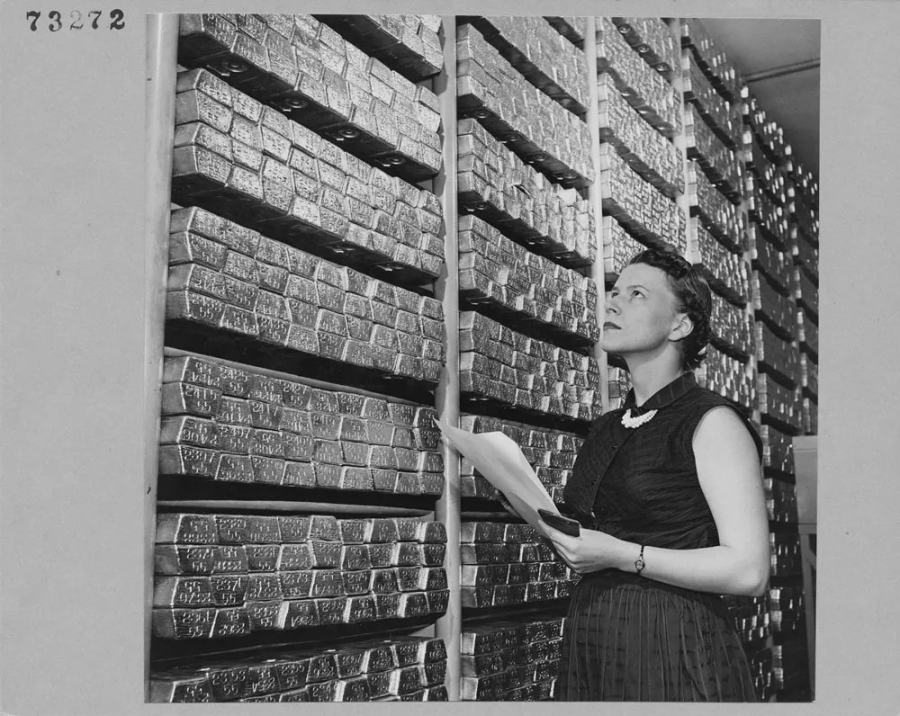
The most notorious case of a nation's looting of gold is the “Executive Order 6102” issued by Franklin D. Roosevelt (Franklin D. Roosevelt) in 1933, which made it illegal for US citizens to hold monetary gold. Unlike passwords or mnemonics, gold can't be “memorized” — it must actually be held, and once discovered, it can be taken away. Moreover, gold is not profitable, does not generate dividends, and is subject to high storage and insurance costs. Much of the world's gold is stored in vaults in London, Switzerland, Singapore, or Manhattan, quietly in the dark, like a forgotten ancient and mysterious Sphinx.
Of course, even though humans inevitably make mistakes, they are extremely creative and will inevitably find better alternatives to this “barbaric legacy.” Although gold itself is almost perfect, the rapid development of the financial system has made it inevitable to create a modern equivalent. Bitcoin stemmed from dissatisfaction with the old model of traditional finance and a desire to innovate. It was born to counter the existing system, but it soon formed a new paradigm that far surpassed its original intention — it may be viewed as the equivalent of “digital gold”!
The rise of cryptocurrencies
During the 2008 global financial crisis, Satoshi Nakamoto published a white paper entitled “Bitcoin: A Peer-to-Peer Electronic Cash System,” which proposed a solution to the “double flower” problem without a central trusted agency.
If gold is a “natural currency,” then Bitcoin is a “currency created by computer engineering” — it is scarce, difficult to “mine”, limited in quantity, and indestructible.
The invention of blockchain triggered the “Cambrian explosion” of all kinds of digital assets, some of which were valuable, but many more were useless. Since Bitcoin's supply was fixed at 21 million, it quickly carried the banner of “digital gold,” while other tokens emerged to fill gaps in various economic sectors.
In 2011, Litecoin positioned itself as “the silver behind Bitcoin's gold,” focusing on faster and cheaper transactions. Four years later, in 2015, Ethereum introduced the concept of a “world computer,” replacing the passive value storage function of gold with active, programmable smart contracts. Although Ethereum's price performance was unsatisfactory, it has become the second-highest cryptocurrency by market capitalization and continues to lead the way.
Privacy coins such as Monero (XMR) and Zcash (ZEC) seek to replicate the anonymity of physical cash and gold — a feature missing from Bitcoin's public ledger. This year, driven by the “concept of privacy,” the price of these privacy coins skyrocketed, while traditional tokens fell sharply. Altcoins, mainstream coins, and even Bitcoin declined one after another, but Zcash (and now Monero) bucked the trend, causing many shorters to lose a lot. However, the total market capitalization of these tokens is still insignificant enough to pose a substantial challenge to Bitcoin.
Ultimately, high-performance blockchains like Solana or MegaETH are sacrificing decentralization in pursuit of speed, and their goal is to achieve NASDAQ level transaction processing speed rather than the speed of traditional wire transfers (that is, the speed of internet capital markets). They have successfully attracted the attention of entrepreneurs, institutions, and banks, but the Layer1/Layer2 (underlying public chain/second-tier network) pattern is already huge, and it is currently impossible to determine which one will last for a long time.
The mainstream industry narrative of the 2110s was not about “coexistence,” but “mutual annihilation” — every new trend replaces the previous one. Grayscale Investments' controversial “Drop Gold” (Drop Gold) campaign in 2019 perfectly reflects the industry's fanaticism to replace precious metals: the ads portray gold investors as people in tired suits with heavy “shiny stones,” while trendy millennials rush past them with their digital wealth.
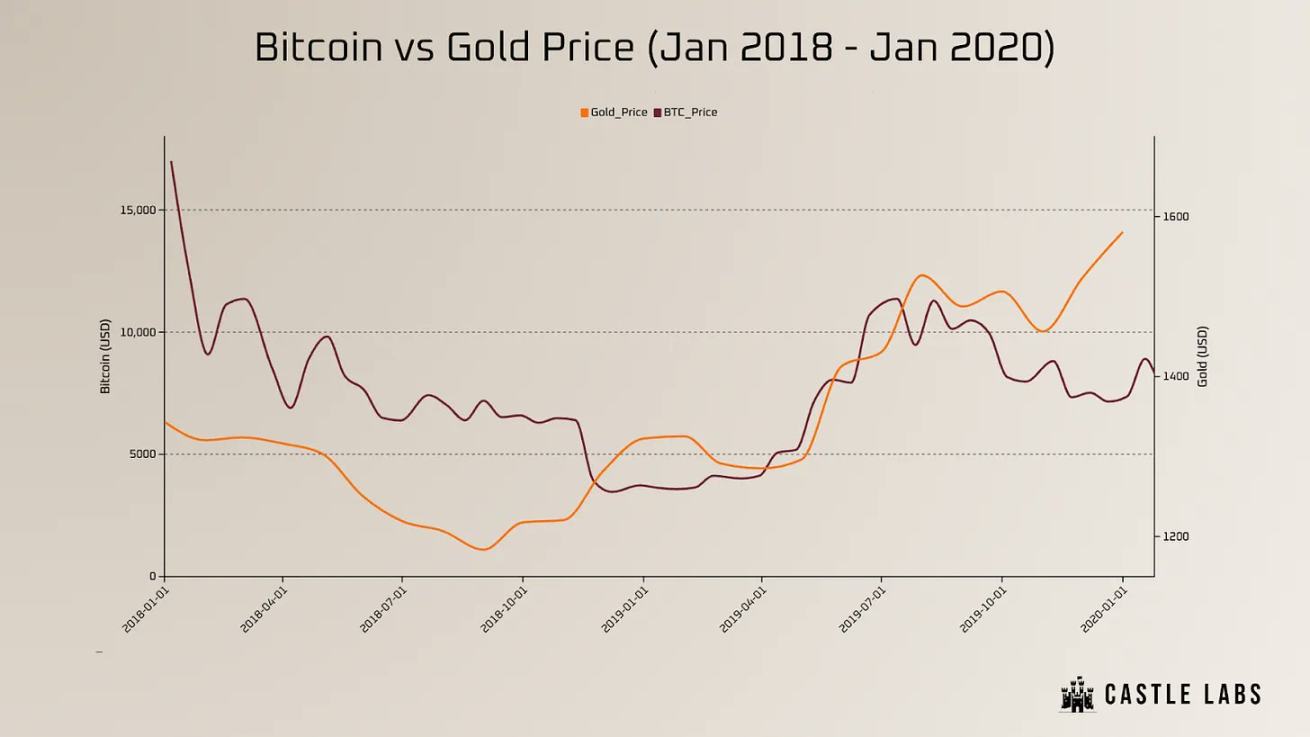
Comparison of Bitcoin and gold price trends from January 2018 to January 2020
Gold is heavy, tangible, and in analog form, while cryptocurrencies are weightless and digital — in short, they are viewed as the “currency of the future.” However, while Bitcoin is still in the cryptopunk niche, promoting “gold is dead” is probably just a cheap and poorly thought out marketing method. However, after the outbreak of COVID-19, the public followed suit. Grayscale took a while to recover its reputation, and the next Bitcoin cycle presented it with an opportunity.
This emerging appetite for risky assets suggests that scarcity can be achieved by human design rather than only through mining.
It is currently unclear whether an artificial virtual product can replace physical assets in the eyes of sovereign countries, but the situation in the 2020s shows that investors are already “hooked up.”
The development history of Bitcoin
Between 2010 and 2025, Bitcoin emerged from the crypto-punk niche, entered Wall Street offices, and grew from a worthless new asset to a trillion-dollar target. The 15-year journey hasn't been easy — every time Bitcoin plummets, it always comes back to life and hits record highs. The media has always been full of doubts about this, and has claimed about 450 times that Bitcoin is “dead.”
Bitcoin's development trend is far from moving in a straight line. In 2017, retail fanaticism took the market by storm, and some even sold their homes to increase their cryptocurrency holdings. Driven by retail fanaticism, ICO (initial coin offering) speculation, and a general sense of adventure, Bitcoin soared from less than $1,000 to nearly $20,000, then crashed in the same year, dragging down the entire cryptocurrency market (the market seemed to have reached its end at the time).
The “macro-hedging era” of 2020, fueled by investment legends such as Paul Tudor Jones (Paul Tudor Jones) and Michael Saylor (Michael Saylor), once again brought this controversial asset to life. Bitcoin has received the necessary public support to become a macro asset that is expected to “challenge gold.” The real breakthrough came in January 2024 — the US Securities and Exchange Commission (SEC) approved a spot Bitcoin ETF (exchange traded fund).
In 15 years, Bitcoin changed from a liberal internet token to a regulated ETF managing billions of dollars. Traditional financial giants such as BlackRock, Fidelity, and Vanda eventually became Bitcoin's “ambassadors”; those who worked on code in basements may have become billionaires, and their old anti-capitalist ideas may have long been left behind and bought one or two yachts instead.
Institutional acceptance pushed Bitcoin past the $100,000 psychological barrier in December 2024 and peaked at $125,000 in October 2025, leaving the market in ecstasy. In that brief moment, the “supercycle” theory seemed irrefutable — the US even began discussing a “Bitcoin strategic reserve,” and cryptocurrency traders were overjoyed.
But just in October, a pricing bug on Binance USDe caused all leveraged long positions to crash. Despite a brief rebound that followed, and the candlestick was eventually filled, Bitcoin began to slowly decline, gradually approaching the key support level — and the market even began to circulate that it “fell to $67,000.”
By the end of 2025, this cycle, which was supposed to be “sustainable,” took a sudden turn. Bitcoin hit a new high, while the rest of the market — including “blue chips” such as Aave, Ethereum, Solana, and Ethena — never recovered. Bitcoin once again maintained an “undefeated record,” but its relative strength did not drive other currencies to rise as well.
This differentiation not only strengthens Bitcoin's position as a “new type of asset,” but also highlights its characteristics as a “reliable and long-lasting asset.” Through absolute scarcity (especially the first-mover advantage), Bitcoin has successfully replicated the precious metals' monetary premium. Unlike fiat currencies that are prone to endless depreciation, Bitcoin is like a decentralized “beacon” — durable, divisible, and instantly transferable. Despite being highly volatile due to its immaturity, it has successfully digitized the inherent characteristics of gold and achieved a complete monopoly on similar assets.
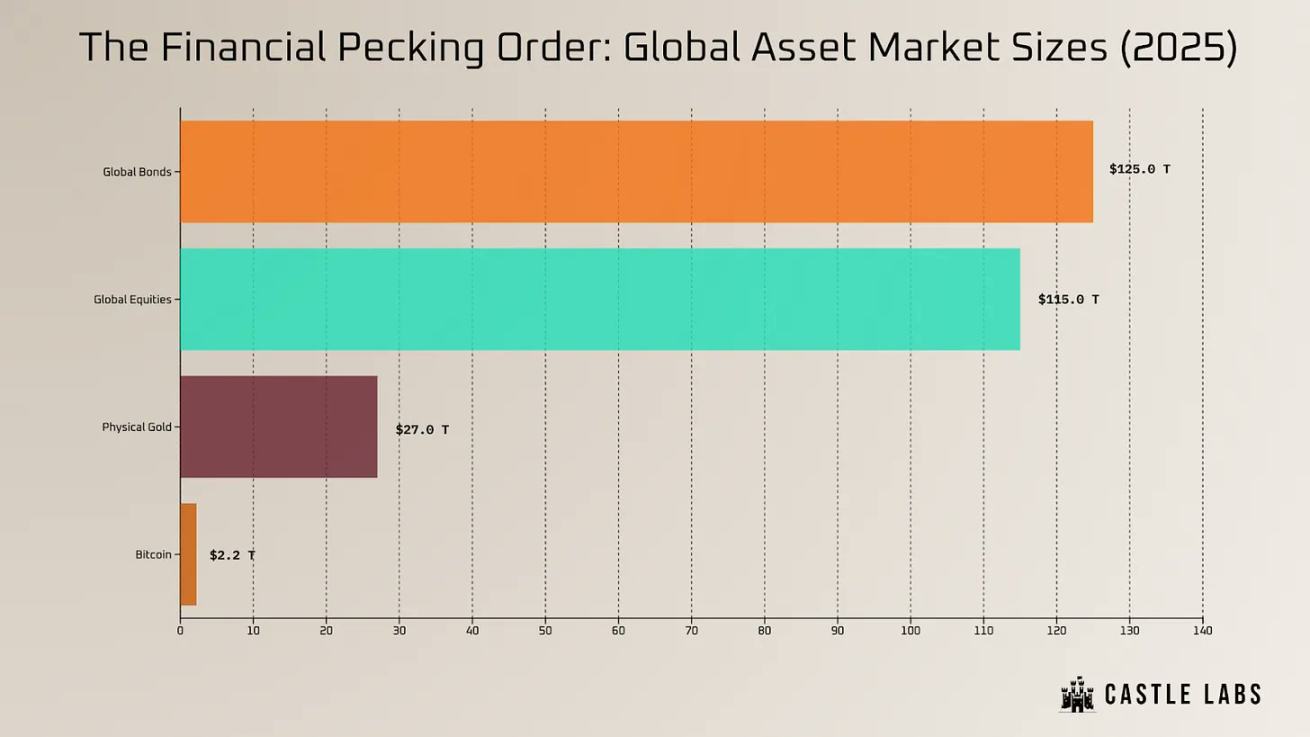
The market size ranking of the world's major assets in 2025 (unit: trillion dollars)
In November 2025, a sharp pullback caused Bitcoin to fall back to $80,000, dragging down the entire market. To everyone's dismay, stocks, gold, silver, collectibles, and various types of assets have all entered a “parabolic” phase of volatility — is the rest of the cryptocurrency really “not working” this time around?
Are we using the “future of real money” in exchange for an ETF code and a “push up shipment”? Is the statement “the agency is about to enter the market” just a marketing scam? Today's Bitcoin is not only a regulated, taxable, and closely monitored asset, but it can't keep up with other assets in the market, and is even more “boring” than gold.
Meanwhile, the price of gold has soared, and so has silver. Even copper, a cheap metal used in electronic products and weapons, is out of control.
Was gold the only “stable currency” from the beginning to the end?
2025: The triumph of gold
Although Bitcoin meets the criteria for a “robust currency,” recent developments suggest that it has yet to show the characteristics that “digital gold” should have.
Gold will outperform Bitcoin in 2025 — not only as a hedge against inflation, geopolitical turmoil, and war, but also an extremely valuable investment.
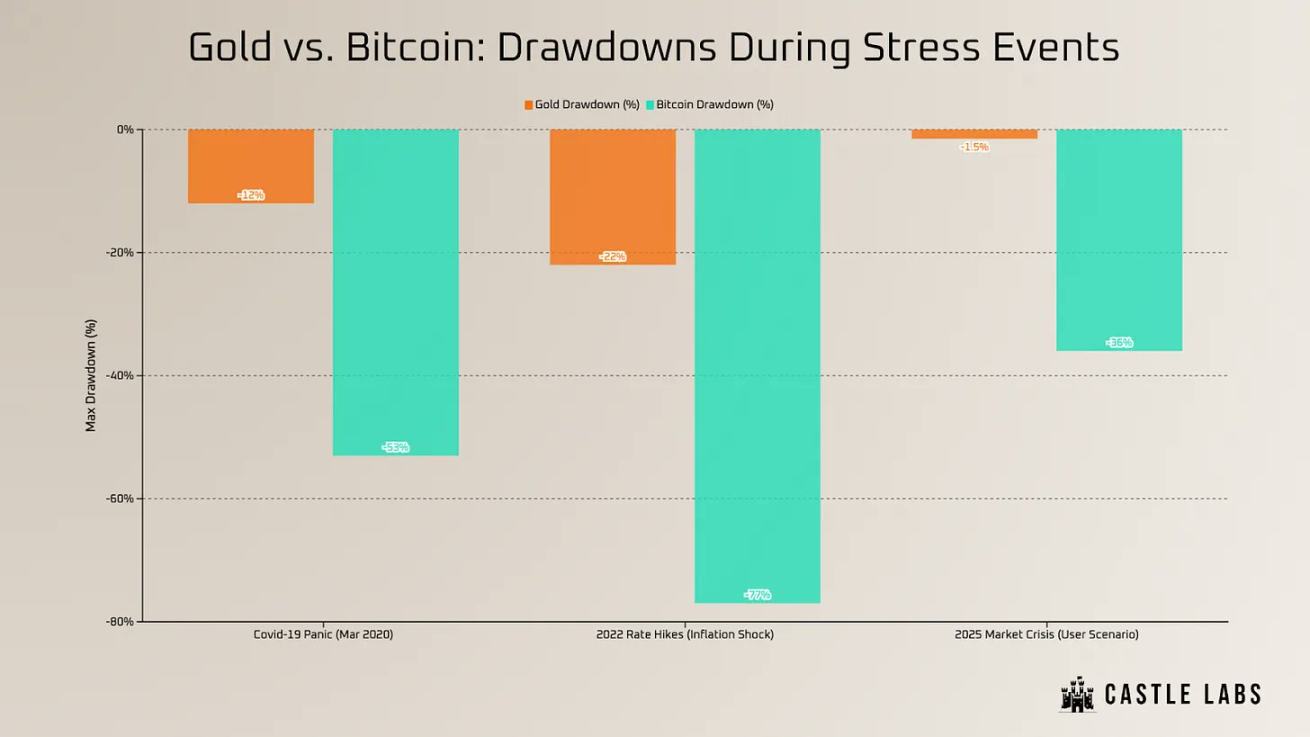
The biggest decline in gold and bitcoin in three market pressure events
The core feature of the global “gold rush” is a massive increase in official reserves: the National Bank of Poland bought heavily, the Reserve Bank of India, Turkey and China continued to increase their holdings, and Brazil joined at the end of the year to diversify foreign exchange reserves. While central banks are promoting a “strategic shift” of gold from west to east, the consumer demand for jewelry and physical gold bars from China and India still ranks first in the world, followed by the US, Turkey, and Iran. In these countries, people see gold as an important hedge against depreciation and economic instability — in 2025 alone, the currencies of Turkey, Argentina, and Iran hit record lows.
If you think the rise in gold is over, then you are sorely mistaken — the agency's argument has changed from “gold is dead” to “gold will rise to $5,000 per ounce.”
VanEck now believes that ongoing geopolitical fluctuations, fiscal instability, and inflationary pressure may push gold to reach $5,000 per ounce by 2030, and that undervalued gold mining companies will inevitably explode.
Wall Street giant J.P. Morgan predicts that the average price of gold will reach $5055 per ounce by the end of 2026 — an increase driven by a “structural shift” rather than a short-term phenomenon. The bank pointed out that there are two core reasons for the rise in gold prices: first, central banks are speeding up the increase in gold holdings (continuing the 2025 trend) to diversify dollar assets; second, the Federal Reserve's interest rate cut has triggered a recovery in Western ETF capital inflows. Gold is being actively traded as a tool to “hedge against currency depreciation,” proving once again that the ancient choice may have stemmed from profound wisdom.
As the market quote says, “Gold is a long-term bet on fear.”
In the cryptocurrency sector, global regulatory pressure has further increased: the European Union's “Crypto Asset Market Regulation Act” (MiCA) has been fully implemented, and the US Treasury has launched a severe crackdown on private coins and non-compliant stablecoins.
Eventually, the illusion that “Bitcoin will replace gold” was completely shattered.
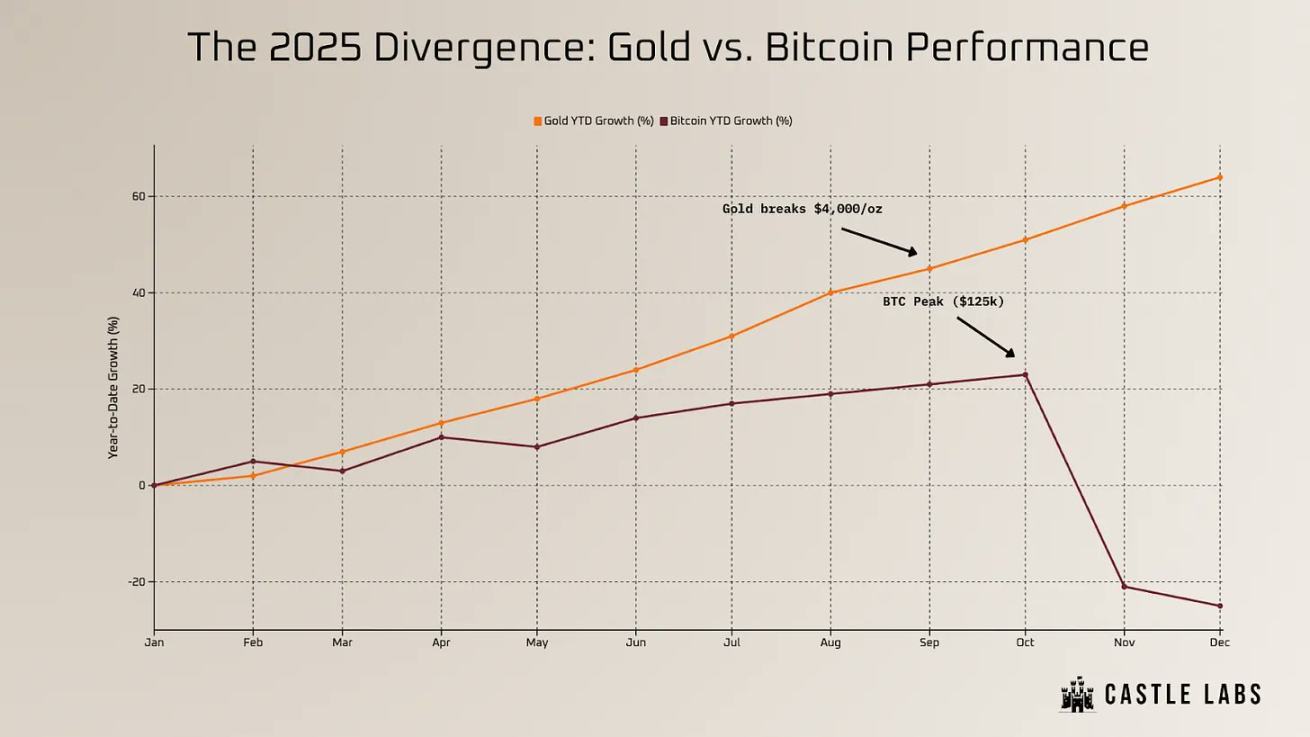
Comparison of the “cumulative annual increase” trend of gold and Bitcoin for the full year of 2025
Currently, we are still undergoing drastic changes, and the situation is difficult to assess. Some may be pessimistic that Bitcoin has failed the “digital gold” test and that the market is returning to normal. After a long period of practice, Bitcoin has not passed the “robust currency” test in the eyes of public and private institutions — although they are open to the concept of “digital gold,” they still prefer gold, an asset that is already heavily held by central banks, which is familiar and reliable.
The relative stability of gold prices is probably another major reason why risk-averse investors prefer it over Bitcoin: although precious metals fluctuate with the global economic situation, they rarely fall sharply. Part of the reason is that even for institutions with sufficient capital to influence the price of precious metals through derivatives, it is extremely difficult to shake the prices of such huge market capitalization assets. Furthermore, a large part of the market value of gold is “dormant” (such as jewelry, central bank treasury, private reserves) and does not flow easily.
In contrast to Bitcoin, retail investors and institutions tend to use leverage to capture its intraday fluctuations. Obviously, driving an asset whose direction is determined by “dynamic liquidity” is much easier than promoting a commodity with a fixed physical shape.
Although investors believe that Bitcoin has “hedge against inflation,” its performance is like an “immature asset” — high volatility and unpredictable fluctuations, far falling far short of what people expect as a “reserve asset.”
The fear of “decoupling” various stablecoins also reminds us: “What you can't actually hold doesn't mean you actually own it.” On the one hand, gold is the ultimate physical asset; on the other hand, it is extremely difficult to store. It is foolish to completely deny Bitcoin, but considering gold as “the only stable currency” in the digital age is also short-sighted.
Currently, market bulls have returned to “safe assets,” and the “baby boomers” (people born in 1946—1964) have once again made a lot of money.
What is certain is that no one could have anticipated: after 15 years of development and fanaticism, Bitcoin still hasn't shown the characteristics of a “reserve asset.” But at the same time, an “asset giant” (gold) that has dominated human imagination, senses, and desires for thousands of years will one day awaken from “slumber.”
Shaking up Bitcoin: a difficult task
At the end of 2025, the claim that “privacy coins or Bitcoin forks may replace gold as a global store of value” resurfaced, but the data revealed a very different reality: the market value of gold was around $32 trillion, while the total market capitalization of Monero and Zcash was difficult to break through $20 billion — a scale that was not even as high as the hourly fluctuation of Nvidia's stock price.
Zcash (ZEC) briefly attracted the attention of the cryptocurrency community (CT) in the fourth quarter of 2025, but not because of its “robust currency” attributes, but due to a narrative shift: thanks to its auditability characteristics, Zcash survived the “clean-up” of private assets from compliant exchanges under the European Union's “Crypto Asset Market Regulatory Framework” (MiCA) and the US “GENIUS Act”. Furthermore, the marketing campaign launched by the founder of Solana has also sparked a wave of spontaneous demand for Zcash in the market.
If you judge Zcash's vitality by gold, silver, stocks, or private equity, you'll find that this kind of price fluctuation is not a typical sign of a “stable currency,” but rather closer to “boosting shipments.”
Instead, privacy coins became a “regulatory contraband” in 2025. Although they can occupy a niche market in short-term narratives, it is difficult to form an atmosphere during the current “boom and bust alternating” stage. Even if concerns about regulatory scrutiny and potential resistance to government intervention occasionally drive up the price of such coins, they are unable to attract the “continuing institutional capital” that cryptocurrencies now urgently need. Paradoxically, such currencies, which were originally designed to “circumvent institutions,” may be able to survive only by relying on institutional funds; however, to achieve long-term survival, they must also come at the cost of “exposure” — after all, funds and banks are unlikely to support an asset designed to “bypass themselves.”
Other alternatives fail the “robust currency” test at all:
Bitcoin Cash (Bitcoin Cash): Lost support from the “store of value” narrative many years ago, today it is just a payment network, more or less forgotten by institutions and retail investors. With the rise of stablecoins, Bitcoin Cash became more irrelevant — well-capitalized tokens designed specifically for payments have replaced it. After two forks and a lack of community attention, Bitcoin Cash is already dwarfed in size compared to Bitcoin.
Zcash (ZEC): The core value is “confidentiality,” but no sovereign country will reserve assets “that global regulators are trying to suppress” or “affected by the heat of speculation.” This token is a “private transaction tool” rather than a “public financial asset,” and lacks the liquidity and stability needed to replace the $32 trillion gold market. Although the total amount of Zcash is also limited to 21 million (an attractive and similar characteristic to Bitcoin), it has always lived in the shadow of Bitcoin.
Monero (XMR): As an alternative to Zcash, Monero's “privacy” is mandatory. In terms of scarcity, although the number of newly minted Monero coins per block is fixed (0.6), the total supply continues to grow, and the inflation rate continues to decline and trend towards 0% (never fully reaching 0%). At least in this attribute, Monero is closer to physical gold than Bitcoin — its stable low annual inflation rate is similar to the characteristics of gold (miners continue to mine new gold).
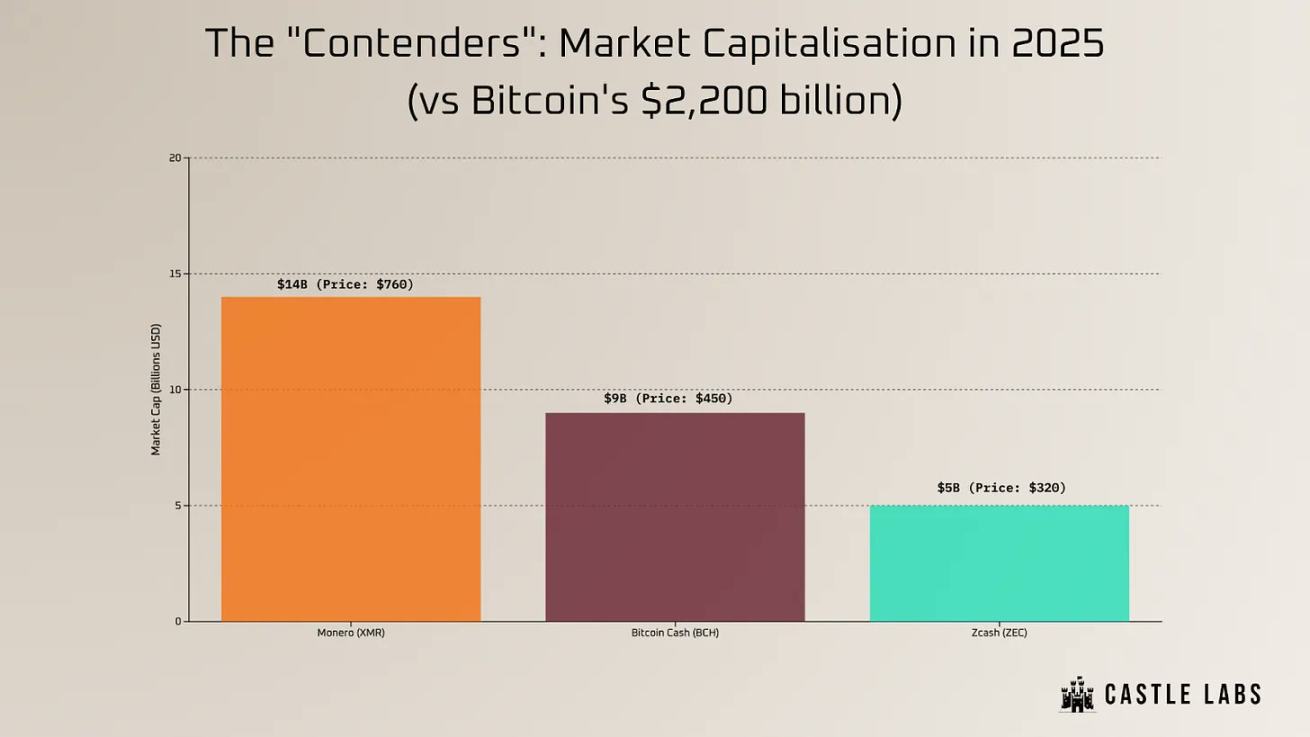
Market capitalization size of Monero, Bitcoin Cash, and Zcash in 2025
However, Monero cannot replace gold as a reserve asset. The core reason is “lack of auditability”: its ledger is completely opaque, and without disclosing private keys or sacrificing the privacy characteristics of the currency's core, it is impossible to prove to the public that it has “sufficient reserves.” But central banks' reserves require “public trust” and “transparency” — a principle that will not change even if the actual accountability mechanisms for US and China's monetary reserves are disputed.
From the above analysis, it can be concluded that from a structural point of view, only Bitcoin could theoretically replace gold. It has passed the “sound currency” test, has sufficient capital, and has received wide recognition at both the institutional and individual levels. Despite intense competition, it has clearly established itself as the “core of cryptocurrency.”
Bitcoin is also the only digital asset “legally recognized” by the US government: in March 2025, the US issued an executive order officially designating more than 200,000 seized bitcoins as “national assets” (not disposed of by auction), thus establishing a “strategic bitcoin reserve (SBR).” This move gave Bitcoin legal status, and countries such as El Salvador (about 6,000 bitcoins) and Bhutan (about 13,000 bitcoins mined through hydroelectric power) have also set up more or less official “strategic Bitcoin reserves” — currently, no other digital asset can receive support from world-class governments.
However, “replacing gold” is still an unrealistic fanatical fantasy, not only because of Bitcoin's high volatility (in 2025, Bitcoin's annualized volatility is about 45%, which is 3 times the 15% volatility of gold), but also because its current market value is far lower than that of gold and silver. Sovereign countries need “deep liquidity” and “huge buffer space” to support monetary policy. Unless the price of Bitcoin regains its rise and reaches 1 million US dollars/unit, it will never have the “influence” of gold.
The best of both worlds?
For 15 years, the most heated debate has revolved around “huge precious metals” and “ambitious digital assets” — gold versus bitcoin. A series of events in 2025 put this debate on hold: gold is still the “real currency,” while Bitcoin is still a “high-risk asset.” Although Bitcoin's volatility reached a record high, its decline did not reach the extent that “prudent strategies are needed to avoid risk”; there is no doubt that the entire cryptocurrency ecosystem has suffered huge losses.
Gold once again confirms its status as a “thousand-year-old imperial coin”: it is a “national asset” and the “ultimate guarantee” — no electricity, no internet, and no license to hold. As shown by the massive increase in gold holdings in countries such as Poland, China, and Brazil (completely ignoring Bitcoin), gold remains the most sought-after commodity during turbulent times.
In contrast, Bitcoin has evolved into a “high beta asset with an image of institutional authority” (a high beta value means that the risk is higher than the market average, and the potential return is higher). It is essentially a “trader's asset” — profiting from its sharp fluctuations in both directions. Its high volatility, high portability and high liquidity enable capital to be transferred across borders within seconds, bypassing the old transaction channels of the traditional banking industry.
Despite the weakening of Bitcoin's image as a “frontier asset,” gold's “perfect reputation” is getting stronger — it is a well-deserved “market winner” in 2025.
The difficult task of “replacing gold” was a false marketing gimmick from beginning to end. Today's financial system “needs both,” not least because Bitcoin has spawned a “trillion-dollar industry” — an industry whose healthy development depends entirely on Bitcoin's stability. However, cryptocurrencies are still “high explosive assets” that we are relentlessly chasing.
In the turbulent years ahead, cautious investors won't choose between “gold (this yellow metal)” and “Bitcoin (this line of code)” — because the two cannot be assimilated with each other.
If gold is “the traditional wealth guarantee that builds families and empires,” then Bitcoin is “a popular maverick asset”: elusive, sometimes out of control, yet mysteriously fascinating. Whether it can transform into the “reserve asset” we expect will only be revealed through more “stress tests” and “years of trial and error.”
Twitter:https://twitter.com/BitpushNewsCN
Compare the TG exchange group:https://t.me/BitPushCommunity
Compare TG subscriptions:https://t.me/bitpush
