


Lobster hasn't grown, big manufacturers have fenced the net: the OpenClaw ecosystem is facing a land crisis
Author: Golem
Original title: Free Mirroring or Rodeo is King? OpenClaw founder bombards Tencent for plagiarism
When major domestic manufacturers scrambled to launch the “one-click installation of OpenClaw,” controversy followed.
OpenCLAW founder Peter Steinberger revealed on X on March 12questionedThe Skillhub created by Tencent made it impossible to quickly scrape data due to a drop in the official rate, adding that “they copied it, but they did not support this project in any way.”
Faced with the controversy, Tencent quickly responded and expressed understanding of Peter Steinberger's concerns.称SkillHub is a localized Skills platform built by Tencent based on the OpenClaw ecosystem. As a local mirror site, it not only always indicates Clawhub as the data source, but also processed 180 GB of traffic (870,000 downloads) for users in the first week of launch, and only pulls 1 GB of non-concurrent requests from the official source. Meanwhile, Tencent expressed its willingness to become a sponsor.
As a matter of course, Tencent's response in this round has clearly explained the question of “whether it is frantically consuming the source site”, which is most likely to trigger a backlash in public opinion, but Peter didn't buy it after reading it.voicedThis is not the point. He can use SkillHub as the official fifth mirror and download statistics simultaneously, but Tencent should actively communicate with it beforehand.
Although this is the end of the matter, if you only understand this incident as “the founder of OpenClaw launched an emotional attack” or “the big manufacturer's normal localization was misunderstood,” then you're really underestimating the problem.
The problem is not mirroring, but the “overbearing” of big manufacturers
If you only look at technical actions, this is actually not unusual.
In the Chinese developer ecosystem, mirroring open source projects is a routine operation. International open source infrastructures such as npm, PyPI, and Docker Hub all have a large number of local images in China. Because of this, Tencent denied that the Skillhub it created was a plagiarism, but rather a localized Skills platform. It explained that it was not scavenging and emptying the official website, but was distributing, speeding up, and adapting to help OpenClaw land in China.
In a sense, Tencent's approach has indeed met the most realistic needs of “shrimp farmers” in China. OpenClaw is so popular in China that not everyone is willing or able to have stable access to the original community, let alone the installation, discovery, and retrieval experience of many Skills itself is still very original.
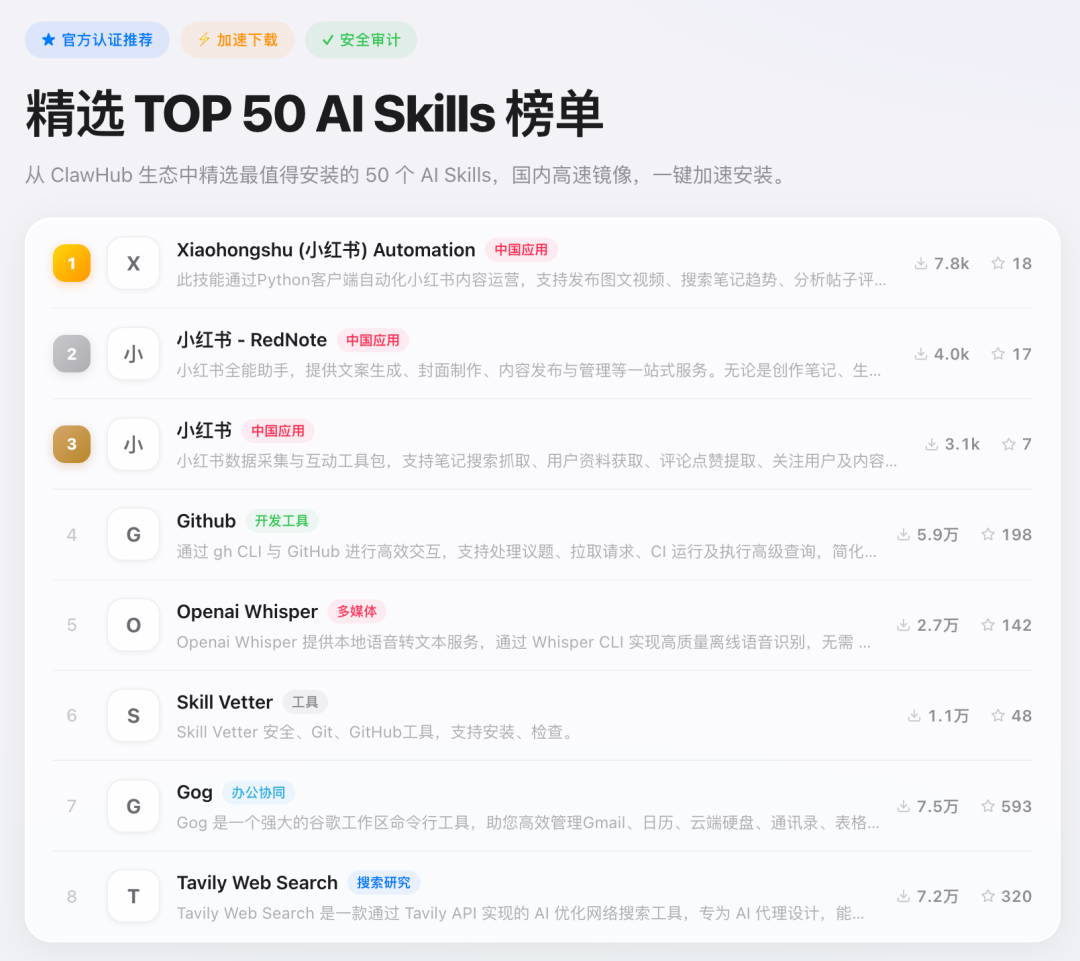
Skillhub
But the question is, are mirror sites naturally innocent? The answer is not necessarily.
Because what open source agreements allow, what community ethics accept, and what will eventually happen in commercial reality, there are often three different sets of accounts.
At the level of the agreement, as long as the license is followed and the source is indicated, many mirroring and redistribution acts are established; at the level of community ethics, Tencent's SkillHub marks OpenClaw's official source status, and also actively reduces the bandwidth costs of the origin site, and seems to have taken responsibility.
However, Tencent forgot that OpenClaw is not a small open source project requiring deliberate resource injection from big manufacturers. It is the most popular project and has received the most stars on GitHub. At this point, Tencent's act of not saying hello became “overbearing.” Because it's no longer just a mirroring issue, it quickly involves three more sensitive issues: who represents the official ecosystem, who is taking away the user portal, and who defines download, distribution, and statistical caliber.
This is what really makes Peter uncomfortable, hisvoicedTencent's behavior directly affects download statistics. Peter doesn't support Tencent's localization of OpenClaw in China, but he thinks it's best to be able to communicate in advance, rather than having Tencent set up the platform, take over users, and then explain that he is actually here to help under pressure from public opinion.
Also, from the perspective of commercial reality, once a platform shell such as SkillHub forms in scale, the official and statistical power that the OpenClaw community originally possesses can easily be marginalized. Today is a localized Skills platform, tomorrow may be the “Default Skills Distribution Marketplace”, and later, it may be “who decides what Skills are seen, installed, and commercialized.”
This is the real danger sign behind this controversy. It is also the most familiar scene on the Chinese Internet over the past 10 years: the Rodeo Campaign.
Big manufacturers are not “raising lobsters”; they are using AI to secure lobster
Over the past period, “raising lobsters” became the hottest topic in the Chinese AI industry, and OpenClaw was quickly promoted as an almost emotional industry symbol. Everyone is saying that lobster represents the new imagination of the Agent era and represents the future of personal AI assistants. It sounds very enthusiastic.
However, when big manufacturers look at lobster, they never look at idealism; what they see is entry, traffic, distribution rights, and next-generation operating system shells.
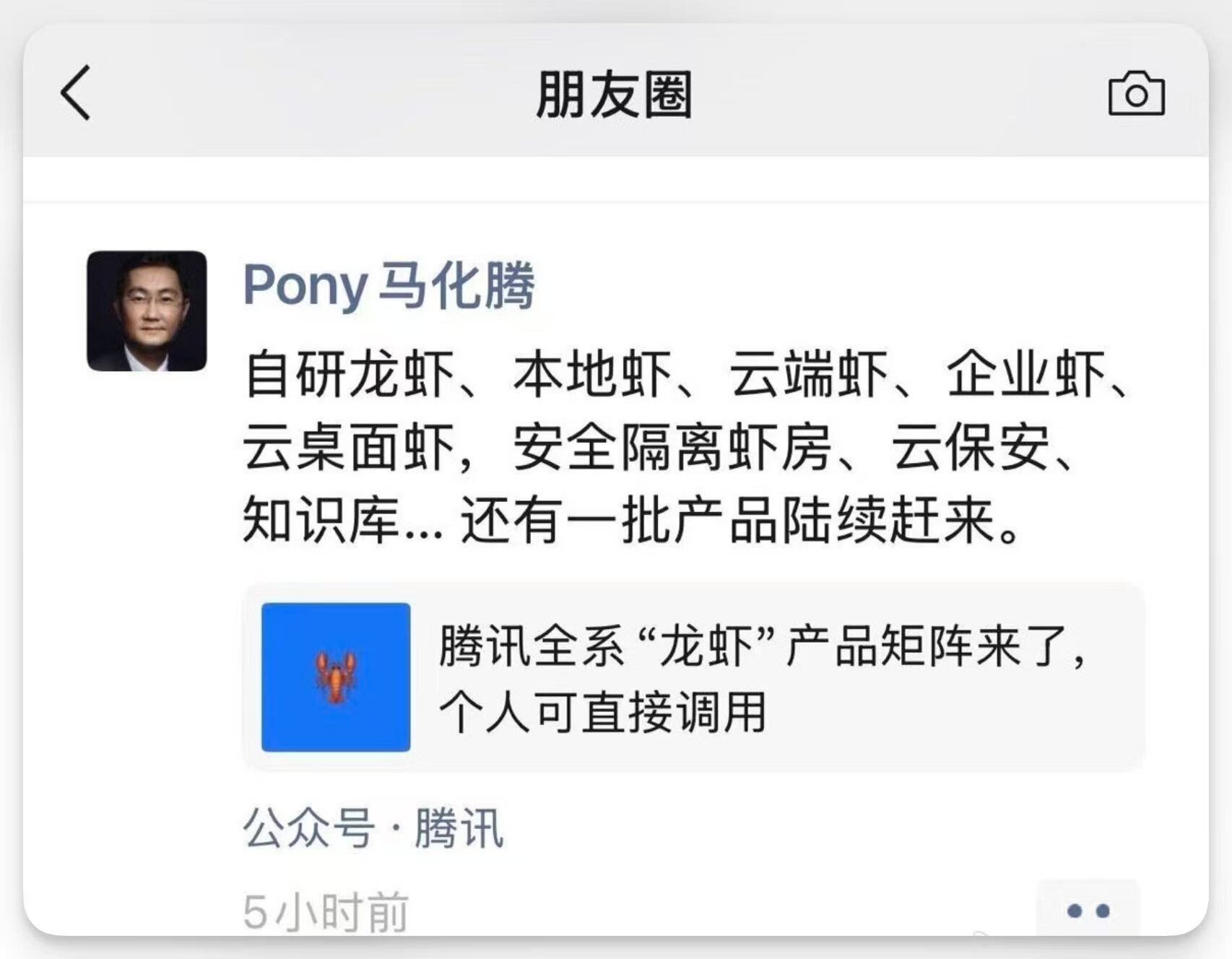
In the early morning of March 11, Ma Huateng promoted Tencent's entire line of “lobster” products in his circle of friends. Tencent's “Lobster Family Bucket” tailor-made a “crayfish” for ordinary users, developers, and enterprise users, to support users with one-click installation without a threshold. SkillHub was also launched simultaneously at this time. It has built-in one-click access to 13,000 localized skills, which can be directly invoked in scenarios such as Xiaohongshu operation and Baidu search.
Of course, it's not just Tencent's family that is “moved by the wind.” Once you open up the timeline, you'll find that major domestic manufacturers almost collectively help users solve the “lobster raising” problem. The movement is as neat as pressing the same switch, but it's the most comprehensive that Tencent has done so far.
On the surface, everyone is well-intentioned, but in reality, there is a set of business path dependencies that Chinese internet companies are most familiar with. Facing a new ecosystem that has already been verified by the market and raised in popularity by public opinion, the first move is not to make money or a business model, but to grab entry first, create a platform first, and pick up users first.
What Tencent wants is not only to make it easier for Chinese users to “raise lobsters,” but when Chinese users first actually start “using agents,” the first reaction is to complete it in Tencent's product shell.
This is where the action of SkillHub is most interesting. On the surface, it is a mirror station, but in essence, it may be the starting point for a larger closed loop. What users see today is a local search and download of Skills; tomorrow, they may be connected to a certain cloud, a certain set of accounts, or an enterprise workbench by default. Further on, developers will slowly discover that even though they are still developing in the OpenClaw ecosystem, what actually determines the path of exposure, recommendation, review, and commercialization has become a platform.
This script has been performed too many times on the Chinese internet. From taxis to takeout, from short video platforms to cloud marketplaces, almost every “ecological boom” is accompanied by the same structural end — the platform first uses free, open, etc. to solicit users, then builds walls, and uses traffic, advertising, etc. to turn the ecosystem back into its own subsidiary layer.
Big players know that now the old portals of search, social networking, content, and e-commerce have reached their limits, and Agent is probably the new entry worth betting on in the next round. Since this is the case, instead of waiting for OpenClaw to grow savagely on its own, it is better to take it first, package it first, and let users develop the habit of “calling lobster” in their own systems.
As a result, everyone is all too familiar with what happens next after major manufacturers scramble to help users solve OpenClaw installation problems. Peter, who doesn't understand the Chinese internet, naturally couldn't understand why Tencent didn't communicate with it beforehand and why it didn't sync data with it.
OpenClaw represents a different AI future: local operation, personal control, community expansion, open connectivity, and the most imaginative part of it is making the Agent truly the user's own execution layer. However, once this ecosystem is repackaged by major manufacturers using “localized mirroring,” “domestic adaptation,” “unified distribution,” and “safety review,” the taste changed. In the eyes of big manufacturers, the entrance belongs to me, the distribution is mine, and the final payment and commercialization are also best for me.
Big manufacturers are not “embracing lobster,” but are “borrowing lobster circles in the AI era.” This is also the most unsettling point behind this minor dispute.
The fence is never built all at once; it always grows slowly in the name of “more convenient” and “more stable.” When developers, users, and traffic are all packed into the same shell, the so-called open autonomy may end up being just a component of the big factory ecosystem.
OpenClaw is currently facing the strangest situation in the country: “lobsters” have not yet grown, but large factories have already begun to fence the net.
Twitter:https://twitter.com/BitpushNewsCN
Compare the TG exchange group:https://t.me/BitPushCommunity
Compare TG subscriptions:https://t.me/bitpush
