


How to throw stolen money into AI unicorns: a crypto scammer's “altruistic” gamble
Author: Shenzhao TechFlow
Original title: 500 million becomes 30 billion: How did the crypto maniac SBF invest in the most valuable company in the AI era?
Anthropic is probably not one of the most important AI companies on the planet today.
Its large Claude model is deployed in the Pentagon, US intelligence agencies, and national laboratories, and is used by the US military for intelligence analysis and target screening of military attacks on Iran.
Its annualized revenue soared from zero to $14 billion in less than three years. In February 2026, Anthropic closed $30 billion in Series G financing, and the post-investment valuation surpassed $380 billion. Amazon, Google, Nvidia, Microsoft, and tech giants are lining up to buy money.
Over the past few weeks, it has been playing a game with the Pentagon over the weaponization of AI that the world is watching.
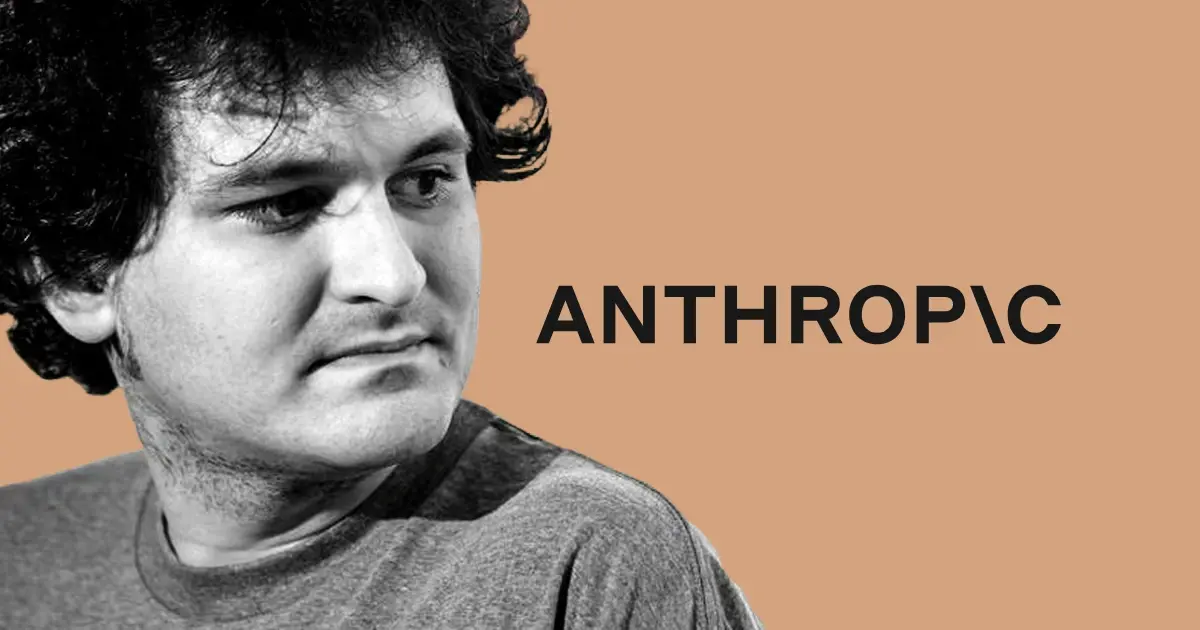
And in the company's early financing history, there is one name that people still relish: Sam Bankman-Fried.
In April 2022, ChatGPT didn't exist yet, and the AI circuit was far less popular than it is today. SBF, through Alameda Research, a hedge fund he controls, spent $500 million on Anthropic's Series B, eating 86% of the entire financing round in one go, and taking about 8% of the shares. Seven months later, the FTX empire collapsed, and SBF became the protagonist of the biggest fraud in cryptocurrency history, and was jailed for 25 years. The $500 million was FTX clients' deposits.
But if SBF hadn't been caught, if that money had come from legal sources, 8% of the shares would theoretically be worth more than $30 billion, according to today's valuation of 380 billion dollars. 500 million became 30 billion, and the return rate was more than 60 times. In the entire history of venture capital, this absolute profit is enough to rank high.
A crypto scammer serving a federal prison sentence almost made one of the craziest bets in AI investment history.
Why did SBF find Anthropic in 2022? Why would he want to smash 500 million? Why did Anthropic take this money?
The answer lies in a circle called “effective altruism.”
A shared house, a sport, a check
In San Francisco in the mid-2010s, a group of people lived in the same type of shared house, attended the same kind of parties, read the same kind of papers, and believed in the same philosophy.
This philosophy is called Effective Altruism (EA). The core proposition is simple: charity should not be based on feelings; it should be based on calculation. Every dollar should go in the direction of mathematically “maximizing good results,” and in the opinion of an important branch of EA, the number one existential risk facing humans is not nuclear war, not a plague, but uncontrolled artificial intelligence.
Dario Amodei is in this circle.
He is the 43rd signer of Giving What We Can Pledge, pledging to donate at least 10% of his revenue, and he became a GiveWell fan back in 2007 or 2008.
He lives in the same shared house with two people: Holden Karnofsky, co-founder of GiveWell and Open Philanthropy, one of the EA movement's most influential money allocators; the other is Paul Christiano, a core researcher in the field of AI alignment. At the time, Dario and Paul were both technical advisors for Open Philanthropy.
Karnofsky later married Dario's sister Daniela. After getting engaged, the couple lived with Dario for a while. In January 2025, Karnofsky quietly joined Anthropic as a “technical employee” responsible for security policies. Anthropic hadn't even announced this appointment to the outside world when the Fortune reporter discovered the incident.
It's an intimate social network.
Amanda Askell, an early employee of Anthropic, is the former wife of William MacAskill, one of the founders of the EA movement. She is the 67th signer of GWWC, and her doctoral dissertation is on a core topic in EA's philosophy, how to handle infinity in ethics.
Anthropic's most important governance body, the “Long-Term Benefit Trust” (Long-Term Benefit Trust), theoretically has significant control over the company. Three of its four members are directly from the EA system: Neil Buddy Shah, former managing director of GiveWell, Zach Robinson, CEO of the Center for Effective Altruism, and Kanika, CEO of Evidence Action, GiveWell's long-time funder Bahl.
The three biggest investors in EA Sports history are all early investors of Anthropic, Facebook co-founder Dustin Moskovitz, Skype co-founder Jaan Tallinn, and Sam Bankman-Fried.
This is the true path for SBF to find Anthropic. It's not a genius investment vision, not an advanced judgment on the AI circuit, but a financial cycle within a circle: EA's money flows to EA's projects to solve problems defined by EA.
SBF believes in the more radical part of EA, “earn to give” (earn to give). He resigned from Wall Street quantification agency Jane Street to join cryptocurrency, publicly claiming that his purpose was not personal wealth, but “altruism,” to earn as much money as possible before investing the money in a direction that would have the greatest positive impact. Anthropic's mission, “Safely Develop Powerful AI,” is almost EA's standard prescription for AI's existential risk.
In May 2021, Jaan Tallinn led Anthropic's A round with $124 million, followed by Moskovitz. In April 2022, SBF took the lead in round B and wrote checks of $500 million in one go, accounting for 86% of the total financing amount of $580 million. Also included in the same round were Caroline Ellison, Nishad Singh, and Jane Street's James McClave.
This follow-up list itself explains the problem quite well. Caroline Ellison is the CEO of Alameda, Nishad Singh is FTX's director of engineering, and Jane Street is the former owner of SBF.
This 580 million round B actually comes almost entirely from the SBF and surrounding controlled capital pool.
Red Flags and Compromise
Dario Amodei isn't stupid.
He later recalled the incident in an in-depth interview, saying that SBF seemed to be a “person who is passionate about AI and concerned about safety” at the time, which was in line with Anthropic's direction, but right after that, Dario said a key phrase: he had detected “enough red flags.”
So he made a decision: take the money, but segregate it in terms of the governance structure. SBF received non-voting shares and was excluded from the board of directors. Dario later rated SBF's behavior as “far more extreme and worse than I had imagined”, and the three “much more” were superimposed.
This decision later proved to be extremely clever. But it also leaves a sharp question: if there are so many danger signs that they need to be quarantined in the governance structure, why are they still taking it?
You can say that the AI financing environment at the beginning of 2022 was far less hot than today. Anthropic needs large sums of money to build computing power. An investor willing to pay 500 million dollars at once is hard to find, no matter how many “red flags” he has.
But there is another more subtle reason: in the logic of the operation of the EA Circle, the “cleanliness” of funding sources is never a priority. What matters is the “effectiveness” of funding, and whether it can help you do more. SBF's entire wealth narrative is based on this: making money is a means, and doing good is an end, so you can be less concerned about how to make money, as long as the final output of “good” is big enough.
This set of logic went to the extreme of the crime in SBF's hands, but at the time he invested in Anthropic, it still seemed like a radical but unlawful philosophical choice.
After the Collapse: A Dark Comedy
Everyone in the crypto community knows the story behind it.
In November 2022, CoinDesk revealed Alameda's balance sheet. Changpeng Zhao announced the sell-off of FTT, a wave of crowding swept through FTX, and the empire collapsed within nine days. SBF was arrested, extradited, tried, and sentenced to 25 years in March 2024. Anthropic's 8% stake, along with all assets, was frozen in bankruptcy and liquidation proceedings.
One episode of the trial that was excluded by the court is worth mentioning.
SBF's defense lawyers tried to use the Anthropic investment as evidence of “foresight,” “Look, he didn't just squander; he made an investment decision that doubled his valuation several times over.”
Prosecutor Damian Williams's response was tough: Whether these investments were profitable had nothing to do with the fraud charges. You stole other people's money to invest, and even if you make money, you still steal it. The judge accepted the prosecution's opinion, and Anthropic's name was excluded from the trial.
The prosecution also made up for it: Isn't FTX itself the best counterpoint textbook? Valued at $18 billion in 2021 and $32 billion in 2022, it's worth nothing today.
Then there's the liquidation auction.
In March 2024, the first round of the $884 million valuation.
The biggest buyer, Abu Dhabi's sovereign fund Mubadala, invested 500 million US dollars, which is exactly the same figure SBF invested that year. The second-largest buyer was Jane Street, the former owner of SBF and Caroline Ellison. Craig Falls, head of quantitative research at Jane Street, even personally paid 20 million to participate. SBF's first job after graduating from MIT was as a trader on Jane Street, and now the old owner is spending money to buy back shares bought by former employees with stolen money.
A total of 1.34 billion dollars were recovered in both rounds. This money flowed into FTX's creditor payment pool and became an important source of funds for victimized users to recover their deposits.
What if the clearing team didn't sell it?
In February 2026, Anthropic completed the G round of financing of US$30 billion, with a post-investment valuation of US$380 billion. If you don't count dilutions, that 8% theoretically went from 1.34 billion to 30 billion. Of course, the clearing team didn't choose that; their duty was to liquidate and repay creditors as soon as possible, but this digital gap, 1.34 billion versus potentially over 30 billion, is the key to understanding why this story is still being discussed today.
It's one of the biggest regrets in the entire FTX bankruptcy case.
EA's collective oblivion
Anthropic's size and influence today need no further explanation, but an interesting phenomenon is that the company is systematically distancing itself from the EA movement.
All seven of its co-founders have pledged to donate 80% of their personal wealth, and these seven founders alone have pledged donations worth around $38 billion at current valuations. Nearly 30 Anthropic employees signed up for the EA conference in San Francisco, more than double the number of OpenAI, Google DeepMind, xAI, and Meta Super Smart Labs combined.
But Daniela Amodei said in an interview with Wired: “I'm not an expert on effective altruism. I don't agree with that term. I had the impression that was a bit out of date.” The person who said this, her husband, one of the most influential allocators of funds for the EA Movement, has just joined her company.
This attitude of “taking EA money, people using EA, living in EA's shared house but not acknowledging it as EA” became understandable after the SBF case. The collapse of FTX has brought the EA Movement's reputation to a rock bottom. Anthropic needs to distance itself from this label, just as any smart company cuts when brands are negatively associated.
But there's the truth: Anthropic's founding logic comes from EA's core discussion about the existential risks of AI; its early funding came almost entirely from funding from the EA network; and its governance structure was controlled by people within the EA system.
Parallel universes in prison
Sam Bankman-Fried is now in federal prison. He was released from prison at the earliest in 2049. He was 57 by then.
During his time in jail, the AI company he invested in with stolen money had surpassed $380 billion in valuation and was in a high-profile game with the Pentagon over AI weaponization. Its founder became a regular visitor to The New York Times and Capitol Hill. If everything were legal, that $500 million bet would be enough to make SBF one of the highest-paying venture capitalists of this era.
SBF's “Earn Money Donate” and Anthropic's “Safe Development AI” share the same underlying operating system and can withstand unusual methods and risks for sufficient good results.
SBF pushes this logic beyond the boundaries of crime, and Anthropic operates on the safe side of this line, but its core proposition — “We must build the most powerful AI ourselves to ensure the safety of AI” itself is an ambitious to almost self-proof bet.
They grow in the same area of soil.
In that soil, Dario and SBF used to attend the same parties, believe in the same philosophy, and live on different nodes of the same social network. One went to an AI empire valued at $380 billion, and the other went to a federal prison.
And the $500 million check that connected them is still one of the strangest pages in Anthropic's history.
Twitter:https://twitter.com/BitpushNewsCN
Compare the TG exchange group:https://t.me/BitPushCommunity
Compare TG subscriptions:https://t.me/bitpush
