


Predicting the rise of the market: how many pieces of cake are left for spinach players?

In the past few years, the forecasting market has risen to prominence and has achieved an astonishing hundred-fold increase thanks to the US election.
After the election, sports became the most traded sector in the prediction market, competing with traditional spinach companies for the fat meat of the US sports betting market worth more than 30 billion US dollars.
Robinhood CEO Vlad Tenev mentioned in an interview that the sports spinach company must have realized the seriousness of the situation and understood that it could completely disrupt their business.
The prediction market has become a new way for millions of Americans to bet on sporting events and elections, so people can't help but speculate: how much of the spinach market share is being taken by the prediction market?
This article will use public data to do some analysis to try to resolve the doubts of all the judges.
Predicting market performance
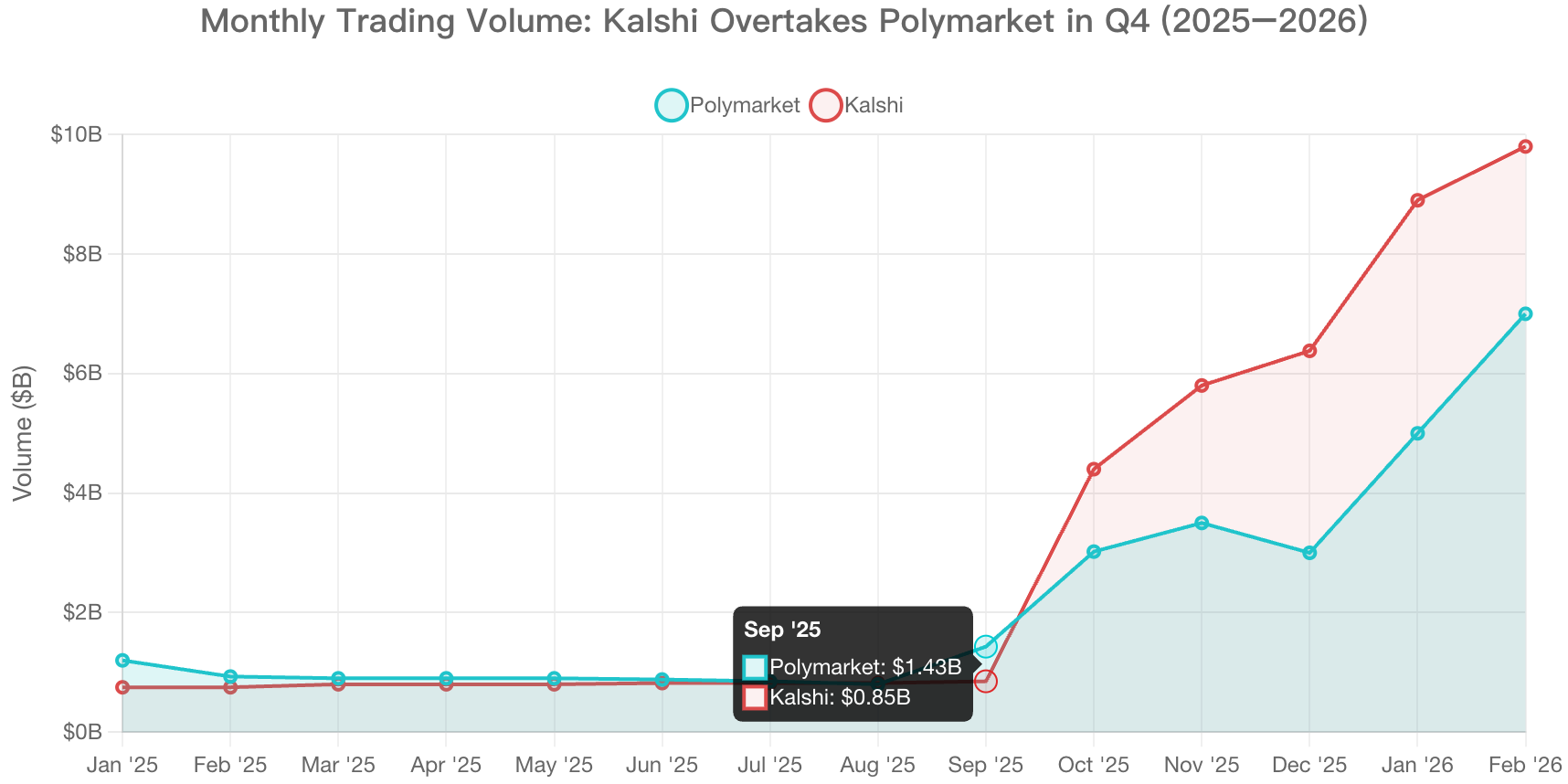
In the first few months of 2025, the monthly trading volume of Polymarket and Kalshi hovered between 800 million and 1.2 billion US dollars. By October, there was a blowout.
Polymarket's monthly trading volume jumped to US$3.02 billion, an increase of 110% in a single month. Kalshi also grew to about 4.4 billion US dollars, reaching 5.8 billion US dollars in November, and set a record of 6.38 billion US dollars in December.
The reason for Kalshi's explosive growth is that it reached a strategic partnership with Robinhood and was directly embedded into a traditional retail brokerage app with tens of millions of active users, bringing in massive amounts of new traditional finance capital and small white users. Polymarket also obtained a compliance license from the US Commodity Futures Trading Commission (CFTC) through the acquisition, reopening the US domestic market.
Another major reason is that October is a super golden period for North American sports. With Americans' favorite NFL, the new NBA season has begun, and the MLB playoffs are also being played.
According to the comprehensive operating rate of 16.8 billion US dollars per month in February 2026 (Polymarket 7 billion US dollars + Kalshi 9.8 billion US dollars), the market is expected to achieve an annual transaction volume of more than 200 billion US dollars. If the growth momentum continues, the predicted market size may reach 1.1 trillion US dollars by 2030.
Not bad, right?
Has the spinach platform been encroached upon?
On the day Kalshi launched “Kalshi Combos” (Kalshi Combos), the DraftKings (DKNG) stock price once plummeted by more than 12%, and the market value evaporated by about 2.5 billion US dollars in a single day. Flutter's (FLUT) stock price plummeted by more than 10%, and the market value evaporated by about 5.5 billion US dollars in a single day.
Wall Street analysts pointed out that the advent of Kalshi Combos marks the official entry of the prediction market into the core territory of traditional betting, and Parlays is the most profitable and deepest moat business for DraftKings and FanDuel.
DraftKings CEO Jason Robins talked about the fall in stock prices in an interview, saying that this is not only a threat from prediction markets such as Kalshi and Polymarket, but it is indeed one of the main reasons.
Under media portrayals, a voice began to spread: predicting that the market is disrupting and devouring the 100 billion dollar empire of traditional sports betting. But what is the truth?
If we compare the actual turnover of compliant sports giants such as FanDuel and DraftKings, and Stake, an unregulated crypto casino hegemon, and Polymarket in the same data dimension, we'll find that no real encroachment occurred between 2023 and 2025; the two showed explosive growth in parallel on two tracks.
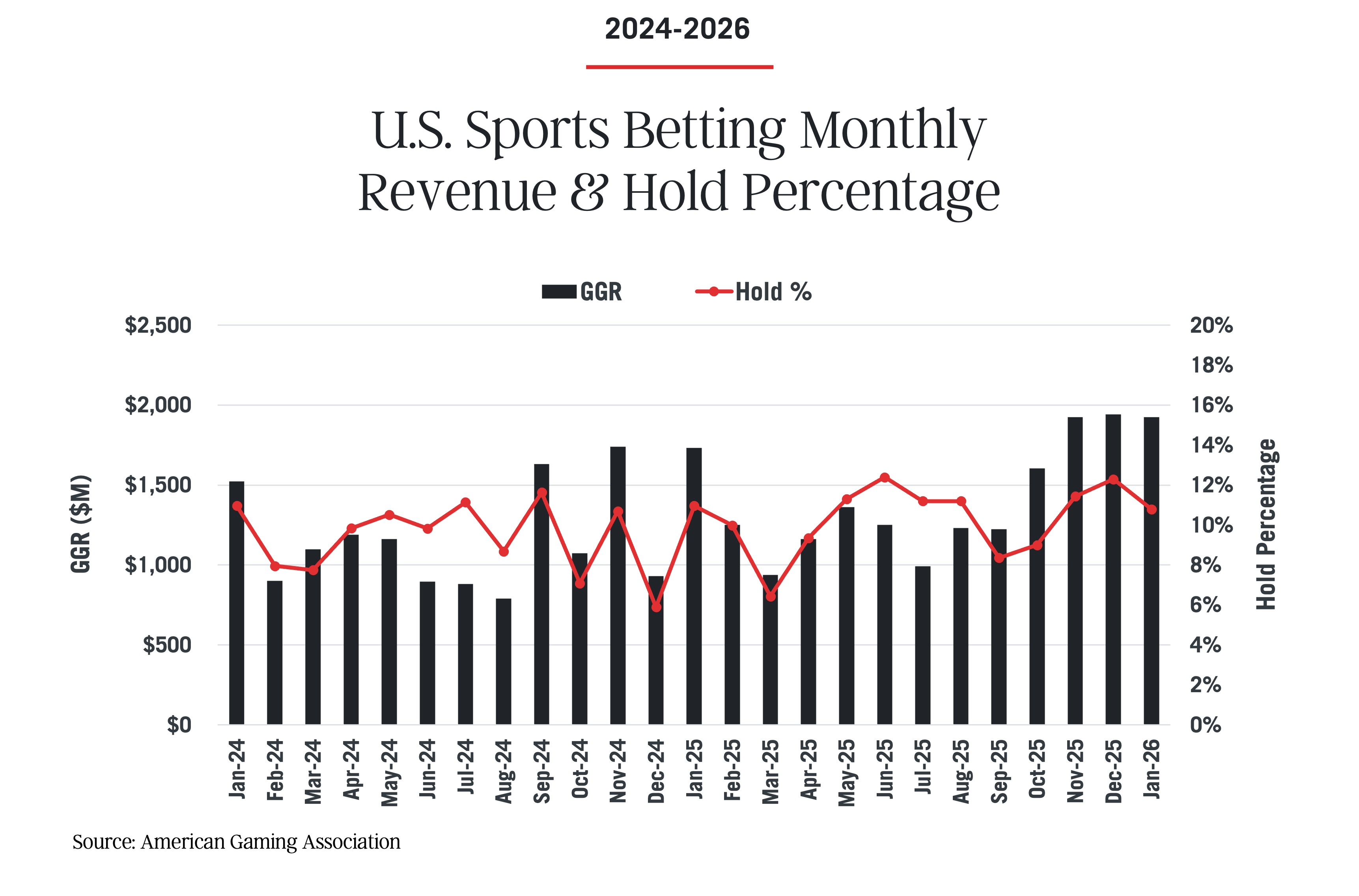
According to the latest “Commercial Gaming Revenue Tracking” report published by the American Gaming Association, the US legal sports betting industry hit record highs in both 2024 and 2025.
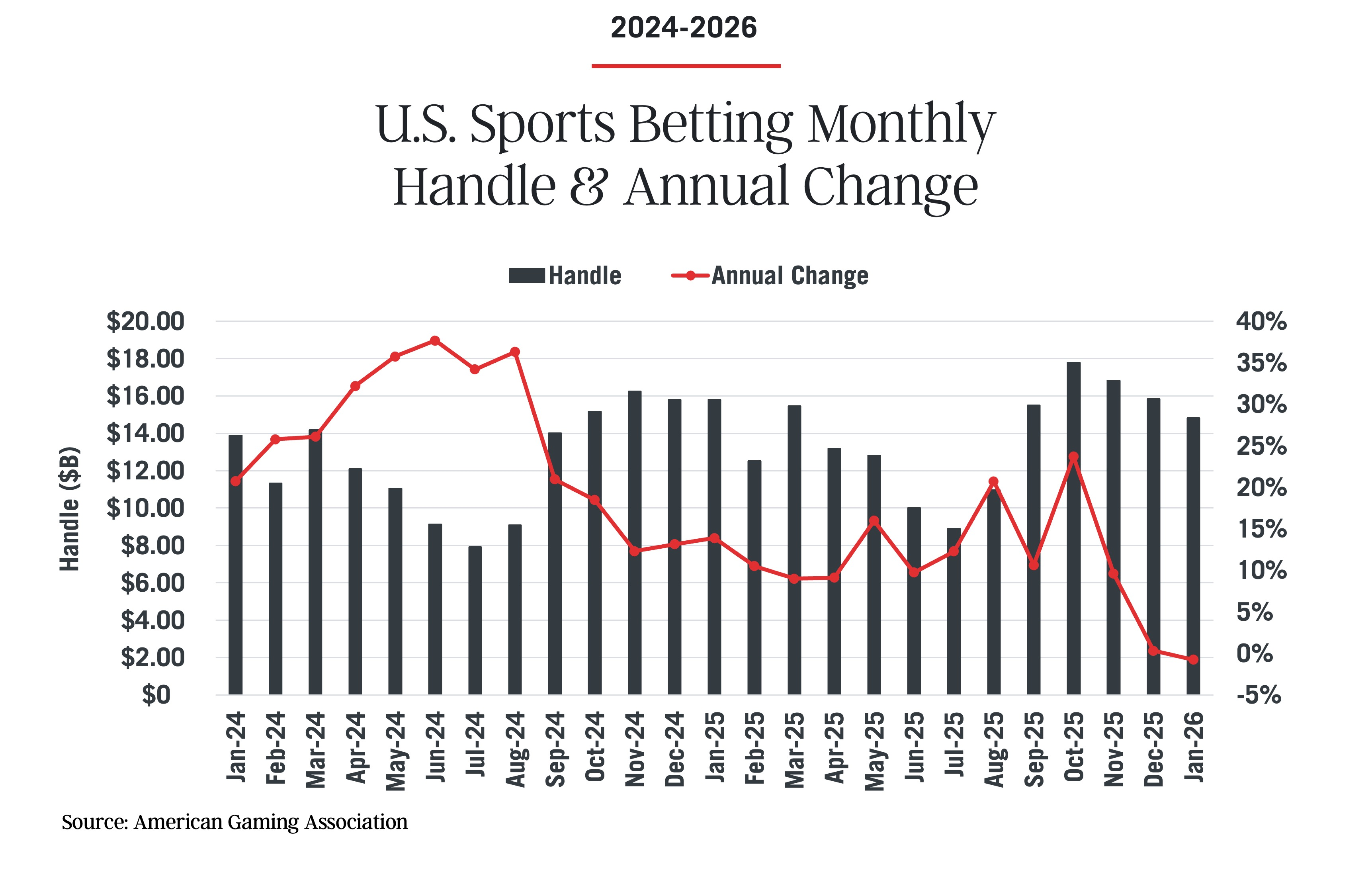
Total US commercial gaming revenue reached $78.72 billion in 2025, up 9.2% year over year.
Legal gaming contributed $181 billion in tax revenue to state and local governments, up 15.1% year over year.
And this doesn't include data on non-compliant crypto casinos such as Stake.

Although Stake remains privatized with undisclosed financial reports, its current size is astonishing through recent disclosures such as KuCoin research and MEXC news:
The total amount of bets processed by Stake is stable at around $100 million per month, while monthly deposits of pure crypto assets are as high as $1.1 billion.
In February 2026 alone, the Stake platform recorded a staggering 6.78 billion bets. This means that the platform processes more than 2,800 bets per second on average. This has completely broken away from the rhythm of traditional gambling and has become a typical high-frequency financial activity.
Looking at it this way, the prediction is that the market just ate the layer of cream on the outside of the cake
Well, predicting the market is still not the enemy
Of course, and it's a rapidly growing enemy.
With the end of the super political event, it is predicted that the market platform will seize the core sports sector of traditional sports lotteries in a big way in order to maintain huge liquidity.
In January 2026, App Store data showed:
Kalshi App downloads: ~1.9 million times per month
FanDuel App downloads: ~475,000 times/month
DraftKings App downloads: ~475,000 times per month
Also, in states where sports betting is legal, 10% of DraftKings users use Kalshi at the same time. The sky is about to fall, dude.
Let's look at this year's Super Bowl betting data. Kalshi's daily trading volume is $881 million, double that of FanDuel and DraftKings on the same day. Some analysts pointed out that of all the betting increases for the Super Bowl this year, the Kalshi family alone took 80%.
The American Gaming Association specifically mentioned that prediction markets such as Polymarket, which provide sports contracts, caused legal sports betting to lose more than $500 million in potential tax revenue in 2025.
Today, Kalshi is ranked 7th in sports betting revenue in the US, and predicts that the market conservatively estimates that it will steal at least $1 billion in profits from the traditional betting market every year.
Twitter:https://twitter.com/BitpushNewsCN
Compare the TG exchange group:https://t.me/BitPushCommunity
Compare TG subscriptions:https://t.me/bitpush
