


Asset Allocation for the Year of the Horse: Three Market Strategies for US Stocks, Taiwan Stocks, and Bitcoin
Author: Victor, Mr. Z168X
Original title: “Troika” Investment Law in the Year of the Horse: US Stock, Taiwan Stock, and Bitcoin Market Allocation Strategy
“AI is the biggest infrastructure construction in human history. Currently, the world has invested hundreds of billions of dollars, but this is only the beginning; trillions of dollars of infrastructure still need to be built.” ——Huang Renxun, 2026 Davos Forum
Semiconductors are directly generating productivity for the first time in 40 years. The entire supply chain is completely out of stock, and TSMC orders have already been placed after 2030. Wall Street is still using the old valuation model to call a bubble; this is our perception of interest spreads.
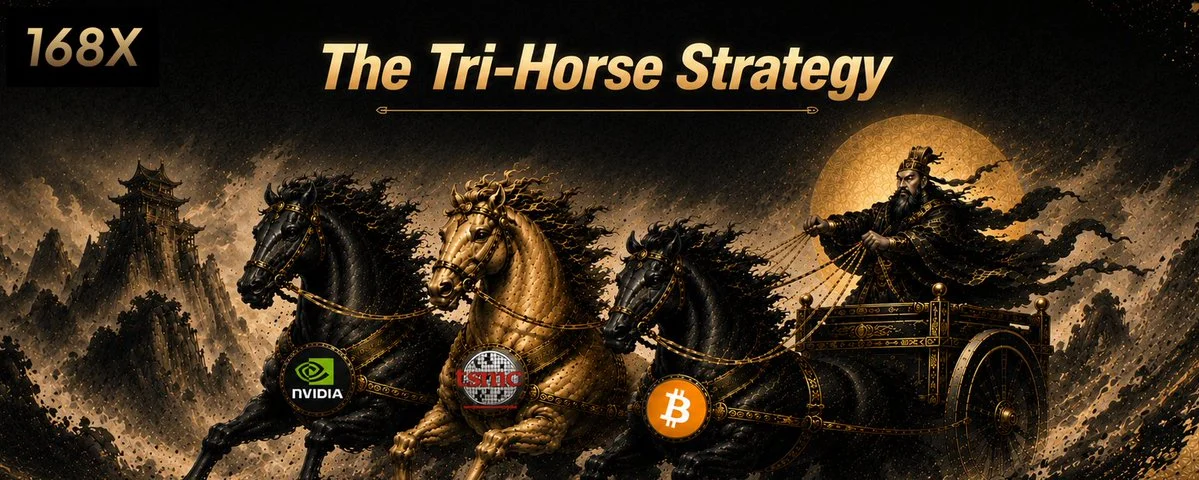
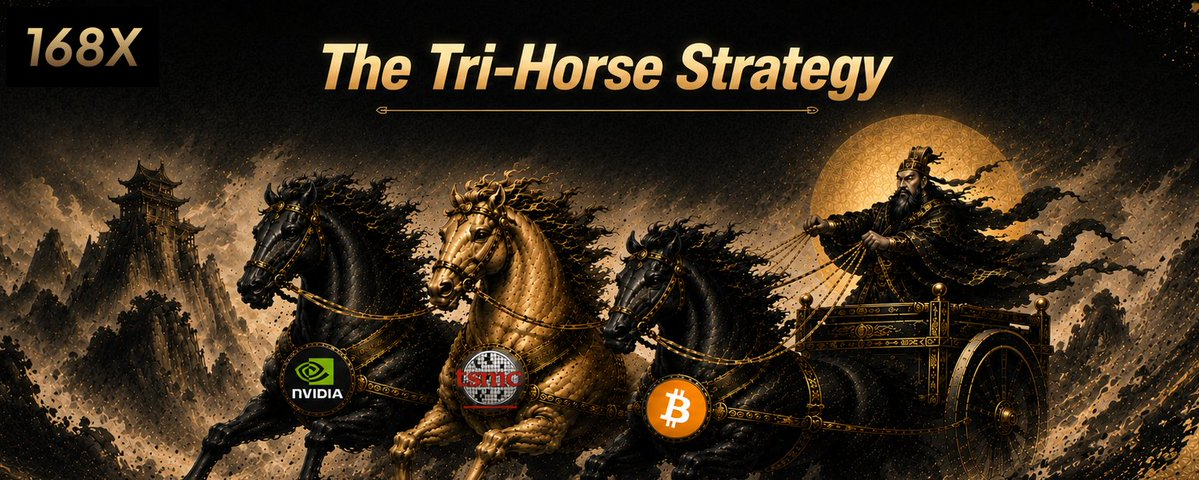
The troika is a cross-market allocation framework proposed by 168X: US stocks, Taiwanese stocks, and crypto. It constructs a nested barbell structure around the three major players (NVIDIA, TSMC, and BTC), and systematically lays out AI and cutting-edge technology. There is only one core discipline: all transactions are aimed at hoarding more leaders.
If you believe in the “second phase” of semiconductors like us, and are unwilling to only get big market rewards and pursue excessive returns with high growth and high impact, the troika is an exclusive investment framework for 2026 designed for you.
1. Semiconductors are preparing to start the second phase
To quote Herman Jin, a former Goldman Sachs FICC executive and founder of Zen Family Office, in a conversation at 168X (Related reading:Interview with former Goldman Sachs FICC executives: It is the catchers who benefit from being out of stock of semiconductors! Optical modules should be sold out):
“For the past four decades, semiconductors have driven PCs, mobile phones, and the cloud, but they have never directly generated revenue. Humans develop software on semiconductors, and software users generate productivity. But starting with this generation of AI models, semiconductors directly shaped productivity.”
This trend began to take shape in 2024, and was later confirmed at TSMC's Q1 conference in 2026, with a CapEx of up to $52-56B. As Hwang In-hoon said, the infrastructure layer is organizing tens of thousands of processors into token factories to directly “create intelligence.” Computing power is production capacity, and production capacity is revenue.
After talking with Herman, we are even more convinced that semiconductors have just finished the first phase, and now the key is how to bet on the second phase.
The first stage is “discovery.” The market realized there was a real demand for AI. NVIDIA went all the way up from $12 to $150, and modelers' private equity valuations soared. TSMC's calm pace of production expansion in the first three years suppressed the bubble, causing all manufacturers to have very high gross profits, and the semiconductor supply chain to rise across the board.
The second stage is “repricing,” which is now. The second phase of the troika bet is based on three core concepts:
1. Under the AI infrastructure cycle, the semiconductor supply chain should be scarce.
According to Hwang In-hoon's “AI Five-Layer Cake Theory”: energy, chips, infrastructure, models, and applications, every successful AI application will drive down the demand of the five layers. As we can see, the wave of semiconductor shortages has spread from chips and advanced packaging to various components and assembly plants, causing prices to rise dramatically throughout the supply chain. Orders from TSMC have been scheduled for 2030, and the shortage will continue for a long time.
2. Perceived interest spreads: Wall Street has yet to understand the importance of CapEx.
In 2026, the four cloud giants CapEx collectively surpassed $700 billion, an annual increase of 77%, but Wall Street has yet to keep up. Over the past few decades, Wall Street's valuation logic was “light assets, high gross profit, and low CapEx,” and seeing a decline in cash flow, it was instinctively a bubble. However, AI turned the company into a token factory. Without CapEx, there would be no production capacity, and without production capacity, there would be no revenue. When the valuation model catches up with actual perception in the industry, companies that are now in production regardless of cost will be drastically upgraded. This is the second phase of alpha.
3. Anthropic and OpenAI are not yet available.
Anthropic and OpenAI's private equity valuation is close to $1 trillion, and model revenue continues to rise. Anthropic's ARR (annualized revenue) has doubled tenfold over the past 12 months to reach $19 billion, and OpenAI's ARR surpassed $25 billion in February this year. Giants' IPOs will pose a huge liquidity siphon risk for the market, but strong revenue means they may delay listing. In other words, the risk of the entire industry being killed before these giants go public is lower.
II. Why Traditional Investment Laws Will Not Be Enough in 2026
Facing the second phase of AI and semiconductors, how can we invest to capture more excess revenue in beta?
There are several mainstream investment methodologies in the market:
1- Indexed investments: long-term holdings, regular quotas SPY or QQQ, etc. For ordinary investors who are unwilling or unable to actively research individual stocks, investing in the market is still the best choice.
However, the cost of investing in indices is that you can only get beta rewards. This year, any stock in the semiconductor supply chain is likely to rise much higher than the general market. In 2026, Taiwan's stock market, which has a high share of semiconductors, will surpass the United Kingdom and Canada, and rise to the sixth largest market capitalization in the world.
2- High-growth investments: All are overvalued and highly volatile, disruptive innovation targets. The most iconic example is Cathie Wood's ARKK, which returned 153% in the 2020 pandemic era, then fell by more than 60% in 2022, which is extremely volatile.
Since the end of 2019, ARKK's cumulative increase of 56.3% is far lower than QQQ's 233% increase over the same period. In the recent AI boom, ARKK's holdings are scattered across software, biotech, fintech, consumer goods, etc., and its performance is clearly lagging behind.
3- Traditional barbell strategy: 90% allocates ultra-low risk assets (treasury bonds, cash) and 10% allocates high-risk speculative positions. Theoretically, it can resist black swans and seize asymmetric opportunities for outbreaks. However, the proponent Taleb also acknowledged that this method cannot “make you rich”; it can only “keep you from becoming poor.”
Our simple calculation:
Let's say you have 1 million in principal, 900,000 lend 4% annualized treasury bonds, and 100,000 lend high-risk parts such as small-cap stocks or cryptocurrencies. Treasury bonds give you 40,000 a year, and the high-risk portion doubles to 100,000, and may even return to zero. The overall remuneration is 140,000, or 14% per annum. It looks great. However, if you directly buy QQQ that tracks the market during the same period, QQQ's increase in 2025 was 20.77%, and your 1 million became 1.2 million.
Traditional barbells lose the index in a bull market. Unless you have a very high capital, the absolute rewards of traditional barbells are simply not enough.
Is there a way to capture the second phase of AI and semiconductors, where the barbell has asymmetrical upside without sacrificing rewards because the low-risk side is too conservative?
3. The troika: US stocks, Taiwan stocks, and Bitcoin allocation strategies
2026 is an extremely vibrant “Year of the Horse”. Traditionally, it is viewed as a period of transformation full of changes and great breakthroughs.
Facing the second half of 2026, 168X proposed a “troika” investment rule, allocating US stocks, Taiwanese stocks, and Bitcoin across three markets to help investors counter changes and turbulence in the global situation this year and capture excess earnings above beta.
The troika can be seen as an aggressive version of the barbell strategy, swapping the low-risk side from treasury bonds to leading the three major markets.
First batch: US stocks (45%), the world's strongest AI ecosystem and cutting-edge technology
Configuration: faucet$NVDA+ 3-5 high-explosive stocks
NVIDIA is the core holdings of the US stock side of the Troika. NVIDIA doesn't just sell chips; its strength is the entire ecosystem; every pit it steps on is a moat. When you buy NVIDIA, you buy the right to rent the entire AI ecosystem.
In addition to NVIDIA, US stocks have the most complete AI and cutting-edge technology targets in the world, including AI cloud infrastructure, storage, optical communication, and space technology and robots that are likely to explode next. These are frontier battlefields where AI extends outward.
Second batch: Taiwanese stocks (45%), the world's strongest semiconductor supply chain
Configuration: faucet$TSM+ 3-5 high-explosive stocks
TSMC (US stock code)$TSM(Taiwan stock code 2330) is the world's leading foundry. Regardless of which model company or chip the AI winner is, they still have to find TSMC to produce it. TSMC's short supply is also driving the entire supply chain to expand production. Advanced packaging, IC design, passive components, test interfaces, heat dissipation, etc. are all lacking.
The middle and downstream segments of the semiconductor supply chain are dominated by small and medium-sized Taiwanese manufacturers, and many of them are themes unique to Taiwanese stocks. These local companies are usually unpopular with international investors, but under a wave of shortages, the explosive power of revenue and stock prices has exceeded expectations.
We continue to focus on Taiwan. By the end of 2026, Taiwan will be in the triple resonance of industrial advantage, smooth policy, and capital momentum.
Third batch of horses: Crypto (10%), a catcher of macro-liquidity spillover
Configuration: faucet$BTC
Bitcoin is a hard currency with scarce and censorship-resistant properties, and there is real hard demand in the grey industry. On the other hand, Bitcoin is extremely sensitive to macro-liquidity. When global liquidity is abundant, the overflow capital often rotates to Bitcoin. Once it starts, it is extremely explosive, but it needs to be held on an annual basis.
Liquidity this year is focused on AI and semiconductors, and overall crypto is in a bear market cycle, so we will only lay out BTC and not allocate any other coins until we see clear signs of a bull market.
4. The structure of the troika: big barbell set with small barbell
The underlying architecture of the troika is a set of nested barbell structures.
Big barbell: Taiwanese and US stocks (90%) vs. Bitcoin (10%).
One end is the stock of a company with fundamentals and verifiable financial data. At the other end is explosive, liquidity-driven crypto.
Small barbells: leading stocks vs. satellite stocks within each market.
Arrange about three to five satellite stocks around the leader, and select targets with high growth potential and clear themes:
Stable type (3-4 levels): Sectoral targets with medium- to long-term supply chain logic can be held for several months.
Explosive (1-2 levels): Bets on short-term catalytic events, has high volatility, holds only a few days to weeks, and rotates extremely fast.
Taking US stocks as an example, the core position is pressured by NVIDIA. In the Taiwanese stock segment, TSMC is the core asset. Satellite stocks cover stocks that are out of stock beneficiary stocks in important sectors such as advanced packaging, heat dissipation, and optical communications, as well as low-orbit satellites and robotics.
As the only asset in crypto, BTC does not require an internal barbell; it itself is the high volatile end of a large barbell.
Large barbells are used to manage cross-market risk, while small barbells capture the rotation rhythm within the market.
5. The core discipline of the troika: hoarding the leader
The troika's core operating principle: all transactions are aimed at hoarding more leaders.
Even if the market capitalization of the leader is very large, it is still very explosive when it starts rising.
Take US stocks in the past six months as an example. When leading NVDA fluctuated at a high level, capital was rotated to other sectors, storage surged, and optical communications were ignited. After all semiconductors rose one round, NVDA only broke to a new high with a huge market capitalization of 5 trillion dollars at the time of the May River Conference.
This logic has also been repeatedly verified in multiple Crypto cycles: “All altcoins exist for the purpose of exchanging more BTC.” Bitcoin's market capitalization is as high as $1.5 trillion, yet there are only a few altcoins that outperformed Bitcoin between 2023 and 2025.
The troika implements the core logic of “hoarding the leader” across three markets. When the short-term profit of satellite stocks comes to an end, we will invest our profits in the lead for a long time at an appropriate price. The lead is the troika's cash.
Explain this logic with a simple trial calculation:
Assuming you allocated 1 million shares in the US half a year ago, the initial configuration is 700,000 for NVDA and 150,000 for satellite stocks A and B each. After a round of rotation, A made a profit with an 80% increase and got back 270,000, B increased 40%, and took back 210,000. All the benefits are poured into NVDA.
After one round, your NVDA position went from 700,000 to 1.18 million. Next, NVDA rose 11% in May, your total assets became 1.3098 million, and your half-year performance was over 30%.
Even if NVDA itself is just trading sideways during this period, after one or two rounds, the faucet will be large enough to make your overall combination highly correlated with the trend of the faucet, and this is exactly the result we want.
The big ones are always great, and the strong ones are always strong.
6. Time Window and Suitable Investors
Any investment framework has a shelf life, and there is no one-size-fits-all investment law. We are evaluating the validity period of the troika until at least the end of 2026.
We think the troika has three failure conditions:
1. Hyperscaler CapEx has been drastically revised. Any cloud giant significantly reduced AI-related capital expenditure or delayed construction plans in financial reports, representing a rift on the demand side.
2. The supply chain changed from being out of stock to being stored. When inventory is accumulated or delivery times are shortened in key links such as HBM and CoWOS, and supply and demand are reversed, the valuation logic will switch back from “out of stock premium” to “inventory cycle.”
3. The commercialization of the AI application layer lags significantly behind infrastructure investment. The logic of the five-layer cake is a top-down pull. If the application layer is unable to generate enough revenue to rationalize the underlying investment, the market will question the return on investment. Here, we need to pay special attention to the timing of Anthropic's and OpenAI's IPOs; high expectations after listing will definitely be tested.
When any of these three occur, it triggers a signal that the strategy may no longer be applicable.
The troika is a highly concentrated and high-growth combination, with 90% of its positions in the AI ecosystem and semiconductor supply chain. 10% of BTC provides an upward opportunity for liquidity spillover. The satellite stock holding period is as long as several months and as short as a few days, and requires active management and discipline.
This isn't a buy-and-forget strategy, nor is it suitable for completely passive investors. The troika is suitable for active investors who have little capital, believe in the second stage of AI and semiconductors, and pursue high growth and high impact.
7. In the Year of the Horse, the time to launch the Troika
2026 The Year of the Horse, a year of great success. However, the troika is not a strategy to rush all the warehouse in today.
Written at the moment (May 19), short-term sentiment in the semiconductor sector is already overheated, and chips are overcrowded. The market is optimistic, and topics such as optical communication have surged irrationally. “Sell in May and go away” is likely happening, and excessive consensus is often a precursor to a short-term correction.
We think the market is likely to reset once within one to two months. This reset will be the real starting point for the second phase of semiconductors and the most important opportunity for the Troika to open positions.
The troika is more than just an investment theory. The 168X team will continue to share our actual operations over the next period, including specific targets, sector judgment, entry and exit timing, and rotation discipline.
All transactions are aimed at hoarding more leaders — NVIDIA, TSMC, and Bitcoin.
In the year of the Bingwu Horse, the troika continued to flourish.
Twitter:https://twitter.com/BitpushNewsCN
Compare the TG exchange group:https://t.me/BitPushCommunity
Compare TG subscriptions:https://t.me/bitpush
