


Goldman Sachs's latest research report: The storage industry's golden window is not over
Written by:Tide direction research, Deep Wave TechFlow
Original title: Interpreting Goldman Sachs Research Report: Store out of stock until 2028, continue to buy
On June 1, Goldman Sachs released the daily Asia-Pacific stock review “The 720,” with a long list of names Samsung, Hynix, Kioxia, MediaTek, Lenovo, and BYD on the cover. It looks like an exhaustive shopping list, but when you read it, you'll find that it has an absolute core: a memory chip.
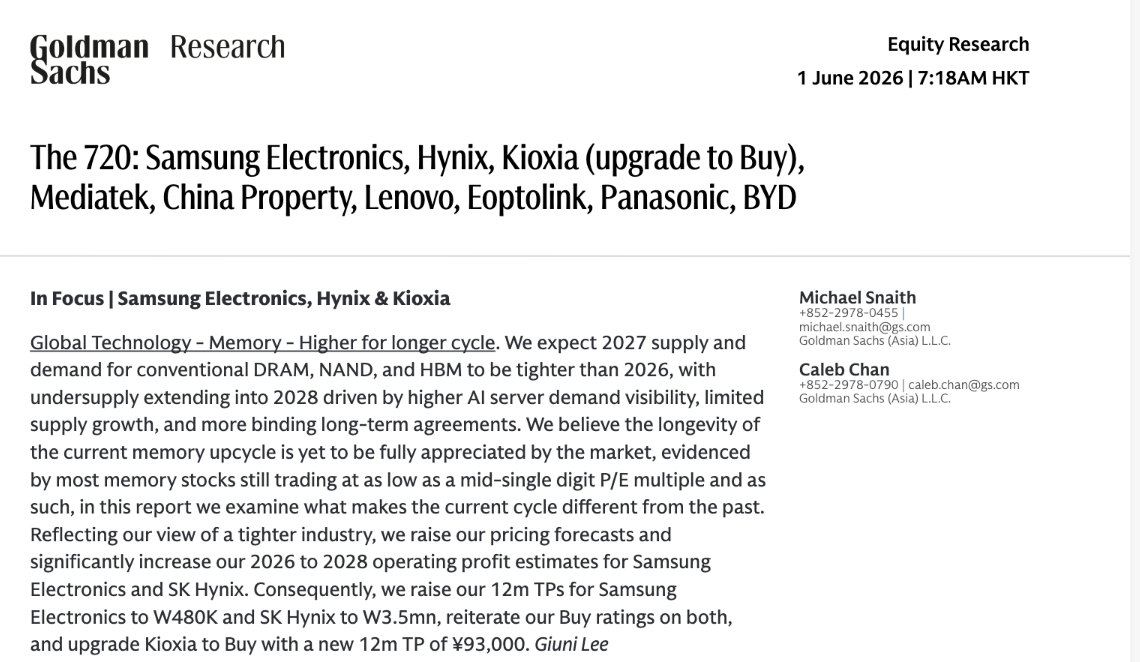
Goldman Sachs's biggest judgment in this issue is that the current storage upcycle “will last longer” (higher for longer), and the shortage will continue until 2028, and the market has far underestimated its length. The evidence lies in valuation: most storage stocks are still trading at mid-single digit price-earnings ratios. The market believes that this is just another normal cyclical rebound; Goldman Sachs doesn't see it that way.
Let's break it down in terms of importance, and a quick list of targets is attached at the end.
Highlight: Out of stock storage will be out of stock until 2028, and the three companies have been collectively upgraded
Goldman Sachs compared this cycle with the past, and concluded that this time was different. There are three reasons: demand for AI servers is more visible, supply growth is limited, and long-term supply agreements die the more they sign (lock the price). When the three are combined, supply and demand for DRAM, NAND, and HBM will be tighter in 2027 than in 2026, and the shortage will continue until 2028.
The most intuitive one is Goldman Sachs's DRAM supply and demand map. A negative number indicates that supply is in short supply. The deeper the gap, the more supported the price. Goldman Sachs has now lowered all of its 2026-2028 predictions to a deeper shortage range. Among them, in 2027, the original forecast of -2.5% was changed in one fell swoop to -5.9%, which almost doubled. Translated as an adage saying: Goldman Sachs believes that storage plants will run out of stock more and more every year after next year, which means that the price increase will continue for a longer period of time.
When it came down to a specific company, the three were collectively manipulated:
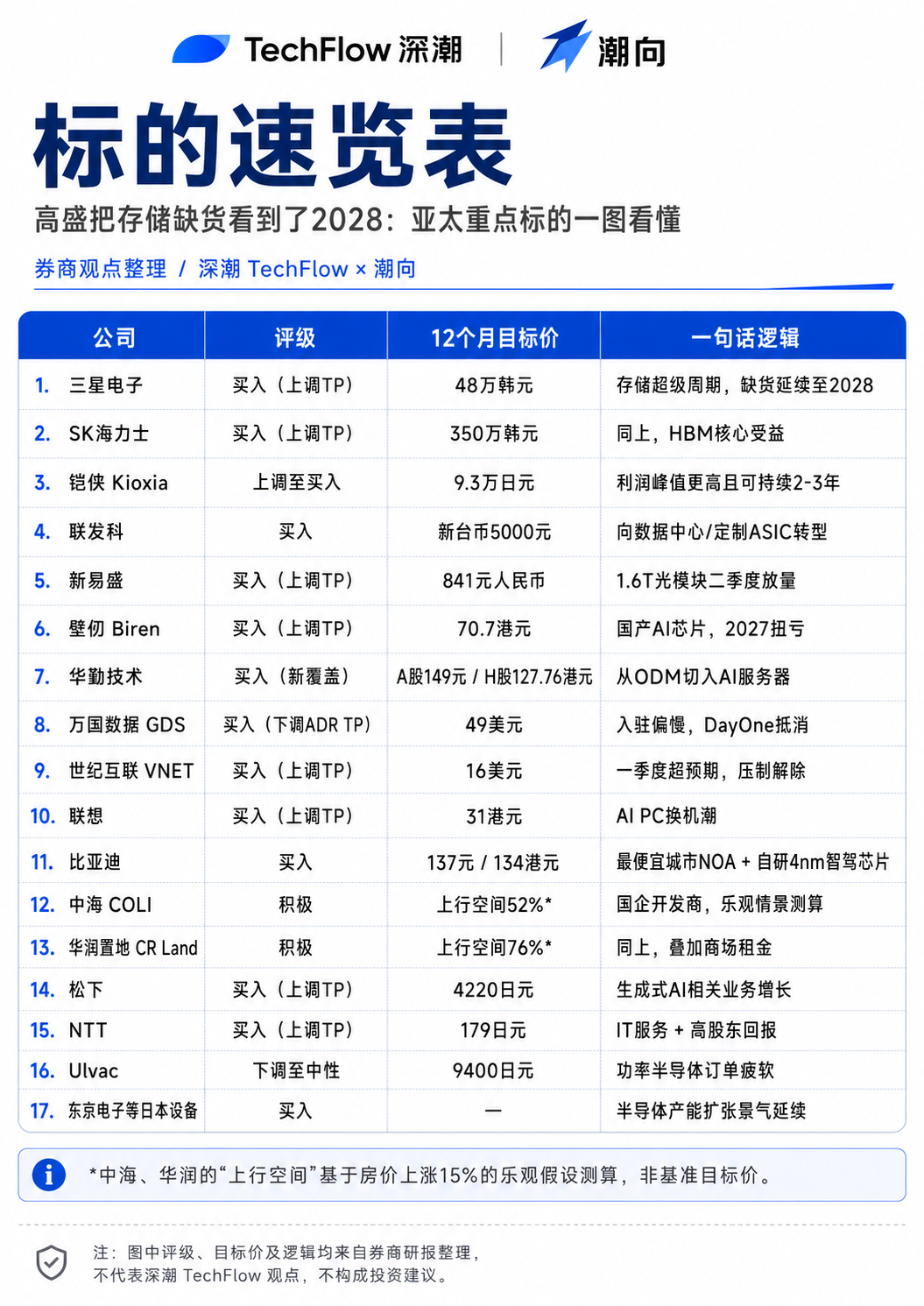
Samsung Electronics raised the 12-month target price to 480,000 won to maintain the purchase.
SK Hynix: Raised the 12-month target price to 3.5 million won to maintain the purchase.
Kioxia (Kioxia): From holding to buying, the new target price is 93,000 yen.
Kioxia is the only rating upgrade in this issue. Goldman Sachs's logic is worth looking at separately: it believes that this cycle's profit peak is higher than previously anticipated, and it can last for two to three years; it doesn't fall back as soon as it hits back. Based on this, Goldman Sachs raised Kioxia's operating profit forecast for the 2027-2029 fiscal year by 16% to 48% at one time, and the gross margin is expected to remain high at around 80%. Giving a judgment on a company with a strong cycle business such as storage that has a high profit and is sustainable for three years is quite a strong statement.
AI Computing Power Chain “Family Bucket”: From Chips to Optical Modules to Data Centers
In addition to storage, this issue almost overhauled the AI hardware supply chain in China and Asia, unifying the logic on one main line: global cloud vendor (hyperscaler) capital expenditure is accelerating, and money is flowing downstream along this chain.
MediaTek (MediaTek): Purchase, target price is NT$5,000. The highlight is its transformation from mobile phone chips to data centers and custom ASICs (AI chips designed for specific customers). The company's goal is to get $2 billion in data center/AI ASIC revenue in 2026 and take 10% to 15% of the $70 to 80 billion ASIC market in 2027.
Eoptolink (Eoptolink): Buy, the target price was raised to RMB 841. It is an optical module, a key component responsible for high-speed data transmission in AI data centers. Goldman Sachs is optimistic that it will start rolling out 1.6T optical modules in the second quarter, accelerate in the second half of the year, and expand production in Thailand, raising profit forecasts for 2027 and 2028 by 5% and 6%, respectively.
Biren (Biren): Buy, target price increased to HK$70.7. The domestic AI chip manufacturer, Bili166, received a first-class safety and reliability rating. Goldman Sachs expects it to turn a loss into a profit in 2027 and raise its revenue forecast for 2026 to 2030 by 4% to 28% as the product migrates to AI chips with higher computing power and is selling more and more expensive.
Huaqin Technology (Huaqin): The purchase is the target of this “new coverage” issue. The target price for A-shares is RMB 149, while covering its H shares for the first time, with a target price of HK$127.76. The logic is that it is moving from consumer electronics foundry (ODM) to AI data centers, and the compound revenue growth rate is expected to be 32% between 2025 and 2027.
Data center duos: Global Data (GDS) maintained purchases, but the ADR target price was lowered to $49 (slow entry rate, lower monthly service revenue, partially offset by higher valuations of the overseas DayOne business); Century Internet (VNET) maintained the purchase, and the target price was raised to $16 (first-quarter performance exceeded expectations, production capacity climbed strongly, and the suppression factors brought about by strategic investors were lifted).
Lenovo (Lenovo): Buy, target price increased from HK$27 to HK$31. Taking advantage of the wave of AI PC switching, Goldman Sachs expects its notebook market share to expand to 28% by 2028, and the AI notebook penetration rate will reach 66%, increasing the overall average price. Its earnings forecasts for Lenovo's 2027 and 2028 fiscal years were 22% and 25% higher than Bloomberg's unanimous expectations, and there were quite a few differences.
Targets that are not on the AI front line, but are also named
China Real Estate (CNOOC, China Resources Land): Goldman Sachs is measuring whether the real estate sector's rebound will hold up. It assumes an optimistic scenario. The 15 key cities will follow the recovery of housing prices in Shanghai and Shenzhen, and housing prices will rise 15% by the end of 2028. Under this premise, it estimates that COLI (COLI) and CR Land (CR Land) will expand their cash profits by more than 30% and 50%, respectively, by 2028. Based on the segmented valuation, Goldman Sachs gave CNOOC 52% and China Resources Land 76% further upside, and maintained a positive view of these two stronger state-owned enterprise developers. Here's the point: this is an estimate based on an optimistic assumption, not a benchmark forecast.
BYD (BYD): Purchase, target price 137RMB/HK$134. The highlight is that at the intelligent strategy press conference, it made the “Eye of Tenjin B” City Pilot Assist (NOA) option for the entire range of 12,000 yuan, bringing the price of the entry-level model equipped with the city NOA to 78,800 yuan, making it the cheapest urban NOA car in China. At the same time, the first self-developed 4nm smart driving chip “Xuanji A3" was released and has already been mass-produced. Goldman Sachs believes that these engineering capabilities can boost the penetration rate of advanced intelligent driving, reduce costs, and improve profit margins.
Japanese semiconductor equipment: Goldman Sachs maintains purchases of Lasertec, Ebara (Ebara), Disco (Disco), and Tokyo Electron (Tokyo Electron). The only reverse operation was to lower the vacuum equipment manufacturer Ulvac (6728.T) from buying to neutral, and the target price to 9,400 yen. The reason was that high-margin power semiconductor orders were weak, and gross margin expansion would be slower than expected.
Panasonic HD (Panasonic HD): Purchased, the target price was raised from 4,000 yen to 4,220 yen, optimistic about generative AI related businesses (backup power supplies, copper-clad CCL, high-performance capacitors).
NTT: For the purchase, the target price was slightly raised from 176 yen to 179 yen, looking at the safety margin provided by domestic IT service demand and a total shareholder return of about 5%.
A macro mainline: the AI boom collides with the energy crisis
What links individual stocks together is Goldman Sachs's macroscopic judgment: emerging markets are being torn in half by two forces. On the one hand, there is a boom in AI investment, and on the other, a contraction in energy supply due to the blockade of the Strait of Hormuz.
Technology-exporting economies such as South Korea and Taiwan benefit from surges in exports and current account surpluses; while energy-importing countries face rising inflation, weakening currencies, and fuel subsidies that drag down their finances. Goldman Sachs expects the average price of Brent crude oil to be 90 US dollars/barrel in the fourth quarter, continuing to put pressure on economies that are heavily dependent on imported oil, and suggests overallocating stocks in China, South Korea, Brazil, and South Africa. This line is compatible with the recent situation in Iran and the macro background of oil prices.
There are two other points that have a direct impact on the financial side of A-shares:
China's imports surged 23.6% year on year in the first four months of this year, but Goldman Sachs believes this is a highly concentrated phenomenon. Gold and semiconductors both account for about 65% of the increase in imports, which does not mean that the external balance continues to deteriorate.
With semi-annual adjustments to the CSI and CNI indices, Goldman Sachs estimates that there will be more than $48 billion in two-way passive capital flows, with technology hardware, semiconductors, and capital goods sectors having the largest inflows (about $3.1 billion and $1.4 billion, respectively), and healthcare and banking outflows. New bids named “expected to receive the largest net inflow of passive capital” include Huagong Technology, Yuanjie Technology, Huahong Semiconductor, GigaYi Innovation, and VeriSilicon. For funds that use index modulation and arbitrage, this is Zhang Mingpai.
In the end, Goldman Sachs buried an egg as usual: in the 2026 World Cup probability prediction, Spain led 26%, France 19%, Argentina 14%, Brazil 8%, and England 5%. The model deducted points for defending champion Argentina for fun.
A quick list of targets
Please keep three things in mind when reading:
1. The target price is the analyst's expectation for the next period of time (usually 12 months). It is a forecast rather than a promise, and will be adjusted repeatedly according to the company's performance and market environment.
2. Naturally, there are too many seller research reports. It is normal for brokerage firms to give “purchases” to covered companies, and some covered companies have investment banking or other interests with that brokerage firm. A list that focuses on “buying” should be read with this background in mind.
3. The value of a research report lies in its main logic and the assumptions it relies on, rather than a specific target price. When the main line is established, the logic of the relevant target is established; once the main line is falsified, the entire string of targets will loosen together. Look at the logic, don't just look at the price.
Twitter:https://twitter.com/BitpushNewsCN
Compare the TG exchange group:https://t.me/BitPushCommunity
Compare TG subscriptions:https://t.me/bitpush
