


Tianya is back, but this time with the Web3 label

Written by:KarenZ, Foresight News
Original title: Tianya Resurrection: Feelings are real, and so is the Web3 package
The resurrection of Tianya.
On June 1, 2026, visits to Tianya Community, which had been suspended for three years, officially resumed. For many old netizens, this isn't an ordinary website reboot; it's like an old era suddenly shone.
Once again, the place that once housed countless divine posts, gossip, long texts, arguments, and late-night stories appeared on the screen. In the first phase, Tianya Community will prioritize the resumption of browsing of some highlights. Interactive functions such as login, posting, and private messaging will gradually resume as data migration and compliance progresses.
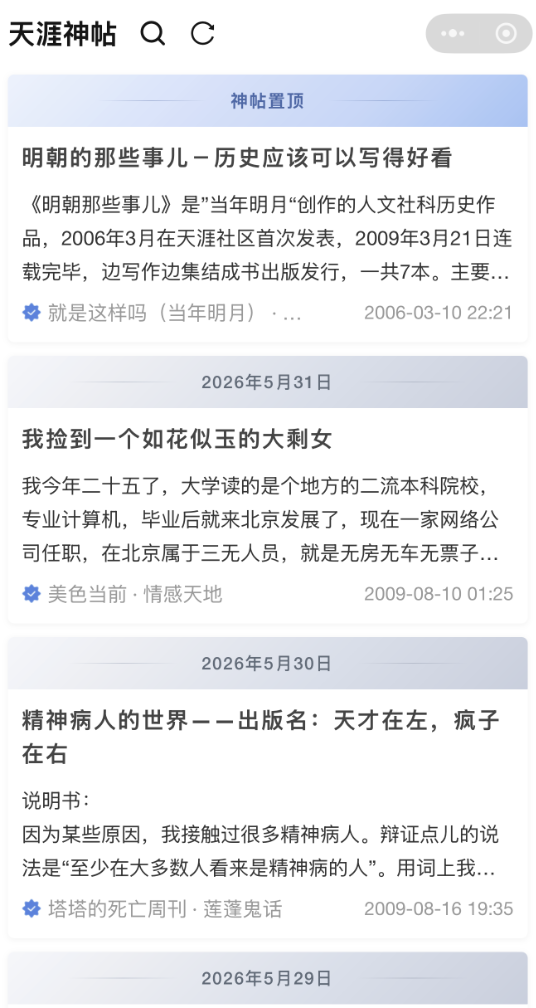
However, unlike the “Grandpa Qinghui” that many people imagine, Tianya's return was first pushed to the front of the stage, not only old posts and memories, but also the 1999 yuan “Xintianya Founding Member Gift Pack,” which was already on sale.
A Chinese forum born in 1999 that uses a 1999 yuan digital collection-style membership package to tell the story of the reboot. This incident itself is both dire and current.
Digital badges have become tickets, and imagination of governance, distribution, and equity have all been stuffed into it
There is also a key player here: Chengdu Tianyake Network Technology Co., Ltd.
According to Tianya Community's February 9 open letter, “Chengdu Tianyake Network Technology Co., Ltd.”, a new Tianya investor founded specifically in 2024, is the core force behind the relaunch of the Tianya community platform and the construction of Xintianya.
The Xintianya Program includes the Tianyake Online Platform (a global social platform for travel and fashion consumption) that integrates online and offline, Tianya Community, and overseas Tianya (decentralized community governance, IP copyright digital asset trading) based on the Web3.0 platform.
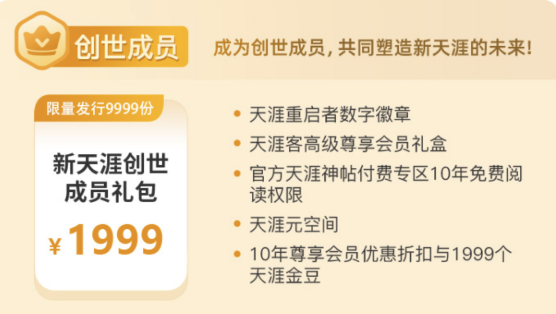
According to the Tianyake member store page, the package is limited to 9999 copies. The benefits include the Tianya Rebooter digital badge, the Tianya Ke Premium Premium Membership Gift Box, 10-year free reading access to the official Tianya Diary Pay Zone, Tianya Yuan Space, a 10-year membership discount, and 1999 Tianya Golden Beans.
According to Tianya Ke's May 31 announcement, the “Tianya Rebooter Digital Badge” has been minted on Ant Chain. It is a digital badge with identity authentication, honor recognition, and commemorative characteristics. Badges support compliant circulation. The transfer is limited to 3 times per year. The transfer must be completed through a national compliance cultural property trading agency or an officially designated compliance platform.
What's more noteworthy is that the announcement binds this badge to a full set of “Xintianya Core Benefits.”
The first is the right to govern. Genesis members who hold badges are defined as the “foundation nodes” of Xintianya. They can participate in the formulation and revision of Xintianya's domestic and international community rules, submit suggestions for platform function optimization, ecological construction and future development, and receive Xintianya Interactive Credit rewards through participation in governance and contributions.
As it sounds, this is close to the common governance narrative in the Web3 community: identity credentials, rule voting, contribution incentives, and point rewards, all placed within the same entitlement framework.
The second is the right to offline space. According to the announcement, Genesis members can prioritize becoming social space managers or partners of the Tianyake chain in cities around the world. In other words, Tianya wants to translate user relationships in the forum era into cultural tourism, social spaces, and local consumer networks.
The third is e-commerce distribution rights. Tianyake's membership-based e-commerce focuses on cultural tourism products. Founding members with badges can be prioritized as “good goods recommendation officers” and “good goods marketing officers” for member stores, recommend global goodies and cultural tourism routes on the supply chain side, and can also earn Tianya Golden Beans through good product promotion and distribution.
This level is already very close to the logic of social e-commerce: the identity of old users is further encouraged by recommendations, marketing, distribution, and points.
The fourth is an equity-related channel. The announcement also stated that Founding members who have already held a specified number of badges and qualified investors who have passed the qualification review can voluntarily apply to participate in a special limited partnership registered and managed by the licensed private equity manager Hainan Shiyuan Tongda Private Equity Fund Management Co., Ltd., and give priority to indirect investment in Xintianya shares.
You must clearly see the restrictions here: it requires a “specified number of badges”, it also requires the status of an “qualified investor”, and it also needs to pass the corresponding review. It is not an ordinary user who buys a 1999 yuan gift package to directly obtain shares.
This list of benefits tells a great story. Governance authority is responsible for creating a “sense of ownership”, managers and partners are responsible for undertaking offline entrepreneurial imagination, good product recommendation officers and marketing officers are responsible for introducing e-commerce distribution, and equity channels are responsible for raising future expectations.
Putting these words together, it's hard not to let people take a closer look: digital badges, limited edition, Genesis members, numbers, metaspace, divine rights, consumption scenarios, governance, and equity channels. It packages a digital collection into a comprehensive portal to community identity, consumer rights, commercial roles, and capital imagination.
The more rights are written, the more specific the problem
Governance, distribution, and equity are all there, but the answer isn't hard enough.
As mentioned earlier, the announcement has given the broad scope of governance powers. What really needs to be questioned is how this system of governance works. For example, what matters will go into the voting process, and which are just solicitation of suggestions? What does the formulation and revision of community rules include? Are there any key issues such as revenue distribution for creators and digital asset circulation rules?
Enforcement issues are also critical. Once the vote is passed, does the platform have to execute it? How are implementation cycles, disclosure of results, objection handling, and review mechanisms designed? How are interactive point rewards calculated? If these mechanisms do not disclose rules, it is easy for governance to remain “participatory” rather than a system that can actually restrain platforms, protect users, and distribute responsibilities.
The distribution rules of good goods recommendation officers and good goods marketing officers also need to be more transparent. How can Tianya Golden Beans be obtained, redeemed, and how has the scope of application changed?
Equity channels also require caution. Once expectations are raised, subsequent disclosures must be more adequate. How much is the specified amount, how is the valuation determined, what the exit mechanism is, and whether risk alerts are sufficient, none of these can be automatically filled by feelings.
A platform that has been out of business for many years, is in urgent need of cash flow, and urgently needs to prove that it still has user appeal, and is trying its best to help itself. Tianya is using the language of Web3 to package a traditional Internet-style self-help for members.
Digital badges are more of a self-help tool here. It compresses identity, memorial, consumer rights, governance narratives, distribution roles, and equity imagination, and has indeed created a very complete entrance to the “New World”. However, it is also because it is so full that its sense of form is clearly ahead of the truth.
At the Web3 level, the really valuable parts are authority, transparency, profit sharing, and governance.
Authorization means that users know who their content belongs to.
Transparency means that users know where the money comes from and where it is being used.
Profit sharing is that creators and content contributors can't just do free fuel forever.
Governance means that so-called “co-builders” are not just consumers, but can actually participate in community rules and future directions.
From the perspective of community revitalization, what can really save Tianya isn't necessarily a digital collection, but three more simple things:
Can the content come back.
Can people come back.
Can trust be restored.
If these foundations aren't established, no matter how many digital badges and meta spaces, it may just end up being a short-term return. Of course, for an old platform, there is still a chance if you want to try it out.
Tianya doesn't want to try Web3 today
Tianya's interest in Web3, the metaverse, and digital collections didn't come out until 2026.
In July 2022, Tianya Community released “Tianya Virtual World White Paper 1.0”, announcing the promotion of the “Tianya Virtual World” metaverse platform and the launch of “Tianya Yuandiamond”. According to the idea at the time, users could incorporate content produced by the Tianya Community and personal data into the “Yuan Diamond”. Each gemstone has a unique ID number and can be gifted or exchanged, or collected as a digital collection.
The announcement also mentioned that Tianya users' personal text works or related IPs can generate on-chain digital collections with one click through “Tianya Yuandian” and circulate them as permitted by laws and regulations.
By 2026, “Tianya Yuanzan” will no longer be the main character, and the stage will be replaced with the “Tianya Rebooter Digital Badge”. After the metaverse boom receded, Tianya switched keywords to AI digital life, overseas world, decentralized community governance, IP copyright digital asset transactions, and compliance alliance chain digital collections.
The name has changed, and the underlying impulse hasn't changed.
This direction is not entirely devoid of logic. Tianya does have scarce content assets. A large number of native narratives, public discussions, and folk texts from the early days of the Chinese Internet have all settled in this forum.
In an age where AI training, IP adaptation, content copyright, and digital identity are being repriced, Tianya's data is not without value. However, whether value can be released still depends on whether follow-up mechanisms can keep up.
Summarize
Tianya's plight is a real dilemma for an old community: content is valuable, but there is not enough cash flow; the feelings are deep, but the product has been suspended for too long; the brand still has memory points, but user attention has already moved to short videos, social media, and AI content platforms.
You can buy a badge and a sense of “Founding Member” for 1999 yuan, but you can't go back to the BBS era. In that era, users were willing to spend a few hours writing a long post, replying to a stranger late at night, and arguing about public events until dawn.
What we need to prove next is that after returning from Tianya, apart from selling a digital ticket to “Xintianya,” it is possible to re-grow a community where people talk, people argue, people create, and people are willing to stay.
In other words, the most noteworthy aspect of Tianya's restart is not whether it has caught up with Web3, or whether it will package itself as the next decentralized community. The real question is: after testing almost all the methods it can test at the end of the day, can it return these concepts to a simple goal, get users back, get content flowing again, and give life back to the community.
In an exclusive interview with Tianya Community founder Xing Ming in the “Science and Technology Innovation Board Daily” on February 12, Xing Ming attributed Tianya's loss back then to a lack of awareness of commercialization, a single monetization model, and missing a key window for Internet commercialization. He mentioned that in the early days, Tianya mainly relied on self-funded rolling development. There was not much commercial pressure. As a result, the community atmosphere was preserved, but it also caused the team to miss the best time for commercialization. Since then, Tianya almost relied on traditional brand advertising revenue, and advertising should not be too intense. Otherwise, it would damage the community atmosphere and further reduce the room for growth.
Xing Ming said in an interview that the core logic of this restart is to abandon the single advertising monetization model of the year, rely on Tianya's user accumulation, community atmosphere, and IP accumulation, combine the resources of the Hainan Free Trade Port, use membership-based e-commerce as the main monetization path, and lay out a dual domestic e-commerce and overseas Web3 circuit. He also mentioned earlier that the capital required for the restart is at the level of several million yuan. Relying on the financial support of early external investors and “Xintianya” co-founding members, it is enough to guarantee that the Tianya community will resume visits on June 1, 2026.
The most tense point here is that while Xing Ming emphasizes the need to avoid excessive commercialization from draining users' emotions, he must use a sufficiently intensive commercial plan to prove that Tianya can survive.
Twitter:https://twitter.com/BitpushNewsCN
Compare the TG exchange group:https://t.me/BitPushCommunity
Compare TG subscriptions:https://t.me/bitpush
