


CEX collectively transformed traditional finance, and altcoins entered a survival test period of “self-survival and self-destruction”
Authors: Henry Kim, Ryan Yoon
Compiled by Chopper, Foresight News
Original title: CEX Embraces Stocks, Are Altcoins Abandoned?
TL; DR
The growth of the cryptocurrency spot transaction fee model peaked, and the rise of decentralized perpetual contract exchanges such as Hyperliquid. Coupled with the easing of the regulatory environment after the Trump administration came to power, multiple factors compounded the world's leading crypto exchanges to readjust their development direction.
Today, major exchanges are laying out traditional financial categories such as stocks and financial derivatives, and their operating models are gradually moving closer to traditional financial institutions.
However, problems have arisen, and centralized exchanges have always been the core liquidity providers in the entire crypto ecosystem. Once exchanges gradually weaken the main cryptocurrency industry, the original order of operation of the entire crypto market may be completely disrupted.
Since then, cryptographic projects have entered the stage of independent survival. Whether they can break away from exchanges to support independent operation will become a watershed in project development, and the industry landscape will soon be clearly divided.
Trade Apple Shares on Binance
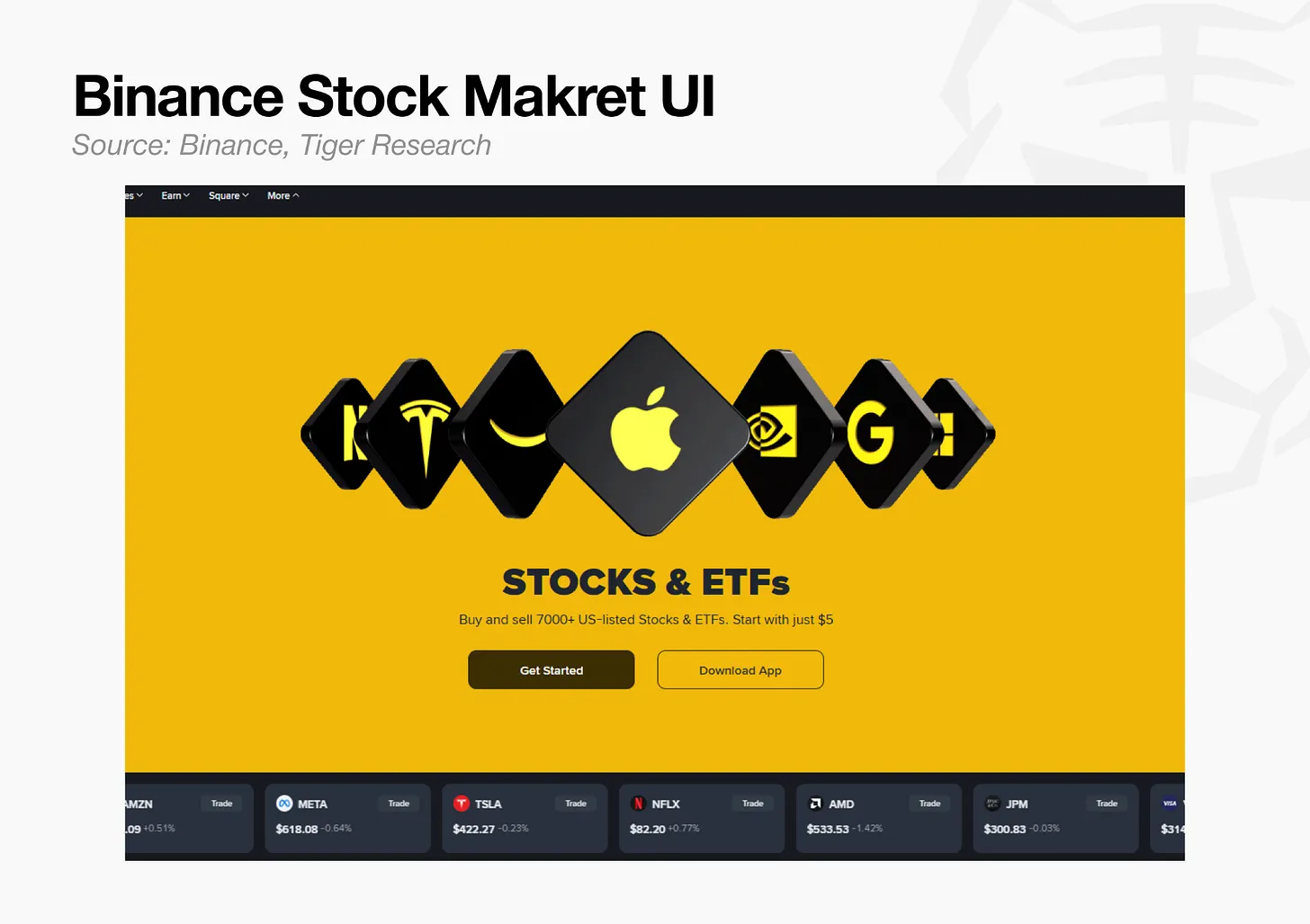
Starting June 1, users can directly trade US stocks such as Apple (AAPL) and Alphabet (GOOGL) through the Binance App. The next day, Binance announced the addition of trading constituent stocks in the Korea Composite Stock Price Index, including SK Hynix, Samsung Electronics, and Hyundai Motor, the three most actively traded Korean stocks.
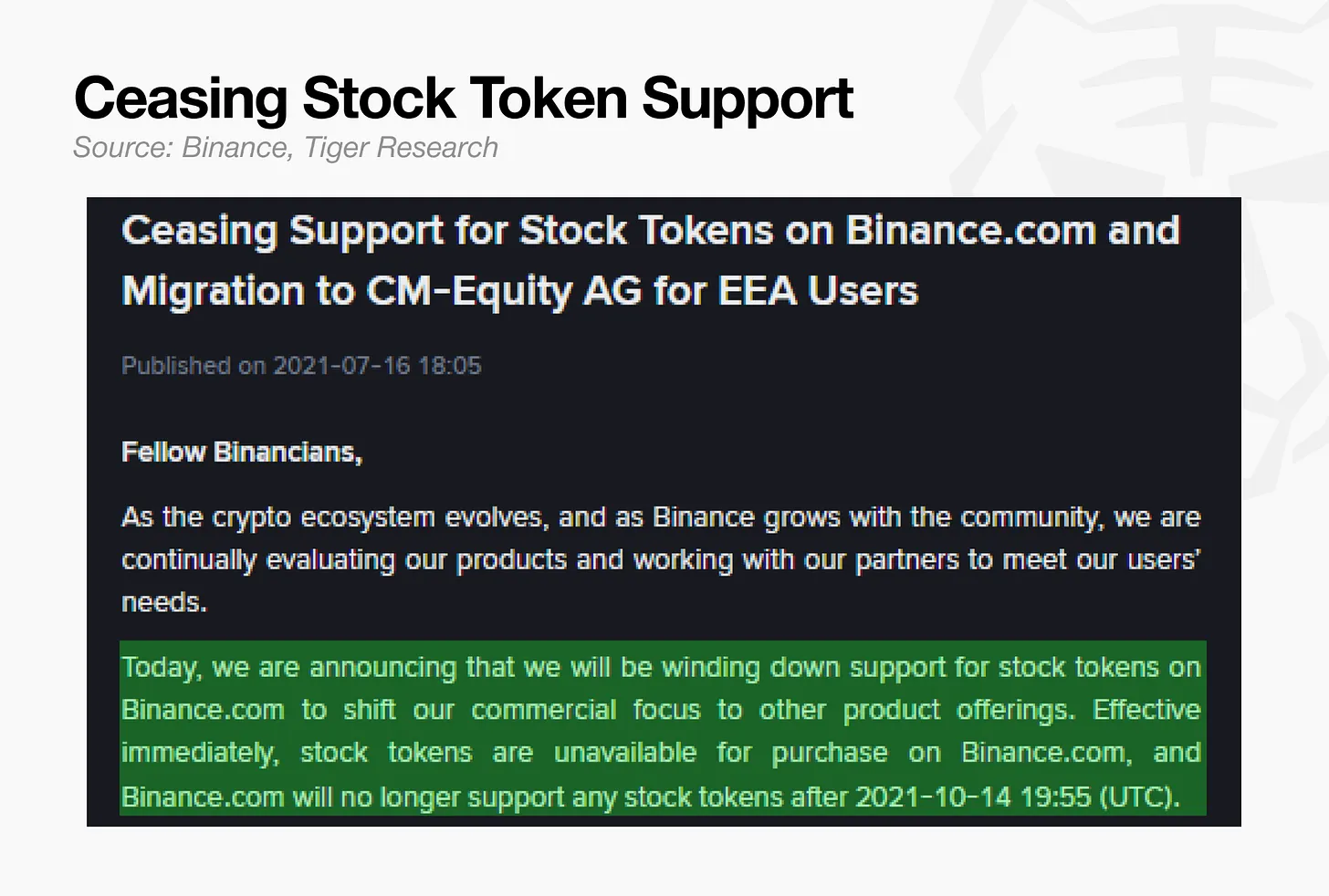
The idea for Binance to lay out the stock business dates back to 2021. In April of that year, the platform launched a tokenized stock trading function, which supports trading targets such as Tesla (TSLA), Apple (AAPL), and Microsoft (MSFT). However, due to continued tightening regulatory pressure, the service was completely shut down in July of the same year. At the time, it was difficult for this business to continue to operate. There were three main structural problems: whether stock tokens were securities or derivatives; the legal characterization of related products was not provided with investor prospectus in accordance with EU regulatory requirements; at the same time, Binance itself was not directly qualified to carry out such business. The German Federal Financial Supervisory Authority, the UK Financial Conduct Authority, and the Hong Kong Securities and Futures Commission all raised objections based on these issues.
Now that the stock trading service has been re-launched, the overall structure has been drastically adjusted. Binance currently completes order execution through licensed brokers in the Abu Dhabi Global Market. The business is clearly defined as a securities brokerage service, completely avoiding previous legal disputes. The core contradiction of the 2021 business shutdown: the problem of vague ownership of underlying asset issuers has now also been largely resolved.
The current industry movements showed a clear coincidence of time. At the same time, Bybit also launched the traditional financial perpetual contract market. It not only launched Korean stock contracts such as SK Hynix and Samsung Electronics, but also opened up space exploration technology company (SPCX) perpetual contract trading. Coinbase also followed suit, announcing support for SPCX contract transactions.
The reasons behind the collective transformation of leading crypto exchanges at almost the same stage, abandoning a single cryptocurrency trading model and switching to a comprehensive traditional financial service platform are worth investigating.
The three drivers of transformation
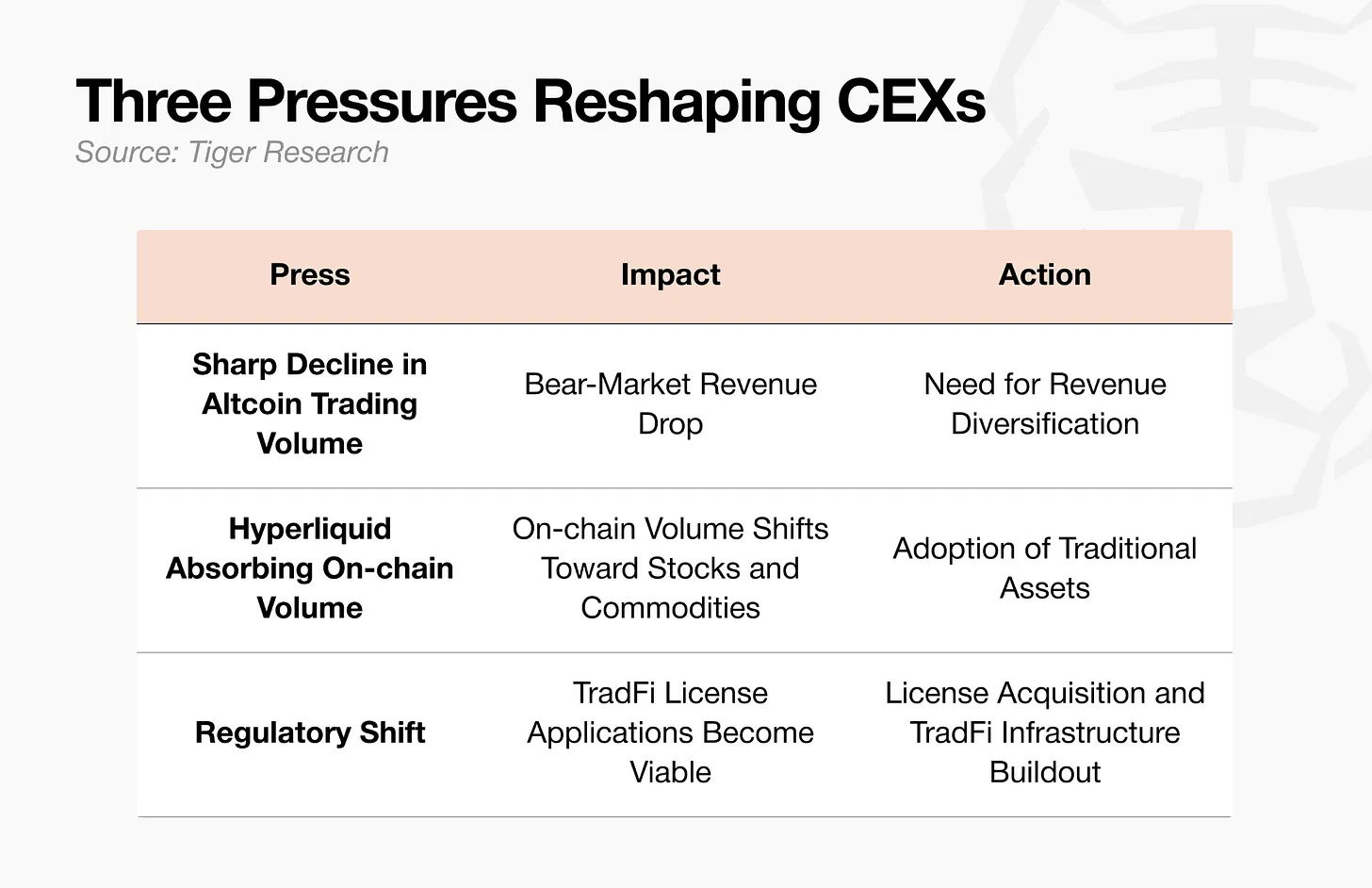
Three external pressures jointly push the exchange to leave the pure cryptocurrency operating model.
Cryptocurrency trading volume continues to decline
The primary pressure comes from a contraction in overall cryptocurrency trading volume. The exchange's core revenue comes from cryptocurrency transaction fees, and the level of trading volume is entirely determined by market sentiment.
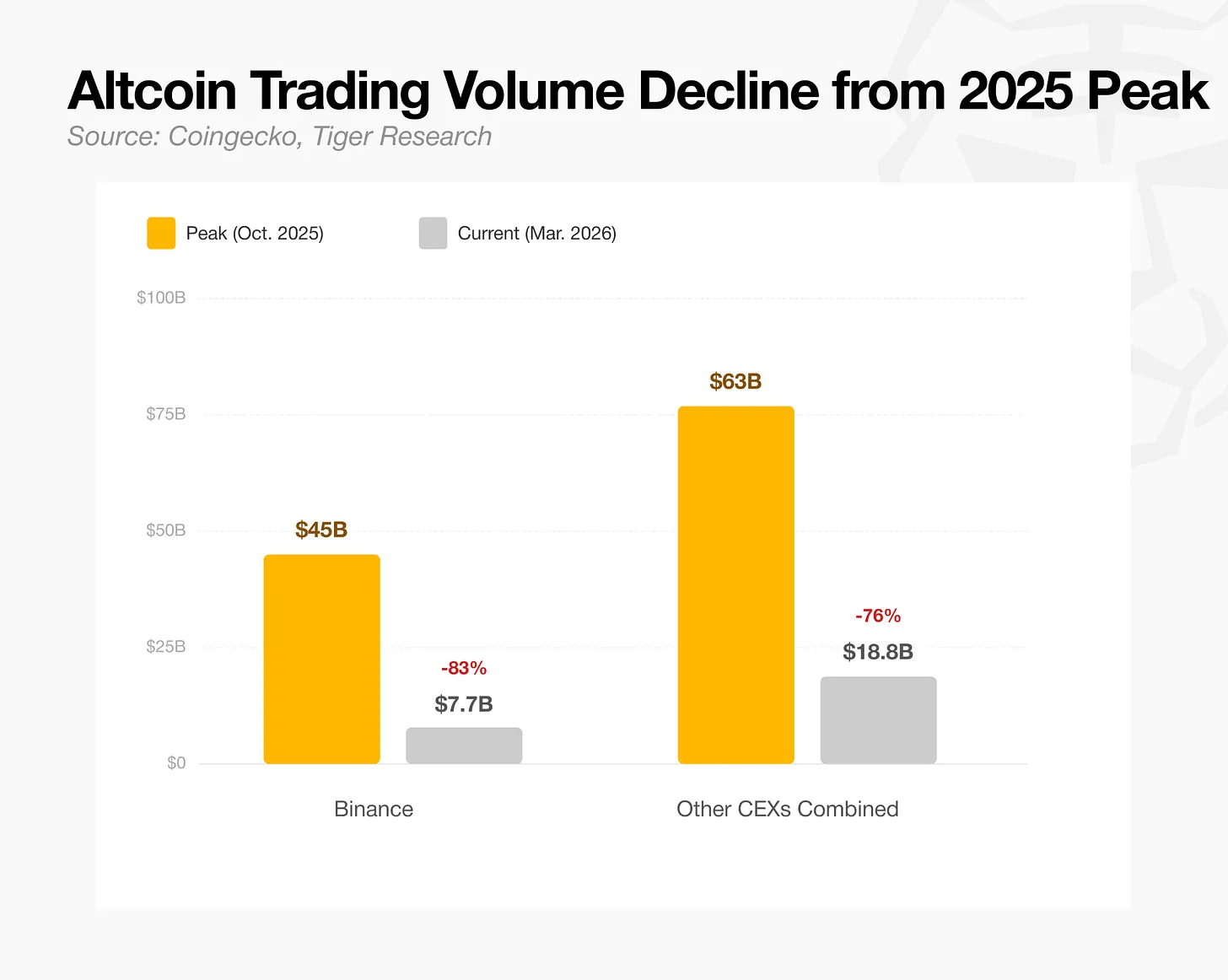
Binance's average daily spot trading volume fell sharply from a peak of around $45 billion in October 2025. Currently, it is only $7.7 billion, a drop of nearly 80%. The total spot trading volume of all other centralized exchanges also fell from a peak of US$63 billion to US$18.8 billion today, a decrease of about 70%. The volume of transactions continues to shrink, which means that a business model that relies on transaction fees to profit is beginning to be unsustainable. In fact, major exchanges have long realized that it is impossible to build a sustainable revenue system by simply relying on cryptocurrency transaction fees.
Hyperliquid divides on-chain liquidity
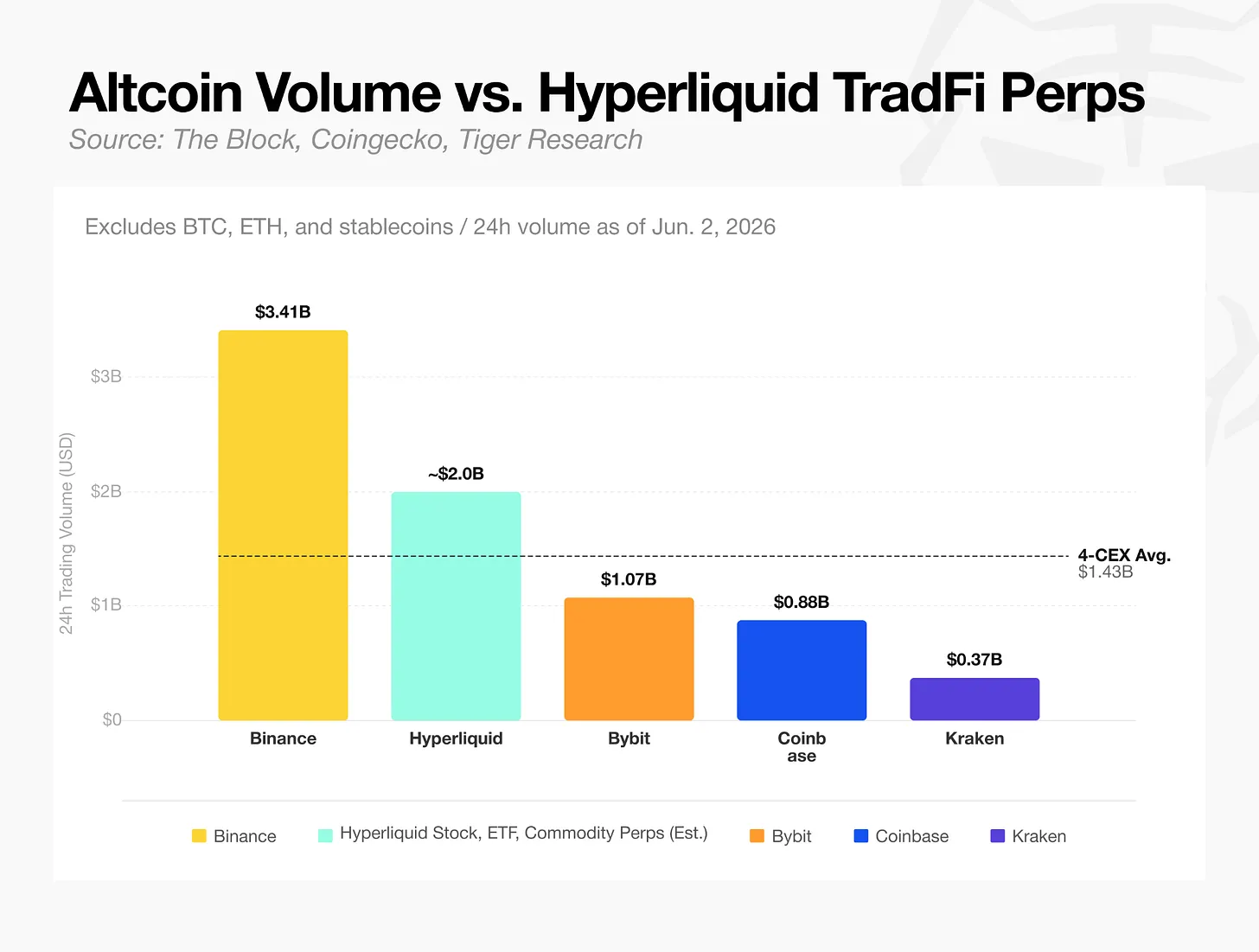
The comparison data clearly shows the current market pattern: comparing the trading volume of altcoins other than Bitcoin and Ethereum with the trading volume of real-world assets such as stocks and commodities on the Hyperliquid platform, the gap is already evident.
Hyperliquid continues to absorb on-chain liquidity through the launch of stock and commodity perpetual contracts. As of mid-2026, 23 of the platform's top 30 perpetual contract trading volume targets were stocks and commodities, while cryptocurrency targets were in the minority.
The on-chain market is no longer an exclusive domain for cryptocurrencies. The trading volume of a decentralized exchange is now sufficient to compete with traditional centralized exchanges, which also sounded a wake-up call for CEXs.
The regulatory environment ushered in a shift
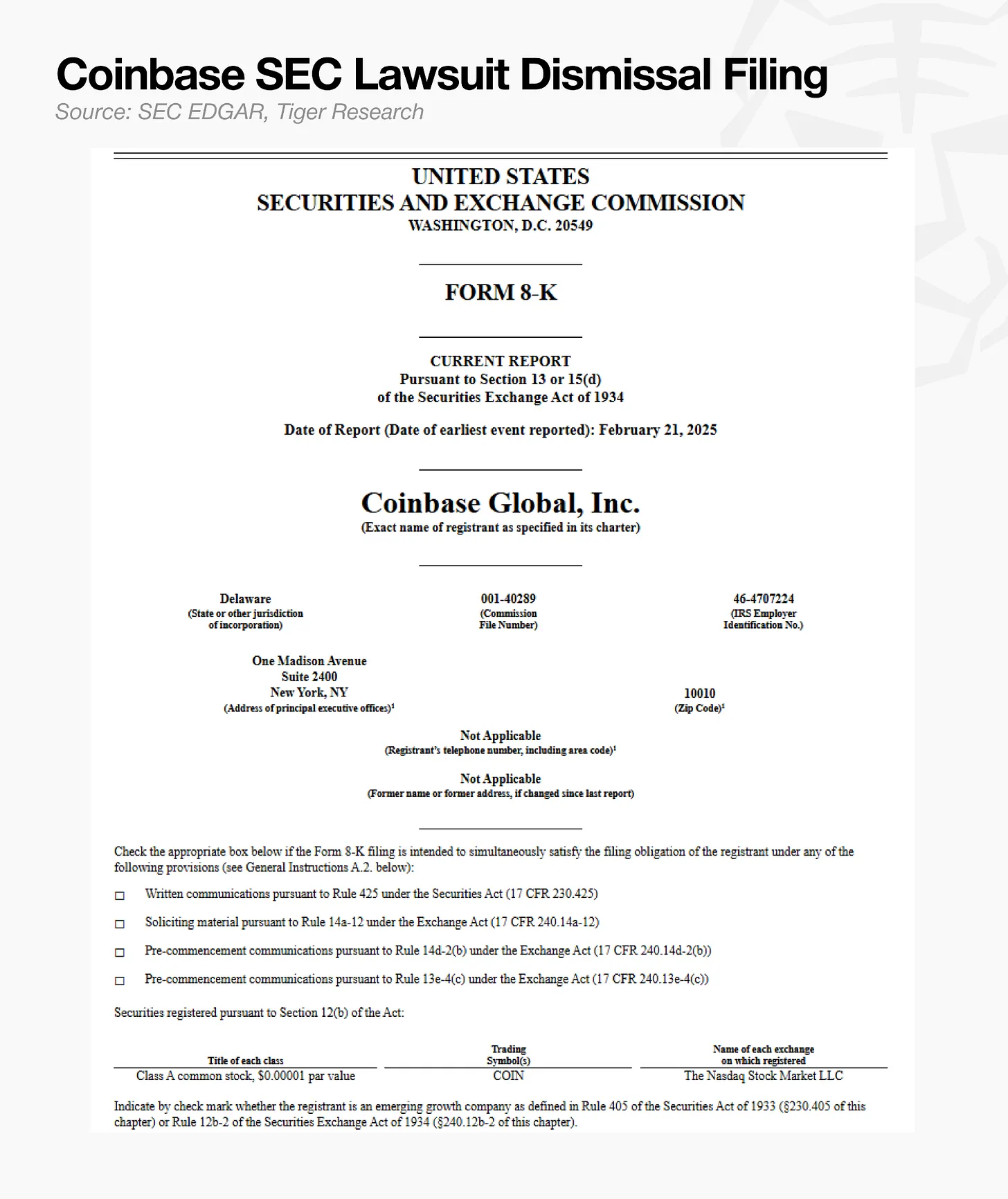
The third pressure comes from changes in overall regulatory trends since the Trump administration came to power. The SEC dropped the lawsuit against Coinbase and Kraken. At a stage where regulators have a tough attitude, applying for a traditional financial license involves extremely high compliance risks; now, the regulatory boundaries are gradually becoming clear, and various types of financial licenses have not only become an endorsement of compliant management, but have also become an advantage in the platform's differentiated competition.
Under a clear framework of rules, transaction proceeds are used to explore new development directions based on one's existing advantages. The three major pressures were concentrated at the same time, compounding that market demand for stocks and various financial derivatives continued to rise. If leading exchanges want to survive for a long time, they must follow the trend and accelerate the pace of transformation and embark on a new development path.
The coping strategies of major centralized exchanges
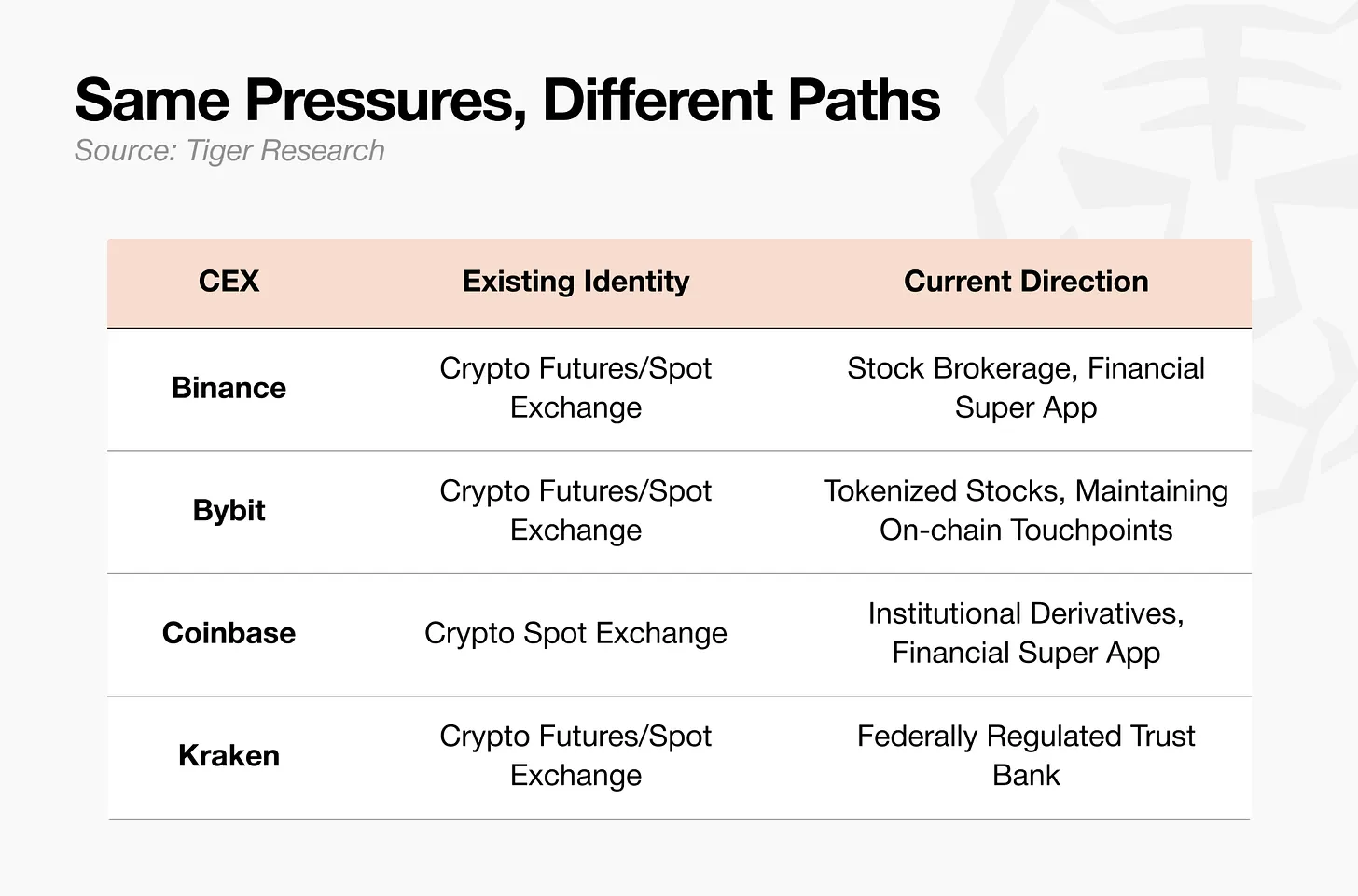
Faced with the same industry difficulties, various centralized exchanges chose very different development paths.
Binance: Building a comprehensive financial superplatform
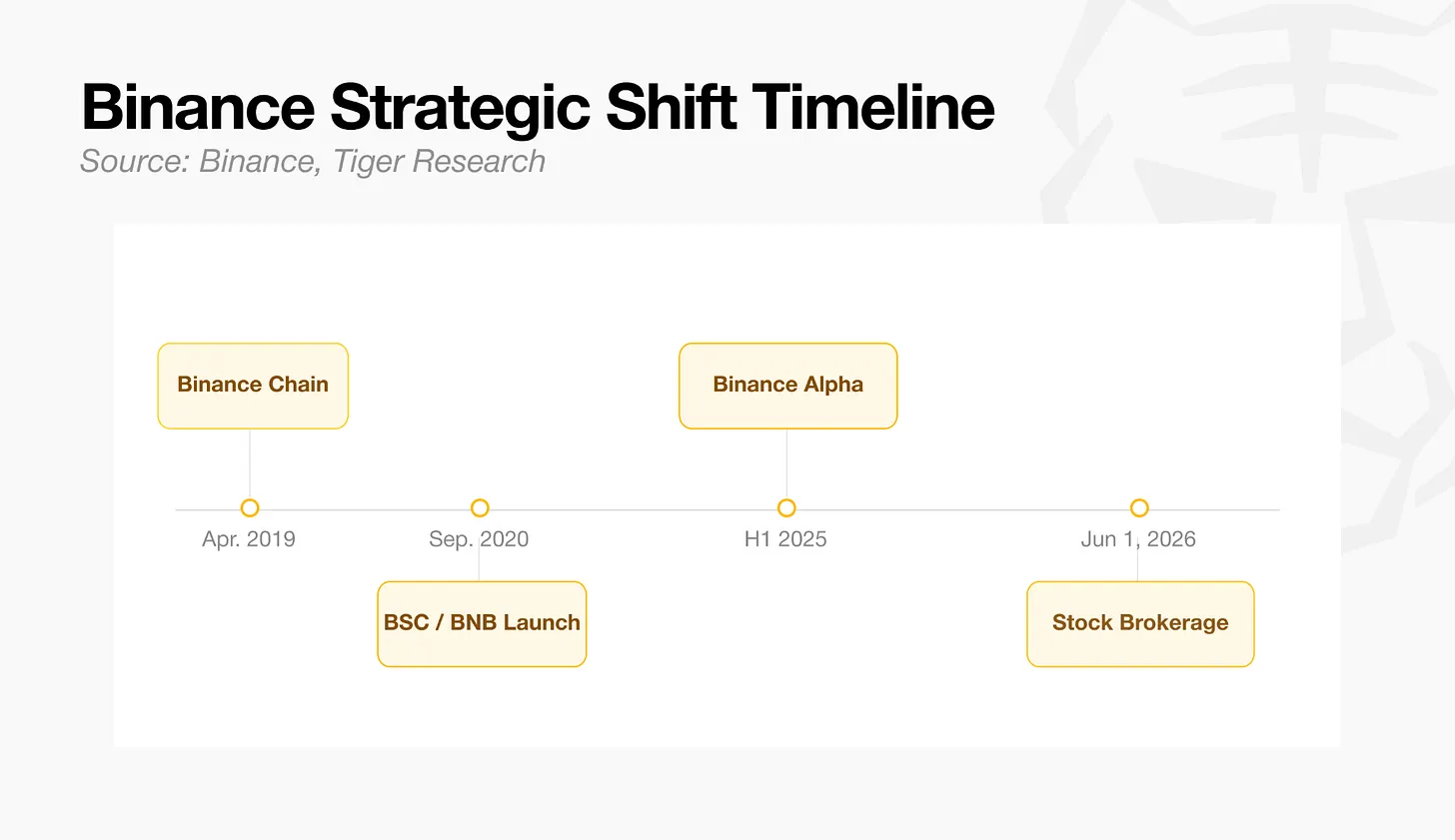
Binance's development philosophy is very clear: create a one-stop integrated trading platform, keep all user transactions in its own ecosystem, and avoid loss of users.
Binance has already laid out the on-chain circuit ahead of schedule, and has achieved great results. The platform first set up a centralized trading business, then launched the Binance Smart Chain in April 2019 to enter the on-chain ecosystem; it also launched Binance Alpha products in the first half of 2025, successfully gaining a considerable share of the on-chain market.
However, in 2026, on-chain liquidity began to lean towards the stock category. Hyperliquid has taken the lead, and Binance's on-chain user base has been directly impacted by continuing to seize liquidity through stocks and commodities-related products. In response, Binance did not choose to compete head-on with Hyperliquid in the on-chain field, but instead took a different approach and launched a stock trading service for its 200,000,000,000 existing users. Compared to going deep into the opponent's home field to fight, retaining existing users is obviously a safer choice.
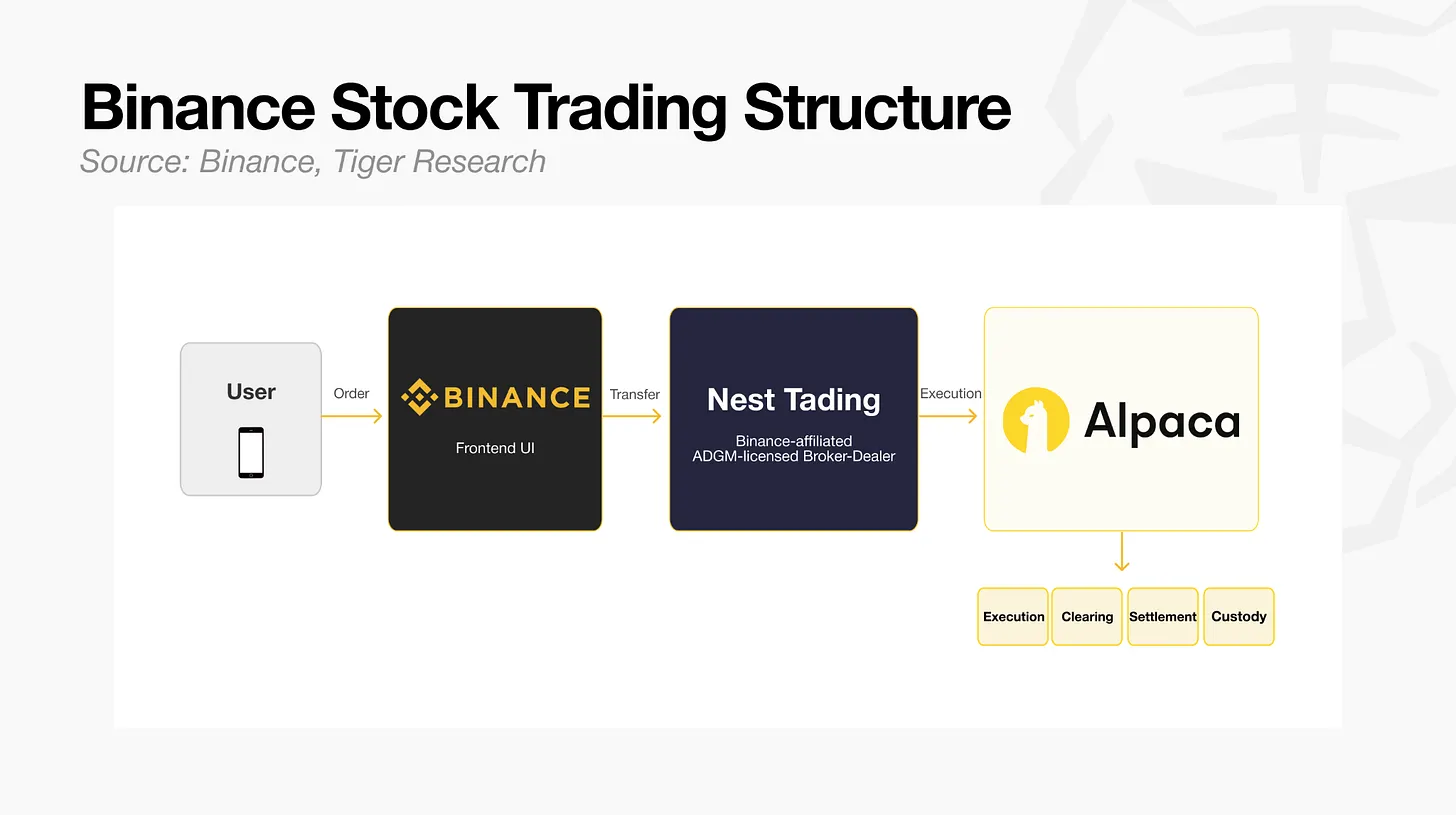
The specific operating model of this business is as follows: trading orders submitted by users on the Binance front-end are first received by Nest Trading, a licensed broker in the Abu Dhabi Global Market, and then forwarded to Alpaca Securities to complete the follow-up process. Alpaca is responsible for order execution, clearing, settlement, and asset custody. Binance does not directly hold the relevant securities assets, and this structural design allows it to avoid the jurisdiction of direct securities regulation.
It is worth mentioning that Nest Trading has been confirmed to be a Binance affiliate, and Binance also holds a minority stake in Alpaca. The two parties signed a revenue sharing agreement, and Nest Trading can share 50% of order flow processing fees and 65% of securities loan revenue.
Currently, Binance is building a full set of supporting infrastructure on its own to fully transform the financial superapp. Before altcoin liquidity flows further to Hyperliquid and the stock market, the platform is making every effort to consolidate the basic market of existing users.
Bybit: Dual line parallel development model
Bybit was founded in 2018 and began in the derivatives trading sector, achieving rapid expansion with up to 100 times leverage and low processing fees. Today, the platform uses a centralized, on-chain parallel strategy: on the one hand, migrating the liquidity of centralized exchanges to the blockchain network, and on the other hand, directly launching traditional financial asset derivatives on the centralized platform.
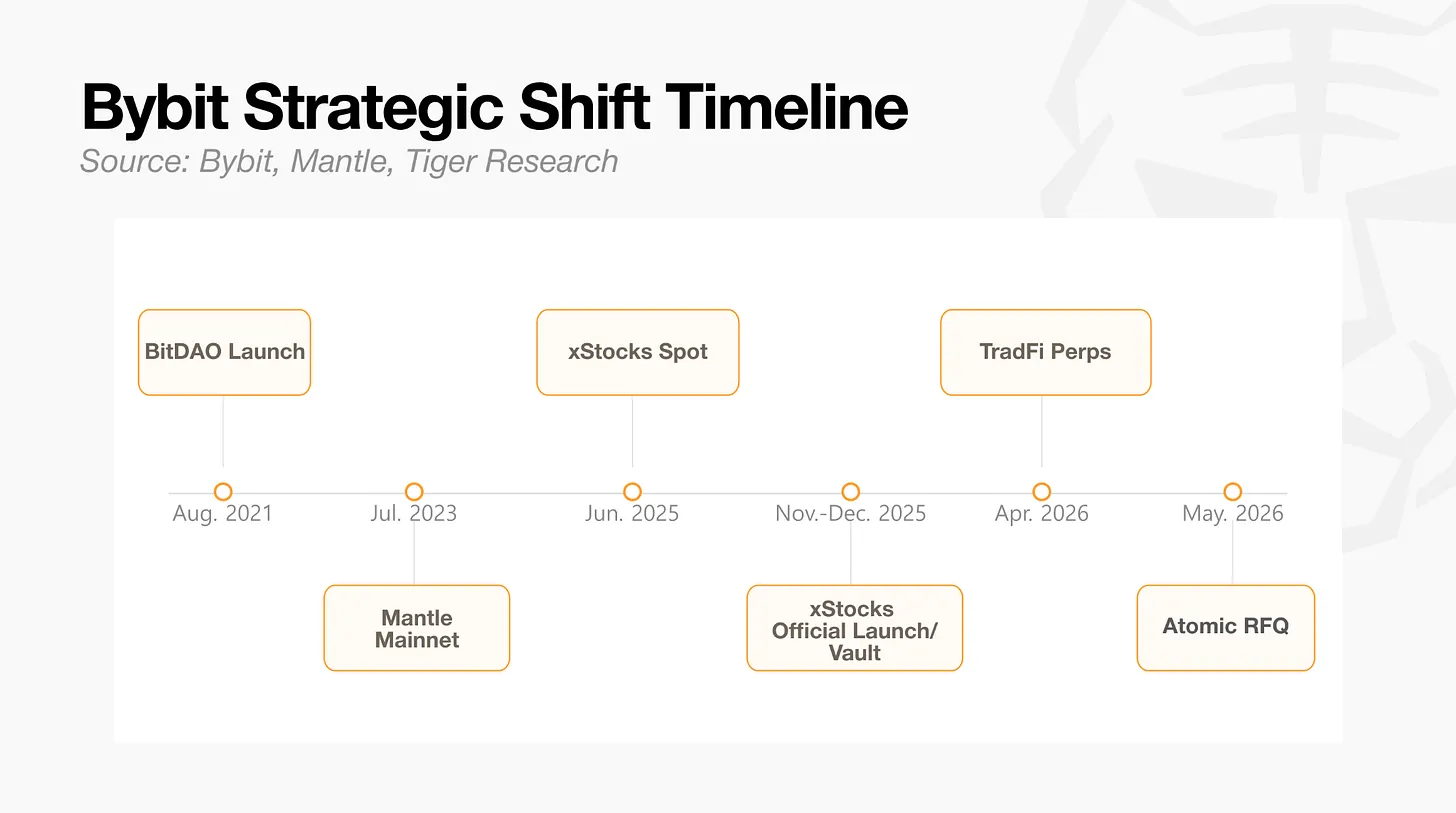
The layout of the platform starts with on-chain business. In June 2025, Bybit launched a tokenized stock product launched by Backed in the spot sector, officially taking the first step in laying out tokenized stocks. In November of the same year, Bybit cooperated with Mantle Public Chain and Backed to officially launch xStocks products on the Mantle Blockchain, covering mainstream US stocks such as NVDA (NVDA) and Apple (AAPL).
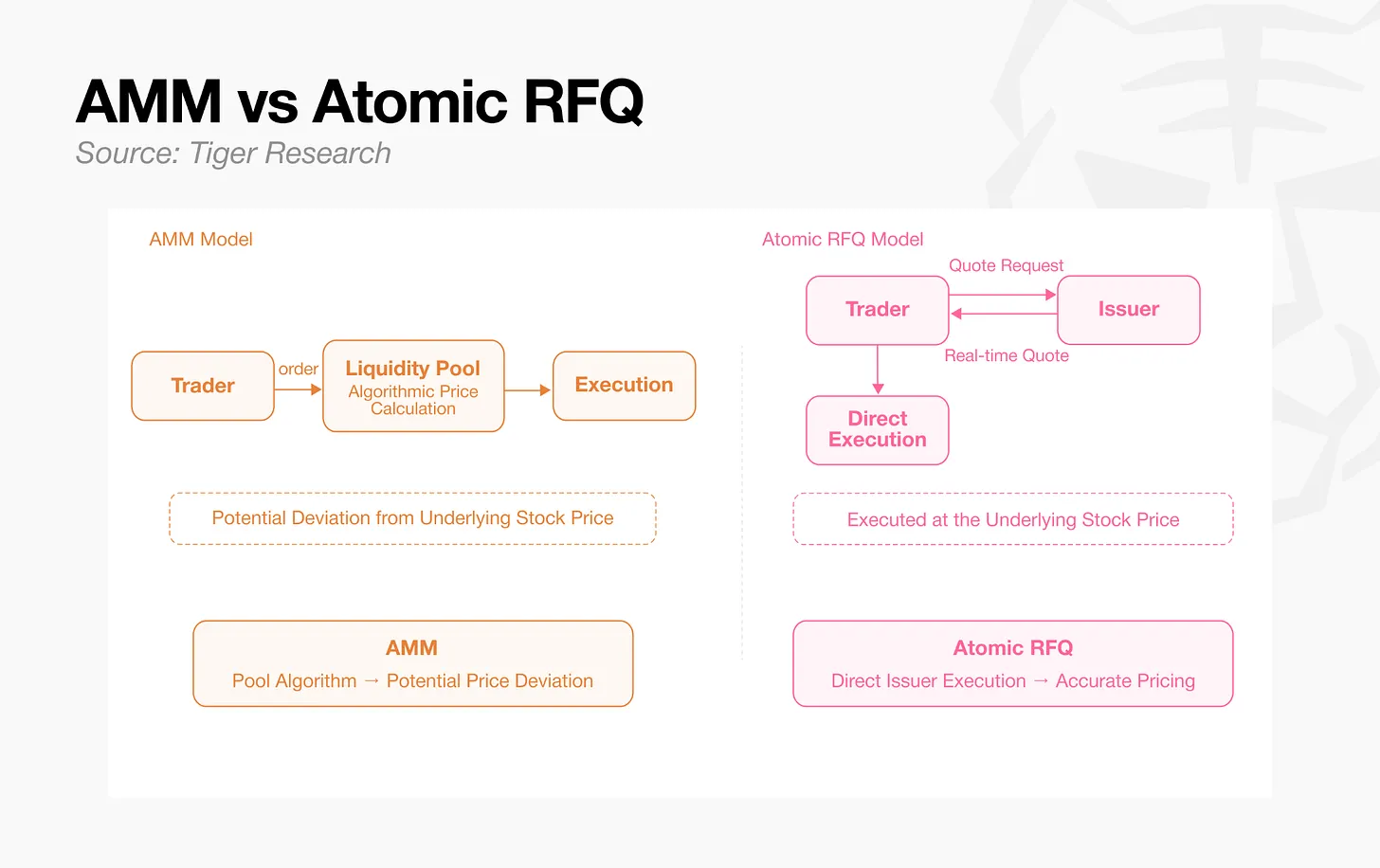
In May 2026, Bybit launched an atomic inquiry function on Fluxion, a decentralized exchange within the Mantle ecosystem. Instead of using automated market makers to match orders, this function directly obtains quotes from asset issuers, so that on-chain transactions can also meet the execution standards required by traditional financial institutions.
In the centralized business sector, Bybit is also moving frequently. Affected by industry pressure similar to Binance, the platform launched traditional financial perpetual contracts in April 2026, and has continued to receive new targets every week since then. Currently, mainstream US stocks such as Tesla (TSLA), Nvidia (NVDA), and Apple (AAPL), and commodities such as gold, silver, and crude oil all support round-the-clock trading using USDT. On June 4, Samsung Electronics, SK Hynix, and Hyundai Motor's perpetual contract was officially launched. At the same time, the platform also opened pre-listing share deals for space exploration technology companies.
The ultimate goal of the two main lines of business is to build and improve infrastructure, open up on-chain and off-chain scenarios, and achieve refined transactions of traditional financial assets. Unlike Binance, Bybit does not bet entirely on a centralized platform, but instead relies on the Fluxion and Mantle public chains to continue to cultivate the on-chain ecosystem.
Coinbase: the most credible exchange in the US market
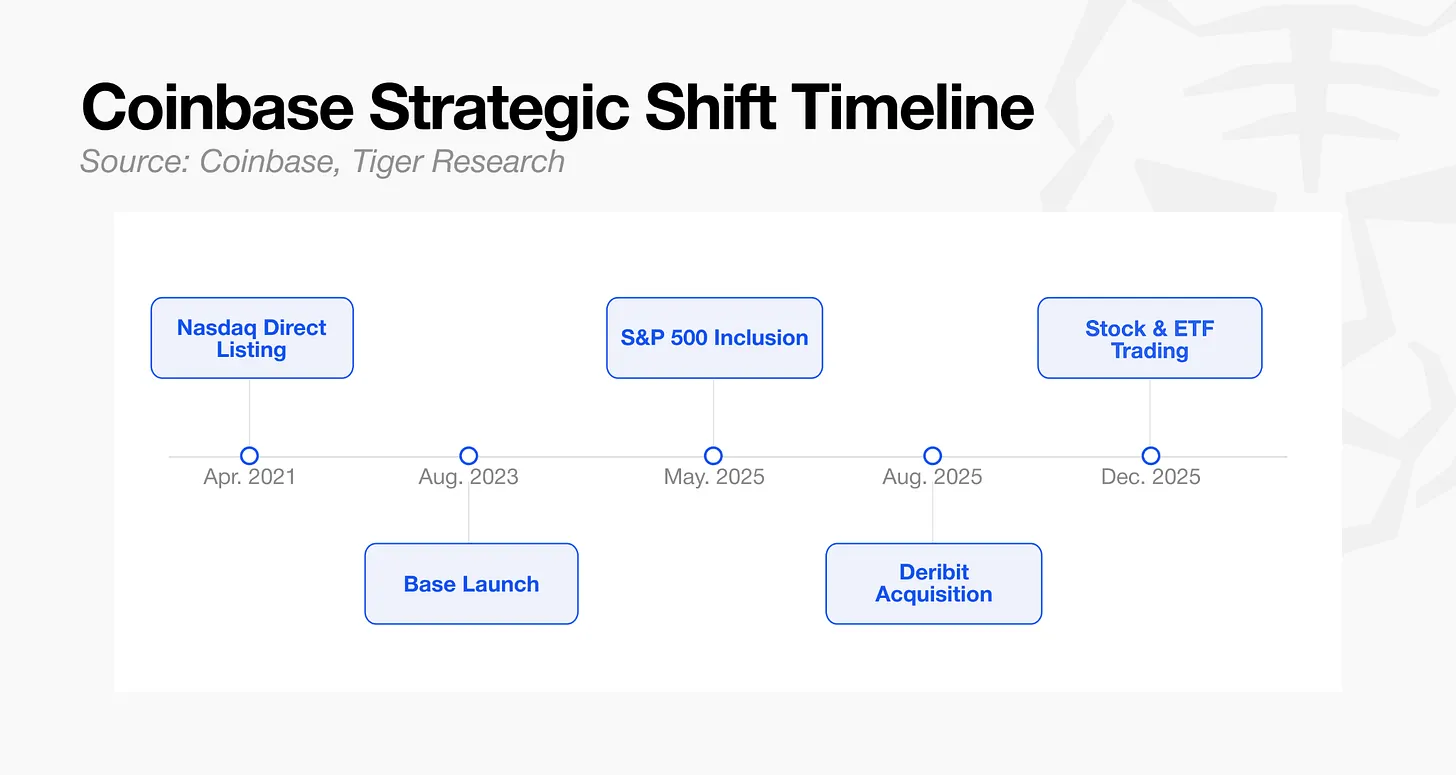
Coinbase was listed on NASDAQ in 2021 and included in the S&P 500 index in May 2025. Backed by Wall Street Capital, it is also currently the centralized crypto exchange with the highest institutional recognition in the world.
Coinbase also maintains an on-chain business layout. It launched the Ethereum layer 2 network Base in 2023. The network developed rapidly. In 2025, the total locked volume of the second layer network once accounted for nearly half. However, after entering 2026, Base's growth came to a standstill, and it was no longer the company's core development direction.
At this stage, the focus of Coinbase's efforts is completely shifting to institutional customers. In August 2025, the company completed the acquisition of Deribit for $2.9 billion, taking over 85% of the global crypto options market in one fell swoop. The platform then obtained the futures broker qualification issued by the US Commodity Futures Trading Commission and launched a cross-margin trading function to integrate spot, futures, and perpetual contract positions into the same margin account to further expand the institutional customer base. Back then, the loan balance of hedge funds and asset management institutions on the platform hit a quarterly high.
In December 2025, Coinbase launched zero-commission stock and exchange-traded fund trading services within its own app. Binance uses an indirect operating model of an external broker, while Coinbase directly carries out stock trading business with compliance qualifications accumulated over many years. On June 4, the platform announced support for SpaceX pre-listing share transactions.
Hyperliquid continues to enrich products and accumulate liquidity in the regulatory grey area, and Coinbase lays out the stock business ahead of schedule, which also gives it more initiative to respond to changes in the industry.
Kraken: Moving towards a federal crypto bank
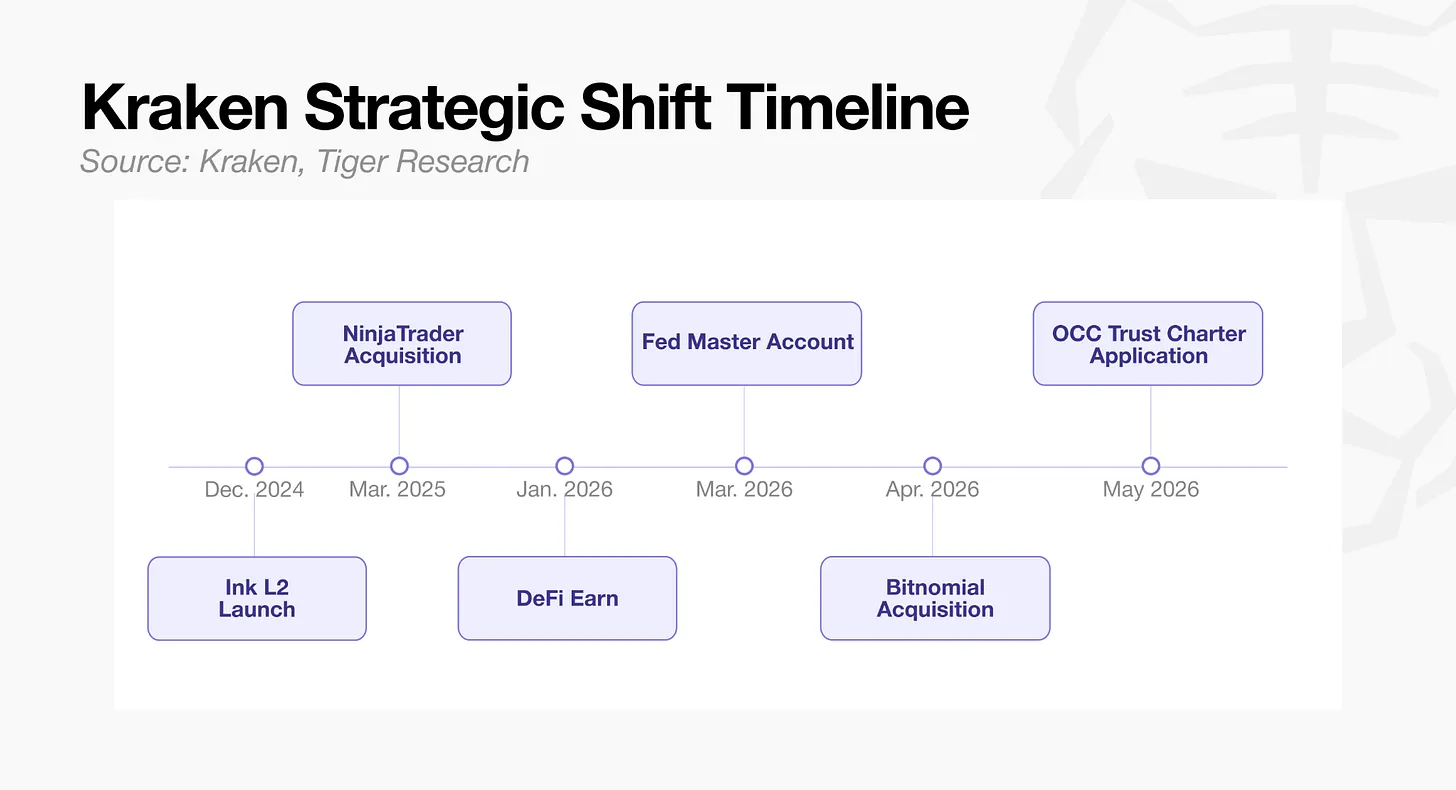
Kraken was founded in 2011 and is one of the oldest exchanges in the crypto industry. Its core strategy is to continue to secure various financial licenses, build an independent infrastructure, and eventually build a crypto asset custodian bank regulated by the US federal government.
Obtaining compliance qualifications is Kraken's number one priority. In March 2025, the company invested 1.5 billion US dollars to acquire the trading platform NinjaTrader, successfully obtained the US Commodity Futures Trading Commission futures broker license, and also took over 20,000 retail trader users of the platform. In April 2026, Bitnomial was acquired for another $550 million. After ten years of operation, this platform is the only native cryptographic platform in the industry that has collected the three core licenses of the US Commodity Futures Trading Commission — designated contract market license, derivatives clearing organization license, and futures broker license. In March 2026, Kraken successfully obtained a master account with the Federal Reserve; in May of the same year, it submitted an application for a national trust company license to the US Monetary Authority.
While making every effort to advance the compliance layout, Kraken has not ignored the on-chain ecosystem. The platform launched its self-developed second-tier network Ink in December 2024, and then built the lending protocol Tydro and the decentralized perpetual contract exchange Nado on top of the network. DeFi Earn, an on-chain wealth management product, was launched in January 2026, and Bitcoin Vault, a Bitcoin escrow service, was launched in May. The design logic of all on-chain products revolves around assets that can clearly explain value to institutional customers, and altcoins are also not within the scope of planning for their on-chain business.
When other exchanges launched stock trading to retain users, Kraken chose a different track and aspired to become a native crypto bank trusted by institutional customers.
Although the specific strategies of each centralized exchange are different, they have one thing in common: altcoins no longer occupy an important place in the future plans of all platforms.
Where will the crypto industry go
Centralized exchanges have long been the backbone of the crypto ecosystem's liquidity. The launch of tokens on exchanges has boosted the popularity of transactions. The vast majority of crypto projects have relied on this support to survive.
The deep problem with the industry is that few crypto projects can rely on actual business revenue to prove their true worth. The supporting logic of token prices has never been a fundamental aspect of the project itself, but rather early drainage methods such as listing on exchanges and liquidity mining. The premise that this operating model can be maintained is that exchanges and traders are always passionate about the crypto circuit.
Today, retail trading volume continues to shrink. After the popularity subsides, the exchange's listing support and marketing resources will also be tightened, and the original ecological model is bound to be difficult to maintain for a long time.
Market trends have changed, and capital has begun to flow to projects that can generate value from physical product revenue rather than simply relying on exchange blood transfusions. Hyperliquid's platform token HYPE is a prime example. Although it is this platform that diverts on-chain liquidity from cryptocurrencies and directs capital to the stock category, HYPE is currently one of the best-performing crypto assets. This phenomenon also means that the originally mutually beneficial symbiotic relationship between centralized exchanges and crypto projects is gradually breaking down.
The strategic choices of major exchanges also confirm this trend. Retail trading volume and user base are the foundation of the exchange's survival. If it continues to stick to the pure cryptocurrency trading circuit, the foundation will only continue to erode. Today, the market has long lost its former enthusiasm for newly launched cryptocurrencies. Exchanges have no choice but to actively explore new revenue streams while protecting the existing platform structure and user base.
This is also the core reason why major platforms are collectively switching to stock derivatives, value-added wealth management services, and asset escrow services. In the process of full resource tilting, exchanges have actually let go, allowing altcoin projects to cope with market challenges on their own.
In the past, when the market fell into a downward cycle, centralized exchanges would share the pressure and bear market with the entire crypto industry. But now, exchanges are exploring ways to grow without cryptocurrencies. This also indicates that the current downturn in the industry will be more difficult for the crypto sector than any previous bear market.
Twitter:https://twitter.com/BitpushNewsCN
Compare the TG exchange group:https://t.me/BitPushCommunity
Compare TG subscriptions:https://t.me/bitpush
