


Sharplink CEO's opinion: Technology is only an image; people are the core asset

author:Joseph Chalom, CEO of Sharplink
Compiled by Yuliya, PANews
Original title: Sharplink CEO: Ethereum's real moat is not a performance parameter, but a “person”
Editor's note: In the competition where many new public chains claim to be “faster,” Ethereum still ranks first. Sharplink CEO Joseph Chalom pointed out after visiting Asia that Ethereum has 1 million developers, which is where its core competitiveness lies. He emphasized that competition in the crypto world is not only about internet speed, but also about “where the top brains build houses.” With its deep cultural heritage, seamless “financial LEGO”, and forward-looking layout to resist technical challenges such as quantum computing, Ethereum has gone beyond simple parameter comparisons and built a truly insurmountable moat. The following is a compilation of the original text:

I just came back from Asia, and during that time I had in-depth conversations with Ethereum developers and ecosystem leaders. Special thanks to Seoul's Nonce Classic, Four Pillars, and DSRV, as well as our Hong Kong friend SNZ and the recently launched Ethereum Community Center. This hub is Asia's first permanent physical Ethereum community space, supported by the Ethereum Foundation.
What impressed me the most was not only the enthusiasm of the people, but also the rigorous attitude and ambition shown by the builders. I am inspired and truly admire the projects, experiments, and long-term thinking that have emerged in the Ethereum ecosystem.
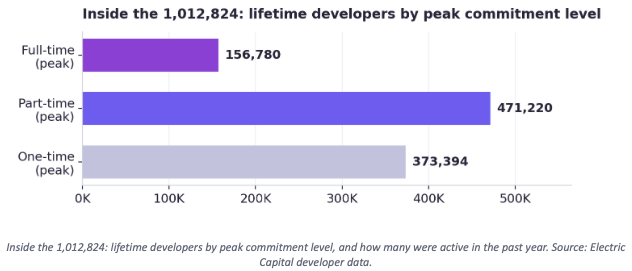
This also brought an originally abstract figure to life: According to Electric Capital, the number of lifetime developers on Ethereum has now crossed the 1 million mark, or 10,12824 independent developers who have contributed to the ecosystem to be exact. No other ecosystem comes close to this level in the crypto space.
A milestone worth stopping and reviewing
One million is an integer, and integers can sometimes appear empty. But that number is by no means empty. Behind it is the largest technical talent pool ever assembled around an open, permissionless blockchain network. More importantly, this talent pool continues to deepen and expand.
Of these 1 million developers, around 232,000 developers have been active in the past 12 months.
Why Ethereum: the real core question
Over the years, discussions in the crypto space have always revolved around speed, cost, and throughput. Each new chain claims to be “faster than Ethereum.” However, the most important question in the crypto space has never been which chain is the fastest, but a very different question:
“Where will the best builders choose for long-term development?”
Ethereum is still unique on this issue. This advantage is not only technical; it is also reflected in institutions, culture, economy, and composition. It is the result of a decade of continuous accumulation in terms of developers, infrastructure, standards, tools, mobility, research, application, and social coordination, which no other ecosystem can replicate.
Ethereum has become the default operating system for programmable finance and the formation of native capital on the internet.
What is this army of millions building today? And why it deepens the moat
The reason why 1 million developers are critical is due in large part to the challenges they are currently overcoming. Today's focus is on the most difficult and risky issues in the industry: scalability of core protocols, privacy protection, resistance to quantum computing, and intelligent systems that will run on them in the future.
Glamsterdam Upgrades — Innovate without breaking core principles. The Glamsterdam upgrade, which is scheduled to be launched in 2026, shows how Ethereum can achieve a technological leap while protecting its core values. Its core changes — including the proponent and builder separation mechanism (EPBs) and block-level access lists (BARs) included in the protocol, will unlock parallel execution capabilities and significantly increase throughput, while also potentially increasing the gas limit — which will significantly increase the capacity of Layer 1. While expanding capacity for future needs, we are resolutely defending reliable neutrality, safety, and MEV fairness. This is a moat that is working.
Simultaneous composability — making many Rollup experiences feel like a single network. Composability has always been Ethereum's super strength; the next huge leap forward is expanding it to all Layer 2. Native and “base-based” Rollups, with simultaneous composability, perfectly solve this problem. A contract on a Rollup can directly call a contract on the main network or another Rollup in a single atomic transaction. No cross-chain bridges, no waiting. A collaboration between Linea, Ethereum Economic Zone, Gnosis, Zisk, and the Ethereum Foundation is combining this design with real-time proof. The end result: Dozens of Rollups no longer felt like a fragmented independent network, but started to operate like a unified chain. This is the strongest response to criticism of ecological fragmentation.
Resistance to quantum computation — Ethereum's most notable leading edge. When it comes to dealing with the post-quantum era, no mainstream ecosystem is better prepared than Ethereum. The “Lean Ethereum (Lean Ethereum)” roadmap, the exclusive Ethereum Foundation post-quantum security team established in early 2026, the pq.ethereum.org center, and more than 10 client teams already running a weekly post-quantum interoperability developer testnet have come together to form a coordinated open source migration aimed at around 2029. When quantum computing risks really hit, those institutions that host trillions of dollars in assets were only concerned about one thing: which chain prepared the earliest and most thoroughly.
Beyond the developer's moat: Composability, standards, and trust
Due to Ethereum's unique architecture, these developer talent teams have had a strong compounding effect. Its deepest network effect is not its fluidity, but the depth of its composability. Apps are like financial LEGO blocks that can be put together: loans, stablecoins, exchanges, wallets, tokenized assets, oracles, and Layer 2 Rollups. They all interact through shared standards, so developers never need to start from scratch. EVM is the application layer of the crypto world, and the Solidity skills that developers have mastered can be seamlessly applied to Base, Arbitrum, Optimism, Polygon, zkSync, Scroll, Linea, and hundreds of other networks.
Learning about Ethereum's technology stack brings maximum choice, which in turn drives the flywheel effect: attract more developers, create more tools, bring more liquidity, attract more institutions, and then attract more developers to build composable protocols and assets. Liquidity nurtures mobility, and composability breeds composability.
Furthermore, Ethereum dominates the places where real value is deposited, not just the places with the highest level of surface activity.
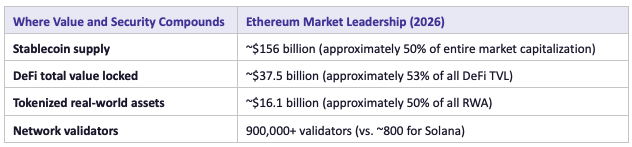
Three forces have further strengthened this leading position:
Reliable neutrality: Ethereum is secured by more than 900,000 verification nodes, compared to Solana, which only has about 800. Large institutions pay a very high premium for this level of decentralization and platform neutrality.
Modularity: Instead of fragmenting Ethereum, Rollups like Base, Arbitrum, and Optimism, have expanded it into an increasingly connected modular internet economy and fully inherit the security of the mainnet.
Culture: Ethereum particularly attracts the industry's top researchers, cryptographers, and authors of the EIP standards, who set the direction for the entire industry. This last advantage is the hardest of all to replicate by a hard fork.
There is only one Ethereum in the world
There is an essential difference between activity in the manufacturing chain and the long-term coordination layer of Internet-native finance trusted by the world's largest financial institutions. In the perception of the largest asset owners who prioritize trust, security, and liquidity, Ethereum absolutely dominates. I've seen it all firsthand during my time at BlackRock.
In the technology market, over time, ecosystems are always integrated around standards, mobility, and developers' mental share. This is Ethereum's insurmountable moat.
After speaking with these developers, builders, and ecosystem leaders in Seoul and Hong Kong, I believe more than ever before in the competitive advantages of Ethereum. I've met people who are building the next generation of financial infrastructure. They are the founders of the future of our industry and the architects of agency finance. It's these people and these teams that will truly change the world.
The future of Ethereum is happening right now.
Twitter:https://twitter.com/BitpushNewsCN
Compare the TG exchange group:https://t.me/BitPushCommunity
Compare TG subscriptions:https://t.me/bitpush
