


From World ID to AI Ecosystems: A Bigger Layout
By Flora, CryptoPulse Labs
Original title: From identity agreements to AI entrances, how big is World's ambition?
Recently, in the crypto market, WLD has become one of the focus of market attention. The market shows that WLD continued to rise and break through $0.6, with a total market capitalization of over $3 billion.
The main reason driving market sentiment is that World announced that it has officially entered the third phase of “The Simple Plan,” and its growth logic began to shift from early token incentives to utility-driven ones. So what is worth thinking about now is, is the world really becoming an important infrastructure in the AI era?
1. From iris scanning to real applications, the world has reached a new stage
Since its inception, World's core goal has been clear: to build a global “proof of personality” network.
Simply put, it aims to solve an increasingly critical problem in the internet world. That is, how to prove that you are a real person and not an identity generated by a robot, script, or AI.
Over the past few years, this issue may seem far off, but with the explosion of generative AI, it is rapidly becoming a real requirement. Today, AI can generate highly realistic images, videos, and voice, and can even operate social accounts in batches and automate complex tasks.
In the future, it is likely that quite a few active users on the internet will no longer be real people, but AI agents. In this context, how to verify the opposite is a real person is beginning to become one of the underlying problems of the Internet.
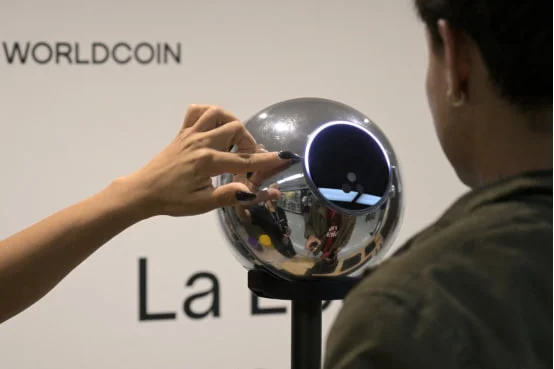
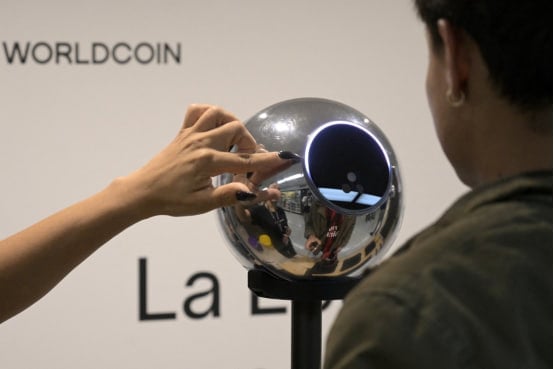
This is the market that World wants to break into. Its core product, World ID, scans users' irises through ORB devices to generate unique digital credentials for each person. What this system aims to achieve is “one person, one ID”, which can not only verify authenticity, but also protect user privacy as much as possible, and support on-chain calls.
The biggest question the market had about World in the past was that although the identity system had a lot of room for imagination, it still lacked real usage scenarios. However, after entering the third phase, this issue is changing. World clearly proposed that implementation will be promoted in three directions: enterprise side, personal end, and AI agent side.
On the enterprise side, World is collaborating with companies such as Zoom, Okta, and DocuSign to launch authentication products that address deep fraud issues. As AI scams and deep forgery attacks become more common, the demand for human authentication by enterprises is rapidly rising. Whether it's video conferencing, telecommuting, or electronic signatures, verifying the authenticity of an identity is beginning to become important.
On the personal side, World is targeting higher-frequency internet pain points. For example, Tinder can use World ID to verify whether users are real people, and concert kits in concert ticketing scenarios can reduce robot ticket grabbing and scalper behavior.
This means that World is trying to solve the problem of fake accounts and machine traffic that has plagued the internet industry for a long time.
The most notable one is the AI agent side. World launched AgentKit to try to establish a trusted authorization relationship between humans and AI. In the future, if everyone has their own AI assistants, these agents may help users manage assets, execute transactions, sign agreements, and even participate in on-chain governance.
But before that, the system must be able to verify who exactly this AI represents and whether it has been authorized by a real human. The value of AgentKit is to establish an underlying trust framework for the future AI economy.
2. In the AI era, “real identity” is becoming scarce
The core reason for WLD's rise is not just news stimulus, but the market is beginning to reprice the scarce value of “real identity.”
Over the past few years, a large number of identity projects have appeared in the crypto market, but most of them are difficult to sustain. The root cause is insufficient demand. Although the traditional internet has authentication requirements, it is not enough to support a huge independent circuit. However, the advent of the AI era completely changed this logic.

When the cost of AI-generated content came close to zero, what was really scarce became humans themselves. In the past, the Internet's most important resources were traffic, content, and attention, but in the future, more scarce resources may be human identity, human behavior, and human authorization.
The reason is simple. AI can copy text, images, sounds, and even videos indefinitely, but it can't naturally have an independent human identity. This means that in the future of the Internet, real humans may become an increasingly scarce resource. Whoever can verify a “real person” has mastered the key entry point.
This is why the market is beginning to re-evaluate the long-term value of World. It's no longer just a cryptographic narrative, it's betting on critical infrastructure needs in the AI era.
At the same time, World's operating strategy has also changed markedly. The team announced that it will focus resources on a few high-density, high-value cities, including San Francisco, New York, and regions such as the United Kingdom, Germany, Japan, and South Korea, while reducing the scale of operations in non-key regions. This shows that the team is no longer pursuing large-scale expansion, but is prioritizing the establishment of network effects in high-value markets.
The business logic behind this strategy is clear. The value of identity systems essentially comes from network effects. The value of World ID can only be truly reflected when a region has enough users, businesses, and application scenarios. Otherwise, even if the number of users grows, it will be difficult to form a stable closed loop of value.
Another key change is a hardware upgrade. The next generation of Orb will evolve towards self-service, with the goal of achieving 95% self-service operations by the end of 2026. This is very important.
The bottleneck in Orb's expansion in the past was that labor costs were too high, and every additional user required offline operation support. And once the equipment can be self-operated on a large scale, customer acquisition costs and expansion costs will drop significantly, and the business model will become healthier as a result.
3. In the AI Agent era, the world may become a key entry point
From a broader perspective, World's advance could have a profound impact on the crypto industry.
First, it could drive the crypto narrative to expand further from finance to identity. In the past, when the market discussed Crypto, the core usually revolved around DeFi, stablecoins, ETFs, and RWA, which were essentially all financial logic. But World represents a different path: identity infrastructure.
In the future, identity itself may become a composable asset. Users with trusted identities may be granted empty investment status, credit scores, governance rights, and even access to AI.
Around the identity layer, the market may spawn new racetracks, such as identity agreements, human credit agreements, and AI licensing agreements.
Second, the world could become an important infrastructure for the AI agent economy. If AI agents are truly the next generation of productivity tools, then the entire industry must address three questions: who the agent belongs, whether the agent is trustworthy, and whether the agent can be verified. It is these three core requirements that World cuts into.
Seen from this perspective, World's ambition is not just to do a cryptographic project, but to become an identity portal in the AI era. Just as Google became an information portal and Meta became a social portal, World is trying to become an identity portal. Once this positioning is established, WLD's valuation logic will be completely restructured.
Finally, the market's biggest concern remains how does WLD capture value? This is also an important change brought about by World ID 4.0. The new version of the agreement introduces a fee mechanism that allows the issuer of the certificate and the agreement to charge the user, while the end user can still use it free of charge.
The point of this model is that it allows the World to start having a real source of revenue. Users use the agreement for free, and ecosystem participants pay. This is highly similar to the business model of internet platforms.
As the number of authentications increases, the scale of enterprise access increases, and the frequency of protocol calls increases, the entire network has the opportunity to generate continuous cash flow.
This is probably the most critical change for the market, as it means that World is no longer just telling the story of the future, but is beginning to build verifiable business models and value capture paths.
epilogue
On the surface, the rise in WLD is a recovery in market sentiment, but in depth, it reflects changes in market perception. What the world is really betting on is not the short-term currency price, but the core issue of the AI era, that is, how to prove that you are human.
As AI becomes more and more human-like, the value of real human identity may continue to increase. And whoever can master the personality proof network will probably master an important gateway to the next generation of the Internet. For World, this is probably just the beginning.
Twitter:https://twitter.com/BitpushNewsCN
Compare the TG exchange group:https://t.me/BitPushCommunity
Compare TG subscriptions:https://t.me/bitpush
