


Money for a racetrack: AI and RWA are sucking out new money
Written by:KarenZ, Foresight News
Original title: 2026 Crypto VC Changes: Fundraising Thresholds Narrow, LP Only Refunds, New Money Flows to AI and RWA
If you only look at head funds, the first half of 2026 was not cold for Crypto VC.
According to Foresight News, of the new Crypto VC funds announced to be completed or launched in the first half of 2026, only a16z Crypto and Haun Ventures reached a scale of $1 billion or more: the former launched a $2.2 billion Crypto Fund 5, and the latter raised $1 billion in new funds.
Of the announced funds that reached more than $500 million and less than $1 billion, there was only Dragonfly's $650 million Fund IV. Further down are Variant's $222 million Variant 4, and ParaFi's new $125 million fund for stablecoins, tokenization, and institutional on-chain finance.
Almost every month, Crypto VCs get hundreds of millions of dollars in new ammunition. The market isn't that cold.
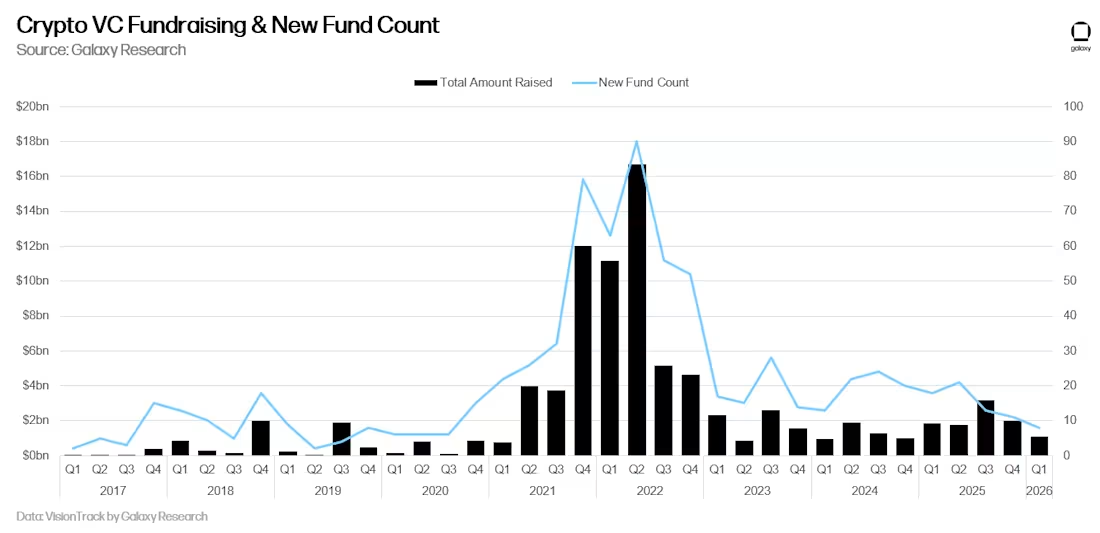
But another set of data gives a colder side.Galaxy Research ReportIt was mentioned that Crypto VC raised only 8 new funds in Q1 2026, totaling about US$1.1 billion, the lowest number of new funds in a single quarter since the third quarter of 2020. Compared with Q1 in 2023, the number of new funds raised in Q1 2026 decreased by about 43%, the total amount raised was halved, the average fund size decreased by about 41%, and the median size also fell from $62.5 million to $55 million.
Source: Galaxy Research
This also makes the previous capital raising more meaningful: the market has not completely cooled down, but the popularity is mainly concentrated on a small number of funds. The emergence of large funds will amplify the sense of recovery. However, the number of new funds, average size, and the pace of annual fund-raising all remind that the overall fund-raising platform of Crypto VC is already much thinner than in the previous round.
Combined with public fundraising data and our interviews with IOSG Ventures founding partner Jocy Lin, HashKey Capital CEO Deng Chao, and Starbase founder Vivian, a clear signal is emerging:
The 2026 Crypto VC was not an all-out recovery, but a narrower recovery. The fundraising window is still open, but the doors have narrowed. Those that can be squeezed in are usually GPs with long-term results, exit cases, clear strategies, and cross-cycle capabilities; projects that can get money are also increasingly focused on projects such as stablecoins, RWA, institutional financial infrastructure, and Crypto x AI, which are easier to verify and are closer to real financial infrastructure.
From changes in LP issues, to the narrowing of racetrack preferences, to the restructuring of investment play styles and exit paths, Crypto VC is entering a new, more demanding cycle.
LP requirements have changed: AUM is not enough to watch, DPI has become hard currency
From 2021 to the first half of 2022, the primary market was like a high-speed financing machine. Funds are raising capital, projects are being financed, ecological funds are subsidizing, and exchanges and market makers are undertaking liquidity.
Crypto VCs at the time had a default consensus: as long as the industry beta continues to expand, early investments can always be caught by the next round of liquidity. But now, that default consensus is no longer valid.
IOSG Ventures founding partner Jocy Lin summarized this change as a shift from “narrative driven” to “DPI driven.” He believes, “In past narrative-driven cycles, the gap between head and waist funds was not fully widened; however, in the DPI-driven present, funds that can actually exit and clearly explain the exit path will take more LP funds, and the remaining money is being contested among a large number of middle and lower back funds.”
Deng Chao emphasized, “Crypto is highly cyclical, so funds must not only rely on a single path to exit; they must have the ability to allocate across cycles. In terms of fund allocation, HashKey Capital places more emphasis on portfolio structures: which are long-term infrastructure, which are cash-flow projects, which are early-stage projects with high volatility but high upward trends, and which can enhance liquidity through secondary or liquidity strategies.”
This is why, looking at AUM alone, it is already difficult to determine the true state of a Crypto VC.
“Fortune” magazine April based on SEC filingsReportA detail was provided: In the market downturn in 2025, the asset management scale of leading institutions such as Paradigm, Pantera, a16z Crypto, and Multicoin were all affected. The total asset management size (AUM) of the four a16z crypto funds declined by nearly 40% to $9.5 billion between 2024 and 2025, partly because its top three funds began allocating capital to LPs.
It is worth mentioning that “Fortune” magazine quoted Newcomer data as reporting that a16z's first crypto fund's net DPI (that is, the ratio of allocated capital to paid-in capital) reached 5.4. Pantera also distributed capital to LP in 2025 due to the listing of five investee companies including Circle and BitGo. Multicoin, on the other hand, is more affected by market cycles, with AUM losing nearly $2.7 billion between 2024 and 2025. Haun Ventures is one of the few leading institutions for AUM growth, with a year-on-year increase of more than 30%, reaching nearly $2.5 billion.
Together, these details point to a change: Crypto VC's narrative of scale is giving way to allocative capacity. What LP really needs to look at is whether GP can turn paper earnings into cash payments.
This dissatisfaction also began to appear in more open discussions. Akshat, co-founder of Maelstrom, a fund owned by Arthur Hayes, mentioned on Twitter in November 2025 that he invested 100,000 US dollars in an early Token fund as an LP, leaving only about $56,000 (3% management fee +30% revenue share) after 4 years; Bitcoin doubled during the same period, and many seed round projects also showed 20 to 75 times returns.
He concluded that the size of many early Crypto funds has exceeded the carrying capacity of real high-quality project pools, and LPs need opportunities that are more suitable for large-scale allocations. Incidentally, Akshat promoted the Maelstrom Equity Fund I product. This foundation focuses on off-chain “shovel” businesses with positive cash flow, providing founders with cleaner cash exits through control acquisitions, while also refining these businesses into targets that can be acquired by new entrants such as Robinhood, Charles Schwab, X, and Wealthfront in the future.
For LPs, such products seek to provide a path that does not directly bear token fluctuations, but can allocate the crypto industry's cash flow assets on a 9-digit scale.
In addition to withdrawing from the assessment, LPs are also increasingly questioning the details of fund governance and risk control.
Deng Chao told Foresight News, “LPs are no longer just about racetracks and projects; they are more concerned about asset protection, compliance risk, exit ability, and true implementation value. What the institutional LP ultimately pays for is a set of reviewable, enforceable, and sustainable investment and risk control processes.”
The tightening of LP standards will eventually be reflected in Crypto VC's fund-raising data. The Galaxy Research data mentioned earlier shows that the number of new funds and the total amount raised are shrinking, but a few leading GPs are still able to open the window.
Dragonfly is a prime example of this cross-cycle fundraising ability. In February 2026, Dragonfly Managing Partner Haseeb Qureshi announced that Fund IV had been overraised by $650 million. Bets on popular projects such as Polymarket, Ethena, Rain, and Mesh became examples of Dragonfly's use to convince LP growth.
Some GPs are also trying to respond to LP's new questions with the fund product itself. Jocy Lin mentioned that IOSG plans to launch new fund products this year, hoping to obtain LP approval through more differentiated product designs and continue to export new investment cases to the market.
In other words, Crypto VC competition is not only about investment projects, but also about whether the product structure can respond to liquidity, DPI, and cross-cycle configuration requirements. A few GPs with brands, track records, and exit cases can still get their money, and more GPs are still facing longer fundraising cycles and stricter LP questionnaires.
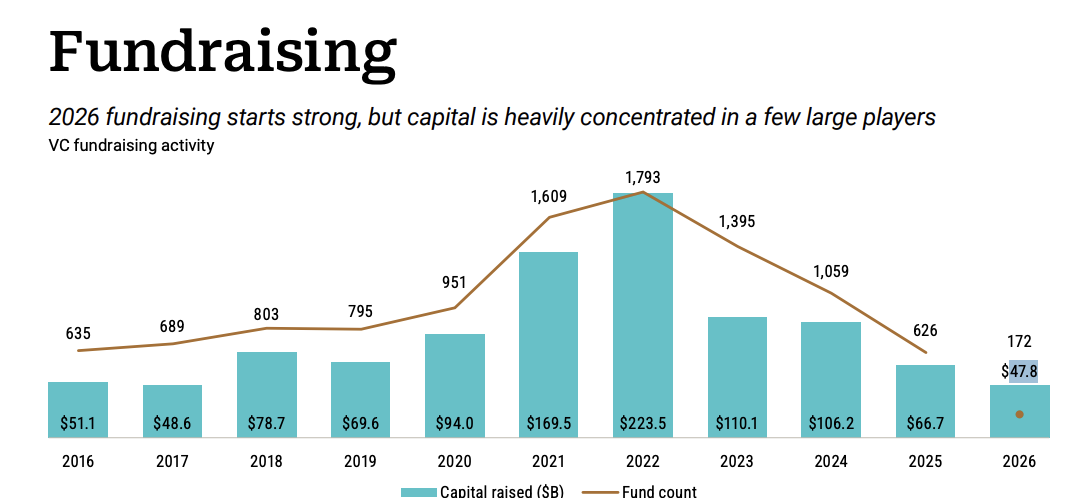
This isn't a phenomenon unique to Crypto. The larger venture capital market is also being concentrated in a few big managers. Jointly published by PitchBook and the American Venture Capital Association (NVCA)2026 Q1 Capital Markets ReportIt shows that in the first quarter of 2026, US VC raised a total of 47.8 billion US dollars.
It sounds pretty strong, but capital is highly concentrated in the hands of a few big managers. Experienced managers took 90.9% of the capital raised, setting a new high for this data set. Meanwhile, the median size of VC funds fell from $25 million in 2025 to $15.3 million in the first quarter of 2026. Big funds seem bigger, and small funds have a narrower living space.
Source: Q1 2026 Capital Markets Report published jointly by PitchBook and NVCA
When it comes to the Asian market, this pressure will be further amplified. Jocy Lin's judgment on Asian Crypto VCs is sharper. He believes that US funds have a more mature LP system, and the last round can also benefit from investing in large currencies such as Bitcoin; Asian funds have a much thinner LP base and limited bullets, so they must use less money to hit more definite opportunities.
As a result, mid-waist funds are shifting from “keeping up with all the hot spots” to “proving that they have unique abilities.” Starbase founder Vivian's judgment was more straightforward. She believes, “Pure Crypto VC has basically died out, and capital will continue to be concentrated in the head. If mid-waist institutions can't find a vertical segmentation track or switch to an incubation and accelerator model, it will be difficult for them to continue to survive with the previous round of pure financial investment.”
Track preferences have changed: new money is betting on Crypto that can be embedded in finance
The LP problem has changed, and so will GP's fundraising narrative.
What is really interesting about this round is not that the keywords in the fundraising materials were replaced by L1, NFT, DAO, SocialFi, and chain games; rather, Crypto VC began admitting that growth most understood by LP is taking place at the interface of the financial system.
Judging by the new fund narratives of a16z crypto, ParaFi, Haun Ventures, and Dragonfly, stablecoins, tokenization, prediction markets, institutional DeFi, and proxy finance are recurring.
They sound different, but what they all have in common is clear: they all seek to make Crypto part of financial processes, information pricing, or machine economics.
These directions can be split into four more core lines: Crypto x AI, stablecoins and payments, RWA and on-chain capital markets, and prediction markets.
The first line is Crypto x AI.
AI Agents are new variables.
Many VCs are putting AI agents on the racetrack, but they are not focusing on the simple “AI + Crypto” concept.
In the IOSG framework, Crypto x AI's weight and evaluation methods are more specific. Jocy Lin told Foresight News that IOSG will invest 30% of its capital in the field of crypto and AI intersecting, particularly decentralized data services, DePIN, data collection, and TOB scenarios. His judgment is that AI is in high demand, but if the Crypto x AI project is looking for a business scenario, it should go to B first because revenue is easier to achieve.
This means that IOSG is not focusing on putting an AI label on the project. What it really wants to verify is whether the AI era will generate new requirements for trusted data, machine payments, decentralized computing power, automated collaboration, and verifiable execution.
Haun Ventures listed the Agentic Economy (AGENTIC ECONOMY) as one of Fund II's three areas of focus, and believes that AI agents will perform more tasks on behalf of humans in the future: they will pay, trade, subscribe to software, purchase services, automatically collaborate between different applications, and create a new paradigm of coordination, trust, and value exchange.
a16z crypto also mentioned that software agents will represent user decisions, actions, and transactions, and obtain computing power, data, and services in the process. Blockchain can provide AI agents with wallet identity, on-chain credentials, stablecoin settlement, smart contract restrictions, and verifiable execution logs.
The proxy economy and payments have also appeared in Dragonfly and ParaFi's new fund themes, which shows that more and more Crypto VCs are looking for a new financial executive in the AI era: who will provide agents with identity, wallets, payments, transactions, data calls, and automated settlement.
It's worth mentioning that Jocy Lin said that social, gaming, and NFT tracks have experienced large-scale counterfeiting, but Jocy hasn't completely eliminated them. His judgment is that if AI can change production methods, IP gameplay, or distribution logic in these directions, new opportunities may still arise. In addition, IOSG will be more cautious about investing in new public chains, because the leading public chain pattern is already relatively stable, investment in new public chains is huge, and migration costs for developers are also very high, so IOSG has basically stopped investing in new public chain projects.
The second line is stablecoins and payments.
The appeal of stablecoins comes not only from the scale of circulation that USDT and USDC have already formed, but also from the fact that they have begun to enter scenarios such as cross-border payments, corporate settlement, treasury management, and merchant collections. This means that stablecoins are beginning to have a commercialization path for financial infrastructure.
In the $2.2 billion Fund 5 official announcement, a16z crypto viewed stablecoins as one of the clearest use cases in the current cycle, believing that their usage continued to grow during the downward cycle and was being used for savings, cross-border transfers, and payments.
McKinsey and Artemis's analysis estimates that, based on the annualization of activity in December 2025, when excluding activities mainly driven by transactions, internal rebalancing, and automated contract cycles, the real stablecoin payment scale is about $390 billion, more than double that of 2024.
Compared to the global payment market, this volume is still very small, but the growth rate and application scenarios are clear enough.
The mergers and acquisitions of this type of infrastructure by traditional fintech companies are also verifying the same direction. Stripe bought Bridge for $1.1 billion, Mastercard announced the acquisition of BVNK for up to $1.8 billion, and Kraken's parent company Payward agreed to buy Hong Kong stablecoin payment company Reap for up to $600 million.
These mergers and acquisitions suggest that stablecoin payment, settlement, and merchant network capabilities are not only internal opportunities for Crypto native companies, but are also beginning to become infrastructure that traditional fintech companies are willing to buy with real money.
This change is also reflected in the track rankings of the VCs interviewed. Jocy Lin said that IOSG Ventures is focusing on laying out stable coin payments, settlement, on-chain credit, etc. with a clear interface with traditional finance. Deng Chao said that the current three main lines of HashKey Capital are trading and financial market infrastructure, stablecoin payment and settlement networks, and RWA and on-chain capital market infrastructure. Vivian also listed consumer-grade stablecoins and payment apps as one of Starbase's current favorite areas to bet on.
The third line is RWA and on-chain capital markets.
RWA is receiving renewed attention in this round not because “moving assets to the chain” itself is new, but because it is beginning to get closer to what traditional finance really cares about: asset issuance, distribution, collateral, trading, and settlement.
In “Tokenization 2030” released in June 2026, Citi predicts that global tokenized assets could reach 5.5 trillion US dollars in the 2030 benchmark case and 8 trillion US dollars in the bull market case.
The actions of traditional financial institutions are also making this logic more specific. Major market infrastructure providers, including DTCC, NYSE, and NASDAQ, are also beginning to integrate tokenization into their core platforms.
For VCs, this type of project is easier to verify than many consumer narratives in the previous round. What is the underlying asset, who is responsible for issuing and managing it, who buys it, how cash flow is generated, how compliance status is obtained, and how secondary liquidity is formed will directly affect whether the project can be established.
Both HashKey Capital and IOSG are looking at this direction in the framework of financial industry innovation.
Deng Chao said, “What attracts us in this direction is the combination of regulatory windows, institutional needs, and exit imagination. “The key to RWA is not just the transfer of assets to the chain, but whether they can improve the availability, liquidity, transparency, and efficiency of use of assets after going on the chain.”
Jocy Lin also mentioned that IOSG values a clear interface between on-chain credit (such as Morpho, etc.), RWA, etc. and traditional finance.
Haun Ventures' statement of this direction is closer to “new assets and markets.” Haun Ventures mentioned, “Stablecoins are just the starting point, and tokenization is expanding to currencies, securities, derivatives, and other real-world assets. Once issued in tokenized form, these assets will become borderless, always-on, and programmable financial primitives.”
The fourth line is predicting the market.
For Crypto VC, the appeal of the predictive market comes not only from the volume of transactions, but also from its potential to grow into a new kind of information market infrastructure.
From Haun Ventures's perspective, predicting the market can naturally extend from tokenization logic. Haun Ventures believes that tokenization can also create new market forms because it can form a global liquidity pool without depending on the separate construction of transaction and settlement infrastructure in each region. Predicting the market is a prime example. Although today's forecasting markets are mainly focused on sports and politics, in the future they may spawn event risk hedging, insurance, and commercial results markets, and the findings of these markets can directly trigger conditional programmable capital flows.”
a16z crypto researcher Scott Kominers is an economist who has long studied markets and incentives. In an article he published in Junevoiced, “Predicting the market can directly give probability estimates; this thing itself is a kind of 'superpower'. The meaning of its investment is not just to “bet on the outcome of the event,” but to put scattered information, incentive mechanisms, event verification, contract settlement, and transparent auditing into the same market structure.”
However, a rapid influx of capital can also drive up entry costs. Jocy Lin believes that the forecasting market circuit has shown signs of capital concentration, and projects such as Polymarket may face the problem of overvaluation.
There is a common thread between these directions: they are easier to embed in real financial processes or informational pricing.
Crypto VC's favorite projects now can hardly rely mainly on grand narratives and long-term token liquidity to support valuations. They need to enter real transaction requirements, institutional distribution networks, financial ledgers, or new automated processes in the AI era.
The investment style has changed: look at level 1, level 2, and exit together
As LP requirements became stricter and VC attention was brought closer to the actual financial process, Crypto VC's style of play also began to shift from “investing in” to “how to catch and exit.”
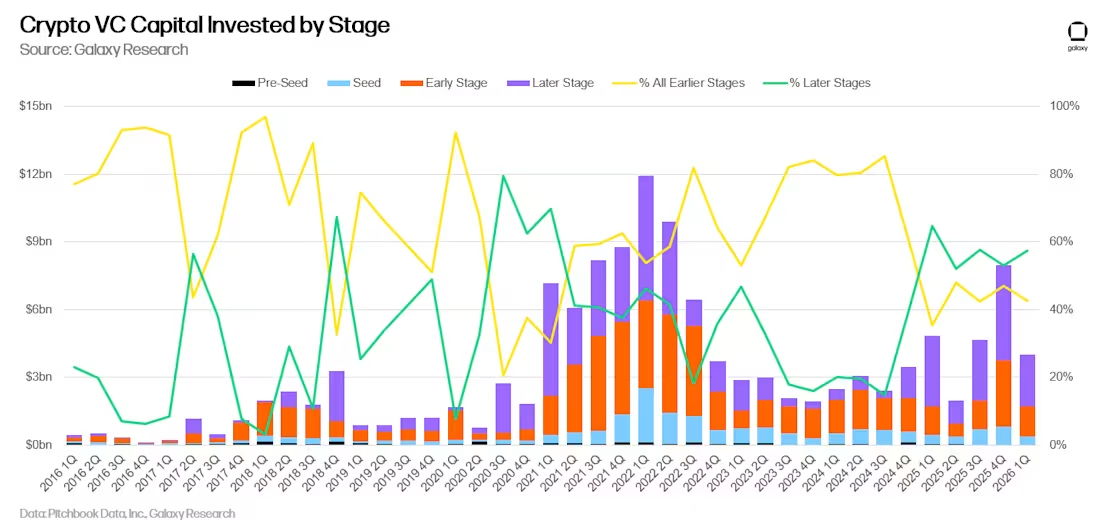
The distribution of investment stages first gave a signal. Galaxy Research in2026 Q1 ReportIt was mentioned that 57% of capital flowed to later-stage (later-stage) projects in the first quarter, and young companies received about 43%; in terms of the number of investment transactions, the share of pre-seed rounds dropped to 19%, and the share of later-stage transactions rose to about a quarter.
Source: Galaxy Research
That doesn't mean early investments aren't important. Variant still emphasizes early investment, and Haun Ventures will also lay out early and late stages at the same time, while a16z crypto places more emphasis on whether the project can enter real user scenarios such as finance and payment.
What has really changed is that early judgments must be placed on the same sheet as product verification, revenue verification, compliance path, and exit path.
This change is also felt by the market at a more microscopic level. On June 15, Jademont, the founding partner and CEO of Waterdrip Capital, mentioned on X that some teams only wanted $36,000 when financing, saying that this was the actual cost after strict calculation. Jademont believes that a more pragmatic industry may be a sign of bottoming out.
In terms of specific configurations, some VCs have begun to manage tier 1, 2, and off-site opportunities in the same combination.
Multicoin Capital has established heavy positions on the privacy coin ZEC since February this year.
IOSG's combination adjustments also reflect this change in style of play. Jocy Lin said, “IOSG maintains a total investment volume of around 15 projects each year, of which 30% are lead investors. Affected by the market environment, the number of high-quality projects in the primary market decreased, leading to a slowdown in the frequency of publicly disclosed investments, but overall activity was maintained through post-TGE and OTC transactions. IOSG adjusted the investment ratio to 50% primary market, 30% post-TGE, and 20% OTC to capture seriously undervalued secondary market opportunities.” Jocy Lin revealed that he personally comes into contact with 3-5 offline projects every week and maintains a high-intensity project screening rhythm throughout the year.
This ratio is more appropriate as a single agency case, but it reflects a more general shift: Crypto VCs are moving from simply investing in Tier 1 projects to simultaneously managing Tier 1, Tier 2, Post-TGE, and OTC opportunities.
Many post-TGE projects have already seen cash flow and user growth, but the token value is not fully priced by the market. Such opportunities were easily overlooked during the last hot money cycle. For the investment team, judging a project should not only be limited to the financing round, but also based on its repricing opportunities in the secondary market, OTC liquidity, and token value capture.
HashKey Capital's changes place greater emphasis on the discipline and ability to allocate across cycles of the investment framework itself. Their biggest optimization over the past year was to make the investment framework more disciplined, systematic, and verifiable. The team remains active, but the frequency of investment is more disciplined than in previous years, and they prefer to invest in teams that have proven to be able to do business, as such projects are generally more resilient in the midst of a low cycle.
HashKey Capital's fund uses a multi-strategy structure, which combines the primary market, open market, OTC, PIPE, convertible bonds, and some cross-investment opportunities with good liquidity.
Starbase adjusted its strategy to small-volume, boutique, and deep operations. Vivian mentioned that Starbase focuses on incubating no more than 3 projects per cycle. Instead of pursuing wide-ranging investment, it concentrates capital and resources to support key teams on vertical tracks such as RWA, AI Agents, consumer-grade stablecoins, and payment applications.
AI is also changing VC's own workflow. Jocy Lin observed that AI is making global capital markets show some kind of “cryptographic” characteristics: information is distributed faster, the judgments and trading decisions of ordinary investors are more likely to be amplified by AI, and capital is also easier to concentrate on a few targets with the highest certainty. For VCs, judgment and trust between people is still difficult to replace, but procedural tasks such as data observation, statistics, backtesting, and collaboration across time zones have begun to be rewritten by AI bots.
Changes in style of play will also weigh down to the level of due diligence.
Crypto VC hasn't stopped taking risks, it's just that risk-taking budgets have become more disciplined.
This discipline is first reflected in changes in due diligence issues. HashKey Capital's due diligence shifts from narrative coverage to hypothesis testing: the era of looking at each new narrative at a glance has passed. The project must answer who the customer is, who is paying, why they need it now, whether there is real retention and natural demand, how value is ultimately captured, and whether the team has long-term execution and fund management capabilities.
At the project level, the granularity of verification will become more detailed.
IOSG's Jocy Lin has broken down this set of due diligence changes in more detail. Revenue is no longer just about total revenue, but also divided into revenue structures: hardware sales, node sales, subscription fees, agreement fees, and recurring revenue each account for, and whether ARR is sustainable. Consumer projects can't just report a beautiful number of users, retention rate, conversion rate, payment behavior, and retention of more granular data, and start entering the basic VC checklist.
In other words, Crypto VC's due diligence language is shifting to unit economies, cost structures, gross margins, and long-term value capture.
Jocy Lin's reminder is more like a risk memo for entrepreneurs. He believes that the key indicator for projects that can survive this round has already moved from TVL or MAU to cash flow. He also stressed that tokens are actually a type of debt; if they can't be issued, they won't be issued; if they can be issued late, they will be issued late.
According to IOSG's internal observation, in the 2024-2026 cycle, the median comprehensive listing cost borne by the project party in the leading exchange was about US$8 million, including structural costs such as security deposits. This number may not apply to all projects, but it reveals a problem overshadowed by the previous round of the bull market: issuing coins does not equal an exit; in many cases, it simply preempts future liquidity pressure. The project party's valuation at the time of financing today determines what kind of targets it will achieve in the next three years before it can be received in the next round. If you can't take it, you shouldn't finance it.
As project screening and due diligence standards change, VC's post-investment value also needs to be carefully assessed.
In the past, funds could help with project financing, ecological BD, and exchange relationships, which was already valuable. Now, invested projects require more regulatory communication, institutional client referrals, Asian market expansion, etc. Deng Chao mentioned that after the investment, HashKey Capital will pay more attention to institutional customer connectivity, Asian market expansion, compliance resources, exchange and liquidity resources, ecological cooperation, follow-up financing, and brand building.
The change in exit path is the final step in changing the style of play.
In the past, Crypto VC could default to Token as the core exit channel. Now, the exit path is becoming more complicated: IPOs, strategic mergers and acquisitions, secondary market exits, and post-TGE liquidity management are all beginning to advance VC investment decisions.
The stablecoin payment infrastructure merger and acquisition chain mentioned above is a signal: when a Crypto project can embed real financial processes such as payment, escrow, trading, brokerage, and settlement, its exit target is no longer just an exchange or secondary market, but also a payment company, exchange, bank, broker, custodian, or fintech platform.
The implications for VC are straightforward: if a project can be understood, integrated, and priced by traditional financial or fintech buyers, it's easier to form an exit story that LP can understand. Token is still important, but it's no longer the only answer.
Why did it change?
This round of change was not VC suddenly becoming conservative; behind it were four forces squeezing at the same time.
First, the trauma of 2022 to 2023 is still there.
FTX, Terra, Three Arrows Capital, and a series of bankruptcies have broken LP's trust in Crypto once. After the last round of overvalued financing, many projects had neither revenue nor real users. In the end, they were only able to create a paper exit for early investors by issuing coins.
LPs are now asking about liquidity, escrow, counterparty risk, and compliance disclosure, and it's cyclical memory that comes into play.
Second, AI has taken the attention of global venture capital.
SutraCrunchbaseAccording to statistics, in the first quarter of 2026, 6000 global startups received about 300 billion US dollars in venture capital, an increase of more than 150% over the previous month. Of these, AI companies received about 242 billion US dollars, accounting for about 80%.
This shows that it's not just other Web3 narratives that compete with Crypto for LP attention, but also a wider range of AI and later-stage tech assets.
When AI absorbs capital at such an exaggerated rate, Crypto VC can no longer compete for LP imagination in the “next generation of the Internet”. It must prove that it still has an irreplaceable place in the AI era, such as machine payments, proxy identity, verifiable data, decentralized computing power, compliant settlement, and on-chain financial execution layers.
Third, institutional customers are starting to actually go online.
Stablecoin payments, tokenized US bonds, on-chain settlement, RWA perpetual contracts, predictive markets, and institutional trading infrastructure have all taken Crypto from retail speculation to more complex financial scenarios. Agencies aren't migrating processes for a pretty narrative; they're just about cost, efficiency, regulatory viability, and new revenue migration processes. This naturally brings Crypto VC's criteria closer to traditional finance.
Fourth, the US policy environment has been greatly improved.
Since 2025, the US regulatory signal has moved from simply enforcing the law to shaping the rules. The US SEC gave a clearer explanation of how securities laws are applied to digital assets, and boundary discussions between the SEC and CFTC have begun to materialize; in May 2026, the US Senate Banking Committee promoted the CLARITY Act.
Regulatory uncertainty has not disappeared, but policy signals have moved from simply enforcing the law to shaping the rules. For VCs, this will improve the investability of compliant payments, stablecoins, escrow, RWA, and market structure projects.
These forces combined to push Crypto VC into a more rigid evaluation system. LPs need to look at DPI and risk control, GPs need to explain the liquidity and exit path in the portfolio, and entrepreneurs also need to prove that projects are not just waiting for the next round of market sentiment.
In the last cycle, Crypto VC was often pricing a future that wasn't fully formed. By 2026, the market requires entrepreneurs to put more things on the table: revenue structures, customer lists, compliance paths, token value capture, and exit plans that can stand up to scrutiny.
That doesn't mean Crypto doesn't need imagination anymore. On the contrary, stablecoins, RWA, prediction markets, and AI agents still require a new market imagination.
What's changing is that imagination must go hand in hand with verifiable requirements, cash flow, compliance pathways, and value capture mechanisms.
Twitter:https://twitter.com/BitpushNewsCN
Compare the TG exchange group:https://t.me/BitPushCommunity
Compare TG subscriptions:https://t.me/bitpush
