


How can a report evaporate hundreds of billions of dollars in US stocks? Substack tops the list of investment and research institutions
Author: Wenser
Original title: Demystifying the “God of Investment and Research” behind Citrini: Substack dominates the list all year round, and a report has caused US stocks to evaporate hundreds of billions
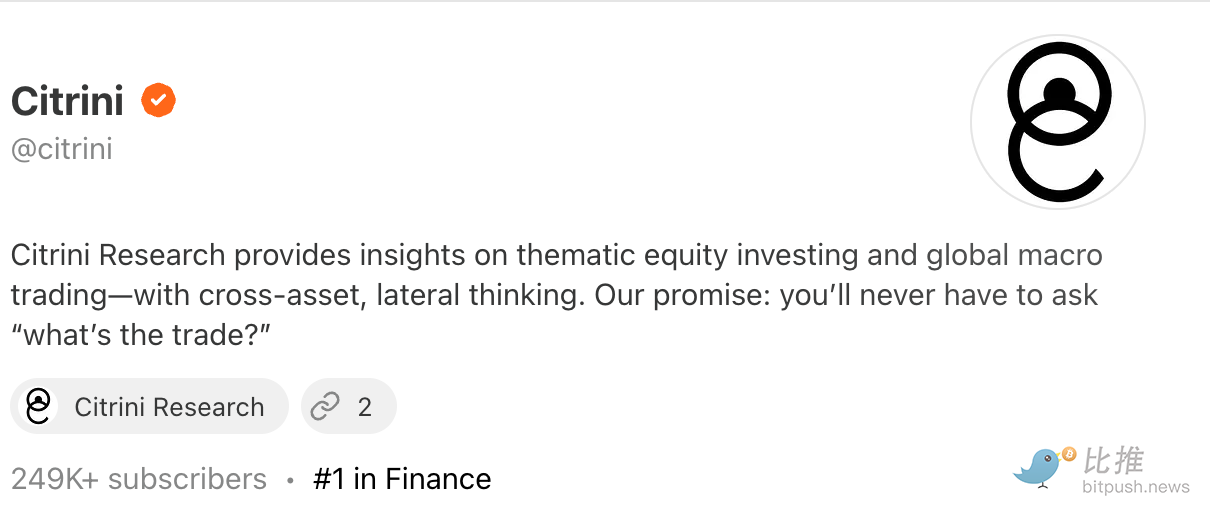
In this round of the US stock bull market, in addition to the “white stock god” Serenity, who is active in public opinion as an individual, another independent investment and research institution called Citrini has also received much attention — ranking first in the Substack financial category all year round, with nearly 250,000 subscribers.
In February of this year, Citrini released“The 2028 Global Intelligence Crisis” (2028 Global Intelligence Crisis)At one point, it triggered a “wave of sell-offs of US software stocks,” which intensified the panic mentality of the wave of unemployment in Silicon Valley; in April, the “Strait of Hormuz Research Report”, an analyst under Citrini, went to the local area to write the “Strait of Hormuz Research Report”, which sparked strong reactions from the outside world, and used first-line experience to clear the layers of fog from the real face of conflict. #3 Recently, Citrini semiconductor analyst Jukan also accurately stated the importance of the copper foil industry in the AI and semiconductor industries, driving a new wave of investment.
The person behind this investment and research institution is the founder of a non-financial science class: James van Geelen, who has a double degree in biology and psychology from UCLA, worked as a first responder, founded a medical company, and broke into the investment community halfway through his career, and is now known as the “god of investment research.” In this issue, the Daily Planet Daily will unravel James's crossover saga.
Founder of Citrini: Master of Storytelling Under “Second Order Thinking”
Referring to Citrini, people in the crypto community first noticed this investment and research account, probably stemming from his post on the eve of the launch of Cerebras (CBRS) in May of this year, referring to “fund managers making early price discoveries at Trade.xyz (in the Hyperliquid ecosystem).” The tweet was later confirmed by Trade.xyz founder Shokun's retweet.
Citrini: Hyperliquid and Trade.xyz's “traditional financial whistleblower”
It's no exaggeration to say that as a former published2028 Global Intelligence CrisisWith this popular investment and research account, Citrini's radiative influence on the traditional financial world is obvious.
And its high affirmation of the Hyperliquid ecosystem and Trade.xyz's pre-market pricing of US stocks has also brought the crypto market's RWA platform, US stock pre-market contract platform, and US stock chain trading platform into the eyes of more people, boosting this year's “US stock RWA asset boom” to a certain extent.
In a sense, Citrini can be called a weather vane that sends a “warning signal” to the traditional financial community — he uses accurate and unmistakable information to warn traditional financial markets. In the past, humble crypto players had their sights set on the “big cake” of the traditional financial market like barbarians.
Behind Citrini is James van Geelen, the founder who believes in “second-order thinking” and “long-term doctrine.”
Multiple labels: biopsychiatric double degree, medical emergency practitioner, “AI panic whistleblower”
James van Geelen (Geelen), 33, probably wouldn't have guessed that a “hot AI discussion post” could actually trigger the rapid evaporation of hundreds of billions of dollars in the US stock market; even earlier, his career had nothing to do with AI.
According to public information, Geelen graduated from UCLA, a prestigious American school, and obtained a double degree in biology and psychology while attending school; he also worked as an emergency medical technician and paramedic in downtown Los Angeles. A graduate of a prestigious school and a medical emergency practitioner, this experience has shaped his personality to pursue efficiency and be good at planning. As he himself said - “If you don't have a plan, you're going to have a miserable life”.Furthermore, he claims to be a “genius musician,” even though he doesn't have any outstanding works.
According to Geelen's original plan, he was supposed to be a doctor who saved lives, but under the wrong circumstances, he embarked on the path of starting a business: first founded a healthcare company and sold it to a private equity fund, thereby successfully breaking out of the “famous school-part-time job-professional manager” circle; then founded the current Citrini.
Also worth mentioning is that he co-founded one of the earliest medical marijuana dispensaries (dispensing points) in Connecticut, according to information he personally mentioned in the 2023 Odd Lots podcast. Seen from this perspective, he is definitely a “serious doctor” who is methodical or even stubborn in the eyes of people.
In 2018, after having some start-up capital, Geelen began a personal investment career under the name Citrinitas Capital, seizing early opportunities such as AI (such as Nvidia) and GLP-1 diet pills (such as Ozempic/Wegovy).
In 2023, Geelen officially founded Citrini Research to “conduct investment analysis across assets and a multi-dimensional way of thinking” to provide in-depth reports on thematic stock investments and global macro transactions. He then rapidly grew into a leading creator in the financial field of the Substack platform. (Daily Planet Daily Note: There are two models: individual subscription and institutional subscription)
May 31, 2023, a model portfolio based on individual investment and researchCitrindexOfficially established, the annual subscription cost is $1,250. According to statistics, the portfolio's cumulative return exceeded 200%, and the monthly increase surpassed the S&P 500 several times.
In March 2024, he boldly predicted that Trump would win the election; in July 2025, in response to the downturn of former Federal Reserve Chairman Powell, he made a high-profile suggestion that more than 50,000 subscribers “buy two-year US Treasury bonds and short 10-year US Treasury bonds” to hedge against policy risks.
In December 2025, according toPitchBook infoCitrini completed a seed round of approximately $5.05 million, has only about 10 employees, and the company is still a privately held company.
Then, in February of this year, he co-wrote an article that shook the US stock market with Alap Shah from the traditional financial world2028 Global Intelligence Crisis. Although it has emphasized many times that the report is only an “thought experiment,” a scenario scenario rather than a predictive analysis, the “large-scale loss of white-collar workers, falling consumer spending, and economic contraction (Ghost GDP)” phenomena mentioned in it still raised fears and concerns in the capital market, leading to a sharp decline in delivery, payment, and software stocks. Among them,On February 23, IBM's stock price recorded its biggest one-day decline since 2025; American Express and Blackstone Group both fell by more than 8%; the entire software sector fell nearly 5%; the stock prices of companies such as DoorDash, Uber, Mastercard, Visa, Capital One, and Apollo Global Management Inc., once fell 3%. Several US stock sectors were involved in a sell-off, and the Dow once fell more than 800 points. Alap Shah then publicly stated that his investment position was to “go short and go long,” that is, shorting companies they think will be disrupted by AI while holding semiconductor technology stocks that benefit from AI.
It is no exaggeration to say that Citrini's report caused US stocks to evaporate hundreds of billions of dollars per report, directly causing the US stock market to “fill the ground with blood” and hundreds of billions of dollars of market value evaporate overnight, triggeringBloombergFollow-up reports from overseas media such as the Wall Street Journal.
On April 6 of this year, the Citrini team “Analyst No. 3” (code name Analyst #3)亲赴美伊冲突中的关键要冲 - Strait of Hormuz) conducted research, revealed many little-known first-line observations, revealed on the ground the specific operating model of Iran's establishment of “toll gates” in the Strait, and came up with a series of unconventional conclusions, such as:No matter how the situation develops, the volume of shipping in the strait will gradually rise; Iran does not want to close the Strait of Hormuz.First, the strait's shipping volume will continue to increase. Second, there are diplomatic “toll gates”. Surprisingly, the traffic order in the strait is actually very standardized. The third is the contradictory nature of the escalation. Even if ground operations are launched, the volume of shipping in the strait is likely that it will continue to increase. The fourth is a restructuring of the pattern, not a match between victory and loss. This conflict is not simply a “confrontation between the two sides,” but rather a multi-party game.Geographic disputes in power games are also a key topic of Citrini's research “within range.”
When referring to why the company was named “citrinitas,” Geelen answered:“The name was inspired by financial magnate Soros's “Financial Alchemy.” This is actually a stage in alchemy, but what most people don't know is that during this transition phase, lead begins to convert to gold, but it hasn't completely turned into gold.” It's also his favorite time to “make a difference” — see the birth of “gold” before anyone else noticed changes in lead.
Investment style: second-order thinking, narrative-driven, reverse scenario
As for Citrini's investment style, thanks to its cross-border experience and diverse labels, it highly values “second-order thinking.”
As Geelen herself said:“Most investors only focus on the ball itself, but I'm more focused on where the ball will bounce next.”
Judging from Citrini's past content and public information, this investment and research agency focuses on long-term “super trends” such as AI, robotics, energy demand, fiscal policy, geopolitics, modern warfare, etc. Furthermore, the agency is committed to providing an executable “package of investment references” and tactical macro-trading ideas, and its research is biased towards long-term structural changes rather than short-term transactions.In its introduction to the Substack homepage, we can see its emphasis on practice, which mentions: “You (the reader) will no longer need to ask 'what the deal is'.”
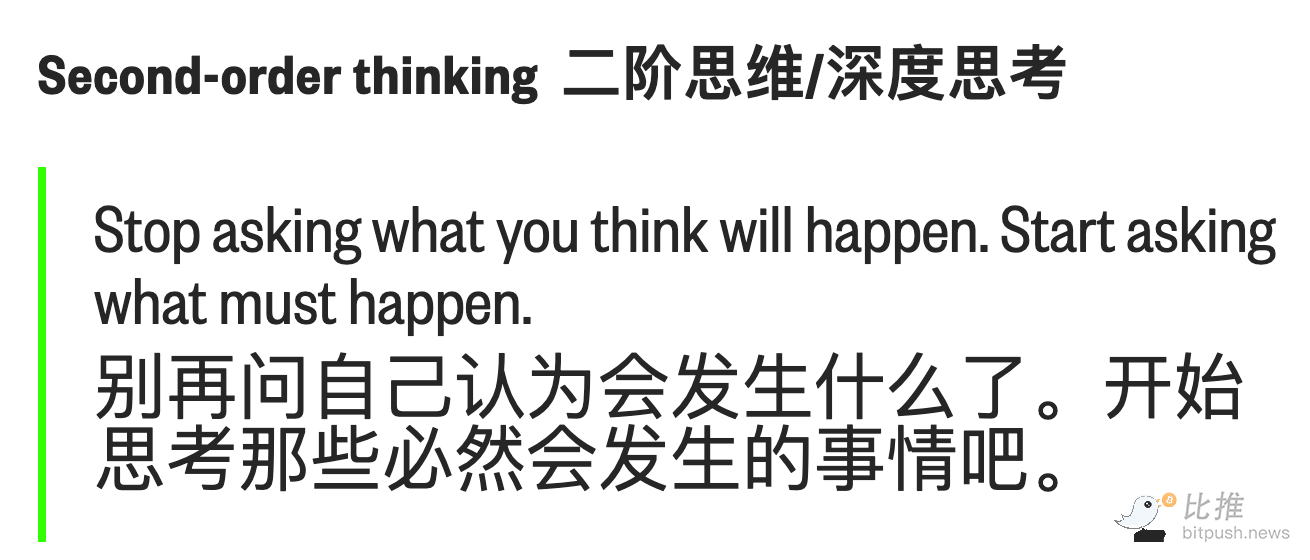
Additionally, Citrini often uses “contextual assumptions” to help readers understand second-order and third-order effects. Geelen once said, “Don't always think about what you think is going to happen. Instead, think about what is bound to happen. How will the market's reaction change the reality? What secondary effects will it have? What are the barriers that keep a trend going? Where will the funds go to overcome these barriers?” Previously, when the Bank of Silicon Valley went out of business in March 2023, he boldly bought bullish options at overnight financing rates and easily reaped nearly 50 times the profit; in December of last year, before the US launched military action in Venezuela, he shared his views on investment opportunities in Venezuelan sovereign bonds.
Since this year, Citrini has successively recruited a number of independent analysts, including macro analystsNick Reece, Korean semiconductor industry analyst@jukan05and AI chip industry analysts@zephyr_z9Others have made up for shortcomings in industry details, technical processes, and changes in industry trends to a certain extent.Currently, the investment research agency is stillMaintain a founder-driven + anonymous elite team collaborative production model.
Twitter:https://twitter.com/BitpushNewsCN
Compare the TG exchange group:https://t.me/BitPushCommunity
Compare TG subscriptions:https://t.me/bitpush
