


Next to Anthropic, has Bitcoin mining salted fish turned around?
Source: Alphabet AI
Authors: Wang Jing, Xiao Jinya
On July 6, Bitcoin mining company TeraWolf signed a 20-year data center lease with Anthropic, with a total contract value of about US$19 billion. Two weeks later, another mining company, Hut 8, announced a long-term lease worth 9.8 billion US dollars. It built an AI data center in Texas and leased 352 MW of the computer room and power capacity to an undisclosed major customer for 15 years, with a total rent of about 9.8 billion US dollars.
This is the second contract of the same size that Hut 8 has received at Beacon Point Park. The total contract value for the two phases of the project reached 19.6 billion US dollars.
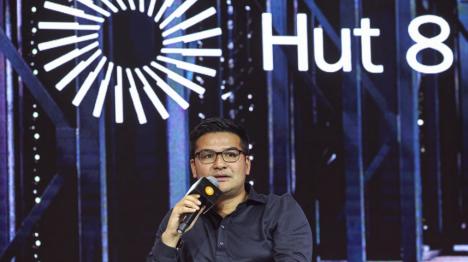
Photo: Hut 8 CEO Asher Genoot speaks at Bitcoin Asia conference in Hong Kong
The companies that signed these two big orders were all companies that started by mining bitcoins.
Until a few years ago, TeraWolf and HUT 8's main business was mining bitcoins. Mining machines are added when the currency price rises, and some equipment is turned off when the currency price falls or the electricity price is too high. The company's revenue also fluctuates greatly along with the currency price.
Now, some of the mining machines are being removed, and the original mine has begun to be converted into an AI data center. The business done by mining companies also changed from mining their own coins to leasing space and electricity to AI companies.
Mining machines have been eliminated from generation to generation, but the mine has stayed. The land, electricity, and grid connection qualifications prepared for mining in the past may now be worth more than the mining rig itself.
The reason why mining companies have reached this point still has to start with the bankruptcy of Core Scientific.
North America's “mining king” went bankrupt in one year
From the second half of 2020 to the end of 2021, Bitcoin ushered in a big bull market, rising all the way from about 10,000 US dollars to nearly 69,000 US dollars.
Taking advantage of this bull market, Core Scientific continued to buy mining machines, expand mining sites, and build large-scale mining facilities in Texas, North Carolina, and Georgia. At one point, it became one of the largest listed mining companies in North America.
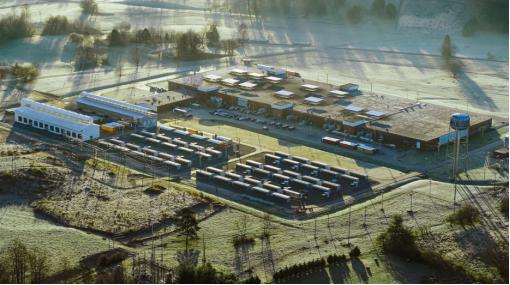
Note: Core Scientific is located at the Marble mine in North Carolina. (Source: Core Scientific)
The logic behind Core Scientific's massive expansion is uncomplicated. Bitcoin mining companies invest in computing power to compete across the network. The higher the share of computing power, the more bitcoins they can usually share. As long as the currency price remains high, buy more mining machines and build more mines, there is an opportunity to recover the investment faster.
This expansion, however, presupposes that mining companies cannot control: Bitcoin prices must be high enough to cover equipment and electricity costs.
In 2022, that premise was shattered. The price of Bitcoin has dropped sharply from its high point, but energy prices such as natural gas are rising, and mining companies still have to pay for electricity and equipment. The mining machine is generating new costs every day, but the bitcoins that have been mined can no longer support previous expansion.
By the end of that year, Core Scientific quickly ran out of cash, and the former North American “mining tycoon” finally filed for bankruptcy protection.
Core Scientific isn't the only mining company like this; falling currency prices and rising costs are impacting the entire industry.
Another listed mining company, Riot, mined 5,554 bitcoins in 2022, an increase of 46% over the previous year, but mining revenue fell from US$184 million to US$157 million. The company's net loss for the year reached US$509.6 million, mostly due to depreciation of mining machines, bitcoins, and acquired assets.
Riot's data also revealed another strain on mining companies.
Mining is an unstoppable equipment race. As more mining machines are added, the Bitcoin network will automatically increase the difficulty of mining, and the number of bitcoins that a single mining machine can mine will also decrease. Old mining machines are slow and consume a lot of electricity. They also cost an electricity bill, but the output is getting lower and lower.
In order to maintain production and reduce electricity costs, mining companies can only continue to buy new mining machines with stronger computing power and lower energy consumption. In other words, not only do they have to continue to pay for electricity, but they also have to repeatedly invest in upgrading equipment. Once the price of the currency falls, the value of newly purchased mining machines and Bitcoin holdings will be reduced, yet the high electricity bill is more than a cent.
In a bull market, it seems like a good deal that can be replicated over and over again, but when it comes to a bear market, it will soon become a cash black hole.
More importantly, starting in early 2023, the Bitcoin price gradually broke out of the trough and broke through the historical high of the previous round of bull markets in 2024. However, the profitability of mining companies did not recover along with the currency price.
In April 2024, Bitcoin was halved for the fourth time, and the rewards for each block mined were reduced from 6.25 to 3.125.
The so-called “halving” means that the Bitcoin network cuts block rewards by 50% approximately every four years.
This means that even if the same computing power is invested, the number of new bitcoins that mining companies can obtain will be drastically reduced. The costs of mining equipment, electricity, and labor will not drop, but output will first be cut in half, and profit margins will be further compressed.
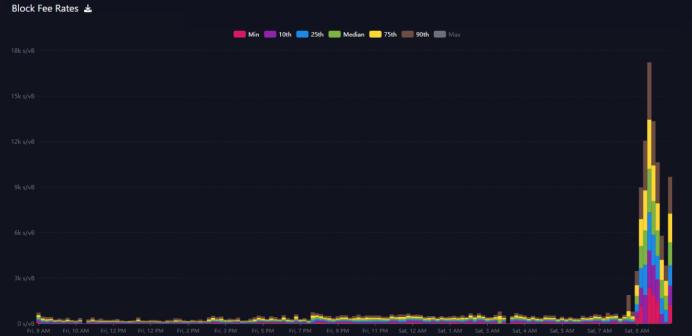
Note: The Mempool.space chart shows that Bitcoin transaction fees have soared sharply. (Source: Mempool.space)
At the same time, the computing power of the entire network is still growing, and the equipment race has not stopped due to halving.
If mining companies don't change machines, the cost of mining will rise. If it were to be replaced, it would be necessary to continue to invest money.
Revenue from rising currency prices will soon be ruthlessly swallowed up by halving, competition for computing power, and equipment spending.
Core Scientific was particularly affected.
In 2024, the number of bitcoins mined by the company decreased by 52% year over year. By 2025, annual production had dropped from 6,595 to 2,276 pieces, and revenue from self-operated mining had also dropped from 409 million US dollars to 229 million US dollars, which is close to the bottom.
Mining is becoming more and more difficult, and Core Scientific can only find another way for the mine in its hands.
The good news is that even if the mine is no longer being used to mine Bitcoin, the land and power supply facilities that Core Scientific has previously purchased can still be used. These sites are already connected to large-scale electricity and can carry other computing devices that require a large amount of electricity.
This is exactly what AI companies lack the most.
Just a few months after Core Scientific completed its bankruptcy and restructuring, an old colleague who also changed his career from the coin industry found the door.
The tenant wanted to buy the landlord twice
An old colleague who came to the door was CoreWeave.
Coreweave is now one of the hottest AI cloud computing companies. The GPUs it currently uses are all from Nvidia. Nvidia is both a supplier and technology partner and an important shareholder of the company, and has invested an additional $2 billion in CoreWeave in 2026. CoreWeave, on the other hand, relies on large-scale GPU clusters to provide large model companies with the computing power needed to train and run models.
However, before becoming a big buyer of Nvidia GPUs, CoreWeave was also a mining company that mined Ethereum.
In 2016, Coreweave's founding team bought the first GPU, placed it on a pool table in the New York office, and dug up their first Ethereum block. Since then, a video card has become a few hundred yuan, and then tens of thousands of yuan.
After entering the cold winter from 2018 to 2019, CoreWeave also took advantage of the withdrawal of a large number of mining companies to buy video cards and data center resources at low prices.
Fortunately, Coreweave uses GPUs to mine Ethereum. Unlike Bitcoin ASIC miners, which can only perform specific calculations, GPUs are more widely used.
After the coin market cooled down, CoreWeave leased these devices to film and television special effects companies and machine learning customers, gradually switching from coin mining to cloud computing services.
This shift later allowed Coreweave to catch up with the generative AI explosion. Big model companies began to compete for GPU computing power, and CoreWeave's graphics cards, computer rooms, and scheduling experience were put to use, and the company also entered the center of the AI cloud computing market as a result.
But as GPUs are bought more, a new question arises: where should these machines be placed?
High-end GPUs can only actually generate computing power if they are connected to sufficient power and networks.
CoreWeave can buy more chips, but it's hard to find an already powered data center in a short time.
On the other hand, Core Scientific has existing mines, electricity, and grid eligibility, but needs new customers who can pay rent for a long time.
The two companies that came out of the coin industry met once again in the AI boom.
In June 2024, Core Scientific signed a number of 12-year contracts with CoreWeave to provide the latter with approximately 200 megawatts of data center infrastructure. Since then, the two sides have continued to cooperate further, and by the beginning of 2025, CoreWeave's leased electricity capacity was close to 590 megawatts.
A match made in heaven, unspeakably wonderful. CoreWeave became a tenant, and Core Scientific relied on mines left over from a previous bull market to become an AI infrastructure provider.
The story soon reversed.
Shortly after signing the first leases, CoreWeave simply proposed to buy Core Scientific for about $1 billion. However, Core Scientific decided that the price of $5.75 per share was too low and refused to sell the company to this tenant who had just moved in.
A year later, CoreWeave bid again. This time, the two sides reached an agreement, and Core Scientific agreed to accept an all-stock acquisition worth approximately $9 billion. However, some shareholders of Core Scientific believe that the company's power resources will continue to appreciate, and using CoreWeave shares to pay for purchases will also cause the transaction value to follow CoreWeave's stock price fluctuations.
In October 2025, the acquisition did not receive sufficient shareholder support, and the two parties eventually terminated the merger.
Although the sale failed, the tenant wanted to buy the landlord's house twice, which shows the change in the value of the old mine. For AI companies that are in a hurry to expand, the resources of land, electricity, and grid-connection qualifications controlled by Core Scientific can be so fragrant and far more attractive than those old mining rigs.
Building a large data center is not as simple as building a few computer rooms. The project must first confirm whether the local grid can provide sufficient electricity, and then complete approval for transmission, transformation, and grid connection. With AI data centers intensively applying for electricity, grid-connected teams in many parts of North America are already a few years away. Even if the AI company has bought a GPU, it may only leave the device idle because the computer room is slow to connect to power.
Core Scientific already has large-scale power access to the mine and can continue to be remodeled, so AI companies can skip the longest waiting period to be connected to the grid.
The collaboration between Core Scientific and CoreWeave has also allowed other mining companies to see the new value of old mines.
In 2024, TeraWolf sold 25% of its shares in the Nautilus mine for approximately $92 million in exchange consideration.
Nautilus is a joint investment project between Terawulf and energy company Talen Energy. It was built next to the Susquehanna Nuclear Power Plant in Pennsylvania. It was the first Bitcoin mine that directly uses electricity from a nuclear power plant and runs entirely on nuclear energy. It was once seen as a model for clean energy mining.
This deal is quite symbolic. TeraWolf sold shares in this iconic mine and transferred the recovered funds to AI and high-performance computing facilities.
Hut 8 directly split the mining business. In 2025, Hut 8 directly split off most of its mining machines and mining operations, and co-formed a subsidiary American Bitcoin with investors such as Eric Trump, the second son of US President Trump, and held a majority stake.
Since then, American Bitcoin has been responsible for financing, buying mining, and storing bitcoins. Hut 8 reserves power and data center resources to provide site and operational services. After breaking up the mining business, Hut 8's parent company began investing more capital and energy into AI data center development.
After companies such as Core Scientific took the lead, more and more mining companies are also looking for AI customers.
Are the good days back?
The mining companies that first got AI customers have already tasted the sweetness.
In the first quarter of 2026, Terawulf's AI data center rental revenue reached $21 million, surpassing the current quarter's $13 million Bitcoin mining revenue for the first time. On July 6, after the announcement of the $19 billion Anthropic contract, TeraWolf's stock price rose by about 19% intraday.
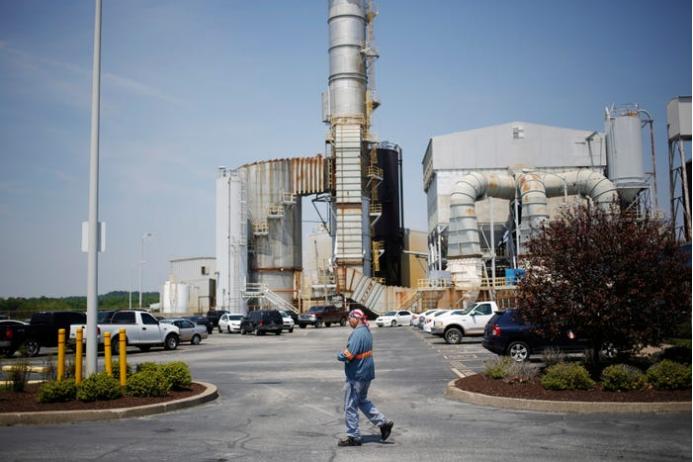
Photo note: Former Century Aluminum smelter in Hawesville, Kentucky, taken in 2017. After Terawulf acquired the site, it is being converted into an AI data center used by Anthropic.
Hut 8's market response was equally clear. In May 2026, it signed its first 15-year, $9.8 billion lease for the Texas Beacon Point campus. On July 20, the same customer leased the second phase of the project, with a contract value of 9.8 billion US dollars.
After the news was announced, Hut 8's stock price rose by about 17% during the intraday period, and the contract value of the entire park during the basic lease period also reached 19.6 billion US dollars.
Compared to mining revenue, which is highly dependent on currency prices, AI data center leases seem much more stable. The customer locked in power capacity in advance and promised to pay rent within ten years. Mining companies can use long-term contracts to finance banks and bond investors, and then use these funds to build data centers.
However, the transformation progress of different mining companies is not the same.
Core Scientific, TeraWolf, and HUT 8 have signed long-term customers, and some of these projects are starting to generate revenue.
IREN, on the other hand, continues to bet on both sides, mining bitcoins while buying GPUs and operating AI cloud services.
CleanSpark continues to mine coins while acquiring land and power resources suitable for building AI data centers to find potential tenants.
The transformation of another group of companies is still in the construction and investment stages. Bitfarms (literally translated as Bitfarm) has announced a gradual withdrawal from Bitcoin mining, and even changed the company name to Keel Infrastructure, but it is still remodeling the site and looking for customers. For these companies, announcing the transformation is only the first step. The next step is to sign long-term customers and actually rent out the renovated mine.
However, even former mining companies that have “successfully transformed” are far from being able to sit back and relax.
Both $19 billion and $9.8 billion are contract values accumulated over the next 15 or 20 years; they cannot be obtained today. TeraWolf is an Anthropic park, and the first batch of capacity is not expected to be put into use until the second half of 2027. The first batch of computer rooms corresponding to Hut 8's second $9.8 billion lease will be delivered in 2028.
Before large-scale leasing begins, mining companies still have to raise billions of dollars to build substations, liquid cooling systems, and network facilities, and meet AI customers' requirements for delivery time, server density, and operational stability.
Long-term contracts can help them finance, but they don't mean that the project has already been completed, let alone that the entire amount on the contract will turn into profit.
Delays in construction, increases in equipment prices, and rising financing costs may reduce final benefits. If AI companies' computing power requirements change, or if customers adjust technical routes, projects that have not yet been delivered may be scaled down or even renegotiated.
Mining companies are starting to invest heavily in advance again, which is easily reminiscent of Core Scientific's bankruptcy in 2022.
In the last round of Bitcoin boom, mining companies bought mining machines and expanded mining farms ahead of time, betting that the price of Bitcoin would continue to rise. In this round of AI boom, they are once again investing huge sums of money to build data centers, betting that AI companies will need more computing power for the next ten years or more.
At the end of the day, mining companies are still gambling; they are only betting on Bitcoin prices to AI companies' computing power requirements for the next ten years or so.
Maybe it doesn't matter anymore.
Where the money is, there is love.
Twitter:https://twitter.com/BitpushNewsCN
Compare the TG exchange group:https://t.me/BitPushCommunity
Compare TG subscriptions:https://t.me/bitpush
