


Why is Apple still hiding a tariff refund out of its first 100 billion dollars in revenue?
Author: Groove BlockBeats
Original title: In the June quarter of the most valuable technology company on Earth, Apple's revenue surpassed 100 billion US dollars for the first time
On July 30, Apple revealed its latest fiscal quarter. The company's revenue reached $109.4 billion for the first time, and Apple called it the strongest June quarter in history. According to the company's press release, the iPhone, Mac, and service businesses all set records for the same period.
What's really worth breaking apart are the two curves with different speeds. Revenue increased 16.4% year over year, while EPS grew 28.7%. The former is saying that Apple is selling more, while the latter also included a tariff refund. According to the earnings press release issued by Apple on the same day, this refund was included separately in the gross margin and earnings per share statement.
How was the 100 billion threshold crossed
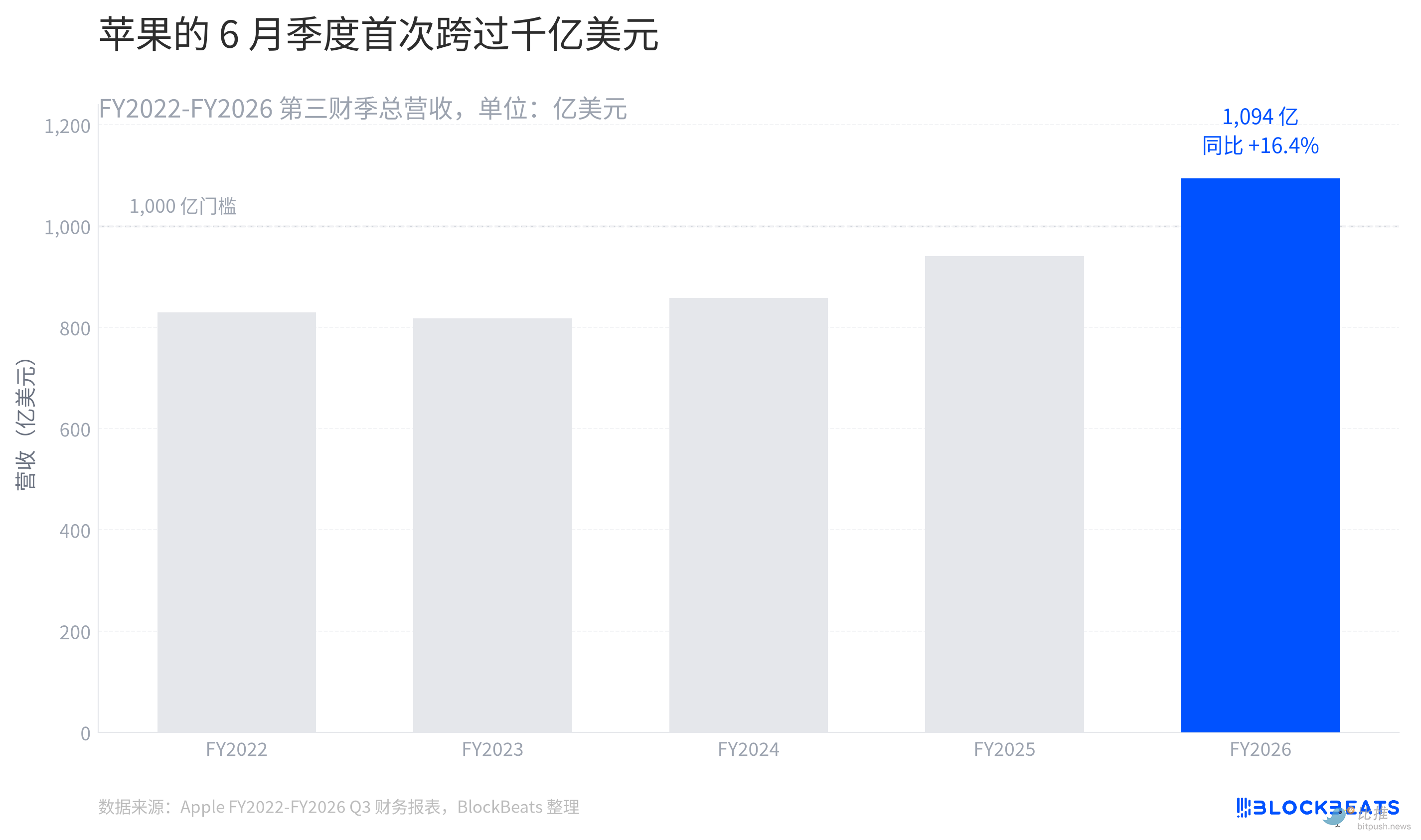
The last blue pillar in the picture is a distance visible to the naked eye from the first four June quarters. Apple didn't rush here from a straight runway. FY2023's revenue declined slightly during the same period, and only then was it faster year by year. According to Apple's consolidated financial statements for each quarter, this quarter's growth rate was the fastest in these five periods.
According to Apple's FY2026 Q3 earnings report, the significance of $109.4 billion is not that an integer threshold has been stepped on. It pushes the quarter where apples are most likely to be labeled as a “new product empty window period” to a scale close to the traditional peak season. The scale itself changed people's intuition about the location of the June quarter in Apple's fiscal year.
The rise in revenue did not fall on only one market. Apple's regional table shows that all five regions have achieved double-digit growth. Europe contributed the biggest absolute increase, while the year-on-year growth rate in Greater China tied with Europe for the highest year-on-year growth. Looking at these regions together, Apple's growth this season is wider than the American market alone.
Who pushed the incremental to the iPhone
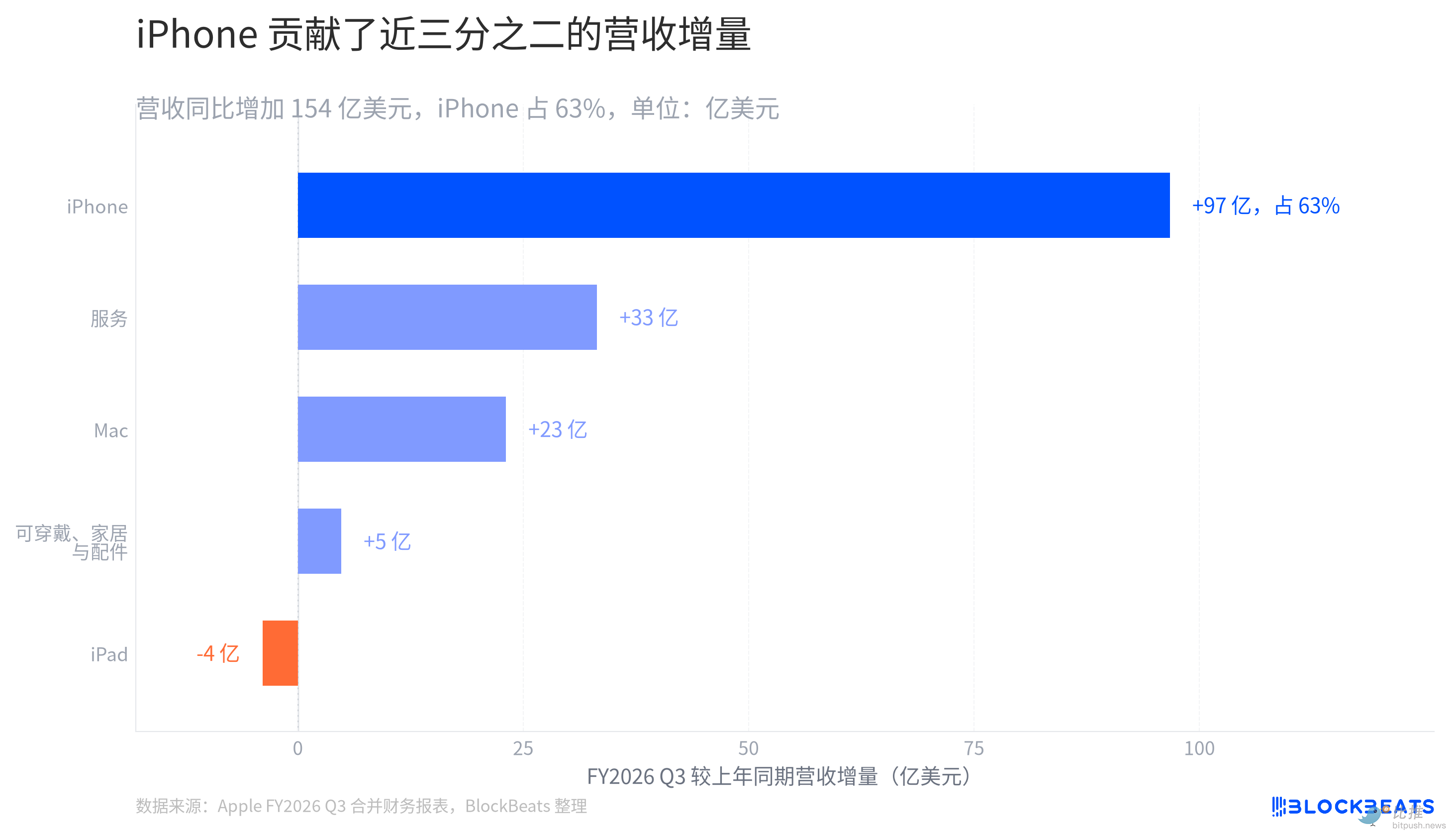
According to Apple's consolidated financial statements for this quarter, the company increased revenue by 15.4 billion US dollars compared to the same period last year. The iPhone alone brings almost two-thirds, which is the longest blue bar in the picture. It explains why the pace of earnings reports for this quarter will be faster than the June quarter of the past few years.
Services and Macs aren't back in the background either. The former brought in new revenue in second place, followed by the latter. iPad is the only category to fall back. The picture spelled out with a few horizontal bars is very straightforward. Apple didn't rely on a single category to pull the numbers up this season; it's just that the iPhone is getting a lot of momentum.
This difference is important. If the service business supports growth on its own, readers will see a company that gradually reduces hardware fluctuations. The current combination is more like two engines speeding up at the same time. The hardware provides a longer acceleration runway, and the service business continues to fill the high-margin portion. According to Apple's earnings report, the iPhone, Mac, and service businesses all set their respective June quarterly records this season.
In addition to the product table, the regional table adds another layer of explanation. According to Apple's regional table for this season, Europe ranked first in absolute revenue growth, with revenue in Greater China growing 22.4% year over year. The changes in these two markets have not changed the fact that the iPhone is the biggest source of incremental growth, yet the answer to “where does growth come from” is no longer limited to one region.
Services are making every dollar more profitable
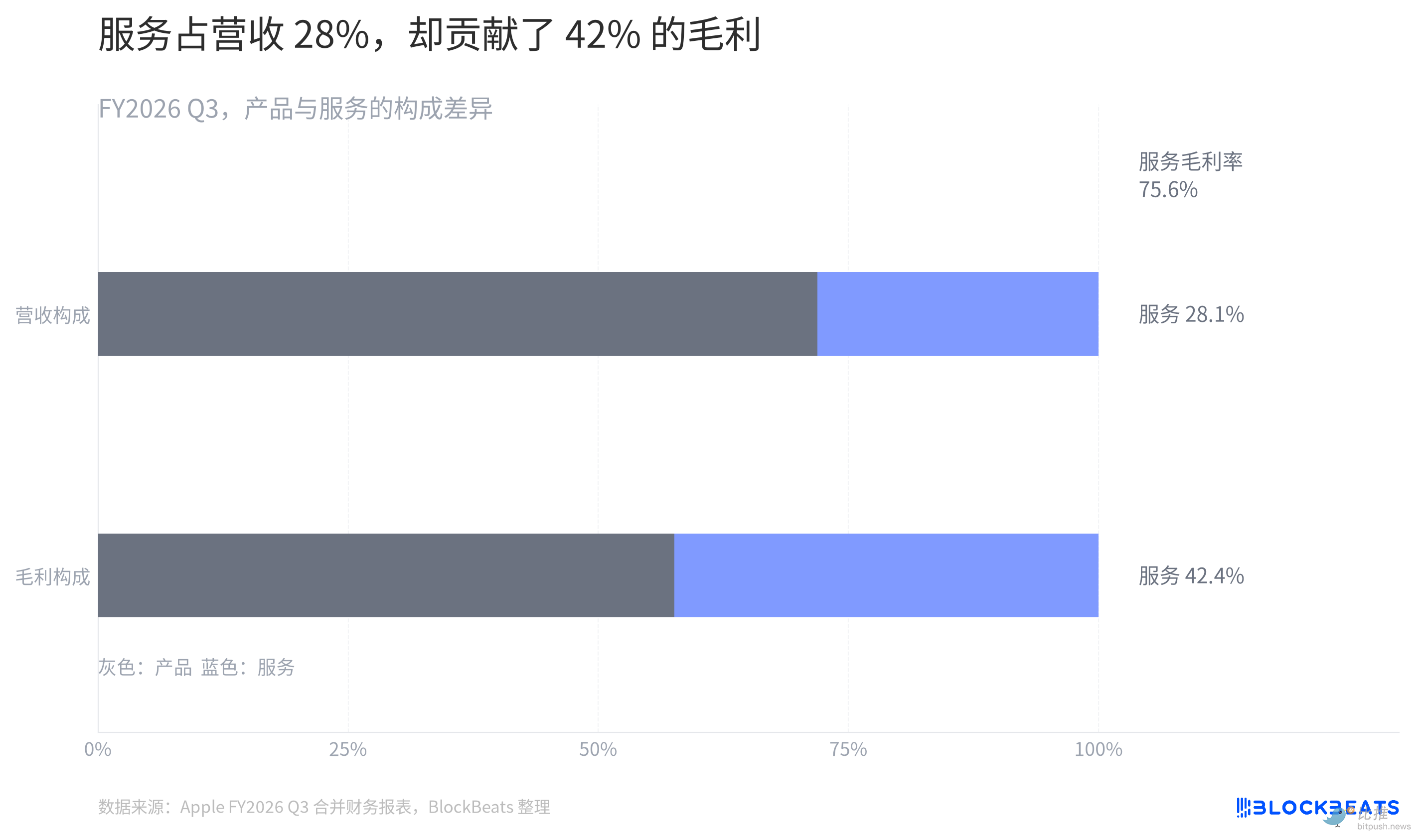
Apple's consolidated statement has one detail that is rarely taken away by news headlines. It lists the cost of selling products and services separately. In this way, the layer of gross profit other than income can also be disaggregated.
According to Apple's earnings report for this quarter, services only account for 28.1% of the company's revenue, yet they contribute 42.4% of gross profit. In everyday language, for every 100 yuan of revenue from Apple's sales, the service volume is less than 30%, but the gross profit left behind is close to half.
The gross margin of the service business was 75.6%, and the product business was 40.1%. The former is like a thick bottom plate. When more equipment is sold, this floor still supports the entire company. This structure also explains why service revenue has not taken the biggest increase in revenue, yet it is still a part that cannot be circumvented when reading financial reports. According to Apple's consolidated financial statements, both ratios are calculated by subtracting their respective revenue and sales costs.
The majority of the new gross profit added this season still comes from the product business. According to Apple's consolidated financial statements, it contributed 77.2% of the new gross profit. This is linked to the recovery of iPhone and Mac in the previous picture. The service did not take over the hardware; it made more profit left over when the hardware was released.
What did that refund change in the profit curve
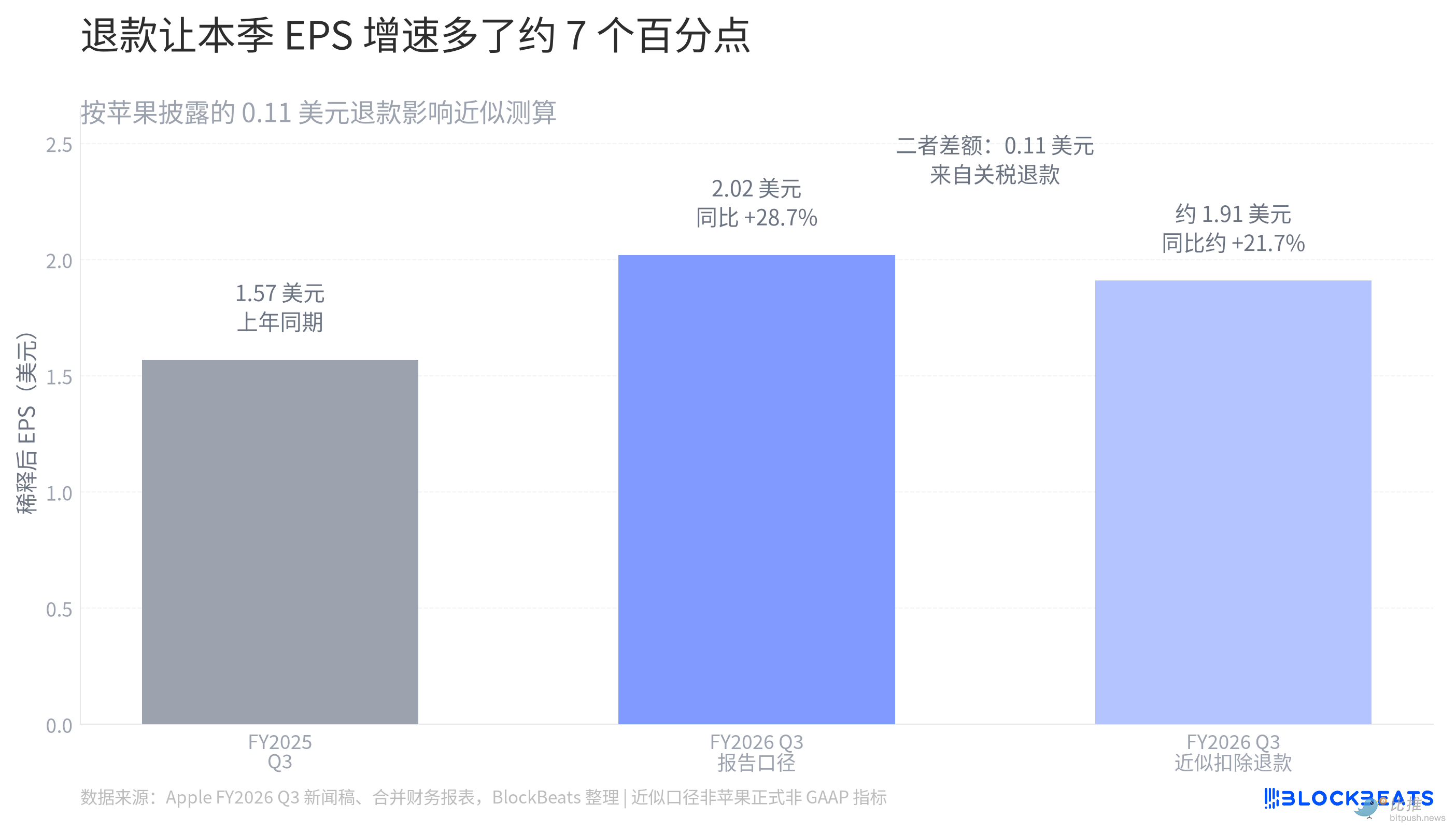
Apple revealed in a press release that tariff refunds had a positive impact of about 2 percentage points on gross margin this quarter and increased EPS by $0.11. This is not a figure that is easy to see at first glance in the text of financial reports, but it is enough to change the way profit growth is read.
After an approximate deduction of the impact disclosed by Apple, the year-on-year EPS growth rate this season was approximately 21.7%. The difference between the reported caliber and this approximate caliber is about 7 percentage points. The light blue bars in the picture are not non-GAAP metrics issued by Apple; they only take the impact of refunds already given in the press release from the reported figures.
The split did not erase Apple's operating performance. After deducting the refund, EPS still outperformed revenue. It just separates two things. One is the growth brought about by the iPhone, Mac, and service businesses together, and the other is the slope that a one-time refund adds to the profit curve.
The outline of Apple's earnings report is also clear. The recovery in hardware has accelerated the scale again, services have made each dollar more profitable, and a refund reminds people that the slope of profit must first be unraveled before reading it.
Twitter:https://twitter.com/BitpushNewsCN
Compare the TG exchange group:https://t.me/BitPushCommunity
Compare TG subscriptions:https://t.me/bitpush
