


How did AI16z, the leader of AI Agent tokens in the past, come to an end?

By David, Deep Wave TechFlow
Original title: Drowning in Tide, the End of AI16z, the Pioneer of “Cryptographic XAI”
ai16z, do you remember the name?
If you remember, it means you experienced the AI coin boom in the cryptocurrency industry at the end of 2024. If you don't remember, it's normal. The AI Agent token category has been quiet for a long time.
Cryptography x AI seems too much like a fake concept and an old-fashioned toy in the current version of AI tools that are gradually being implemented and rapidly progressing.
Today, Shaw Walters, the founder of the Eliza OS project, wrote a long, long article to the effect that the ai16z token is completely dead, the foundation is closed, there will be no repurchases, and the holders will handle it themselves.
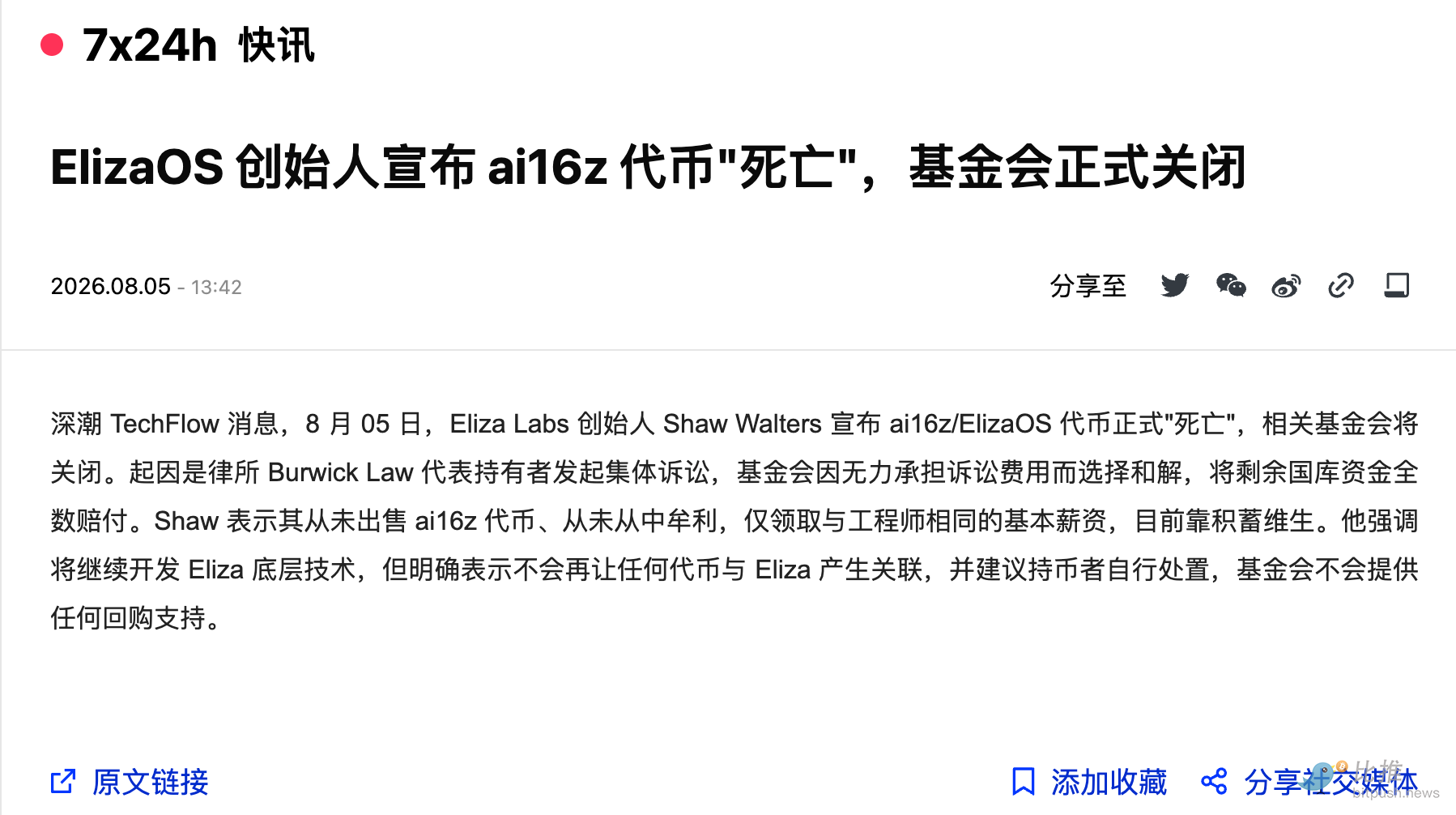
He suggests you either sell it or “get a bunch of people to fry it up,” but don't expect him to do anything more.
The tone of this letter isn't like a founder politely announcing the termination of the project, but more like a person falling down the door in disappointment after scolding everyone. He called the crypto community “a bunch of used to crying bags,” saying that a law firm sued him from the standpoint of the token holder.
However, the Eliza OS Foundation had no money to file a lawsuit and lost all the rest of the money.
Shaw also said that he used to have 25 million dollars of AI16z tokens in his wallet, but not a single one was sold and went all the way back to zero; now he lives on his savings, lives in a small, dilapidated bedroom in San Francisco, and writes code every day.
From his point of view, he probably thinks that he is standing in a smoky market and uses idealistic colors to develop, leaving behind a heart full of ruin, disappointment, and anger.
I have no intention of judging these personal feelings. However, standing at the crossroads of changing hot spots, shifting industry focus, and the rise of AI, the shutdown of Eliza OS inevitably made people feel emotional about encryption X AI. It really started early in the morning and caught up in the evening episode.
Be one step ahead and be in the midst of the waves
In October 2024, ai16z launched crowdfunding on DAOS.fun. The goal is to raise 420.69 SOL, equivalent to about $75,000, to become an investment fund managed independently by AI.
420.69. Anyone familiar with crypto culture knows this is a rough number. Starting with the selection of the amount of capital raised, the undertones of this matter have already been decided.
But it actually flew. In less than three months, ai16z's market capitalization reached $2.6 billion. It also brought in an entire category. Before GOAT, after VIRTUAL, various Agent concept coins were constantly emerging, and the entire AI Agent circuit grew from zero to close to 10 billion US dollars.
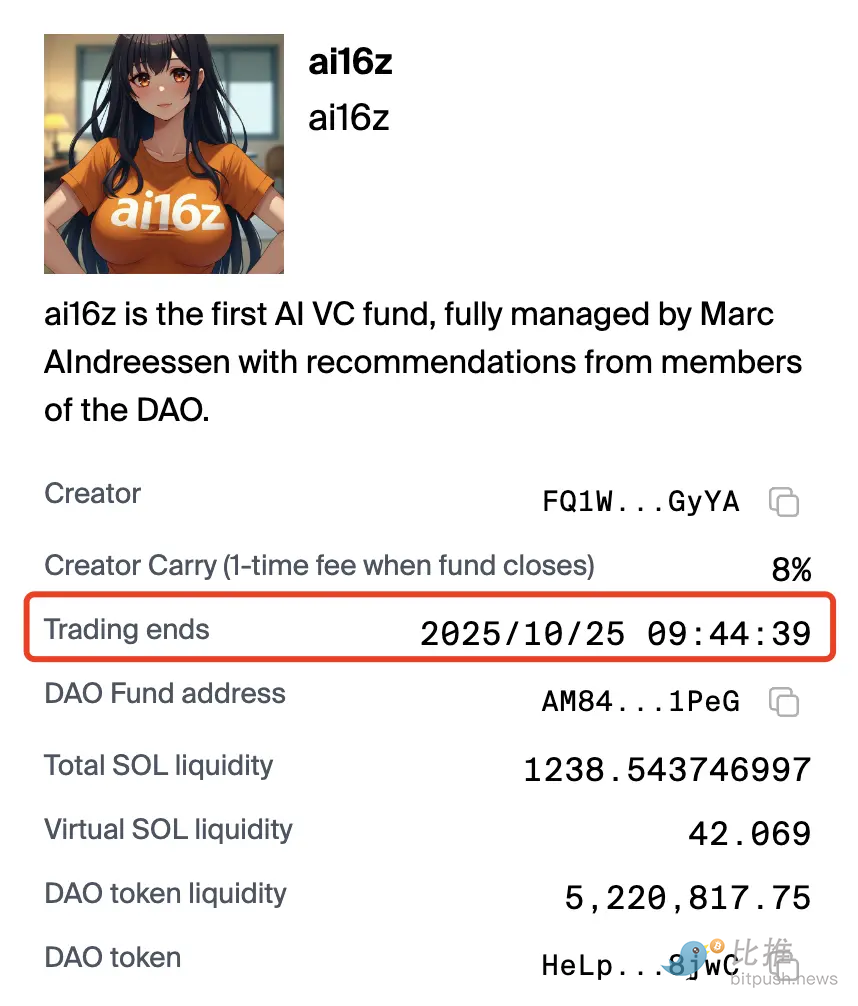
Cryptography is conceptually one step ahead of others. What will the AI market look like at the end of 2024?
ChatGPT has just turned two, and is often criticized for answering various illusions; Claude doesn't have the tools to directly operate a computer, and most people's understanding of an “AI Agent” is still at the conceptual level. The crypto market has already set a price for this concept.
But there is one detail that not many people cared about at the time.
Less than a week after ai16z went live, some cryptographic media published reports questioning it, saying that the AI agent at the core of the ai16z project, the “Marc IndReessen,” which claims to be able to make independent investment decisions, is actually a person operating, not the real agent himself.
This question later also occurred on AIIxBT, a well-known crypto market analysis agent.
At the time, it was difficult for such questioning to cause any uproar and FUD. The market capitalization continues to rise, the community continues to shout, and new AI Agent tokens continue to be issued... Looking back, this is probably the most accurate microcosm of the entire cryptographic AI narrative.
True or false, it doesn't matter. In an environment of excessive fluidity, a leading version of the narrative is enough to cause a wave of speculation.
The concept is realistic, the direction is right, but the token exists before the product, and the price comes before the technology. This is the essence of cryptography being one step faster.
The future has come, but Rain Girl has nothing to do
In 2026, AI Agent is here.
There are CodeX and Claude in the west, and Workbuddy in the east, which are more suitable for domestic physiques. Looking back at the white paper's narratives living in the hype boom of cryptographic AI, such as helping people automatically analyze market conditions, process workflows, monitor public opinion, etc., have actually completely become reality.
This is probably one of the few real-world stories in the crypto industry other than stablecoins.
But the people who cashed them out changed batches. It's Anthropic, it's OpenAI, it's the teams that write code in San Francisco and Hangzhou. The money goes to aggregation platforms like OpenRouter, to cloud service provider GPU bills, and to every API call that actually works.
Shaw's other words in the long post are infinitely emotional:
「There are no such issues on the AI side. The people over there are optimistic and powerful, building the future rather than tearing each other apart. That's my person.” One person who once ignited the cryptographic AI Agent narrative concluded that the industry is incompatible with AI?
Objectively speaking, there really is no reason to issue coins for these successful AI applications or big models.
Anthropic relies on subscription and API call fees, and OpenRouter's transit station business generates over 100 million dollars a year. These companies have never issued coins or built DAOs, but the business model works. Developers vote with their feet, and bills are the best consensus mechanism.
Looking the other way around, the situation for cryptographic AI projects is cruel. When the token price holds up, it seems like everything is there; the treasury is rich, the community has people, and the story is hot. Once the price falls, everything disappears at the same time.
The developers have left because the purchasing power of using tokens to pay wages has shrunk by 90%, and the community has become a rights protection group. People who want to do things seriously may eventually find that the project can't even afford to recruit an engineer.
Ironically, the Eliza frame itself in his hands isn't dead. The code is still being updated, and some companies are discussing cooperation on it. An open source AI framework that can survive without issuing coins, whether it's selling services or being bought, the road is much wider than tokens.
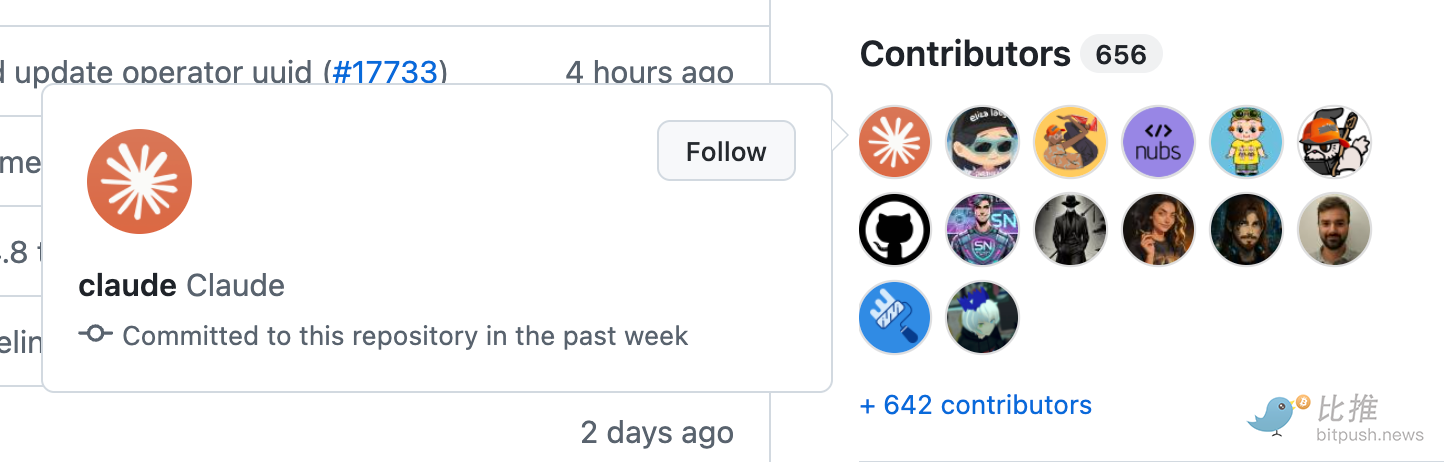
What's even more shocking is that Eliza, an open source AI framework that originated in cryptography, was an active contributor in the last week, actually Claude.
An AI developer and project that doesn't tie a token is probably worth more in the 2026 market than when the token is tied.
Embrace change
As a crypto practitioner, I can't help but be amazed to see the once hot projects fall one by one.
But feeling emotional doesn't mean being completely pessimistic.
The cryptographic AI narrative really shatters. However, what is broken is the path of “issuing coins to AI concepts”, and the possibilities between encryption and AI have not been completely cut off.
The few projects that are still alive do completely different things from ai16z. For example, Bittensor is building a decentralized AI computing power market, and Render is building a distributed GPU rendering network.
They all use tokens to coordinate a real computing resource. Of course, there is still a certain market, but not a bull market is more premium and persuasive.
In addition, AI is gradually being put into place and effective in scenarios such as on-chain data analysis, vulnerability scanning, giant whale wallet tracking, public opinion monitoring, and DEX contract strategies in the circle.
A professional crypto trader opens Hyperliquid in 2026, and it is likely that a strategy window supported by Claude or GPT is already open next to it. It also means that the relationship between encryption and AI is not over, but the direction will be reversed.
It has become a kind of political correctness for AI to empower every scenario, and encryption can also be covered. And as for how big the crypto market is, you probably have to ask when BTC will get better.
Personally, what we should do even more is to embrace change. A developer who sheds the burden of tokens has much more value in today's AI world than tokens can give; and a crypto player who has firmly embraced AI can obviously reap much more benefits than the previous reckless model.
Being encrypted, people are often quick to see the direction, or we just reverse the location of this site.
Twitter:https://twitter.com/BitpushNewsCN
Compare the TG exchange group:https://t.me/BitPushCommunity
Compare TG subscriptions:https://t.me/bitpush
