


The performance hit a record but plummeted after the market. What is the difference in SanDisk's earnings report?
Author: Azuma
Original title: SanDisk handed over a record financial report, why did it still plummet by eight points after the market?
After the market on Wednesday EST, memory chip giant Sandisk (Sandisk) announced results for the fourth fiscal quarter and full fiscal year ending July 3.
According to financial data, SanDisk's revenue for the current fiscal quarter was US$8.97 billion (market forecast US$8.48 billion), surging 372% year over year; adjusted earnings per share (EPS) under the non-GAAP caliber were $39.25, 135 times the level of a year ago ($0.29), and increased 68% month-on-month, nearly 10% higher than market expectations; adjusted gross margin reached 84.6%, a sharp increase of 58.2 percentage points year over year.
In terms of a full year, SanDisk's 2026 fiscal year was also amazing. Annual revenue reached $20.05 billion, up 175% year over year; GAAP net profit of $11.43 billion, and annual non-GAAP earnings per share reached $70.88. You need to know that SanDisk was still losing 1.64 billion US dollars in FY2025. The fact that this reversal was completed in a year itself shows the power of the NAND storage cycle resonating with AI requirements.
However, the capital market did not give positive feedback on this financial report. Before the earnings report was announced, SanDisk closed down 5.4%; after the release of the earnings report, it plummeted by nearly 8% after the market, with an interim report of $1,243 as of 11:00.
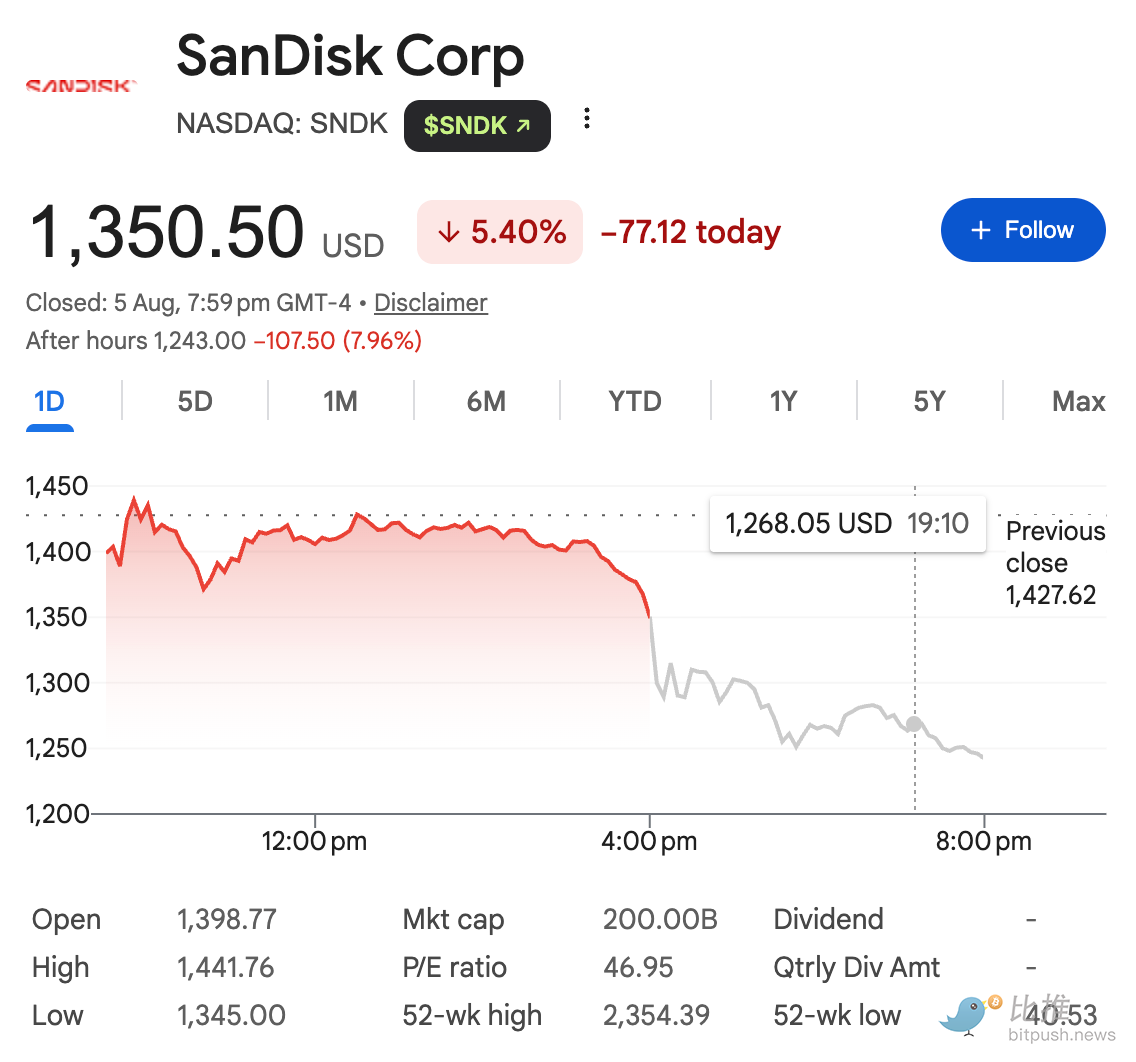
Why didn't the market reward such a “record breaking” financial report? The underlying logic is similar to how we previously wrote Hynix's earnings report for this quarter (see “Why did Hynix's most profitable quarter still “fall short of expectations”?》). For such major storage companies, investors are not only concerned about whether performance can grow, but whether growth can continue to exceed expectations that have already been greatly raised.
Another layer of problems different from Hynix is the unfinished guide. SanDisk's revenue guidance range for the next fiscal quarter was 10.3 billion to 10.8 billion US dollars, with a median value of 10.55 billion US dollars, while the market had previously expected 11.16 billion US dollars, a gap of about 5.5% — in a nutshell,The market is not denying the results SanDisk has already delivered, but is worried about whether its future growth rate will continue to meet higher expectations.
Core business disassembly: How has the revenue structure changed?
By disassembling SanDisk's revenue structure for this fiscal season, we can more clearly see the qualitative changes the company is experiencing.
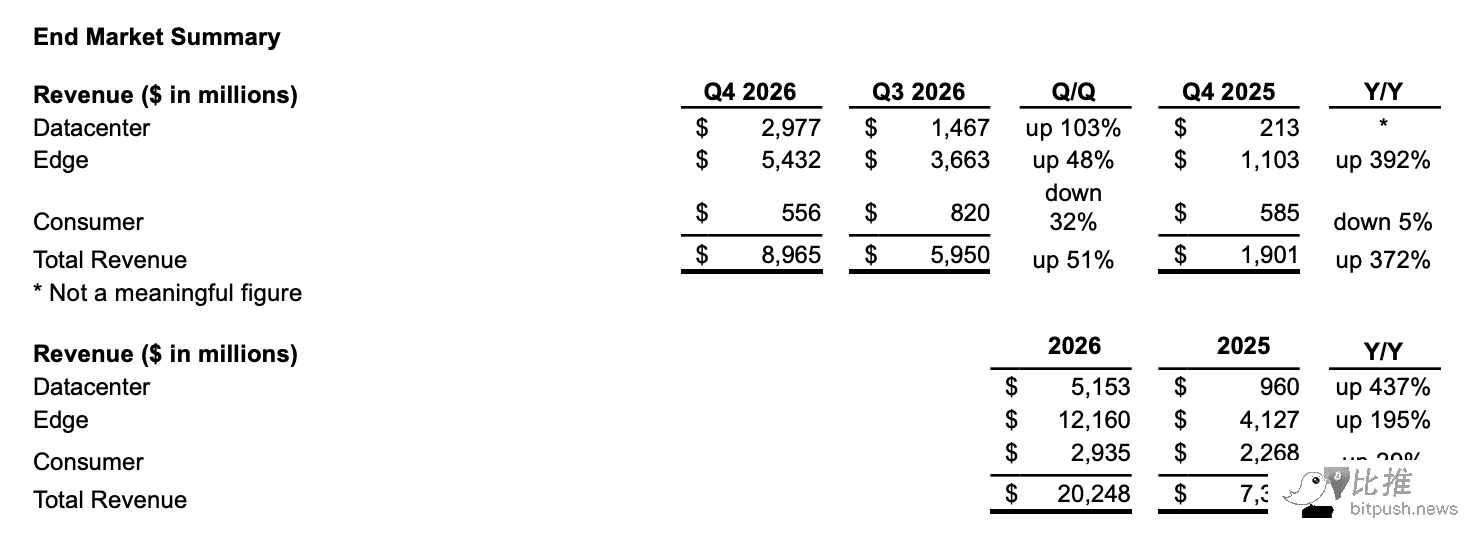
As SanDisk CEO David Goeckeler emphasized, the data center business has become SanDisk's well-deserved growth engine.Data center revenue for the fourth fiscal quarter was US$2.98 billion, up nearly 13 times year on year (1298%) and doubled month-on-month (103%), and its share of revenue jumped to 33% from about 11% a year ago. Data center revenue soared 437% throughout fiscal year 2026, and management has clearly established this as a “key growth pillar.” Against the backdrop of burgeoning demand for AI servers, high-performance computing and storage, SanDisk has clearly reaped the dividends of this wave of infrastructure investment.
The Edge Computing (Edge) business is still SanDisk's biggest source of revenueThis quarter's revenue was US$5.43 billion, up 392% year over year and 48% month on month. This section is mainly aimed at the enterprise level and terminal equipment market. It is huge in size and has a steady growth rate, making up the basic SanDisk market.
The only relative shortcoming is in the consumer side (Consumer).Consumer revenue for the quarter was only US$556 million, a slight decrease of 5% year over year and a sharp decline of 32% month-on-month, far below market expectations of US$874 million. Weak demand for traditional consumer electronics and lengthening PC and smartphone switching cycles have made this business the most obvious drag on financial reports. However, from a strategic perspective, SanDisk is actively optimizing its customer structure, favoring high-value-added data centers and enterprise-level markets. The contraction in the consumer business is also to some extent a pain during the transition period.
The biggest highlight: Changxie+repurchase
Notably, SanDisk management spent a lot of time on the earnings call explaining the strategic significance of its “New Business Model” (NBM) long-term agreement.
In the history of the NAND industry, supply and prices have usually been negotiated quarterly, and the cycle has fluctuated drastically.SanDisk revealed that following the announcement of 5 BNM long-term agreements for the April earnings season, this quarter's earnings report once again revealed 5 NBM long-term agreements, including 3 new agreements and 2 expansions and upgrades of the original agreements.The relevant orders will cover supply for many years to come. Of these, more than half of the supply for FY2027 has already been locked in advance, and about two-thirds of the supply for FY2028 has also been arranged.
David Goeckeler said bluntly that he hopes to “enhance the predictability and cyclical resilience of the business and get rid of the industry's past cycle of sharp ups and downs” through long-term agreements. Judging from industrial logic, this is undoubtedly the correct long-term strategy — using Changxie to lock in production capacity, smooth price fluctuations, and deepen bonds with major customers; however, in short-term transactions, Changxie also means that some price flexibility is locked. When the market is at the peak of the price increase cycle, investors may worry about whether the company “sells cheaper” by locking in orders in advance.
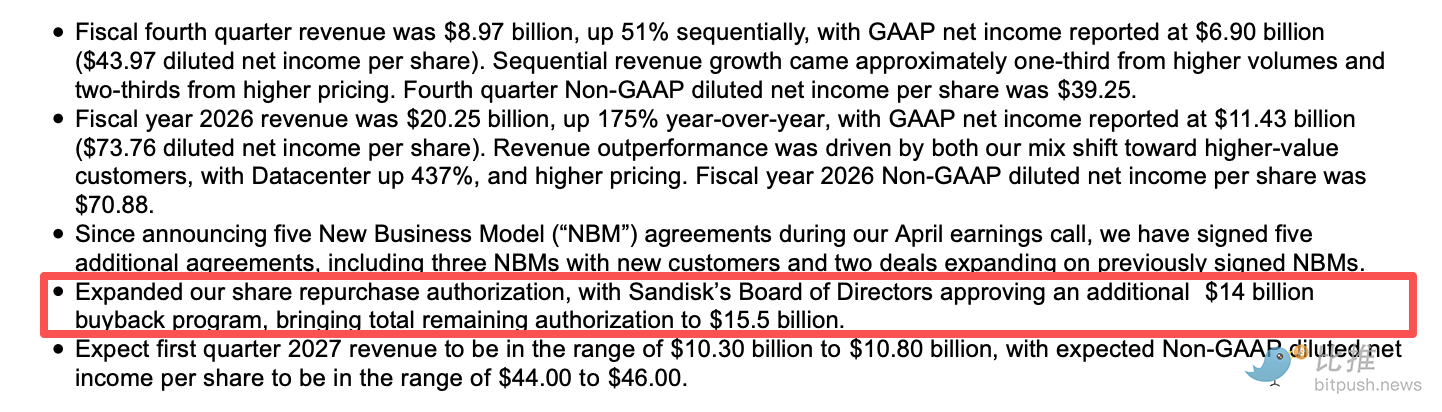
The $14 billion share repurchase plan revealed simultaneously in financial reports is another notable sign. With the original quota, SanDisk's total remaining repurchase authorization has reached US$15.5 billion.For a company that experienced a 47% drop in stock prices in July and the market capitalization evaporated by more than $150 billion, such a large-scale repurchase was not only a demonstration of management's confidence in cash flow, but also a signal to the market that “current stock prices are attractive.”
However, buybacks are generally medium- to long-term variables, and it is difficult to hedge against selling pressure brought about by disappointing guidelines in the short term.In particular, in the event window where financial reports are released, transaction logic will still be better subject to the core proposition of “whether to improve revenue guidelines”.
What exactly are the “gaps” in the guidelines?
Back to the forward-looking guidance that the market is most concerned about.SanDisk expects revenue of 10.3 billion to 10.8 billion US dollars in the first fiscal quarter of fiscal year 2027, with a median value of 10.55 billion US dollars, corresponding to a year-on-year increase of about 359%.This number itself is not bad — it is still growing month-on-month, and the year-on-year growth rate is still high — but the market has already filled this expectation too much.
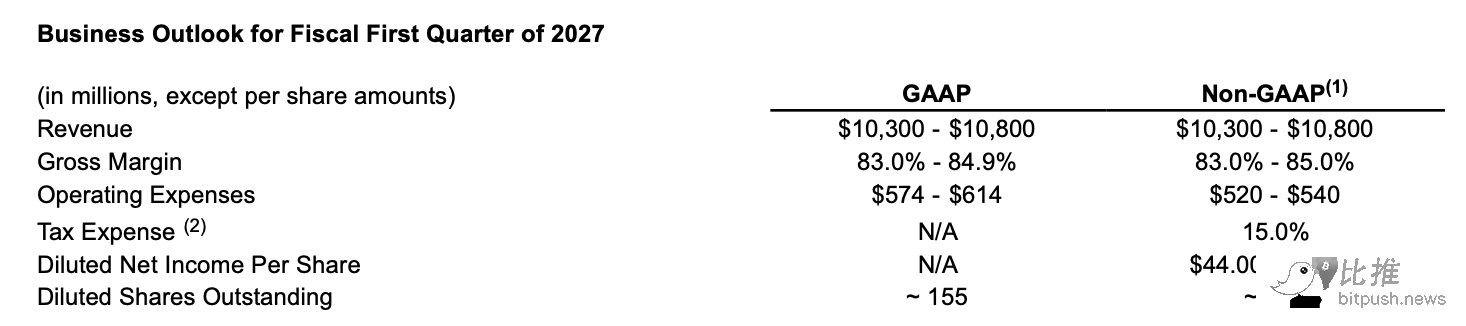
The more subtle signal comes from gross profit margin. SanDisk's adjusted gross margin reached an all-time high of 84.6% in the fourth fiscal quarter, but the company's gross margin guidance range for the next fiscal quarter is 83% to 85%, with a median value of about 84%. Although it is still at a very high level, there is no sign of continuing expansion; on the contrary, it gives people the feeling of “peaking at a high level and entering the platform period”. For investors accustomed to SanDisk breaking through the gross margin ceiling over the past few quarters, this “being flat is bad” mentality has been further amplified in the current market environment.
The EPS guidance range is between $44 and $46, with a median value of $45, which is almost close to market expectations, which is hardly a surprise.After a “record breaking” earnings report, the market waited for another “more record” guide, and SanDisk only gave a “normal good one.”
The market is not focused on growth, but on the acceleration of growth
Yesterday I was compiling Arthur Hayes' newwritingsAt the time, I saw this phrase: “The real deal to invest is not growth itself, but the acceleration of growth.”
In other words, the market is actually focused on second derivative (Second Derivative) — whether growth is accelerating or decelerating.
Judging from this financial report, SanDisk's fundamentals have not weakened significantly. Whether quarterly revenue hits record, gross margins remain high, or the data center business becomes a new pillar of growth, the company is benefiting from structural changes brought about by NAND cycle repairs and AI infrastructure investments. However, the focus of the capital market's attention has long since shifted from “whether performance is excellent” to “how can we still grow.”
Over the past year, the storage sector experienced a significant reassessment of expectations. On the one hand, AI data center construction has driven the growth in demand for high-performance storage; on the other hand, supply contraction and price recovery in the NAND industry have also boosted the profit margins of related companies.
Against this backdrop, the market's valuation of SanDisk already not only reflects the current level of profit, but also takes into account the expectation that growth will continue to accelerate in the next few quarters. Therefore, when the company's guidance for the next quarter only maintains high growth without further revisions, the market reaction is more sensitive.
This is also the most central contradiction in SanDisk's current earnings report —The fundamentals are still strong, but expectations are already ahead of the performance.
Twitter:https://twitter.com/BitpushNewsCN
Compare the TG exchange group:https://t.me/BitPushCommunity
Compare TG subscriptions:https://t.me/bitpush
