


Binance claims $473 million, will RedotPay's IPO path be blocked?

Author:Asher_ 0210
Original title: Claimed by Binance for US$473 million, can U-card leader RedotPay successfully go public?
RedotPay, the leader of crypto payment cards (U cards), has been sued in court by its former partner Binance.
Last night, according to Bloomberg, several Binance related entities sued the three RedotPay co-founders Gao Zhangpeng, Chan Wa Choi, and Yao Chao, accusing the three of violating the agreement between the two parties.More than 470,000 Binance Card users were directed to RedotPay, and $472.8 million was claimed.Binance said that since the two parties cooperated, RedotPay has received about US$304 million in user funds through Binance Pay, but the relevant funds were not isolated as agreed, and some of the funds were eventually used to recharge RedotPay cards.
RedotPay later responded,The relevant lawsuits will not affect the company's current or future day-to-day operations, and all charges will be actively defended.Since the case has already entered judicial proceedings, the company will not comment further on the specific dispute.
In order to give readers who are not familiar with the U card sector a general idea of who is being sued by Binance, RedotPay currently occupies half of the crypto payment card market and is impacting the $4 billion valuation.
Securely sitting at the top of the crypto U card, RedotPay is already preparing to go public in the US
Established in April 2023, RedotPay mainly provides stablecoin payment cards, multi-currency wallets, fiat currency exchange, and global transfer services. After users deposit stablecoins such as USDT and USDC into RedotPay, they can complete online subscriptions, offline purchases, and cross-border payments through virtual or physical cards. Currently,The company has more than 8 million users, annual payments of $14 billion, and annualized revenue of about US$180 million.
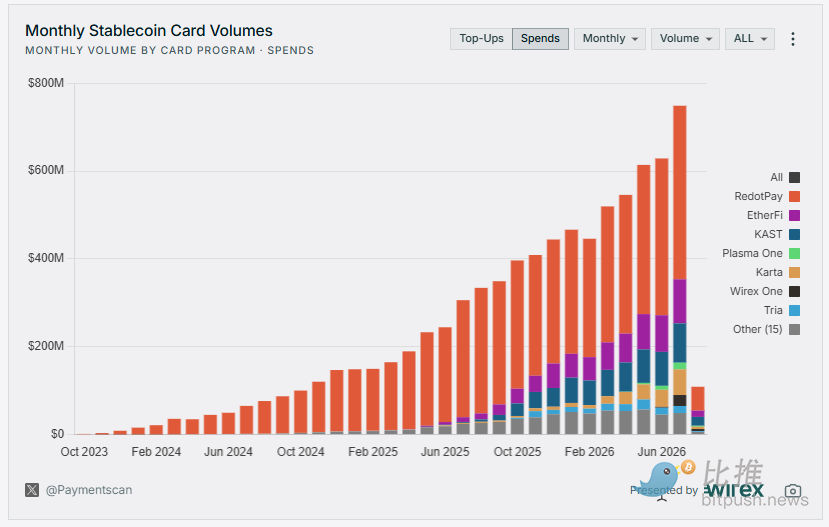
Since 2024, RedotPay has been at the top of the crypto U-card market.
According to Paymentscan data
In July of this year, the total transaction volume of the crypto U card circuit was about 749 million US dollars, of which RedotPay's transaction volume reached 395 million US dollars, accounting for about 52.8%, the first fault; Ether.fi's transaction volume was 100 million US dollars, accounting for 13.4%, ranking second; and KAST's transaction volume was 89.6 million US dollars, accounting for 11.9%, ranking third.
Last year, RedotPay closed three rounds of financing, totaling $194 million:
In March,RedotPay closes $40 million Series A funding round, led by Lightspeed. At the time, the company had more than 3 million users;
September,RedotPay closes $47 million strategic financing, led by Coinbase Ventures, the valuation exceeded 1 billion US dollars, and the number of users increased to more than 5 million;
December,RedotPay closes $1.07 billion Series B fundingLed by Goodwater Capital, Pantera Capital, Blockchain Capital, Circle Ventures, and HSG participated.
After becoming a crypto U-card unicorn, RedotPay began preparations to go public in the US.The company plans to conduct an IPO in New York as early as this year. The potential funding scale is over 1 billion US dollars, the target valuation is over 4 billion US dollars, and it is also currently negotiating a new round of financing of up to 150 million US dollars.
RedotPay's early growth, from Binance Pay
In November 2023, RedotPay partnered with Binance to join Binance Pay.Users can directly deposit funds from their Binance account to their RedotPay Card through a mini program within the Binance app (officially announced publicly on December 15).
Binance Pay is a crypto payment tool launched by Binance. Users can directly use the assets in their Binance account to complete transfers and payments; Binance Card is a cryptographic U card introduced by Binance for everyday consumption scenarios, and is a similar product to RedotPay Card.
Once connected to Binance Pay, RedotPay can directly connect funds and users in the Binance account. Binance users can use stablecoins for fiat exchange, in-app transfers, and other payment scenarios without a complicated on-chain withdrawal process.
For RedotPay, which was only established for half a year at the time, this channel not only lowered the threshold for users to recharge and use encrypted payment cards, but also enabled it to directly reach mature users who already own stablecoins and are familiar with the crypto payment process.
What is Binance saying?
Initially, RedotPay and Binance agreed on the scope of cooperation, including using Binance Pay funds to recharge RedotPay Cards. Users can directly use the assets in their Binance account to deposit funds into the RedotPay Card. Originally, it was the capital and user needs of the Binance Pay ecosystem, so it has entered RedotPay's own payment card system.
Shortly after the first cooperation, the two sides had differences over recharge issues, and the first agreement was terminated about half a year later. In March 2025, Binance and RedotPay re-signed an agreement, clearly requiring that Binance Pay funds be segregated and their use restricted, and only allowed for fiat exchange, in-app transfers, and purchases of RedotPay branded products.Prohibited for recharging RedotPay cards。
Until March 2026, Binance discovered that RedotPay was still allowing related funds to enter its own card business, and closed the partnership channel the following month.Binance estimates that during the cooperation between the two parties, approximately $304 million of user funds flowed through Binance Pay to RedotPay. In addition to capital, Binance believes it has also lost a number of more important assets — Binance Card users who have already been able to generate real purchases.
In the Binance lawsuit, the three co-founders of RedotPay were accused of using channels and user touchpoints obtained through previous collaboration.Directed over 470,000 Binance Card users to RedotPay.Binance believes that RedotPay initially entered the Binance payment system as a partner and understood the needs, recharge habits, and usage scenarios of cardholder users during the cooperation process. Subsequently, when Binance Card was deactivated at the end of 2023, RedotPay accepted this group of customers to its own payment card products through the existing user portal.
Binance is responsible for accumulating users, building brand trust, and depositing funds, while RedotPay takes over deposits and purchases in the final step. Users are still using stablecoins to pay, but the cards they use have changed from Binance Card to RedotPay Card, and associated transaction volume, fees, and subsequent revenue have also entered RedotPay.
Binance is now filing a $472.8 million claim. Part of the funds being recovered are $304 million of funds flowing into RedotPay through cooperative channels, and the other part is subsequent business losses due to loss of customers.
Currently, $472.8 million is not compensation that RedotPay has determined to be paid; it is simply the amount of claims currently filed by Binance affiliated entities. There is no answer as to whether the court upheld all of Binance's allegations, what the final compensation amount will be, and whether the parties will settle.
But the timing of this lawsuit was fatal for RedotPay. Binance's affiliates filed lawsuits against the three RedotPay co-founders in Hong Kong (and there are also related lawsuits in Singapore), which happened to be stuck in a critical window for RedotPay to prepare for a US IPO. The company has previously been advancing plans to go public in New York, and has reached out to investment banks including J.P. Morgan Chase, Goldman Sachs, and Jefferies. For potential investors, the company's current annualized revenue of $180 million and annual payments of $14 billion are important, but how these figures are formed will also affect the final pricing.
Binance's lawsuit directly points to the most sensitive part of RedotPay's growth story: early customer sources.In subsequent listing due diligence, underwriters and investors may need to reconfirm:
whether RedotPay is in breach of the partnership agreement with Binance;
Whether Binance Pay funds are quarantined as agreed;
Whether the conversion process for over 470,000 Binance users was compliant;
How much potential compensation risk may be posed by litigation between Hong Kong and Singapore.
RedotPay's previous management changes will also exacerbate these questions.Over the past year, the company had at least five senior employees for less than 12 months, changed the position of the head of compliance twice, and once promoted the listing plan without a chief financial officer.Now, Binance is taking the funding and user issues from the early cooperation between the two parties to court.
The lawsuit may not directly end RedotPay's IPO, but it is likely to disrupt the pace of its funding and listing. The company not only needs to prove that the existing business can still grow normally, but also explain to investors how much of the growth over the past three years has come from normal market expansion, and how much is based on cooperation channels with Binance.
Twitter:https://twitter.com/BitpushNewsCN
Compare the TG exchange group:https://t.me/BitPushCommunity
Compare TG subscriptions:https://t.me/bitpush
